Pharmaceutical Sales Representative Cover Letter Example (2026)
By FindAJobAI team Updated How we built this page
Pharmaceutical sales ads ask for a territory plan, a product launch, and a story about getting past a gatekeeper. The cover letter should name one physician relationship you built or changed, the clinical detail that mattered to them, and what happened to their prescribing after that conversation.
Pharmaceutical Sales Representative cover letter template
This letter as a one-page template: an opening that names the job and your strongest fact, proof that answers the ad, a reason for this employer and a short close.
After you sign up, FindAJobAI drafts your own letter for a real job from your CV in this format, and you edit it before you send it.
Example 1 · Experienced
Specialty rep applying to a cardiology-focused territory
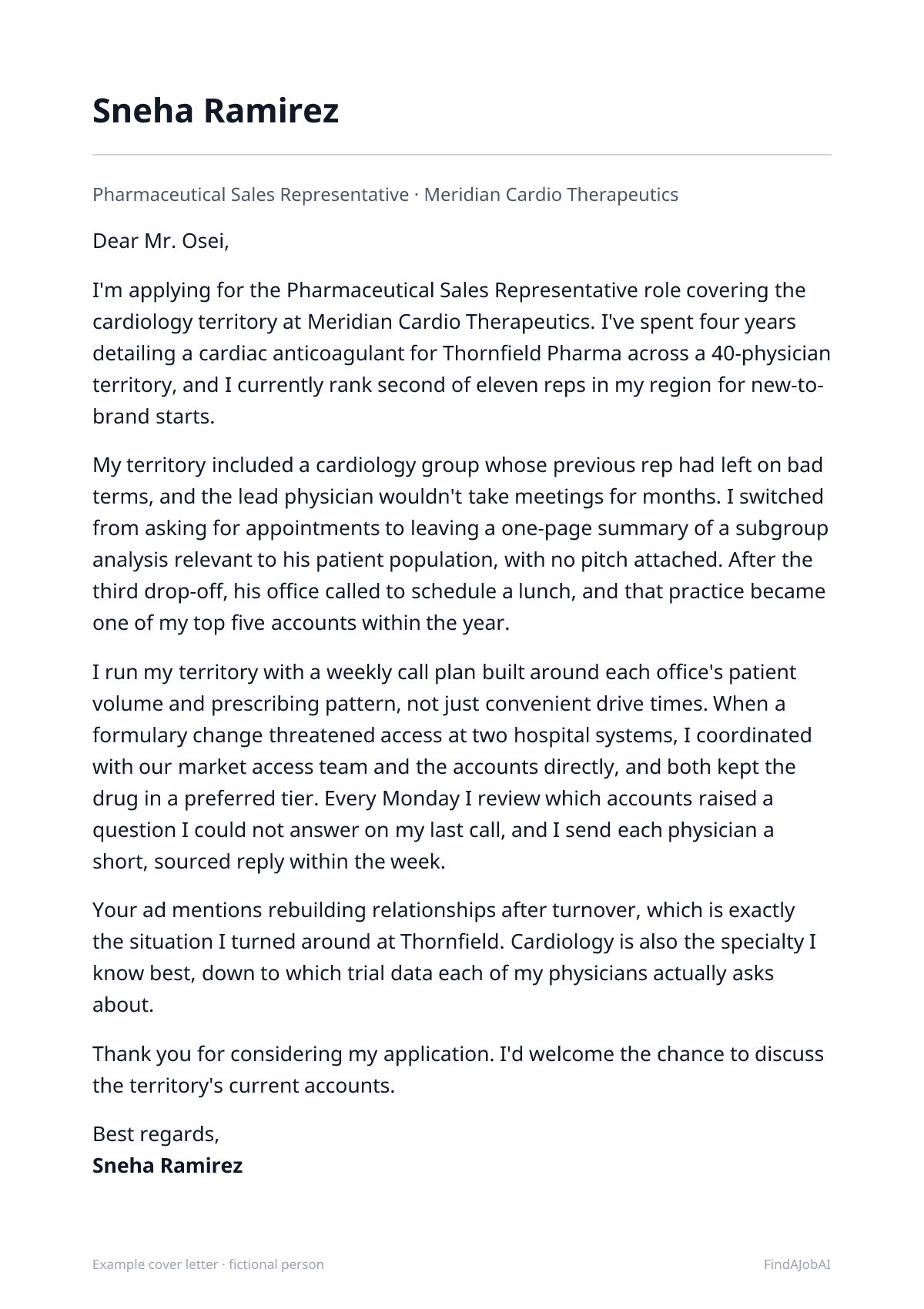
Sneha details a cardiac drug across a mid-size territory. The ad wants someone who can rebuild relationships after a rep turnover.
Example letter · fictional
Dear Mr. Osei,
I'm applying for the Pharmaceutical Sales Representative role covering the cardiology territory at Meridian Cardio Therapeutics. I've spent four years detailing a cardiac anticoagulant for Thornfield Pharma across a 40-physician territory, and I currently rank second of eleven reps in my region for new-to-brand starts.
My territory included a cardiology group whose previous rep had left on bad terms, and the lead physician wouldn't take meetings for months. I switched from asking for appointments to leaving a one-page summary of a subgroup analysis relevant to his patient population, with no pitch attached. After the third drop-off, his office called to schedule a lunch, and that practice became one of my top five accounts within the year.
I run my territory with a weekly call plan built around each office's patient volume and prescribing pattern, not just convenient drive times. When a formulary change threatened access at two hospital systems, I coordinated with our market access team and the accounts directly, and both kept the drug in a preferred tier. Every Monday I review which accounts raised a question I could not answer on my last call, and I send each physician a short, sourced reply within the week.
Your ad mentions rebuilding relationships after turnover, which is exactly the situation I turned around at Thornfield. Cardiology is also the specialty I know best, down to which trial data each of my physicians actually asks about.
Thank you for considering my application. I'd welcome the chance to discuss the territory's current accounts.
Best regards,
Sneha Ramirez
Example 2 · Career changer
Retail pharmacist moving into pharmaceutical sales
Dmitri has fielded physician questions and run vaccine clinics for six years. The ad wants strong clinical knowledge over sales experience.
Example letter · fictional
Dear Hiring Manager,
I'm applying for the Pharmaceutical Sales Representative role at Alderbrook Biosciences. For six years I've worked as a retail pharmacist at Prescott Family Pharmacy, where I field physician calls about dosing and interactions almost daily and have run our seasonal vaccine clinic since it started.
Two years ago I noticed a local clinic consistently prescribing a diabetes medication at doses that caused avoidable side effects for several patients. I called the prescribing physician directly, walked through the dosing guidance with him, and he adjusted his protocol for new patients going forward. That conversation is the kind of clinical detailing I understand this role asks for, just without a product line behind it yet.
I know drug interactions, insurance formulary issues, and physician communication from the inside, having fielded frustrated calls from both sides for years. I've also shadowed two pharma reps who call on our pharmacy, asked them detailed questions about territory management, and completed a self-paced course on pharmaceutical sales fundamentals this year. I keep a running log of the questions physicians ask me most, which is the same list a rep needs for call preparation.
Your ad emphasizes clinical knowledge over prior sales quota experience, which is where my six years behind the counter should count for more than a typical entry-level applicant's. I'm comfortable explaining mechanism of action and trial data because I do it with physicians already, just not yet with a sales target attached.
Thank you for your time. I'd welcome the opportunity to discuss how my clinical background would translate to your territory.
Sincerely,
Dmitri Kowalczyk
Example 3 · Senior or lead
District trainer applying to lead a regional sales team
Yusuf trains new reps across a twelve-person district. The ad is for a district manager who will cut ramp-up time for new hires.
Example letter · fictional
Dear Ms. Carrington,
I'm applying for the District Sales Manager role at Fenbrook Pharmaceuticals. For the past three years I've served as a field trainer for a twelve-person district at Hollowgate Pharma, pairing with new reps during their first several months, and before that I carried my own territory for six years in oncology support care.
Your ad names ramp-up time as a problem for new hires. We had the same issue at Hollowgate: new reps averaged nearly a year before hitting target call volume on their assigned specialists. I built a 90-day structured ride-along program with weekly call reviews and a shared library of objection responses by specialty, and our last four hires reached full call volume well ahead of the previous average, with two exceeding their first-year quota.
The account I'm proudest of wasn't mine. A newer rep on my district had a neurologist who refused all rep visits after a bad experience with a prior company. I coached her through a non-pitch approach, bringing only relevant safety data updates with no appointment request, and after four visits the neurologist agreed to a lunch meeting. That physician now prescribes our product as a second-line option for a meaningful share of eligible patients.
I haven't managed budget allocation across a full district, that's sat with my manager, and at Fenbrook I'd want to understand how sample budgets and speaker programs are currently planned before taking that on.
I'd welcome a conversation about your district's current ramp-up timeline and where new hires tend to stall.
Sincerely,
Yusuf Abiodun
All three letters, and the short version below, are fictional: the people, employers and numbers are invented. Borrow the structure, never the facts.
- Prefer to write it yourself? Use the free cover letter template.
- Check your CV against the job first: the free CV score shows the missing keywords.
Why the first letter works, paragraph by paragraph
Paragraph 1: Opening
States the current product class (a cardiac anticoagulant), territory size, and a ranking figure, giving the reader a concrete sense of performance before any story begins.
Paragraph 2: The relationship rebuilt from nothing
Names a specific problem (a physician who wouldn't meet after a bad rep turnover), the tactic that worked (clinical summaries instead of pitches), and the business result, a top-five account.
Paragraph 3: Territory management and a crisis handled
Shows the writer plans by patient volume, not convenience, and coordinated across teams during a formulary threat, protecting access at two hospital systems.
Paragraph 4: Why this company
Directly answers the ad's stated need, rebuilding relationships, and connects the writer's specialty knowledge to the territory.
Paragraph 5: Close
Offers to discuss the specific territory's accounts rather than repeating general enthusiasm for pharma sales.
What the career changer's letter does differently
The pharmacist's letter reframes six years of clinical calls as detailing experience the ad didn't expect from this background. It uses one physician interaction to show the writer already does clinical communication, names concrete steps taken toward the industry (shadowing reps, a course), and directly answers the ad's stated preference for clinical knowledge over quota history.
What the senior letter does differently
A district manager letter reports team-wide patterns instead of one rep's numbers: a structured ramp-up program, a measurable drop in time to full call volume, and a coaching story about turning around a difficult account through someone else's effort. The named gap, budget planning, keeps the letter honest about scope.
Short pharmaceutical sales representative cover letter: an email-ready version
Many applications arrive as an email or a small text box, and a full page doesn't fit. This version runs 120 to 150 words and keeps only what a reader needs to decide whether to reply. A pharma rep answers a biotech's short online application after a conference conversation led to the opening.
Short version · email · fictional125 words
Subject: Pharmaceutical Sales Representative application – oncology territory – Celestine Varga
Hello Dr. Mbeki,
I'm applying for the Pharmaceutical Sales Representative role at Larkspur Biosciences. I've detailed an oncology supportive care product for three years, currently ranked third of nine reps in my region for call volume with key specialists.
Last year I rebuilt a relationship with an oncology group that had stopped seeing reps after a formulary dispute. I brought only relevant safety updates with no pitch for several visits, and the lead oncologist now prescribes our product as a standard supportive care option for her patients. She now asks me for our safety updates before her group's formulary meetings.
I'd like to bring that same patience to Larkspur's territory. My resume is attached, and I'd welcome a conversation about the role.
Best,
Celestine Varga
The short version keeps one rebuilt physician relationship and a ranking figure, cutting the territory-management detail and the formulary story since there's room for only one proof point.
Opening lines that work for pharmaceutical sales representative cover letters
The first sentence decides whether the second gets read. Here are six openings, one for each situation you might be in. Pick the one that matches yours and swap in your own facts: every name and number below is invented.
1. You have a standout result
Last year I rebuilt a relationship with an oncology group that had stopped seeing reps entirely after a formulary dispute, and that account now ranks among my top five. I'd like to bring that same approach to your territory.
2. The ad names a problem you've solved
Your ad mentions slow ramp-up for new hires. At my current company I built a structured 90-day training program that cut new reps' time to full call volume noticeably, and I'd like to apply that experience to your team.
3. Someone referred you
Your regional manager, Desmond Achebe, sat on a panel with me at a specialty pharma conference last spring and mentioned this opening, knowing I've been looking to move into a new therapeutic area.
4. You admire what they build
I've watched your company's recent product launches from the outside as a competing rep, and the way your team supported physicians through the transition stood out enough that I wanted to apply here directly.
5. You're new to the field or switching into it
I spent six years as a retail pharmacist fielding physician calls about dosing and interactions before deciding I wanted to do that kind of clinical communication full time, with a product line behind it.
6. You have senior scope or a specialism
As a field trainer for a twelve-person district for three years, I built the onboarding program the team still uses. I'm looking for a role where I can take on that kind of structure at a larger scale.
How to write a pharmaceutical sales representative cover letter
Five steps, in the order you'd write them. The shape stays the same for every job (a short opening, proof, a reason for this employer, a close), and what goes into each part is what changes with the role.
Open with your product class and a performance figure
State the therapeutic area you detail and one number, a ranking, a call volume figure, or a new-to-brand start count, in your opening lines. Hiring managers in pharma sales look for quota context before anything else.
Tell the story of one relationship you built or rebuilt
Pick a physician who was difficult to access, skeptical, or recovering from a bad experience with a prior rep, and describe the specific approach that worked. This matters more than a list of accounts you simply inherited.
Name a clinical detail that mattered to a specific physician
Mention a trial finding, a dosing nuance, or a safety update that changed how a particular physician prescribed, not a general product summary. This shows you detail with substance rather than scripted talking points. Pick the one detail the physician actually asked about.
Show how you handle a gatekeeper or a crisis
A formulary change, an office manager who blocks visits, or a competitor's aggressive move are common obstacles. One sentence on how you worked through one of these situations tells the reader more than a claim of persistence.
Match the ad's stated gap and close with a question
If the ad names a specific problem, rebuilding relationships, a new launch, slow ramp-up, answer it directly with your experience. Close by asking about the territory's current accounts or challenges rather than repeating enthusiasm. One specific question is enough.
Pharmaceutical Sales Representative cover letter do's and don'ts
Do
- Name one physician relationship you built, changed, or rebuilt, and what happened to their prescribing or referrals afterward.
- Mention a specific clinical detail, a trial finding, a dosing nuance, that mattered to a particular physician, not a general product summary.
- Show how you handle a gatekeeper, a formulary problem, or a difficult account, since ads often screen for resilience more than charm.
Don't
- Don't name specific patients or share clinical details that could identify someone; describe the issue, not the person.
- Don't claim quota attainment figures you can't support if an interviewer asks for documentation.
- Don't write 'passionate about healthcare' as your reason for wanting the job; name a clinical area or patient population you actually care about.
Common pharmaceutical sales representative cover letter mistakes
Each one is easy to make and quick to fix before you send the letter.
Opening with enthusiasm instead of a number
Hiring managers scan for quota context first. Lead with your product class and a ranking or call volume figure, then use the rest of the letter for the relationship story that shows how you got there.
Describing a product instead of a physician interaction
A paragraph that only summarizes mechanism of action reads like a product brochure. Anchor the clinical detail to one specific physician conversation and what changed in their prescribing afterward.
Naming identifiable patients or private prescribing data
Describing a specific patient's case or sharing a physician's exact prescribing numbers risks a compliance problem. Describe the type of clinical issue and the outcome without identifying details.
Claiming quota attainment with no supporting detail
'Exceeded quota every quarter' means little without a timeframe, a rank, or a comparison to peers. Give a figure you could explain or document if asked in an interview.
Skipping how you handle a difficult or blocked account
A letter full of smooth wins leaves out the hardest part of the job, getting past a gatekeeper or a skeptical physician. Mention briefly how you've turned around one such account, since that's often the deciding factor in hiring.
Email subject lines for pharmaceutical sales representative applications
Applying by email? Put the job title, any reference number and your name in the subject line.
- Pharmaceutical Sales Representative application – cardiology territory – Sneha Ramirez
- Pharmaceutical Sales Representative – retail pharmacist, clinical background – Dmitri Kowalczyk
- Application: Specialty Sales Representative, Endocrinology – Sneha Ramirez
Everything for Pharmaceutical Sales Representatives
- Pharmaceutical Sales Representative resume exampleA full resume, plus bullet and summary examples
- Pharmaceutical Sales Representative interview questions30 questions with sample answers
- Pharmaceutical Sales Representative job descriptionDuties, skills and requirements
- Career change cover letter: template + examples
Other cover letter examples
Pharmaceutical Sales Representative cover letter FAQ
What should I write in a pharmaceutical sales cover letter?
One physician relationship you built or changed, the clinical detail that mattered to them, and the result, more appointments, a formulary win, or increased prescribing. A sentence on how you handle a difficult account rounds it out.
How do I write a pharmaceutical sales cover letter with no sales experience?
Use clinical experience from pharmacy, nursing, or a related field, a specific physician or patient interaction, and any steps you've taken toward the industry, such as shadowing a rep or completing a sales fundamentals course.
Should I mention quota attainment or rankings in a pharma sales cover letter?
Yes, if you can support the figure if asked, such as a regional ranking or a new-to-brand start count. Avoid vague claims like 'top performer' without a number or rank attached.
How we built this page
The FindAJobAI team wrote the three example letters, the short email version, the opening lines and the advice for pharmaceutical sales representative roles. The people, employers and numbers in the letters are invented; the structure, the kind of evidence and the order of the paragraphs are the parts to copy.
Once we track enough live pharmaceutical sales representative job ads, this page also shows the skills they ask for most, counted the same way as our in-demand skills report.
Last reviewed on November 1, 2026.