Product Designer Cover Letter Example (2026)
By FindAJobAI team Updated How we built this page
Product design hiring managers will open your portfolio either way, so the cover letter has a narrower job: point them to the right case study and show how you think. The strongest letters describe one problem, the research behind your decisions and what changed for users, instead of saying you're proficient in Figma.
Product Designer cover letter template
This letter as a one-page template: an opening that names the job and your strongest fact, proof that answers the ad, a reason for this employer and a short close.
After you sign up, FindAJobAI drafts your own letter for a real job from your CV in this format, and you edit it before you send it.
Example 1 · Experienced
Senior product designer applying to a home buying platform
Isabel leads design for an online loan application. The ad says the company wants home buying to feel less stressful.
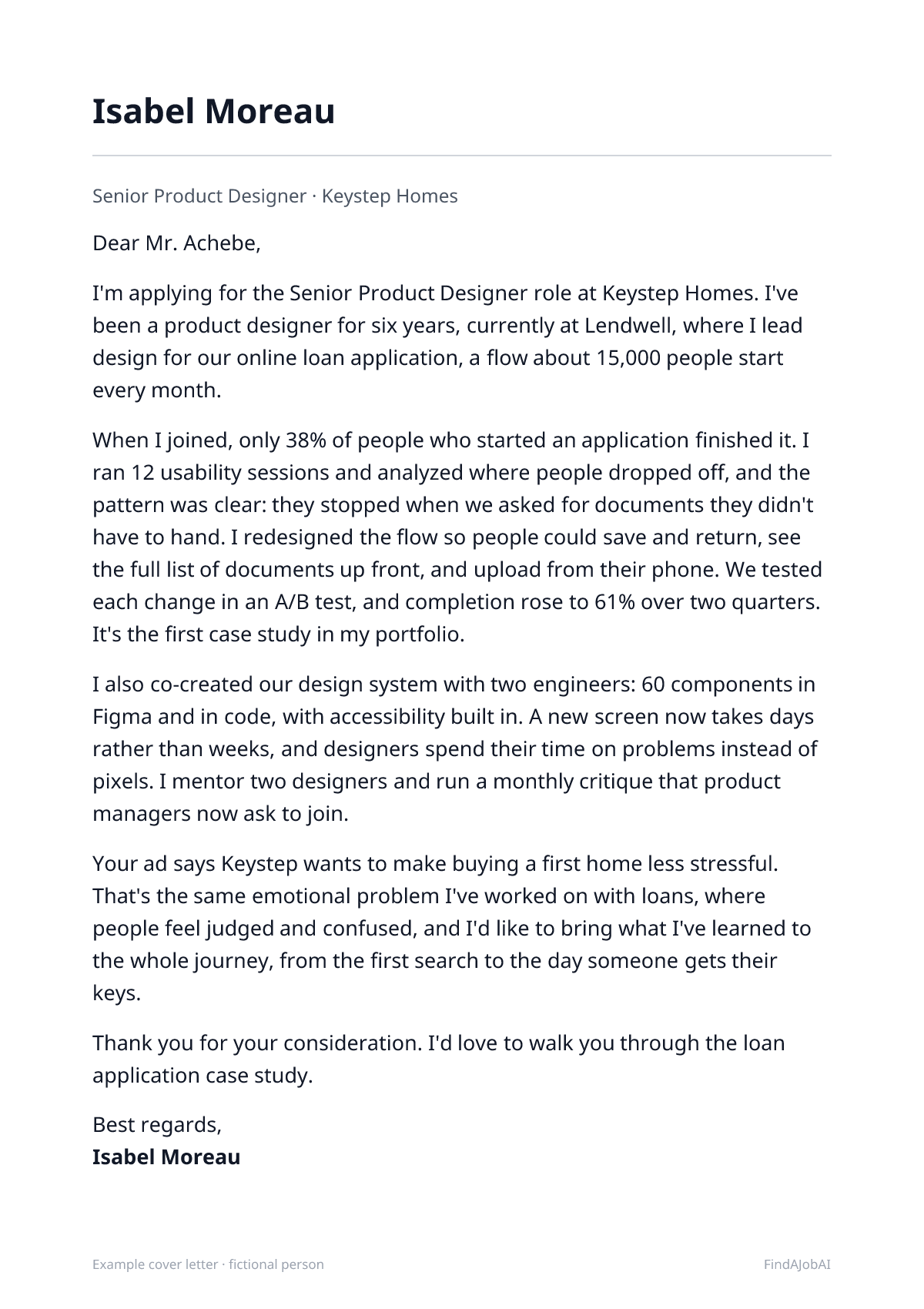
Example letter · fictional
Dear Mr. Achebe,
I'm applying for the Senior Product Designer role at Keystep Homes. I've been a product designer for six years, currently at Lendwell, where I lead design for our online loan application, a flow about 15,000 people start every month.
When I joined, only 38% of people who started an application finished it. I ran 12 usability sessions and analyzed where people dropped off, and the pattern was clear: they stopped when we asked for documents they didn't have to hand. I redesigned the flow so people could save and return, see the full list of documents up front, and upload from their phone. We tested each change in an A/B test, and completion rose to 61% over two quarters. It's the first case study in my portfolio.
I also co-created our design system with two engineers: 60 components in Figma and in code, with accessibility built in. A new screen now takes days rather than weeks, and designers spend their time on problems instead of pixels. I mentor two designers and run a monthly critique that product managers now ask to join.
Your ad says Keystep wants to make buying a first home less stressful. That's the same emotional problem I've worked on with loans, where people feel judged and confused, and I'd like to bring what I've learned to the whole journey, from the first search to the day someone gets their keys.
Thank you for your consideration. I'd love to walk you through the loan application case study.
Best regards,
Isabel Moreau
Example 2 · Career changer
Graphic designer moving into product design
Tom designed a children's reading app after years in print. The ad asks for design for young learners and close work with researchers.
Example letter · fictional
Dear Wildfern Design Team,
I'm applying for the Product Designer role at Wildfern Learning. I've worked as a graphic designer for five years, most recently at an education publisher, and over the past two years I've moved into digital product work, which I'd now like to do full time.
When my publisher launched its first learning app, I volunteered to design the reading activities for children aged six to eight. I sat in on 15 classroom sessions, watched where children got stuck, and found that they ignored written instructions but followed spoken ones. I redesigned the activities around audio prompts and bigger touch targets; in the next round of testing, the share of activities children finished without a teacher's help rose from about half to four in five.
To build the skills a print background doesn't give you, I completed a UX certificate, learned to prototype and test in Figma, and redesigned two flows in our parent app with the product team, from user interviews to developer handoff. I'm still learning to use quantitative data, such as funnels and experiments, alongside qualitative research, and I've started reading our app's funnel reports every week.
Your posting asks for someone who can design for young learners and work closely with researchers and engineers. My visual design background means I care about clarity and delight, and my classroom research means I design for how children actually behave.
My portfolio, with the reading app case study first, is linked on my resume. Thank you for considering my application.
Kind regards,
Tom Fischer
Example 3 · Referral or internal move
Designer applying for an internal move to a new product area
Elena has designed the traveler app for two years. The internal posting is for a new B2B tool for travel agents, and her design lead supports the move.
Example letter · fictional
Dear Mr. Linde,
I'm applying for the Product Designer role on Agent Tools, the new product for travel agents. I've designed the traveler app at Mosswood for two years, and my design lead, Tomás Rey, knows about this application and supports it. I'd like to explain what I would bring to a very different kind of user.
My strongest work in the traveler app is the booking-changes flow. Travelers used to call us to change dates, so I interviewed 14 of them, mapped where they got stuck and redesigned the flow around one question: what do you want to change? Calls about date changes fell by 29%, and the flow now handles most changes without an agent. In the follow-up survey, 88% of travelers called it easy.
That work taught me where agents spend their days, because I sat in on their calls. For this application I spent four days shadowing six agents, watching what they type, which screens they keep open and how many tabs a booking takes. One finding was that they re-enter the same traveler details in three systems, which I think the new tool can remove.
The honest gap is that I've designed for occasional users, not professionals who use a tool all day. They need density, keyboard shortcuts and bulk actions, so for the past month I've been prototyping a bulk-edit table with two agents and an engineer, and I'd be glad to show you where it stands.
I'd like to talk about what the first release of Agent Tools needs to prove, and about how the design team would support me while I learn.
Thank you,
Elena Rossi
All three letters, and the short version below, are fictional: the people, employers and numbers are invented. Borrow the structure, never the facts.
- Prefer to write it yourself? Use the free cover letter template.
- Check your CV against the job first: the free CV score shows the missing keywords.
Why the first letter works, paragraph by paragraph
Paragraph 1: Opening
Names the product, the writer's role on it and its scale. "Leads design for a flow 15,000 people start a month" says more than "passionate about user-centered design".
Paragraph 2: One case study, in brief
Tells the story of the case study the reader will open: the metric, the research, the insight, the design changes and a tested result, then says where to find it.
Paragraph 3: Systems and influence
A design system built with engineers, mentoring and critique show seniority. Product managers asking to join the critique is a small, convincing sign of influence.
Paragraph 4: Why this company
Connects the company's mission to a similar user emotion the writer has designed for, which makes the interest believable.
Paragraph 5: Close
Invites a walkthrough, which is how design interviews actually run.
What the career changer's letter does differently
The graphic designer's letter shows product design already done: classroom research, an insight about how children behave and a measured improvement. It names the training and handoff experience that fill the gaps, and is honest that quantitative methods are still developing.
What the referral letter does differently
An internal designer proves the move with research already done: shadowing agents for four days, a prototype built with two of them and a finding about duplicated data entry. The letter admits that expert users need a different design approach, and shows work in that direction rather than only promising it.
Short product designer cover letter: an email-ready version
Many applications arrive as an email or a small text box, and a full page doesn't fit. This version runs 120 to 150 words and keeps only what a reader needs to decide whether to reply. A designer sends a short note with a case study link to a head of design who wrote 'show me one project, I'll open the link'. The link comes first.
Short version · email · fictional133 words
Subject: Product Designer – patient intake redesign, case study inside – Freya Lindahl
Hello Ms. Obuya,
The project I'd most like you to open is my redesign of patient intake for a chain of clinics (intake-case-study.example). I led the design with one researcher and two engineers over four months. I'm applying for the Product Designer role at Hollin Health.
Intake forms took patients 14 minutes and often went unfinished. After testing with 18 patients, including several over 70, we cut the form to five minutes and made it work with a screen reader. Completion rose from 63% to 91%, and front-desk staff stopped retyping answers.
Hollin's patient app is clear about what happens next, which is rare in health. I'd like to design alongside the team that built it, and to learn how it serves patients who aren't confident with phones. Resume attached.
Best,
Freya Lindahl
The designer's reader will open the link, so the note gives it first, then states the writer's role and team in one sentence. The two facts after it, patients tested and completion rate, are the ones the case study will confirm.
Opening lines that work for product designer cover letters
The first sentence decides whether the second gets read. Here are six openings, one for each situation you might be in. Pick the one that matches yours and swap in your own facts: every name and number below is invented.
1. You have a standout result
Moving a loan application from 38% to 61% completion took replacing a 12-field page with a conversational flow. Your onboarding is where I'd like to bring the same clarity.
2. The ad names a problem you've solved
A checkout that confuses first-time buyers is what your ad describes. I ran 12 usability sessions on a similar flow last year and cut the steps from seven to three, and more shoppers finished their orders.
3. Someone referred you
Naledi Mokoena, your head of research, put your opening in front of me. We ran a navigation study together a few years ago, and she said your team needs a designer who runs their own research.
4. You admire what they build
I rely on your scheduling app every week, and the way it shows conflicts before I commit to a time is the best interaction I've used; I'd like to design for that team.
5. You're new to the field or switching into it
Five years as a graphic designer, plus a children's reading app I designed from first sketch to release last year, taught me I want to design products full time.
6. You have senior scope or a specialism
I've led design for a fintech product used by two million people, built its design system and managed four designers. Now I'm looking for a principal role that shapes design across a product area.
How to write a product designer cover letter
Five steps, in the order you'd write them. The shape stays the same for every job (a short opening, proof, a reason for this employer, a close), and what goes into each part is what changes with the role.
Link a case study that shows process
Choose one project in your portfolio that shows the problem, your research, the options you rejected and the result, and make sure the link opens without a password. Reviewers read cover letters beside the portfolio, so the letter should point them to the right page.
Open with the user and the problem
Name the title, then one sentence on who you designed for and what wasn't working: patients abandoning a form, agents retyping data. Starting from the user problem, not from your style, tells a design lead you think the way their team does.
Report a result you can measure
Give a number that came from the design: completion rate, error rate, time to task, calls avoided. Describe how you tested, such as sessions or a before and after comparison. Even a small, honest metric is stronger than a claim that the new design looked better.
Explain your part in a team
Say who you worked with, such as a researcher, a product manager or engineers, and what you owned. Design work is collaborative, and a precise account of your contribution is both more honest and more useful to a hiring manager than a claim to the whole project.
Say what you'd want to learn at this company
End with something specific about their product that interests you, such as an interaction you admire or a user group you haven't designed for. It shows you looked at the product closely, and it gives the portfolio review a conversation to start from.
Keywords employers use for product designer roles
The skills named most often in the 490 newest product designer job ads we track (out of 1,672 live postings), with the share of ads that mention each:
- Prototyping 72%
- Design systems 64%
- Figma 62%
- UX design 45%
- UX research 43%
- Usability 40%
- UI design 38%
- Wireframing 33%
Don't list them in your letter: pick the two or three the ad repeats and back each with one sentence of evidence. Full list: Product Designer resume keywords.
From live job ads · updated November 2, 2026
Product Designer cover letter do's and don'ts
Do
- Point to one case study in your portfolio and summarize it: problem, research, decision, result.
- Name the research methods you used (usability tests, interviews, analytics) and what they changed.
- Mention how you work with engineers and product managers: design systems, handoff, critique.
Don't
- Don't list design tools; everyone applying uses Figma.
- Don't describe only the visual side of your work when the ad asks for research and product thinking.
- Don't link a portfolio full of unrelated work; put the most relevant case study first.
Common product designer cover letter mistakes
Each one is easy to make and quick to fix before you send the letter.
Describing the look instead of the problem
'Clean, modern and intuitive' says nothing about what you solved. Start from what users struggled with, what you learned from them and what changed in their behavior, and leave the style to the portfolio.
Claiming a team project as solo work
Design leads ask who did the research and who built it. State your role and the team around you, and the reader will trust the parts you do claim.
Linking visuals with no process
A page of polished screens doesn't show how you think. Pick a case study with the problem, the evidence, the options and the outcome, and tell the reader which section to start with.
Leaving out constraints
Real design happens under limits: a legacy system, a deadline, accessibility rules. Mention one constraint you worked within and how you handled it, because that is what hiring managers actually hire for.
Sending a portfolio link that needs a login
A password wall or a dead link ends the review. Check the link in a private window on a phone before you send, and keep a PDF version ready in case the reviewer asks.
Email subject lines for product designer applications
Applying by email? Put the job title, any reference number and your name in the subject line.
- Senior Product Designer application – fintech flows, portfolio inside – Isabel Moreau
- Product Designer – graphic designer with an ed-tech UX case study – Tom Fischer
- Application: Product Designer, Mobile (Ref PD-23) – Isabel Moreau
Everything for Product Designers
- Product Designer jobs1,672 open roles, updated hourly
- Product Designer salary in the United StatesAdvertised pay in real job ads
- Product Designer resume exampleA full resume, plus bullet and summary examples
- Product Designer interview questions30 questions with sample answers
- Product Designer resume keywordsThe skills job ads ask for most
- Product Designer job descriptionDuties, skills and requirements
- Career change cover letter: template + examples
Other cover letter examples
Product Designer cover letter FAQ
Do product designers need a cover letter if they have a portfolio?
A short one helps when the application allows it: it tells the reader which case study to open first and why it's relevant to their product. Keep it to around 250 to 300 words.
What should a product designer cover letter include?
One case study told briefly (problem, research, design decision, measured result), how you collaborate with product and engineering, and why their product interests you. Leave tool lists for your resume.
How do I move from graphic design to product design?
Show digital product work you've done, even inside a print-focused job: research, prototypes, tested flows and handoff. Present your visual skills as an asset, and be honest about what you're still learning, such as working with product data.
How we built this page
The FindAJobAI team wrote the three example letters, the short email version, the opening lines and the advice for product designer roles. The people, employers and numbers in the letters are invented; the structure, the kind of evidence and the order of the paragraphs are the parts to copy.
The live keyword section is based on 490 product designer job ads analysed, the newest we track, with the same deterministic skill matcher as our in-demand skills report: no AI model reads the postings. It was last computed on November 2, 2026 and refreshes daily.
Last reviewed on November 1, 2026.