Product Owner Cover Letter Example (2026)
By FindAJobAI team Updated How we built this page
Product owner ads often blur into project manager and scrum master postings, so the letter should make the distinction plain: you own a backlog, you decide what ships next, and you can explain why one feature beat three others. Say that with one real prioritization call.
Product Owner cover letter template
This letter as a one-page template: an opening that names the job and your strongest fact, proof that answers the ad, a reason for this employer and a short close.
After you sign up, FindAJobAI drafts your own letter for a real job from your CV in this format, and you edit it before you send it.
Example 1 · Experienced
Product owner applying to a logistics software company
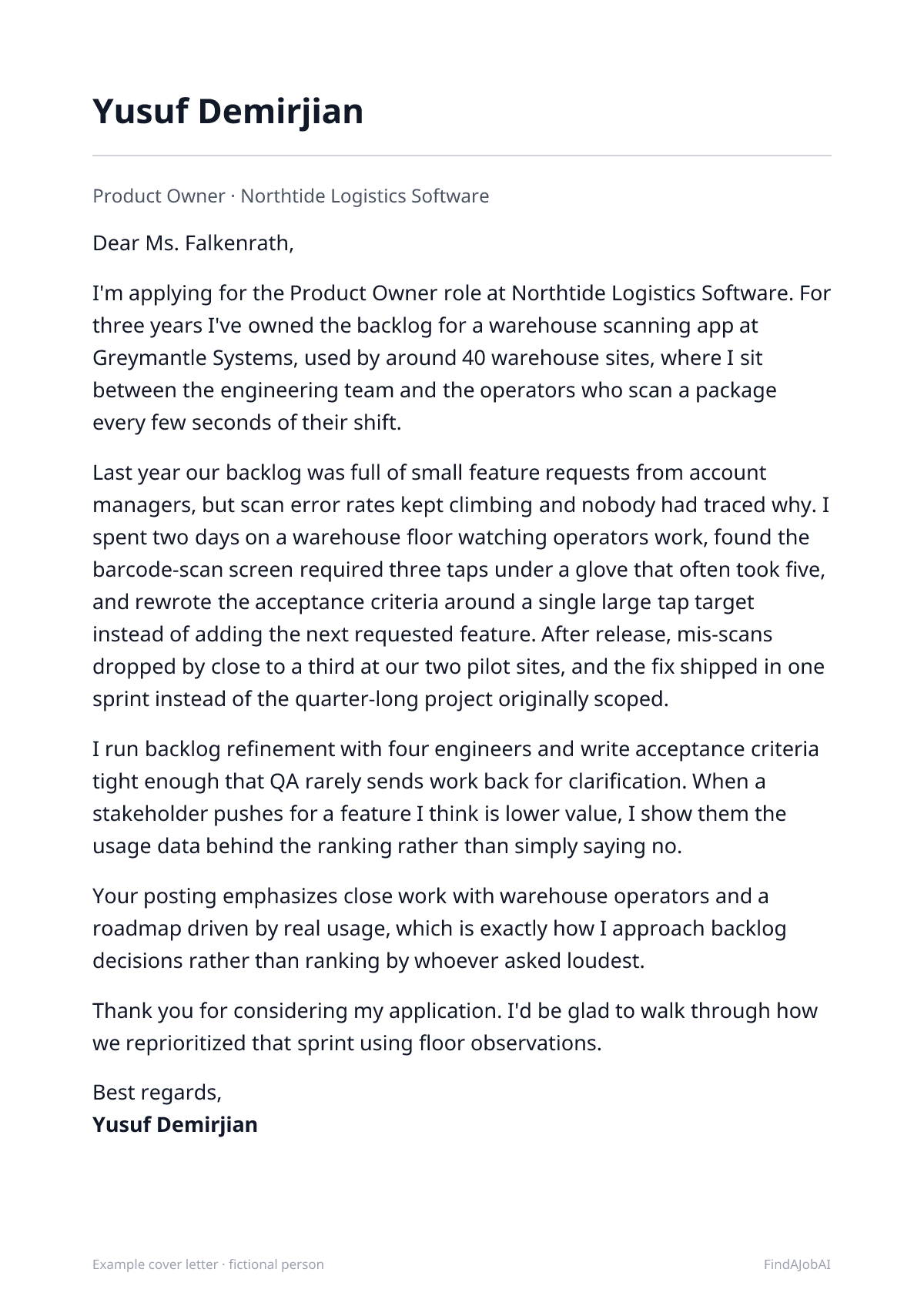
Yusuf owns the backlog for a warehouse scanning app. The ad asks for close work with warehouse operators and a usage-driven roadmap.
Example letter · fictional
Dear Ms. Falkenrath,
I'm applying for the Product Owner role at Northtide Logistics Software. For three years I've owned the backlog for a warehouse scanning app at Greymantle Systems, used by around 40 warehouse sites, where I sit between the engineering team and the operators who scan a package every few seconds of their shift.
Last year our backlog was full of small feature requests from account managers, but scan error rates kept climbing and nobody had traced why. I spent two days on a warehouse floor watching operators work, found the barcode-scan screen required three taps under a glove that often took five, and rewrote the acceptance criteria around a single large tap target instead of adding the next requested feature. After release, mis-scans dropped by close to a third at our two pilot sites, and the fix shipped in one sprint instead of the quarter-long project originally scoped.
I run backlog refinement with four engineers and write acceptance criteria tight enough that QA rarely sends work back for clarification. When a stakeholder pushes for a feature I think is lower value, I show them the usage data behind the ranking rather than simply saying no.
Your posting emphasizes close work with warehouse operators and a roadmap driven by real usage, which is exactly how I approach backlog decisions rather than ranking by whoever asked loudest.
Thank you for considering my application. I'd be glad to walk through how we reprioritized that sprint using floor observations.
Best regards,
Yusuf Demirjian
Example 2 · Career changer
Customer support lead moving into product ownership
Renata shaped a product fix from support tickets and wants to own a backlog full time. The ad covers a customer-facing SaaS dashboard.
Example letter · fictional
Dear Hiring Manager,
I'm applying for the Associate Product Owner role at Bellcrest Analytics. I've led a customer support team of six for four years at Larkmoor Software, and the part of that job I've grown to love most is turning a pile of complaints into a specific fix engineering can build.
Eighteen months ago, ticket volume on our billing dashboard tripled after a redesign. I tagged 200 tickets by root cause instead of just closing them, found that most complaints traced to one confusing toggle between monthly and annual views, and wrote a one-page spec with the exact wording customers used to describe the confusion. Engineering shipped the fix in two weeks, and billing tickets fell by more than half the following month.
That project is why I want to own a backlog directly rather than hand specs to someone else. I've since completed a certified scrum product owner course and shadowed our product team's sprint planning for three months to learn how they write and size stories.
Your ad describes a customer-facing dashboard with a backlog shaped by support volume, which is close to the exact problem I solved at Larkmoor. I'd bring both the habit of tracing a ticket to its root cause and a support team's sense of what frustrates a customer enough to call in.
Thank you for your time. I'd welcome the chance to talk through how I'd approach your current backlog. I can bring the one-page spec, with customer details removed, to an interview.
Kind regards,
Renata Kowalczyk
Example 3 · Senior or lead
Product owner applying to lead a team of product owners
Ingrid owns three backlogs across a fintech platform. The ad is for a lead product owner coordinating four owners and a shared roadmap.
Example letter · fictional
Dear Mr. Okwuosa,
I'm applying for the Lead Product Owner role at Redwell Financial Platform. For the last two years I've owned three related backlogs, payments, statements, and notifications, at Marrowfield Bank, coordinating with two other product owners so our three teams don't ship conflicting changes to the same screens.
Your ad says four product owners currently prioritize independently and features sometimes collide in the same release. I solved a version of that at Marrowfield by building a shared quarterly theme document that the three of us agree on before any backlog refinement starts, plus a weekly quarter-hour sync just to flag overlap. Release conflicts, which used to require a rollback almost every other sprint, dropped to roughly one every two quarters, and our release notes stopped reading like three separate products.
The clearest proof of the approach was a statements redesign that touched the same account summary screen as a payments feature already in flight. Instead of each owner finishing their piece and discovering the collision at QA, we merged the two into one sprint with one set of acceptance criteria, and it shipped two weeks earlier than either would have alone.
I haven't managed other product owners directly, only coordinated as a peer, and I've never set a roadmap budget across teams. At Redwell I'd want to spend real time with your engineering leads understanding how capacity is currently split before proposing changes.
I'd like to talk through how your four backlogs currently collide and what a shared prioritization process would need to account for.
Sincerely,
Ingrid Vasiliauskas
All three letters, and the short version below, are fictional: the people, employers and numbers are invented. Borrow the structure, never the facts.
- Prefer to write it yourself? Use the free cover letter template.
- Check your CV against the job first: the free CV score shows the missing keywords.
Why the first letter works, paragraph by paragraph
Paragraph 1: Opening
Names the product (a warehouse scanning app), the scale (around 40 sites), and the specific users the writer serves, which matters more for a product owner than years of experience alone.
Paragraph 2: The prioritization call
A concrete investigation (two days on the floor), the root cause found instead of the requested feature, and a measured result, mis-scans down and shipped in one sprint, not a quarter.
Paragraph 3: How the backlog is run day to day
Naming refinement, acceptance criteria, and how pushback is handled with data shows ownership of the process, not just the artifact.
Paragraph 4: Why this company
Mirrors the ad's specific language (close work with operators, usage-driven roadmap) rather than generic enthusiasm for the product.
Paragraph 5: Close
Offers to walk through the reprioritization story, a concrete next step that invites a conversation rather than restating interest.
What the career changer's letter does differently
The career changer's letter turns a support role into backlog-relevant proof: 200 tickets tagged by root cause, one spec written from customers' own words, and a measured drop in ticket volume after the fix shipped. It names the certification and the shadowing that formalized the skills, and draws a direct line from support work to the company's stated problem.
What the senior letter does differently
The lead product owner letter reports a structural fix, a shared theme document and a weekly sync, and the organizational outcome: release conflicts cut from nearly every sprint to roughly one every two quarters. It names what the writer hasn't done (managing other owners, setting a cross-team budget) instead of implying readiness for a title it hasn't held yet.
Short product owner cover letter: an email-ready version
Many applications arrive as an email or a small text box, and a full page doesn't fit. This version runs 120 to 150 words and keeps only what a reader needs to decide whether to reply. A product owner answers a healthtech startup's brief 'why you' application field, sent by email since the posting listed no online form.
Short version · email · fictional125 words
Subject: Product Owner (backlog, patient scheduling) – Kwabena Litvinenko
Hello Ms. Farrow,
I'm applying for the Product Owner role at Hollowmere Health. I own the backlog for a patient scheduling app used across six clinics, where I work closely with front-desk staff to shape what ships each sprint.
My strongest result was tracing a spike in missed appointments to a confusing confirmation screen rather than the reminder-timing fix originally requested. The screen change shipped in one sprint, and missed appointments at our two pilot clinics fell by close to a quarter.
I'd like to bring that same floor-level investigation to your scheduling backlog. My resume is attached, and I can walk through the confirmation-screen project in more detail. I can also share how I write acceptance criteria for a screen change.
Best,
Kwabena Litvinenko
The short version keeps one prioritization story, the wrong fix requested versus the right one found, since a brief field can't hold two examples. It ends with an offer to go deeper rather than restating interest in the role.
Opening lines that work for product owner cover letters
The first sentence decides whether the second gets read. Here are six openings, one for each situation you might be in. Pick the one that matches yours and swap in your own facts: every name and number below is invented.
1. You have a standout result
A confirmation-screen fix I shipped last quarter cut missed appointments at two pilot clinics by close to a quarter, after tracing the real cause past the fix originally requested. I'd like to bring that kind of investigation to your scheduling backlog.
2. The ad names a problem you've solved
Your ad says four product owners currently prioritize independently and releases sometimes collide. I built a shared theme process across three backlogs that cut release conflicts by more than half, and I'd like to set up something similar here.
3. Someone referred you
Your engineering lead, Tobias Anwaruddin, mentioned you need an owner who writes acceptance criteria tight enough that QA stops sending work back, which is exactly the habit that prompted this application.
4. You admire what they build
I've used Redwell's statements feature for two years, and a recent redesign made me curious how your backlog balances payments and statements teams; I'd like to help answer that from the inside.
5. You're new to the field or switching into it
I led a customer support team for four years, tracing tickets back to one confusing product screen instead of just closing them. I'd rather own that backlog directly than hand specs to someone else.
6. You have senior scope or a specialism
As the owner who built our current quarterly theme process across three backlogs, I'm looking for a role where I can set that structure for a larger team of owners.
How to write a product owner cover letter
Five steps, in the order you'd write them. The shape stays the same for every job (a short opening, proof, a reason for this employer, a close), and what goes into each part is what changes with the role.
Identify the backlog and users behind the ad
Product owner ads name a product and often the users it serves, warehouse operators, clinic staff, support agents. Read for both, then pick an example tied to a similar user group or product type rather than your most generic sprint story.
Open with the decision, not the ceremony
Lead with what you chose to build instead of the obvious request and why, in one or two sentences. Save standups, refinement, and sprint structure for later; a reader wants the decision first, the process second.
Show the investigation behind the call
Describe what you did to find the real problem, floor observation, ticket tagging, usage data, rather than stating you 'gathered requirements.' The method is what separates an owner who investigates from one who just transcribes requests.
Quantify the shipped result, not the backlog size
State what changed after release: an error rate down, tickets down, a feature shipped in one sprint instead of a quarter. Avoid counting backlog items groomed or story points delivered, which say nothing about impact.
Describe how you handle disagreement with evidence
One sentence on how you respond when a stakeholder pushes for a lower-value feature: usage data, a customer quote, a cost estimate. This shows ownership of the ranking itself, not just the artifact that holds it.
Product Owner cover letter do's and don'ts
Do
- Describe one prioritization decision: what you chose to build, what you chose not to, and the evidence behind the call.
- Name the artifact you own (backlog, roadmap, acceptance criteria) and one habit that keeps it honest, like usage data or root-cause tagging.
- Show how you handle stakeholder pushback with evidence rather than authority or a title.
Don't
- Don't describe yourself as a 'bridge between business and engineering' without a specific decision that bridge produced.
- Don't list every ceremony you run (standups, refinement, retros); mention the one that changed an outcome.
- Don't take credit for an engineering team's technical solution; describe your role in defining the problem and the acceptance criteria.
Common product owner cover letter mistakes
Each one is easy to make and quick to fix before you send the letter.
Calling yourself a 'bridge' with no bridge built
'Bridge between business and engineering' is a label, not evidence. Replace it with one specific decision you translated from a business need into acceptance criteria engineering could build without clarification.
Listing ceremonies instead of decisions
Naming every ritual you run, standups, refinement, retros, says nothing about judgment. Pick the one decision from one of those meetings that changed what shipped, and tell that story instead.
Counting backlog items instead of outcomes
'Managed a backlog of 300 items' describes volume, not value. Say what shipped, what changed for users or the business afterward, and skip the item count entirely.
Blurring product owner with project manager
A letter heavy on timelines, budgets, and status updates reads as project management. Keep the focus on what to build and why, backed by user or usage evidence, which is the product owner's core job.
Taking credit for the engineering solution
Describing the technical fix in detail can read as overstepping. Focus on the problem you defined and the acceptance criteria you wrote, and credit engineering for how they built it.
Email subject lines for product owner applications
Applying by email? Put the job title, any reference number and your name in the subject line.
- Product Owner application – warehouse scanning backlog, usage-driven roadmap – Yusuf Demirjian
- Associate Product Owner – support lead with CSPO certification – Renata Kowalczyk
- Application: Product Owner, Billing Platform (Req. 3015) – Yusuf Demirjian
Everything for Product Owners
- Product Owner resume exampleA full resume, plus bullet and summary examples
- Product Owner interview questions30 questions with sample answers
- Product Owner job descriptionDuties, skills and requirements
- Career change cover letter: template + examples
Other cover letter examples
Product Owner cover letter FAQ
What should I write in a product owner cover letter?
One prioritization decision: what you chose to build instead of the obvious request, the evidence behind it, and the result once it shipped. Then one sentence on how you handle a stakeholder who disagrees with your ranking.
How do I write a product owner cover letter with no formal product title?
Use a decision you shaped from support, operations, or analyst work, such as turning complaints or data into a spec engineering built. Add a certification like CSPO and name the specific result once the fix shipped.
How is a product owner cover letter different from a product manager's?
A product owner letter should focus tighter on backlog decisions, acceptance criteria, and sprint-level results, rather than market strategy or long-term vision. Keep the example close to what ships in weeks, not quarters.
How we built this page
The FindAJobAI team wrote the three example letters, the short email version, the opening lines and the advice for product owner roles. The people, employers and numbers in the letters are invented; the structure, the kind of evidence and the order of the paragraphs are the parts to copy.
Once we track enough live product owner job ads, this page also shows the skills they ask for most, counted the same way as our in-demand skills report.
Last reviewed on November 1, 2026.