Public Relations Specialist Cover Letter Example (2026)
By FindAJobAI team Updated How we built this page
Public relations ads ask for pitching, media relationships and crisis composure, which are hard to prove with a resume alone. The cover letter should name one pitch that landed, one outlet it landed in, and what happened because of that coverage.
Public Relations Specialist cover letter template
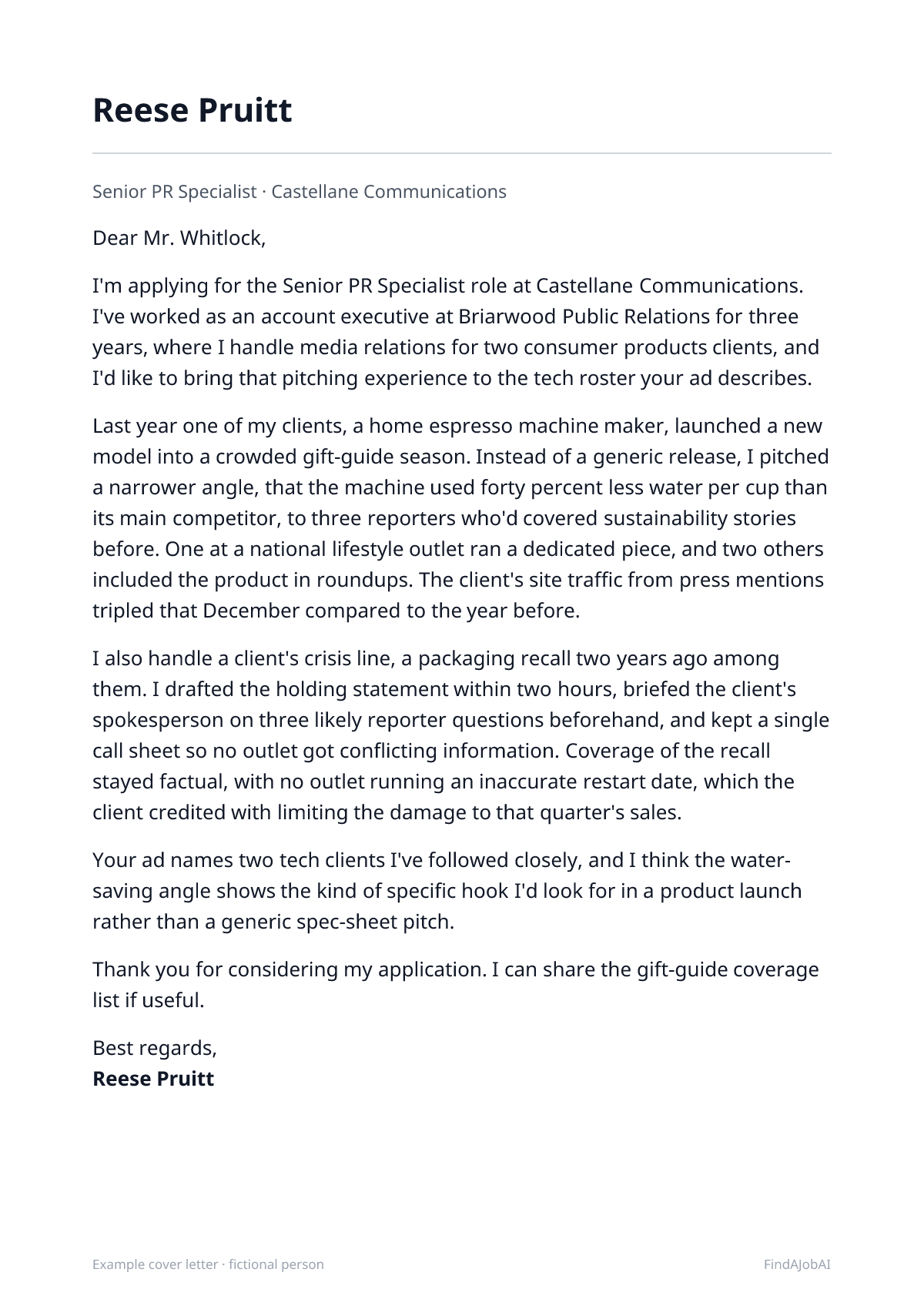
This letter as a one-page template: an opening that names the job and your strongest fact, proof that answers the ad, a reason for this employer and a short close.
After you sign up, FindAJobAI drafts your own letter for a real job from your CV in this format, and you edit it before you send it.
Example 1 · Experienced
Agency account executive applying to a consumer tech client roster
Reese pitches consumer products at a mid-size agency and wants to move to a shop with tech clients, which the ad lists by name.
Example letter · fictional
Dear Mr. Whitlock,
I'm applying for the Senior PR Specialist role at Castellane Communications. I've worked as an account executive at Briarwood Public Relations for three years, where I handle media relations for two consumer products clients, and I'd like to bring that pitching experience to the tech roster your ad describes.
Last year one of my clients, a home espresso machine maker, launched a new model into a crowded gift-guide season. Instead of a generic release, I pitched a narrower angle, that the machine used forty percent less water per cup than its main competitor, to three reporters who'd covered sustainability stories before. One at a national lifestyle outlet ran a dedicated piece, and two others included the product in roundups. The client's site traffic from press mentions tripled that December compared to the year before.
I also handle a client's crisis line, a packaging recall two years ago among them. I drafted the holding statement within two hours, briefed the client's spokesperson on three likely reporter questions beforehand, and kept a single call sheet so no outlet got conflicting information. Coverage of the recall stayed factual, with no outlet running an inaccurate restart date, which the client credited with limiting the damage to that quarter's sales.
Your ad names two tech clients I've followed closely, and I think the water-saving angle shows the kind of specific hook I'd look for in a product launch rather than a generic spec-sheet pitch.
Thank you for considering my application. I can share the gift-guide coverage list if useful.
Best regards,
Reese Pruitt
Example 2 · Career changer
Local news reporter moving into public relations
Bastien covered business and tech for a regional paper for six years and wants the ad's tech-sector PR opening.
Example letter · fictional
Dear Hiring Manager,
I'm applying for the PR Specialist role at Ferris & Dunmore. For six years I covered business and technology for the Haverstock Tribune, and I'd like to use that reporting experience from the other side of the pitch.
I've been pitched hundreds of times, and most pitches I deleted without reading past the subject line. The ones I opened named why my specific beat should care, in one sentence, with a fact I could use in the first paragraph. I built that instinct from the inside, and I know what makes a reporter on deadline stop scrolling.
Over the past year I've written three mock press kits for local businesses as practice, including a bakery chain's expansion announcement with a one-page fact sheet and three pitch angles for different outlet types, local news, food blogs, and a regional business journal. I also completed a short course on crisis communications to learn the client side of situations I used to cover as a reporter. I've also built a small media list for each mock kit by reading what each reporter actually covered over the past six months, not just their title.
Your ad asks for someone who can get coverage in trade and local press for a tech client base, and I know both of those beats from years of being on the receiving end of good and bad pitches.
Thank you for your time. I'd welcome the chance to discuss how my reporting background would translate to pitching. I can send the bakery fact sheet as a sample of how I write.
Sincerely,
Bastien Okonkwo
Example 3 · Senior or lead
Communications director applying to build a first in-house PR function
Rosalind leads PR for a nonprofit network and is applying to build an in-house team for a logistics company replacing its agency.
Example letter · fictional
Dear Mr. Asante,
I'm applying for the Communications Director role at Marrow & Finch. I currently lead communications for a national nonprofit network with a staff of two, and before that spent five years at an agency handling industrial and logistics clients, so I've seen your sector from both the outside and the inside of a small team.
Your ad mentions moving PR in-house after years with an outside agency. I led a similar transition at a previous employer, building a one-page style guide and spokesperson briefing document so three regional directors could all give consistent interviews without me on every call. That cut my direct involvement in routine local press to about a quarter of what it had been, freeing my time for the stories that mattered company-wide.
The clearest example of that larger work was a driver shortage story that several trade outlets were covering critically. Rather than a defensive statement, I pitched our own driver retention data to one trade reporter directly, with a named spokesperson available same day. The resulting piece quoted our numbers instead of a competitor's, and two other outlets picked up the same framing within the week.
I haven't built a function from zero with no existing team, and I haven't worked in freight specifically, though I have handled warehousing and distribution clients. I'd want to understand your current spokesperson bench and existing media relationships before proposing a structure.
I'd welcome a conversation about which media relationships you'd want to keep from the agency and which gaps you most want an in-house director to close first.
Sincerely,
Rosalind Achterberg
All three letters, and the short version below, are fictional: the people, employers and numbers are invented. Borrow the structure, never the facts.
- Prefer to write it yourself? Use the free cover letter template.
- Check your CV against the job first: the free CV score shows the missing keywords.
Why the first letter works, paragraph by paragraph
Paragraph 1: Opening
States the writer's current client type and agency size, then names the specific gap (a tech roster) the ad is hiring for.
Paragraph 2: The pitch that landed
Names the angle (a water-saving stat, not a generic spec sheet), the outlets, the result, and a business metric, tripled press-referred traffic, that ties coverage to something the client cared about.
Paragraph 3: Crisis handling
A specific incident, a specific response time, and a concrete outcome (no outlet running a wrong fact) show composure under pressure, which most PR ads ask for but is hard to prove without an example.
Paragraph 4: Why this agency
References named clients from the ad and connects the writer's specific skill, a narrow angle over a generic pitch, to what a tech launch needs.
Paragraph 5: Close
Offers a concrete, low-friction follow-up (a coverage list) rather than a generic thank-you.
What the career changer's letter does differently
The reporter's letter turns years of receiving pitches into an asset: he knows exactly what makes a pitch work from the other side of the inbox. It adds self-built practice (mock press kits, pitch angles for different outlet types) and a short course to cover the client-facing skills a newsroom job wouldn't have taught him, like crisis communications.
What the senior letter does differently
The director's letter reports on a function, not a pitch: a style guide covering three regional directors, direct involvement in routine press cut to a quarter of what it was, and a trade story reframed around the company's own data. It names a real gap, no experience building a team from zero, and proposes a sensible first question rather than overstating readiness.
Short public relations specialist cover letter: an email-ready version
Many applications arrive as an email or a small text box, and a full page doesn't fit. This version runs 120 to 150 words and keeps only what a reader needs to decide whether to reply. A PR specialist answers a beverage company's five-line application field after seeing the opening shared in an industry newsletter.
Short version · email · fictional140 words
Subject: PR Specialist application – beverage launch pitching experience – Niamh Castellano
Hello Mr. Delacroix-Webb,
I'm applying for the PR Specialist role at Hartshorn Beverage Co. I have three years of pitching experience at a beverage-focused agency, where I handle media relations for a sparkling water brand.
My most useful placement was a local-sourcing angle for a flavor launch, pitched to two food writers instead of a general release. One ran a feature, and the brand's retail inquiries rose noticeably in the following weeks, which the client traced directly to that piece. I keep a running note on each writer's last three stories before I pitch.
I'd like to bring that kind of narrow, reporter-specific pitching to your upcoming launches. My resume is attached, and I'm happy to talk this week. I'd start with one reporter list per flavor launch and bring a draft pitch to our first call.
Best,
Niamh Castellano
Five lines force the writer to drop the agency's size and client roster and keep only the one placement that proves pitching skill. The result (retail inquiries rising) is kept because it ties coverage to something the client measured.
Opening lines that work for public relations specialist cover letters
The first sentence decides whether the second gets read. Here are six openings, one for each situation you might be in. Pick the one that matches yours and swap in your own facts: every name and number below is invented.
1. You have a standout result
A narrow sustainability angle I pitched, rather than a generic spec-sheet release, got one client's product into three gift-guide roundups and tripled press-referred site traffic that December. I'd like to find a similarly specific hook for your tech launches.
2. The ad names a problem you've solved
Your ad mentions a packaging recall handled poorly by a previous team. I drafted a holding statement within two hours during a similar recall last year, and no outlet ran an inaccurate detail throughout the week it was live.
3. Someone referred you
Your senior editor, Phineas Larkspur, mentioned he's covered three of your launches and suggested I apply, since he knows the kind of pitches I send his desk.
4. You admire what they build
I've followed your brand's press coverage for over a year, and the way your last launch avoided a generic release made me want to see who's behind that pitching.
5. You're new to the field or switching into it
I spent six years as a business reporter deleting pitches that didn't name my beat in the first sentence. I'd like to write the pitches reporters actually open.
6. You have senior scope or a specialism
As an account executive handling two consumer clients for three years, I've built the kind of narrow, reporter-specific pitching your ad describes. I'm ready to take that work to a larger roster.
How to write a public relations specialist cover letter
Five steps, in the order you'd write them. The shape stays the same for every job (a short opening, proof, a reason for this employer, a close), and what goes into each part is what changes with the role.
Lead with your current client type and scale
Name the kind of clients you handle now, agency or in-house, and how many, in your first paragraph. A reader hiring for a specific sector, like tech or consumer products, needs this before anything else to judge fit.
Tell one pitch story with a real angle
Describe the specific hook you used, not just 'I pitched the product.' A narrow, specific angle, like a single statistic, beats a generic release, and naming it shows the kind of thinking the role actually requires.
Name the outlet and the result, not a clip count
Say which outlet ran the coverage and what happened because of it, like traffic, inquiries or sales attributed to the piece. A placement without a result reads as a line on a media list, not a reason to hire you.
Add a crisis or fast-turnaround example if you have one
Most PR ads mention composure under pressure. One specific incident, your response time, and what you prevented or controlled proves this better than claiming to be 'calm under pressure' on its own. Name the deadline you were working against.
Reference the ad's actual clients, sector or outlets
Name a client, outlet or beat the ad specifically mentions and connect it to your own experience. A letter that never touches the specifics of this employer's world reads as sent to everyone. Specifics show you did the homework.
Public Relations Specialist cover letter do's and don'ts
Do
- Name one pitch, the specific angle you used, the outlet that ran it, and a result tied to the client's business, not just a clip count.
- If the ad or your experience touches crisis work, describe one real incident and how fast and clearly you responded.
- Reference specific outlets, beats or clients from the ad itself; a generic 'media relations' sentence reads as unresearched.
Don't
- Don't say you have 'great writing skills and media relationships'; name one outlet relationship and what it got a client.
- Don't count press releases written; count placements that mattered and what changed because of them.
- Don't share a current client's name if the campaign isn't public yet; describe the industry and result instead.
Common public relations specialist cover letter mistakes
Each one is easy to make and quick to fix before you send the letter.
Claiming 'great media relationships'
Every PR applicant writes this. Name one outlet or reporter relationship and what it actually got a client, like a specific placement or a faster response during a sensitive story.
Counting releases instead of placements
The number of press releases written says nothing about their effect. Describe the one placement that mattered and the result it produced for the client's business.
Naming confidential client work
Unannounced campaigns or clients under a current NDA shouldn't appear by name. Describe the industry and the result instead, and offer specifics once confidentiality allows it.
Writing a crisis claim with no example
'Experienced in crisis communications' without a story is just a phrase. Give one real incident, your response time, and what stayed under control because of your handling.
Ignoring the sector the ad is hiring for
A letter with no reference to the employer's industry, clients or outlets could apply anywhere. Name something specific from the ad and connect it directly to a story from your own pitching experience.
Email subject lines for public relations specialist applications
Applying by email? Put the job title, any reference number and your name in the subject line.
- Senior PR Specialist application – consumer tech roster – Reese Pruitt
- PR Specialist – business reporter moving into communications – Bastien Okonkwo
- Application: PR Specialist, Tech Clients (Req. 3390) – Reese Pruitt
Everything for Public Relations Specialists
- Public Relations Specialist resume exampleA full resume, plus bullet and summary examples
- Public Relations Specialist job descriptionDuties, skills and requirements
- Career change cover letter: template + examples
Other cover letter examples
Public Relations Specialist cover letter FAQ
What should I write in a PR specialist cover letter?
One pitch, the specific angle, the outlet it landed in, and a result that mattered to the client, plus a sentence on how you've handled pressure or a fast-moving story if the ad mentions crisis work. Save a full list of past clients for your resume.
How do I write a public relations cover letter with no agency experience?
Use pitching or writing experience from journalism, marketing or a volunteer role, plus a self-built project like a mock press kit or pitch angles for a real local business. Name a specific skill, like knowing what makes reporters respond, and back it with one example.
Should I name real clients or outlets in a PR cover letter?
Name outlets that ran your coverage; that's public. For unannounced client work, describe the industry and the result instead of the client's name, since campaigns are often confidential until launch.
How we built this page
The FindAJobAI team wrote the three example letters, the short email version, the opening lines and the advice for public relations specialist roles. The people, employers and numbers in the letters are invented; the structure, the kind of evidence and the order of the paragraphs are the parts to copy.
Once we track enough live public relations specialist job ads, this page also shows the skills they ask for most, counted the same way as our in-demand skills report.
Last reviewed on November 1, 2026.