Quality Engineer Cover Letter Example (2026)
By FindAJobAI team Updated How we built this page
Quality engineer ads ask for the same handful of tools: root cause methods, SPC, a quality management system. A cover letter earns a second look when it names a defect you traced to its source and the process change that kept it from coming back, not just the certifications you hold.
Quality Engineer cover letter template
This letter as a one-page template: an opening that names the job and your strongest fact, proof that answers the ad, a reason for this employer and a short close.
After you sign up, FindAJobAI drafts your own letter for a real job from your CV in this format, and you edit it before you send it.
Example 1 · Experienced
Supplier quality engineer applying to an automotive parts maker
Skyler audits suppliers and runs corrective actions for a seat-belt component maker. The ad asks for PPAP and 8D experience.
Example letter · fictional
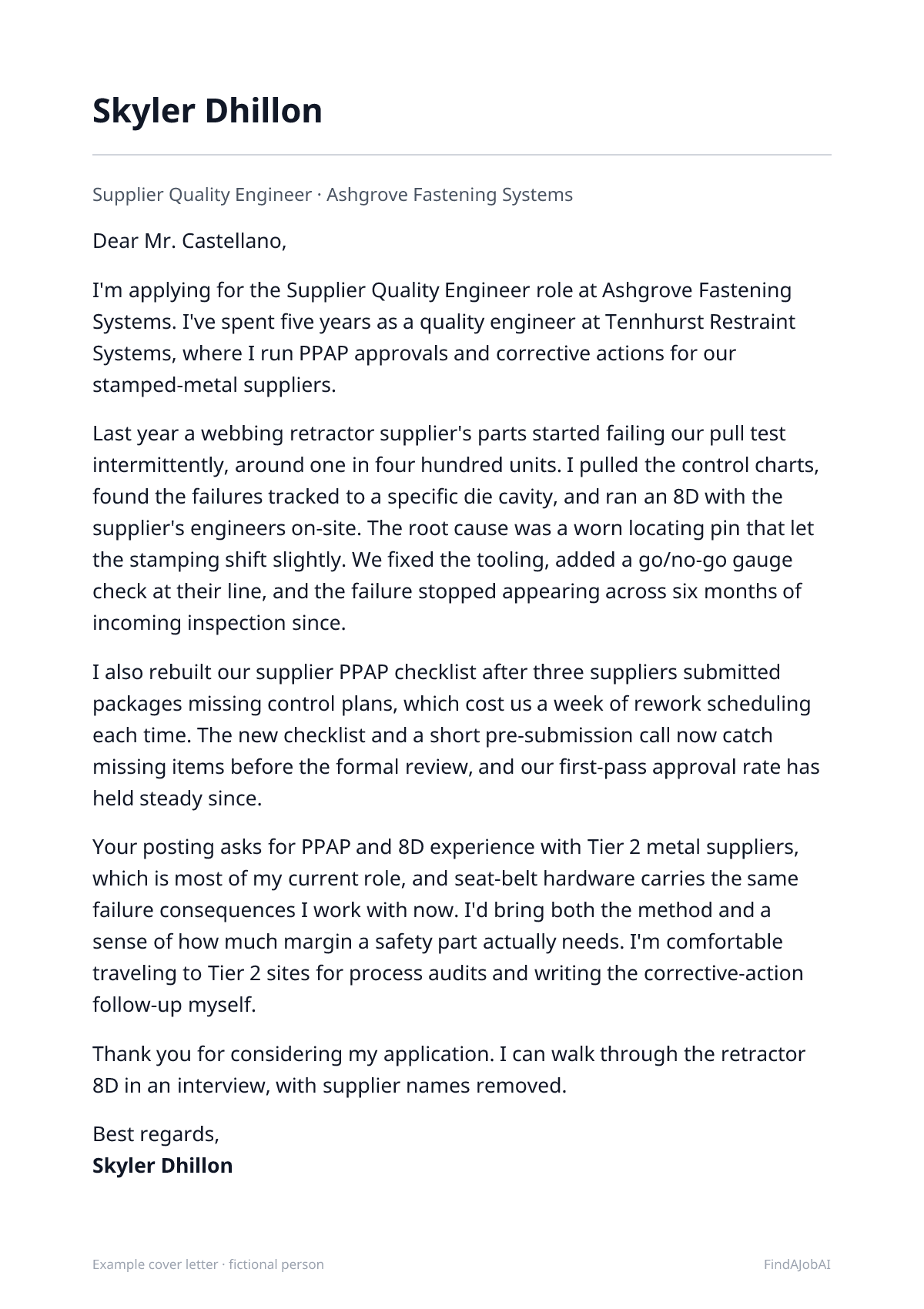
Dear Mr. Castellano,
I'm applying for the Supplier Quality Engineer role at Ashgrove Fastening Systems. I've spent five years as a quality engineer at Tennhurst Restraint Systems, where I run PPAP approvals and corrective actions for our stamped-metal suppliers.
Last year a webbing retractor supplier's parts started failing our pull test intermittently, around one in four hundred units. I pulled the control charts, found the failures tracked to a specific die cavity, and ran an 8D with the supplier's engineers on-site. The root cause was a worn locating pin that let the stamping shift slightly. We fixed the tooling, added a go/no-go gauge check at their line, and the failure stopped appearing across six months of incoming inspection since.
I also rebuilt our supplier PPAP checklist after three suppliers submitted packages missing control plans, which cost us a week of rework scheduling each time. The new checklist and a short pre-submission call now catch missing items before the formal review, and our first-pass approval rate has held steady since.
Your posting asks for PPAP and 8D experience with Tier 2 metal suppliers, which is most of my current role, and seat-belt hardware carries the same failure consequences I work with now. I'd bring both the method and a sense of how much margin a safety part actually needs. I'm comfortable traveling to Tier 2 sites for process audits and writing the corrective-action follow-up myself.
Thank you for considering my application. I can walk through the retractor 8D in an interview, with supplier names removed.
Best regards,
Skyler Dhillon
Example 2 · Career changer
Machine operator moving into a quality technician role
Priya caught a drifting tolerance on her own line before it became a quality role. The ad mentions gauge calibration and first-piece inspection.
Example letter · fictional
Dear Hiring Manager,
I'm applying for the Quality Technician role at Brightwell Molding. For four years I've operated injection molding presses at Ferncroft Plastics, and I'd like to move into quality work full time, which I've already been doing informally on my line.
Six months ago I noticed one cavity on our eight-cavity tool was running parts slightly undersized, close enough to pass but trending down over a shift. I flagged it to my supervisor with measurements from our caliper and a sketch of which cavity, and we caught a worn core pin before it produced any rejects. Since then I've been asked to do first-piece inspection for new setups on two of our presses.
I completed a gauge calibration and GD&T basics course through the plant's training program, and I'm studying for a CQT certification on my own time. I'm comfortable with calipers, micrometers and go/no-go gauges, and I've started learning to read control charts from our quality lead.
Your posting mentions gauge calibration and first-piece inspection on molded parts, which is the work I've already stepped into. I know the molding floor from the operator's side, which means I'd also know where a tolerance problem is likely to start. For the last two months I've also asked our quality lead to let me sit in on first-piece sign-offs, so the inspection checklist your ad mentions is already part of my week, and I keep my own notes on every measurement I take.
Thank you for your time. I'd welcome the chance to talk about how I could grow into this role.
Kind regards,
Priya Nkemdirim
Example 3 · Senior or lead
Quality manager applying to lead quality at a growing supplier
Simone manages a team of three quality engineers at an electronics assembler. The ad is for a quality manager who will set up a formal management system.
Example letter · fictional
Dear Mx. Okonkwo,
I'm applying for the Quality Manager role at Redfern Circuit Works. For the past three years I've managed a team of three quality engineers at Hollisbrook Electronics, a contract assembler, and before that I spent seven years as a quality engineer across two plants.
Your posting says customer returns are rising and the company has outgrown an informal, spreadsheet-based quality system. Hollisbrook had the same gap when I joined. I led the certification to ISO 9001, built a single nonconformance database to replace five separate tracking sheets, and set up a monthly Pareto review with production leads. Repeat defect types fell from being roughly a third of our open corrective actions to a small minority within a year, and customer returns dropped enough that our largest account removed us from a watch list.
Quality earns its place by catching what inspection alone misses. When a connector supplier's plating started failing salt-spray testing intermittently, I traced it to a bath concentration drifting between their shifts, something their own records hadn't flagged. We added a daily concentration check with sign-off, and the failure hasn't recurred across a year of lot testing since.
I've hired and trained two of my three engineers, but I haven't built a quality system from an informal baseline the way this role asks, and I'd want to move carefully through document control and training records with your operations lead rather than rushing a certification.
A conversation about which customer complaints you most want resolved first, and how your floor currently escalates a problem, would be a good place to start.
Sincerely,
Simone Vachon
All three letters, and the short version below, are fictional: the people, employers and numbers are invented. Borrow the structure, never the facts.
- Prefer to write it yourself? Use the free cover letter template.
- Check your CV against the job first: the free CV score shows the missing keywords.
Why the first letter works, paragraph by paragraph
Paragraph 1: Opening
Names the supplier types and the exact tools (PPAP, 8D) the writer already handles, which matches a hiring manager's shorthand for the role before any story starts.
Paragraph 2: The defect that was traced to its source
States the failure rate, the method (control charts, an on-site 8D), the specific root cause (a worn locating pin) and a corrective action with a result measured over time, not just 'resolved'.
Paragraph 3: A process fix beyond the one incident
Shows the writer improves the system, not just one case: a checklist rebuilt after a recurring problem, with a measurable effect on approvals.
Paragraph 4: Why this company
Connects the ad's specific requirement to the writer's daily work and adds a reason the industry's stakes suit their judgment.
Paragraph 5: Close
Offers to go deeper in an interview while respecting the current supplier relationship's confidentiality.
What the career changer's letter does differently
The career changer's letter opens with a specific catch, a drifting cavity found from the operator's own measurements, before any quality title existed. A calibration course and informal first-piece assignments show the shift is already underway, and the letter turns operator experience into an advantage: knowing where problems start on the floor.
What the senior letter does differently
A quality manager letter reports a plant's habits, not a single fix: one ISO 9001 certification, five tracking sheets reduced to one database, a customer removed from a watch list. The supplier example shows the writer finding a cause the supplier itself had missed, and the gap, building a system from scratch, is named rather than glossed over.
Short quality engineer cover letter: an email-ready version
Many applications arrive as an email or a small text box, and a full page doesn't fit. This version runs 120 to 150 words and keeps only what a reader needs to decide whether to reply. A quality engineer answers a medical device maker's short online application question, sent as an email because the portal's upload tool was down.
Short version · email · fictional125 words
Subject: Quality Engineer (CAPA, risk files) – catheter line – Thomas Lindqvist
Hello Ms. Abiodun,
I'm applying for the Quality Engineer role at Marrowfield Devices. I have four years of CAPA and risk management experience on a catheter assembly line at a Class II device maker, where I own our nonconformance process.
My most useful project was tracing a recurring seal failure, about one in five hundred units, to a heat-sealer temperature that drifted between maintenance cycles. We added an inline temperature log with an alert, and the failure rate held near zero across the following two quarters of production.
Device quality work rewards patience with documentation and a willingness to keep testing a theory until it holds. My resume is attached, and I can walk through the CAPA file with identifying details removed.
Best,
Thomas Lindqvist
A short application keeps one traceable defect with its rate and fix, since device quality readers look for rigor over breadth. Naming the willingness to walk through the CAPA file, with details removed, signals comfort with the documentation the role actually runs on.
Opening lines that work for quality engineer cover letters
The first sentence decides whether the second gets read. Here are six openings, one for each situation you might be in. Pick the one that matches yours and swap in your own facts: every name and number below is invented.
1. You have a standout result
One root cause investigation I led last year traced a recurring seal failure to a drifting sealer temperature and held the defect rate near zero for two quarters after. I'd like to bring that kind of tracing to your line.
2. The ad names a problem you've solved
Your ad mentions rising customer returns. At my current plant I rebuilt our nonconformance tracking into a single database and cut repeat defect types to a small share of open corrective actions within a year.
3. Someone referred you
Your production supervisor, Alain Desrosiers, worked with me for two years on a prior line and suggested I apply, since he knew I'd pushed harder than most on root cause rather than just sign-off.
4. You admire what they build
I've watched your recall notices as part of my own supplier audits, and the corrective action you published on the clip assembly was unusually clear; I'd like to help write ones like it from the inside.
5. You're new to the field or switching into it
I spent four years operating a molding press, then started catching tolerance drifts before they became rejects. Quality work is where I'd like to keep doing that, formally.
6. You have senior scope or a specialism
As quality manager for a seven-engineer team for five years, I built our first management system from a spreadsheet baseline. I'm looking for a plant that's ready for that next step.
How to write a quality engineer cover letter
Five steps, in the order you'd write them. The shape stays the same for every job (a short opening, proof, a reason for this employer, a close), and what goes into each part is what changes with the role.
Find the failure mode this ad cares about
Quality ads differ by what fails: a supplier defect, a line escape, an audit finding, a customer return. Read for the specific risk named and choose an example of yours that traced a similar failure to its cause, in a similar process or industry.
Lead with the defect rate, not the tool
State what was failing and how often before naming the method you used to trace it. A reader who sees the scale of the problem in your first sentence will trust the fix that follows, whether it was an 8D, a fishbone, or a control chart review.
Name the root cause specifically
'Fixed the process' tells the reader nothing. A worn locating pin, a drifting bath concentration, a sealer temperature between maintenance cycles: a specific cause shows you actually found it rather than patched the symptom and moved on.
Show the fix held over time
A corrective action that worked for one week isn't proven. Say how long the defect stayed away, measured in a quarter, a year, or a number of lots, so the reader can judge whether the fix was real or temporary.
Close with how you work with the people upstream
Quality engineers depend on operators, suppliers, and production leads to act on findings. One sentence on how you communicate a corrective action, such as a short checklist or an on-site review, shows you can get a fix adopted, not just documented.
Quality Engineer cover letter do's and don'ts
Do
- Name the defect, the root cause method (8D, 5 Why, fishbone) and the fix, then how long it held.
- Mention the specific standard or tool the ad names (PPAP, SPC, ISO 9001, GD&T) inside a real example.
- Show who relied on your finding: a supplier, a production line, or an audit that would otherwise have failed.
Don't
- Don't write "strong attention to detail"; show a tolerance or defect you actually caught.
- Don't count inspections performed; one root cause fix that stopped recurring failures beats a tally of checks.
- Don't share a current employer's supplier names or defect rates; describe them in general terms or with figures removed.
Common quality engineer cover letter mistakes
Each one is easy to make and quick to fix before you send the letter.
Listing certifications without a defect to anchor them
A row of Six Sigma, ISO 9001 and CQE tells the reader you've studied the material. Attach one certification to a specific defect you traced using it, so the credential has evidence behind it.
Saying 'resolved' without a timeframe
A fix that lasted a week and one that held for a year look identical if you only say 'resolved.' State how long the defect stayed away after the corrective action, so the claim can be trusted.
Counting inspections instead of catches
'Performed 200 incoming inspections' describes volume, not judgment. Describe the one inspection that caught something real, what it was, and what would have happened if it had shipped.
Omitting the industry's actual stakes
A seal failure means something different in a toy and in a catheter. Name what the defect would have cost downstream, such as a recall, a safety risk, or a warranty claim, so the reader understands why the fix mattered.
Writing "detail-oriented" as the whole pitch
Every quality applicant claims this. Replace it with the exact measurement, tolerance, or drift you caught, and let the specificity make the claim for you.
Email subject lines for quality engineer applications
Applying by email? Put the job title, any reference number and your name in the subject line.
- Supplier Quality Engineer application – PPAP and 8D experience – Skyler Dhillon
- Quality Technician – molding operator with calibration training – Priya Nkemdirim
- Application: Quality Engineer, Line 3 (Req. QE-204) – Skyler Dhillon
Everything for Quality Engineers
- Quality Engineer resume exampleA full resume, plus bullet and summary examples
- Quality Engineer interview questions30 questions with sample answers
- Quality Engineer job descriptionDuties, skills and requirements
- Career change cover letter: template + examples
Other cover letter examples
Quality Engineer cover letter FAQ
What should I write in a quality engineer cover letter?
One defect or failure you traced to its root cause, the method you used, the fix, and how long it held after. Then a sentence on how you work with the production or supplier teams involved. Your certifications are already on your resume.
How do I write a quality engineer cover letter with no experience?
Use a quality catch from another floor role, such as a tolerance drift or a process step you flagged, then add a calibration or GD&T course. Name the measuring tools you used and what happened after you raised the issue.
Should I mention specific standards like ISO 9001 or AS9100 in the letter?
Yes, if the ad names one and you've worked under it. Tie the standard to something concrete, such as an audit you prepared for or a corrective action you documented, rather than listing it alone.
How technical should a quality engineer cover letter get?
Specific enough that another quality engineer could picture the defect and the fix, but without proprietary numbers. Explain acronyms the ad doesn't use, and keep the business result, not just the method, in view.
How we built this page
The FindAJobAI team wrote the three example letters, the short email version, the opening lines and the advice for quality engineer roles. The people, employers and numbers in the letters are invented; the structure, the kind of evidence and the order of the paragraphs are the parts to copy.
Once we track enough live quality engineer job ads, this page also shows the skills they ask for most, counted the same way as our in-demand skills report.
Last reviewed on November 1, 2026.