Recruiter Cover Letter Example (2026)
By FindAJobAI team Updated How we built this page
Recruiter ads ask how you find and close people, so hiring managers read cover letters for the roles you've hired for, hires per quarter, time to fill, and the sourcing channels and applicant tracking system you use. A recruiter's cover letter is also a sample of how they'd pitch a candidate.
Recruiter cover letter template
This letter as a one-page template: an opening that names the job and your strongest fact, proof that answers the ad, a reason for this employer and a short close.
After you sign up, FindAJobAI drafts your own letter for a real job from your CV in this format, and you edit it before you send it.
Example 1 · Experienced
Senior technical recruiter applying to a robotics company
Sophie hires engineers across software, data and hardware. The ad mentions a small, competitive pool of embedded engineers.
Example letter · fictional
Dear Ms. Engström,
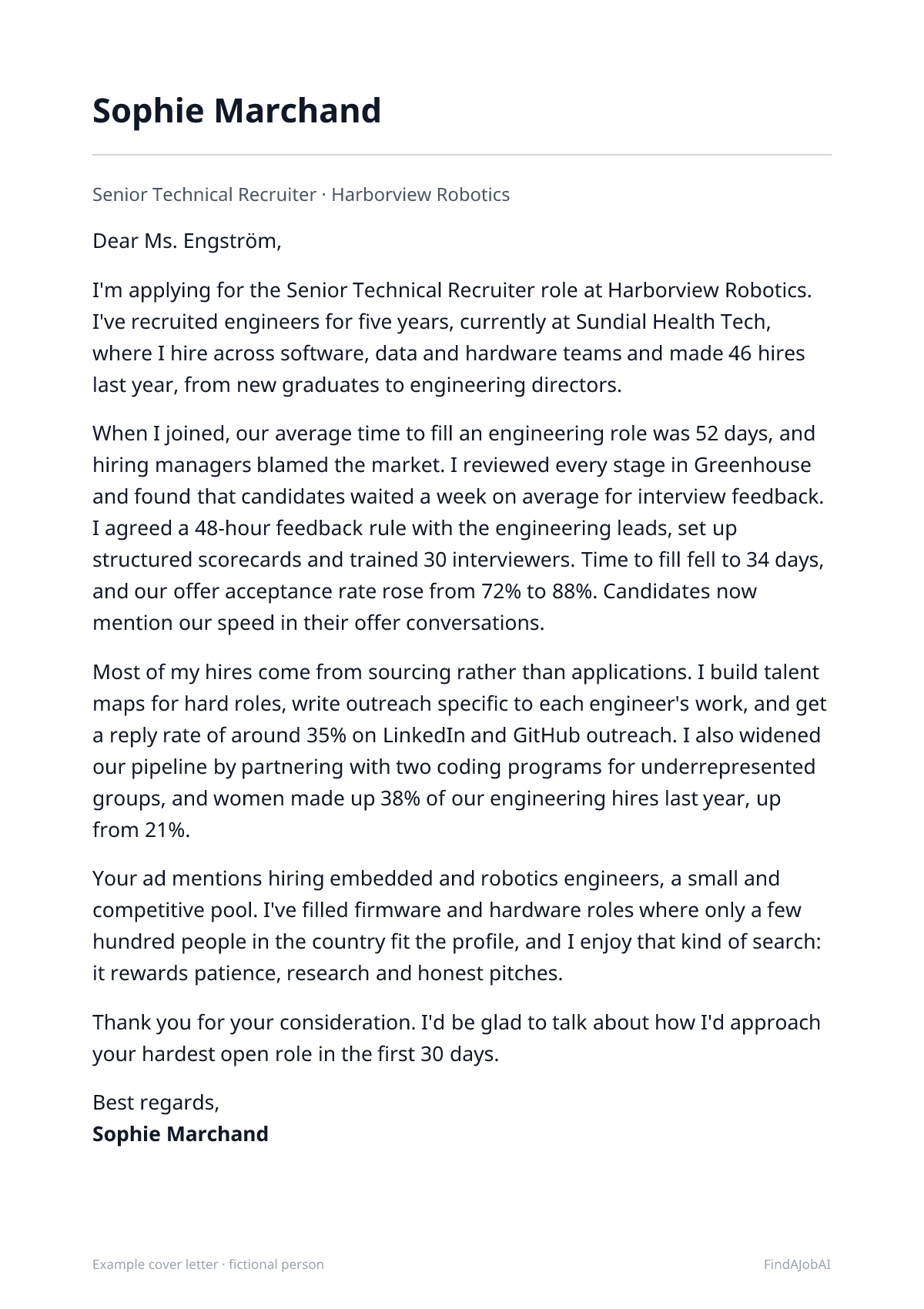
I'm applying for the Senior Technical Recruiter role at Harborview Robotics. I've recruited engineers for five years, currently at Sundial Health Tech, where I hire across software, data and hardware teams and made 46 hires last year, from new graduates to engineering directors.
When I joined, our average time to fill an engineering role was 52 days, and hiring managers blamed the market. I reviewed every stage in Greenhouse and found that candidates waited a week on average for interview feedback. I agreed a 48-hour feedback rule with the engineering leads, set up structured scorecards and trained 30 interviewers. Time to fill fell to 34 days, and our offer acceptance rate rose from 72% to 88%. Candidates now mention our speed in their offer conversations.
Most of my hires come from sourcing rather than applications. I build talent maps for hard roles, write outreach specific to each engineer's work, and get a reply rate of around 35% on LinkedIn and GitHub outreach. I also widened our pipeline by partnering with two coding programs for underrepresented groups, and women made up 38% of our engineering hires last year, up from 21%.
Your ad mentions hiring embedded and robotics engineers, a small and competitive pool. I've filled firmware and hardware roles where only a few hundred people in the country fit the profile, and I enjoy that kind of search: it rewards patience, research and honest pitches.
Thank you for your consideration. I'd be glad to talk about how I'd approach your hardest open role in the first 30 days.
Best regards,
Sophie Marchand
Example 2 · Career changer
Retail store manager moving into high-volume recruiting
Luis has hired more than 150 people as a store manager. The ad asks for fast hiring at volume and respect for every candidate.
Example letter · fictional
Dear Fairlane Talent Team,
I'm applying for the Recruiter role on your high-volume hiring team. I've managed retail stores for six years, and hiring has been the part of my job I've enjoyed and done best: I've hired more than 150 people, and I'd like to make recruiting my full-time work.
As store manager of a 60-person grocery store, I owned hiring for every role, from cashiers to department leads. Before each holiday season I had to hire 25 temporary staff in four weeks. I moved our job ads to the channels local candidates actually used, ran group interview days, and made offers on the spot to strong candidates. We filled every seasonal role on time for three years running, and half of those hires stayed on permanently.
I've also cut turnover. Exit conversations showed that new hires left in their first month because of unclear schedules, so I introduced a first-week buddy and set schedules two weeks ahead; first-90-day turnover fell from 40% to 22%. I've completed a recruiting fundamentals course and I'm learning sourcing. I've used Workday for hiring approvals but haven't yet run a full recruiting pipeline in an applicant tracking system.
Your ad asks for someone who can hire quickly at volume and treat every candidate with respect. That's how I've run hiring in retail, where a good hire on Friday is the difference between a good weekend and a bad one.
Thank you for considering my application. I'd welcome the chance to talk about how I'd approach your warehouse hiring.
Kind regards,
Luis Navarro
Example 3 · Senior or lead
Talent acquisition lead applying to build a recruiting team
Tessa leads three recruiters and 120 hires a year. The ad is for a first head of talent to build a team and a hiring process at a growing biotech.
Example letter · fictional
Dear Dr. Oyelowo,
I'm applying for the Head of Talent Acquisition role at Pinewright Labs. I've recruited for eleven years, and for the last four I've led talent acquisition at Medlark Diagnostics: three recruiters, one coordinator and about 120 hires a year across laboratory, engineering and commercial teams. I'd like to build a recruiting function from an earlier stage.
Your ad says Pinewright plans to double in two years and has no shared hiring process. Medlark faced that. I introduced structured interviews with a scorecard for every role, a standard intake meeting with each hiring manager, and a weekly pipeline review in which managers see their candidates' status. Time to fill fell from 61 days to 38, and first-year attrition among new hires dropped from 19% to 12%.
What I care about is the candidate experience, because a lab technician who is treated well tells colleagues. We reply to every applicant within five working days, and a short survey of rejected finalists helped us fix two scheduling problems. Offer acceptance rose from 74% to 88% after we began a call with the hiring manager within a day of the final interview.
I coach my team on sourcing and on pushing back when a manager's requirements don't match the market. Two of my recruiters were promoted, and I hired a recruiting coordinator who now runs interview logistics. I haven't hired for an executive team or built a function from nothing, and I'd draw on an experienced search adviser for the first few senior roles.
Which five hires matter most in Pinewright's next year? I'd like to start the conversation there.
Sincerely,
Tessa Lindell
All three letters, and the short version below, are fictional: the people, employers and numbers are invented. Borrow the structure, never the facts.
- Prefer to write it yourself? Use the free cover letter template.
- Check your CV against the job first: the free CV score shows the missing keywords.
Why the first letter works, paragraph by paragraph
Paragraph 1: Opening
Names the type of recruiting (technical), the teams hired for and annual hires. Recruiting leaders compare candidates by volume and difficulty.
Paragraph 2: Fixing the process
Finds the real cause of slow hiring in the ATS data, changes the process, and gives two results: time to fill and offer acceptance. It also shows the writer can influence hiring managers.
Paragraph 3: Sourcing and reach
Proves the writer finds people rather than waiting for applicants: talent maps, personal outreach, a reply rate and a measurable change in the pipeline.
Paragraph 4: Why this company
Matches the ad's hardest hiring need, embedded and robotics engineers, with a similar search the writer has done.
Paragraph 5: Close
Offers to discuss their hardest open role: confident, and a concrete topic for the interview.
What the career changer's letter does differently
The store manager's letter shows recruiting results from retail: 150 hires, seasonal hiring on time, and first-90-day turnover nearly halved. It states the applicant tracking system gap plainly and aims at high-volume hiring, where the experience transfers best.
What the senior letter does differently
A head of talent writes about a system: structured interviews, standard intake meetings and a weekly pipeline review, with time to fill, early attrition and offer acceptance as the proof. Candidate experience is handled as a result, and the writer names executive search and function-building as new.
Short recruiter cover letter: an email-ready version
Many applications arrive as an email or a small text box, and a full page doesn't fit. This version runs 120 to 150 words and keeps only what a reader needs to decide whether to reply. A recruiter replies to a hiring contact who asked for 'two short paragraphs on how you'd fill a hard-to-fill engineering role'.
Short version · email · fictional134 words
Subject: Technical Recruiter – how I'd fill a hard embedded role – Darius Mohammadi
Hello Ms. Saunders,
For a hard-to-fill embedded engineer role, I'd start with a 30-minute intake to learn which requirements are truly essential, then look in adjacent fields, such as automotive and medical devices, where people already use the same toolchain. I'm applying for the Technical Recruiter role at Foxton Engineering with four years of this work.
At my last company, that approach filled an embedded firmware opening in 31 days after it had been open for four months. Candidate replies came from a short, specific message that named the project, and two of our last five hires came from referrals by engineers I'd recruited.
Foxton's work on rail signalling is the kind engineers like to talk about, and I'd like to help you find more of them. Attached is my resume.
Best,
Darius Mohammadi
Asked how the writer would fill a hard role, the note gives the method in two sentences, intake and adjacent fields, then one real example with the days it took. Naming a specific project the employer is known for makes the closing line more than flattery.
Opening lines that work for recruiter cover letters
The first sentence decides whether the second gets read. Here are six openings, one for each situation you might be in. Pick the one that matches yours and swap in your own facts: every name and number below is invented.
1. You have a standout result
I cut time to fill for engineering roles from 52 days to 34 and made 46 hires last year. Your robotics team would get the same pace and care from me.
2. The ad names a problem you've solved
A small pool of embedded engineers, slow to reply: that's what your ad says. I filled three such roles last year by recruiting from adjacent industries, and the average fill took six weeks.
3. Someone referred you
Ellen Thorsen, your VP of engineering, and I go back to a previous company, where I recruited two of her managers. She said you want a recruiter who talks easily to engineers, so I'm applying.
4. You admire what they build
Your careers page is the only one I've seen that tells candidates how many interview rounds to expect and how long each takes, which is why I'd like to work for your talent team.
5. You're new to the field or switching into it
Hiring more than 150 people as a store manager showed me that recruiting is the part of the job I enjoy most. I'd like to make it the whole job.
6. You have senior scope or a specialism
After eleven years in talent acquisition, with a team of four and 120 hires a year, I'd like to build a function as head of talent at a company that is doubling.
How to write a recruiter cover letter
Five steps, in the order you'd write them. The shape stays the same for every job (a short opening, proof, a reason for this employer, a close), and what goes into each part is what changes with the role.
Say which hiring you do and at what pace
Recruiter roles are specialist or high volume: technical, executive, retail, healthcare. State which you've done, how many roles you carry at once and your hires a year. The reader is deciding whether your pace and your pool match theirs.
Lead with time to fill and hire quality
Open with time to fill and one measure of whether the hires worked out, such as offer acceptance or first-year retention. Speed alone suggests hurried hiring, so pair it with a quality figure. Give the before and after if you improved either.
Tell a story about a hard search
Describe one role that stayed open, what you changed and how it filled: widening the pool, rewriting the message, adjusting the requirements with the manager. Hiring managers judge recruiters by how they handle difficulty, and this is the place to show it.
Show how you partner with hiring managers
Add one example of an intake meeting, a calibration or a time you pushed back on a requirement. Recruiting depends on influence over managers, and a concrete case of redirecting one shows a skill that no tool list can.
Treat candidates as part of the result
Mention one practice that improves the candidate's experience, such as reply times or clear interview steps, and a result. Keep every detail about individual candidates confidential. Close with the roles you would expect to fill first, based on the ad.
Keywords employers use for recruiter roles
The skills named most often in the 463 newest recruiter job ads we track (out of 2,780 live postings), with the share of ads that mention each:
- Sourcing 69%
- Applicant tracking systems 48%
- Hiring manager partnership 48%
- Interviewing 45%
- Full-cycle recruiting 25%
- LinkedIn Recruiter 21%
- Onboarding 19%
- Recruiting metrics 17%
Don't list them in your letter: pick the two or three the ad repeats and back each with one sentence of evidence. Full list: Recruiter resume keywords.
From live job ads · updated November 2, 2026
Recruiter cover letter do's and don'ts
Do
- Give your hiring numbers: hires per year, roles, time to fill, offer acceptance.
- Name your sourcing channels and the applicant tracking system you use (Greenhouse, Lever, Workday).
- Show how you work with hiring managers: feedback rules, scorecards, interviewer training.
Don't
- Don't send a generic letter; you'll be judged on how well you pitch, starting with yourself.
- Don't claim diversity results without numbers or methods; vague statements carry no weight.
- Don't forget candidate experience; say how you keep candidates informed.
Common recruiter cover letter mistakes
Each one is easy to make and quick to fix before you send the letter.
Writing 'passion for people'
It's what every recruiter says. Show the passion through results and habits: a candidate reply time, a pipeline review you run, a hard role you filled by changing how you searched.
Quoting volume with no quality measure
Fifty hires a year mean little without acceptance rate or retention. Add a measure of how well hires worked out, so the reader can see you aren't trading quality for speed.
Skipping the hiring manager
A letter that only describes sourcing leaves out half of recruiting. Include how you run intake, give managers feedback on their requirements and keep them informed, with one example.
Naming applicant systems and sourcing tools
Greenhouse, Lever and LinkedIn Recruiter are standard. Mention the one the ad lists, then spend the paragraph on what you did with it, such as a pipeline report that changed how managers acted.
Revealing candidate details
Never include names, current employers or salaries of people you placed or rejected. Hiring teams read your discretion in the letter as a preview of how you will handle theirs.
Email subject lines for recruiter applications
Applying by email? Put the job title, any reference number and your name in the subject line.
- Senior Technical Recruiter – 46 engineering hires, time to fill 52 to 34 days – Sophie Marchand
- Recruiter, High-Volume – store manager with 150+ hires – Luis Navarro
- Application: Talent Acquisition Partner (Ref TA-12) – Sophie Marchand
Everything for Recruiters
- Recruiter jobs2,780 open roles, updated hourly
- Recruiter salary in the United StatesAdvertised pay in real job ads
- Recruiter resume exampleA full resume, plus bullet and summary examples
- Recruiter interview questions30 questions with sample answers
- Recruiter resume keywordsThe skills job ads ask for most
- Recruiter job descriptionDuties, skills and requirements
- Career change cover letter: template + examples
Other cover letter examples
Recruiter cover letter FAQ
What should a recruiter cover letter include?
The roles you hire for, your annual hires, time to fill and offer acceptance, your sourcing methods and ATS, and one example of improving a hiring process. Write it as carefully as you'd write outreach to a top candidate.
How do I become a recruiter with no recruiting experience?
Use the hiring you've done as a manager, plus any sales or customer-facing results, and give the numbers: people hired, positions filled on time, turnover reduced. High-volume and agency roles are common ways in.
Should a recruiter cover letter mention LinkedIn Recruiter?
If the ad mentions it or sourcing is central to the role, yes, together with a result such as your outreach reply rate or hires sourced. Tools matter less than evidence that you can find and close people.
How we built this page
The FindAJobAI team wrote the three example letters, the short email version, the opening lines and the advice for recruiter roles. The people, employers and numbers in the letters are invented; the structure, the kind of evidence and the order of the paragraphs are the parts to copy.
The live keyword section is based on 463 recruiter job ads analysed, the newest we track, with the same deterministic skill matcher as our in-demand skills report: no AI model reads the postings. It was last computed on November 2, 2026 and refreshes daily.
Last reviewed on November 1, 2026.