Scrum Master Cover Letter Example (2026)
By FindAJobAI team Updated How we built this page
Scrum Master ads tend to list the same ceremonies and the same certification, so most letters sound interchangeable. Yours stands out by naming a specific team dysfunction you fixed, how the team's own metrics changed, and what you did when a ceremony wasn't working.
Scrum Master cover letter template
This letter as a one-page template: an opening that names the job and your strongest fact, proof that answers the ad, a reason for this employer and a short close.
After you sign up, FindAJobAI drafts your own letter for a real job from your CV in this format, and you edit it before you send it.
Example 1 · Experienced
Scrum Master applying to a payments platform team
Roger runs Scrum for two backend teams at a logistics company. The ad asks for experience with distributed teams and stakeholder pressure.
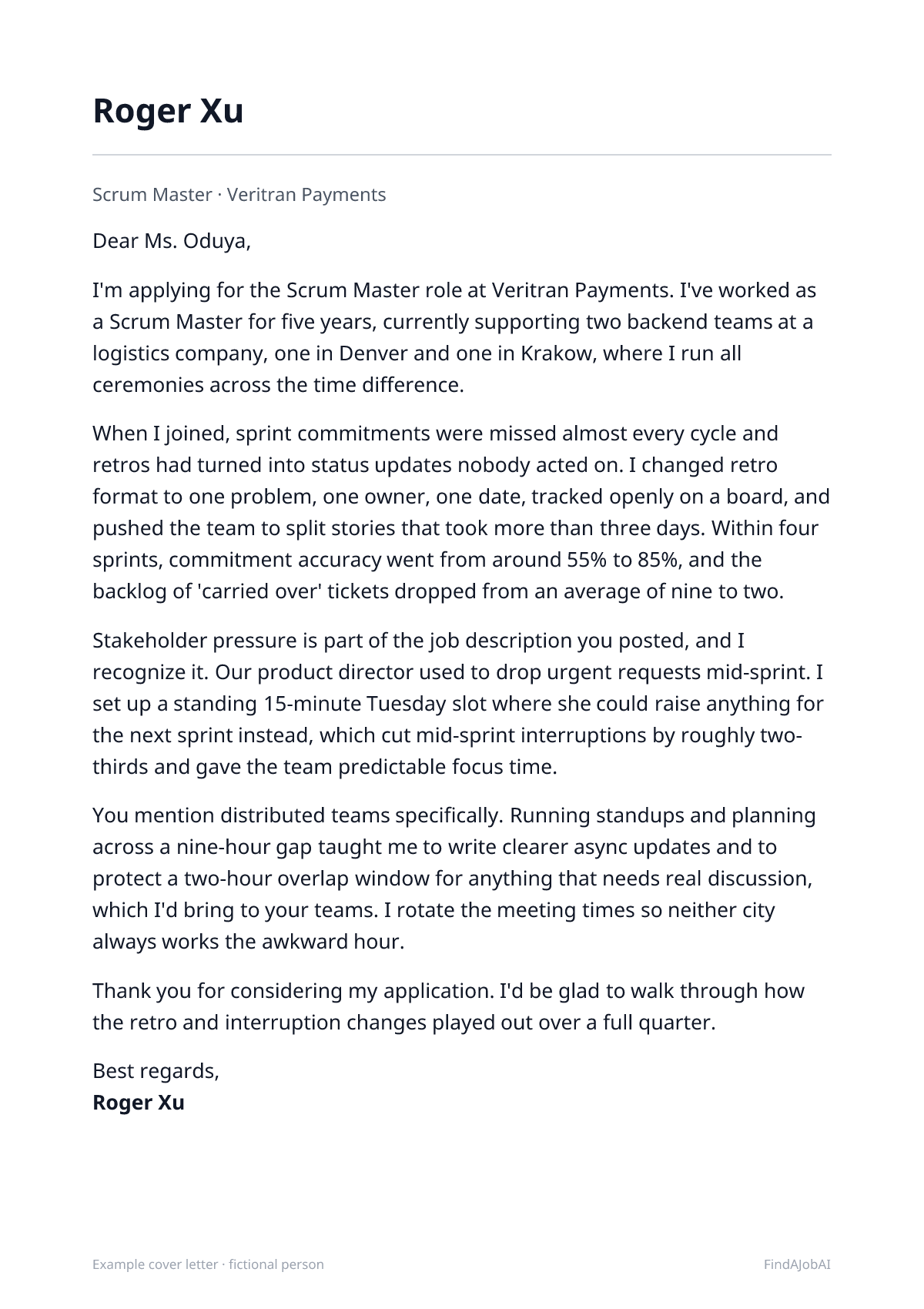
Example letter · fictional
Dear Ms. Oduya,
I'm applying for the Scrum Master role at Veritran Payments. I've worked as a Scrum Master for five years, currently supporting two backend teams at a logistics company, one in Denver and one in Krakow, where I run all ceremonies across the time difference.
When I joined, sprint commitments were missed almost every cycle and retros had turned into status updates nobody acted on. I changed retro format to one problem, one owner, one date, tracked openly on a board, and pushed the team to split stories that took more than three days. Within four sprints, commitment accuracy went from around 55% to 85%, and the backlog of 'carried over' tickets dropped from an average of nine to two.
Stakeholder pressure is part of the job description you posted, and I recognize it. Our product director used to drop urgent requests mid-sprint. I set up a standing 15-minute Tuesday slot where she could raise anything for the next sprint instead, which cut mid-sprint interruptions by roughly two-thirds and gave the team predictable focus time.
You mention distributed teams specifically. Running standups and planning across a nine-hour gap taught me to write clearer async updates and to protect a two-hour overlap window for anything that needs real discussion, which I'd bring to your teams. I rotate the meeting times so neither city always works the awkward hour.
Thank you for considering my application. I'd be glad to walk through how the retro and interruption changes played out over a full quarter.
Best regards,
Roger Xu
Example 2 · Career changer
QA lead moving into Scrum Mastery
Olivia ran Scrum informally while leading QA because her team's actual Scrum Master had left. The ad mentions coaching teams new to agile.
Example letter · fictional
Dear Hiring Manager,
I'm applying for the Associate Scrum Master role at Hearthline Insurance. For four years I've led a QA team of five, and for the last year I've also run Scrum for our squad after our Scrum Master moved teams and wasn't replaced. I'd like to make that my full-time role.
Our team was new to agile and treated the sprint as a deadline rather than a planning tool, so scope kept changing mid-sprint and testing was always rushed at the end. I introduced a definition of done that required tests written before a story could move to review, and I ran planning poker instead of letting the lead estimate everyone's work. Cycle time from 'in progress' to 'done' dropped from an average of nine days to five, and we stopped shipping untested code under deadline pressure.
Since taking this on I've completed my Certified ScrumMaster training and sat in on three sprint reviews run by our senior Scrum Master to see how she handled a stakeholder who kept adding scope live in the meeting. I'm comfortable with Jira, sprint reporting and facilitating retros; I'm still building experience with scaling ceremonies across multiple teams.
Your posting mentions coaching teams that are new to agile. That's the exact situation I walked into, and having been the one explaining 'why we don't change scope mid-sprint' to skeptical engineers, I understand both sides of that conversation.
Thank you for your time. I'd welcome the chance to talk about how I'd approach a team earlier in its agile adoption than mine was.
Kind regards,
Olivia Petrov
Example 3 · Senior or lead
Agile coach applying to oversee Scrum across five teams
Darius coaches Scrum Masters across five teams at a healthcare software firm. The ad is for an agile coach to standardize practice and mentor others.
Example letter · fictional
Dear Mr. Lindqvist,
I'm applying for the Agile Coach role at Meridian Health Systems. For the last two years I've coached five Scrum Masters across five teams at a healthcare software company, and before that I spent six years as a Scrum Master myself. I'd like to bring that coaching to a larger group.
Your ad says each team runs Scrum differently and leadership can't compare velocity or predictability across them. I found the same thing when I started: five teams, five definitions of done, three different estimation scales. I ran a half-day working session with all five Scrum Masters to agree on one definition of done and one estimation scale, then coached each of them individually through the change over two sprints rather than mandating it top-down. Cross-team predictability, measured by how often a team's forecast matched its actual delivery, rose from roughly 50% to 78% within two quarters.
Standardizing is only useful if it serves a decision. When our roadmap team wanted to know which of three teams could absorb a new initiative, the shared metrics showed one team had been over-committing for months while another had slack nobody had noticed. Leadership moved the initiative to the team with capacity instead of the one that volunteered, and that comparison is now part of quarterly planning.
I've mentored four Scrum Masters through their CSM certifications and coached two through their first difficult stakeholder conflict. I haven't yet coached a team using SAFe at full program level, and at Meridian I'd expect to learn your specific PI planning cadence from your release train engineer.
A conversation about which of your five teams is hardest to compare right now, and why, would be a good place to start.
Sincerely,
Darius Whitfield
All three letters, and the short version below, are fictional: the people, employers and numbers are invented. Borrow the structure, never the facts.
- Prefer to write it yourself? Use the free cover letter template.
- Check your CV against the job first: the free CV score shows the missing keywords.
Why the first letter works, paragraph by paragraph
Paragraph 1: Opening
Names the specific teams and setup (two backend teams, a time-zone split) so the reader knows immediately what kind of Scrum Mastery the writer has actually done.
Paragraph 2: The dysfunction fixed
States the problem in the team's own terms (missed commitments, dead retros), the concrete change made, and the metric that moved, which shows facilitation translating into results rather than ceremonies for their own sake.
Paragraph 3: Handling stakeholder pressure
Directly answers a line from the ad with a specific mechanism (a standing Tuesday slot) and its effect, which is more convincing than claiming to be 'good with stakeholders.'
Paragraph 4: Distributed team detail
Responds to the ad's distributed-teams requirement with a concrete practice (protected overlap window) rather than a general claim of experience.
Paragraph 5: Close
Offers to go deeper on the two examples already given, keeping the offer specific rather than a generic 'happy to discuss.'
What the career changer's letter does differently
The career changer's letter opens from the real situation, QA lead filling a gap after the actual Scrum Master left, and uses a concrete process fix (a definition of done requiring tests before review) with a cycle-time result. It names the certification and the specific thing being learned (scaling ceremonies across teams), and ties the writer's QA background directly to the ad's mention of coaching agile-new teams.
What the senior letter does differently
An agile coach letter reports on an organization's practice, not one team's sprint: one shared definition of done across five teams, predictability moving from 50 percent to 78 percent, a capacity decision the standardized metrics made possible. The gap, no program-level SAFe coaching, is named rather than glossed over.
Short Scrum Master cover letter: an email-ready version
Many applications arrive as an email or a small text box, and a full page doesn't fit. This version runs 120 to 150 words and keeps only what a reader needs to decide whether to reply. A Scrum Master answers a fintech company's short-application field after a recruiter reached out directly, so the reply goes by email, not as a full letter.
Short version · email · fictional125 words
Subject: Scrum Master (distributed teams) – Samira Okonkwo
Hello Mr. Park,
Thank you for reaching out about the Scrum Master role at Ledgerline Financial. I've run Scrum for a nine-person backend team for three years, most recently fixing a sprint where commitment accuracy had fallen to around 50%.
I replaced our estimation process with planning poker and capped work-in-progress per engineer, and commitment accuracy rose to 82% within three sprints. I also run a standing weekly slot for stakeholders to raise next-sprint requests instead of interrupting the current one. Planning now takes the team under an hour, down from nearly two.
I'd like to bring that same discipline to a distributed team. My resume is attached, and I'm happy to share more detail on the estimation change on a call.
Best,
Samira Okonkwo
A recruiter-initiated reply skips the full greeting-to-close letter and gets straight to one result (commitment accuracy from 50 percent to 82 percent) and one ongoing practice (the stakeholder slot), since the recruiter already knows why they reached out.
Opening lines that work for Scrum Master cover letters
The first sentence decides whether the second gets read. Here are six openings, one for each situation you might be in. Pick the one that matches yours and swap in your own facts: every name and number below is invented.
1. You have a standout result
When I took over Scrum Mastery for a nine-person team, sprint commitment accuracy was around 50%. After I introduced planning poker and a work-in-progress cap, it rose to 82% within three sprints, and I'd like to bring that discipline to your platform team.
2. The ad names a problem you've solved
Your ad mentions stakeholders who interrupt sprints with urgent requests. I solved exactly that by setting up a standing weekly slot for next-sprint asks, which cut mid-sprint interruptions by roughly two-thirds.
3. Someone referred you
Your engineering director, Felix Okonjo, sat in on a sprint review I ran last year while consulting for his previous team. He mentioned you're looking for someone who can coach a team that's new to agile, which is why I'm writing.
4. You admire what they build
I've followed your engineering blog's posts on scaling Scrum across teams for a year, and the challenges you describe with cross-team dependencies are ones I've worked through directly.
5. You're new to the field or switching into it
I led a QA team for four years before informally running Scrum after our Scrum Master left. That experience is why I want to do the role formally now.
6. You have senior scope or a specialism
As Scrum Master for five teams over the past two years, I built the shared definition of done those teams still use. I'm looking for a role that extends that kind of coaching across an organization.
How to write a Scrum Master cover letter
Five steps, in the order you'd write them. The shape stays the same for every job (a short opening, proof, a reason for this employer, a close), and what goes into each part is what changes with the role.
Identify the team structure the ad describes
Scrum Master ads vary by setup: a single team, several teams, distributed time zones, or teams new to agile entirely. Read for which one this ad describes, then lead with the experience of yours that matches most closely rather than your broadest example.
Open with the dysfunction you fixed, not the ceremonies you ran
Say what was actually wrong, such as missed commitments or scope changing mid-sprint, in one sentence. Facilitating standups and retros is the baseline of the job; naming the problem those ceremonies were failing to solve is what shows judgment.
Give the metric a fix moved, with its starting point
Commitment accuracy, cycle time, or carried-over story count are the usual markers. State the number before your change and after, and over what period, so a reader can judge whether it's a meaningful shift rather than a vague claim of improvement.
Answer the ad's specific pressure point directly
Most Scrum Master ads name a recurring problem: stakeholder interruptions, distributed teams, or a department new to agile. Pick the one your example addresses and say so explicitly, rather than listing general facilitation skills and hoping the reader connects them.
Name your tools and certification inside the story
Mention Jira, Azure DevOps or a CSM certification as part of what you used to make a change happen, not as a standalone line. Close with a specific question about their team's current setup, so the letter ends on what you'd actually work on.
Scrum Master cover letter do's and don'ts
Do
- Name the specific dysfunction you fixed (missed commitments, scope creep, silent retros) and the metric that changed, not just 'I facilitated ceremonies.'
- If the ad mentions distributed teams, scaling frameworks (SAFe, LeSS) or stakeholder pressure, answer that exact point with one concrete example.
- Mention the tool the ad names (Jira, Azure DevOps, Rally) inside a story, not as a bare list.
Don't
- Don't describe yourself as a 'servant leader' without a specific example of what you did in that role.
- Don't list every ceremony you've ever run; show one you changed and why it worked better afterward.
- Don't claim credit for team velocity alone; velocity reflects many things, so point to a process change and what it affected instead.
Common Scrum Master cover letter mistakes
Each one is easy to make and quick to fix before you send the letter.
Describing ceremonies instead of problems solved
'I ran daily standups, sprint planning and retros' describes the job description, not your impact. Name one thing that was broken and the specific change you made to fix it.
Claiming credit for team velocity
Velocity reflects story sizing, team changes and scope, not just facilitation. Point to a process change you made, such as a new definition of done, and the specific metric it affected, rather than velocity alone.
Calling yourself a 'servant leader' with no example
It's the most common phrase in Scrum Master letters and means nothing on its own. Replace it with one sentence describing an actual situation where you removed a blocker or protected the team from an interruption.
Ignoring the ad's specific pressure point
If the ad mentions distributed teams, scaling frameworks or stakeholder conflict, a generic letter about ceremonies misses it entirely. Pick the matching example from your own experience and say directly how you handled it.
Overstating scaled-agile experience
Claiming SAFe or LeSS fluency you don't have surfaces fast in an interview. State what scale you've actually coached at and name what you'd expect to learn, which reads as more credible than an inflated claim.
Email subject lines for Scrum Master applications
Applying by email? Put the job title, any reference number and your name in the subject line.
- Scrum Master application – distributed backend teams – Roger Xu
- Associate Scrum Master – QA lead with CSM certification – Olivia Petrov
- Application: Scrum Master, Platform Group (Req. 2240) – Roger Xu
Everything for Scrum Masters
- Scrum Master resume exampleA full resume, plus bullet and summary examples
- Scrum Master interview questions30 questions with sample answers
- Scrum Master job descriptionDuties, skills and requirements
- Career change cover letter: template + examples
Other cover letter examples
Scrum Master cover letter FAQ
What should I write in a Scrum Master cover letter?
One team dysfunction you fixed: what was happening before, the specific change you made to a ceremony or process, and the metric that moved, such as commitment accuracy or cycle time. Then a sentence on how you handle stakeholder pressure, since that's where most Scrum Master jobs actually get hard.
How do I write a Scrum Master cover letter with no formal title but real experience?
Describe the situation plainly, such as running Scrum informally after the actual Scrum Master left, and give one concrete process change with its result. Add your certification and name what you're still building experience with, rather than overstating it.
Should I mention my Certified ScrumMaster (CSM) or similar certification in the letter?
Briefly, yes, especially if you're newer to the role, but don't let it replace an example. The certification shows you know the framework; the example shows you can apply it under real team pressure.
How do I address scaling frameworks like SAFe if the ad asks for them?
If you have direct experience, give one example of running a ceremony at that scale, such as a PI planning session or a Scrum of Scrums. If you don't, say what you do have and what you'd expect to ramp up on, rather than claiming familiarity you can't back up.
How we built this page
The FindAJobAI team wrote the three example letters, the short email version, the opening lines and the advice for Scrum Master roles. The people, employers and numbers in the letters are invented; the structure, the kind of evidence and the order of the paragraphs are the parts to copy.
Once we track enough live Scrum Master job ads, this page also shows the skills they ask for most, counted the same way as our in-demand skills report.
Last reviewed on November 1, 2026.