Sound Engineer Cover Letter Example (2026)
By FindAJobAI Team Updated How we built this page
Studio managers and production leads read sound engineer cover letters for reliability and ears. Name your setting and the consoles you run, give a count of sessions or shows, and tell one story about solving a problem before the audience or client noticed. Link your credits, and keep the letter as tidy as your patchbay. These cover letter examples show three ways to do it.
Sound Engineer cover letter template
This letter as a one-page template: an opening that names the job and your strongest fact, proof that answers the ad, a reason for this employer and a short close.
After you sign up, FindAJobAI drafts your own letter for a real job from your CV in this format, and you edit it before you send it.
Example 1 · Experienced
Venue engineer applying to a recording studio
Rosalind has mixed front of house at a music venue for four years. The ad is for a staff engineer at a busy recording studio.
Example letter · fictional
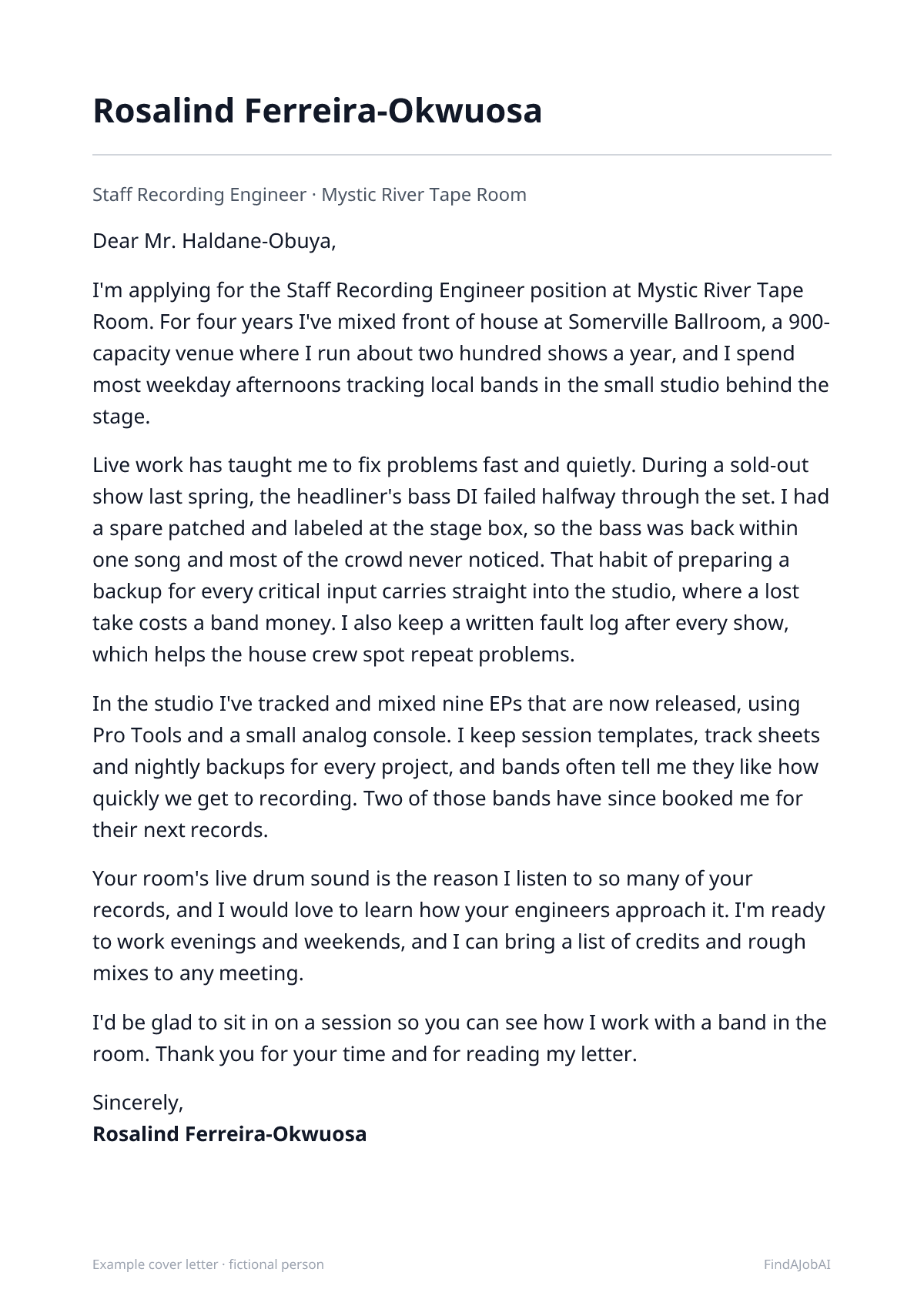
Dear Mr. Haldane-Obuya,
I'm applying for the Staff Recording Engineer position at Mystic River Tape Room. For four years I've mixed front of house at Somerville Ballroom, a 900-capacity venue where I run about two hundred shows a year, and I spend most weekday afternoons tracking local bands in the small studio behind the stage.
Live work has taught me to fix problems fast and quietly. During a sold-out show last spring, the headliner's bass DI failed halfway through the set. I had a spare patched and labeled at the stage box, so the bass was back within one song and most of the crowd never noticed. That habit of preparing a backup for every critical input carries straight into the studio, where a lost take costs a band money. I also keep a written fault log after every show, which helps the house crew spot repeat problems.
In the studio I've tracked and mixed nine EPs that are now released, using Pro Tools and a small analog console. I keep session templates, track sheets and nightly backups for every project, and bands often tell me they like how quickly we get to recording. Two of those bands have since booked me for their next records.
Your room's live drum sound is the reason I listen to so many of your records, and I would love to learn how your engineers approach it. I'm ready to work evenings and weekends, and I can bring a list of credits and rough mixes to any meeting.
I'd be glad to sit in on a session so you can see how I work with a band in the room. Thank you for your time and for reading my letter.
Sincerely,
Rosalind Ferreira-Okwuosa
Example 2 · Career changer
IT support technician moving into live sound
Benedikt spent five years in IT support and runs weekend sound for a church and a theater. The ad is for a junior audio engineer at an event company.
Example letter · fictional
Dear Ms. Varga-Ellingsworth,
I'm writing to apply for the Junior Audio Engineer role at Neponset Stage and Event Services. I've spent five years in IT support for a hospital network, and for the last four years I've run sound every weekend for a large church and a community theater.
The two worlds overlap more than people think. Modern audio runs on networks, and at the theater I set up our Dante system, assigned addresses and fixed a clock problem that had caused random clicks for months. The theater's board later asked me to document the system so volunteers could run it. My IT work made that a short job, because tracing a fault through a network is something I do every week.
On the mixing side, I run a sixteen-channel console for weekly services and mix six theater productions a year with up to twenty wireless microphones. I build cue lists with the director, label every channel and keep spare batteries charted by scene. Last season we finished every performance without a dead microphone. The director now asks me to help plan sound from the first rehearsal.
I know I'm new to paid event work. I haven't mixed large corporate shows or toured, and I expect to learn a great deal about rigging and bigger systems from your senior crew. I'm calm under pressure, careful with gear and happy to load in at any hour. I can also help your team with network setup, since that is where my IT background is strongest.
I would welcome the chance to help on a show day so you can see how I work. Thank you for considering my background.
Best regards,
Benedikt Oyelowo-Sandström
Example 3 · Senior or lead
Senior engineer applying to run a broadcast audio department
Augustin has twelve years in studio and broadcast audio and leads mixing at a post house. The ad is for a chief audio engineer at a regional public broadcaster.
Example letter · fictional
Dear Dr. Castellanos-Rowe,
I'm applying for the Chief Audio Engineer position at Pioneer Valley Public Media. I've worked in studio and broadcast audio for twelve years, the last five as lead mixer at Harborlight Post, where I mix documentaries and series for national broadcasters and streaming services.
When I joined Harborlight, about one in four of our deliveries came back from network QC, mostly for loudness and channel layout errors. I built delivery templates for each broadcaster, added a loudness check to every export and wrote a one-page checklist for the team. Within a year, rejections had become rare, and producers stopped budgeting days for fixes. The templates are still in use by engineers who joined after me.
I also helped move our three mix rooms onto a shared Dante network, which let any engineer pick up a project in any room. That project taught me to plan downtime with producers, test thoroughly and document everything so others can support the system.
Running a whole broadcast department would be a step up. I've led a small team and handled equipment budgets, but I haven't managed union scheduling or an on-air radio operation. I would spend my first weeks with each shift, learn where the pain points are and agree priorities with you before changing workflows. I would also want to meet the station's producers, since they are the department's main clients.
Your recent investment in local documentary work is a big reason for my interest, and I'd welcome a conversation about where you want the department to go over the next few years. I can provide references from two broadcasters I deliver to regularly.
Sincerely,
Augustin Mbatha-Lindholm
All three letters, and the short version below, are fictional: the people, employers and numbers are invented. Borrow the structure, never the facts.
- Prefer to write it yourself? Use the free cover letter template.
- Check your CV against the job first: the free CV score shows the missing keywords.
Why the first letter works, paragraph by paragraph
Paragraph 1: Opening
States the venue, its size and the yearly show count, plus studio work, so the reader sees both live and recording experience at once.
Paragraph 2: Live fix story
Shows preparation and calm: a labeled spare at the stage box turned a failure into a short gap, which studio managers value too.
Paragraph 3: Studio credits
Gives released projects and working habits like templates and backups, proving the applicant can run a studio session.
Paragraph 4: Fit with the studio
Names a specific sound the studio is known for and offers credits, which is more convincing than general praise.
Paragraph 5: Close
Offers to sit in on a session, a practical next step that suits how studios hire.
What the career changer's letter does differently
The career changer's letter links IT network skills to Dante audio and shows real weekend mixing with counts and outcomes. It is honest about missing large-show experience and offers to help on a show day.
What the senior letter does differently
A chief engineer letter moves from mixing to running a department: a QC problem solved for the whole team, a shared network built and documented, and an honest note about the parts of broadcast operations that would be new.
Short sound engineer cover letter: an email-ready version
Many applications arrive as an email or a small text box, and a full page doesn't fit. This version runs 120 to 150 words and keeps only what a reader needs to decide whether to reply. A podcast audio engineer emails a production company owner who posted a freelance mixing opening and asked for a short note.
Short version · email · fictional126 words
Subject: Podcast Mix Engineer – 300 episodes mixed, iZotope RX – Henrietta Okafor-Bjornstad
Hi Mr. Delgado-Farnsworthy,
I'm writing about the freelance mix engineer opening for your narrative shows. Over three years I've edited and mixed about three hundred podcast episodes, from interview shows to scripted series.
Much of my work is rescuing difficult tape. Last year a client recorded a key interview in a noisy café, and I cleaned it with iZotope RX and careful editing so the episode aired without a re-record. I deliver to -16 LUFS with clean stems and clear file names, and I keep every project archived for a year after delivery.
My reel and credits are linked below. I can take a test episode this week if that helps, so you can hear my work on your format before deciding.
Kind regards,
Henrietta Okafor-Bjornstad
The short version suits a busy producer: volume and formats first, one rescue story with the tool used, then a delivery spec and an offer to take a test episode.
Opening lines that work for sound engineer cover letters
The first sentence decides whether the second gets read. Here are six openings, one for each situation you might be in. Pick the one that matches yours and swap in your own facts: every name and number below is invented.
1. You have a standout result
After mixing about two hundred shows a year at a 900-capacity venue, I'd like to bring that speed and calm to your recording rooms.
2. The ad names a problem you've solved
Your posting asks for an engineer who can keep sessions moving. Preparing a backup for every critical input is how I've done that on stage and in the studio.
3. Someone referred you
Your senior engineer, Lucinda Abernethy-Tsegaye, suggested I apply after I assisted her on a live album recording last summer.
4. You admire what they build
Five years of IT support and four years of weekend mixing have prepared me to move into professional live audio.
5. You're new to the field or switching into it
As a lead mixer who cut broadcast QC rejections to a rare event, I'm ready to run an audio department.
6. You have senior scope or a specialism
Your studio's live drum sound is the reason I've studied your records closely for years.
How to write a sound engineer cover letter
Five steps, in the order you'd write them. The shape stays the same for every job (a short opening, proof, a reason for this employer, a close), and what goes into each part is what changes with the role.
Lead with setting and gear
Say whether you work in a studio, venue, broadcaster or post house, and name the consoles and DAWs you run every week. A hiring manager can then judge quickly whether you could take a session or show without weeks of extra training.
Give volume and credits
Mention how many sessions, shows or episodes you handle and point to released credits. Numbers show you can keep pace, and credits let the reader hear your work before the interview. Be exact about your role on each credit.
Tell one story about a failure you fixed
Pick one moment when something failed, such as a cable, a network or a noisy recording, and explain how you fixed it quickly. Calm, prepared problem solving is what employers fear losing most when an engineer leaves.
Connect to their sound
Mention a record, program or event the employer produced and what you noticed about its sound. This shows genuine interest and listening skill, and it gives the interviewer an easy first question to ask you.
Offer to sit in or mix a test
Studios and event companies often hire after seeing you work. Offer to sit in on a session, help on a show day or mix a test track, and link a short reel so the reader can listen right away.
Sound Engineer cover letter do's and don'ts
Do
- Name your setting, consoles and DAWs in the first paragraph.
- Give a count of sessions, shows or released credits.
- Tell one short story about fixing a problem before anyone noticed.
Don't
- Don't attach large audio files; link a short reel or credits list instead.
- Don't list every plugin you own; focus on skills a show or session needs.
- Don't share unreleased client material without permission.
Common sound engineer cover letter mistakes
Each one is easy to make and quick to fix before you send the letter.
Writing a gear catalog
A long list of equipment says little. Show how you used a few key tools to deliver a result.
No way to hear your work
Always link a short reel or credits list, and say what your role was on each project.
Overclaiming credits
Be exact about whether you tracked, mixed, assisted or mastered. Studios check, and small worlds talk.
Staying silent on late nights and weekends
Audio work runs late and on weekends. Say clearly when you can work so the reader can plan.
Email subject lines for sound engineer applications
Applying by email? Put the job title, any reference number and your name in the subject line.
- Staff Recording Engineer – 4 years FOH plus 9 released EPs – Rosalind Ferreira-Okwuosa
- Junior Audio Engineer – IT technician with Dante and live mixing – Benedikt Oyelowo-Sandström
- Chief Engineer – 12 years studio and broadcast audio – Augustin Mbatha-Lindholm
Everything for Sound Engineers
- Sound Engineer resume exampleA full resume, plus bullet and summary examples
- Sound Engineer interview questions30 questions with sample answers
- Sound Engineer job descriptionDuties, skills and requirements
- Career change cover letter: template + examples
Other cover letter examples
Sound Engineer cover letter FAQ
What should a sound engineer cover letter include?
Your setting, the consoles and DAWs you run, how many sessions or shows you handle, one problem-solving story and a link to credits or a reel. Keep it to one page.
How do I write a sound engineer cover letter with no experience?
Lead with your training and any volunteer, church, theater or student work. Give counts of events and channels, name the gear you used and say what you still want to learn.
Should I include a portfolio link in a sound engineer cover letter?
Yes. Add a link to a short reel or credits list near your signature and say what you did on each item, such as tracking, mixing or live sound.
How we built this page
The FindAJobAI team wrote the three example letters, the short email version, the opening lines and the advice for sound engineer roles. The people, employers and numbers in the letters are invented; the structure, the kind of evidence and the order of the paragraphs are the parts to copy.
Once we track enough live sound engineer job ads, this page also shows the skills they ask for most, counted the same way as our in-demand skills report.
Last reviewed on November 1, 2026.