Supply Chain Manager Cover Letter Example (2026)
By FindAJobAI team Updated How we built this page
Supply chain manager ads tend to ask for the same tools: an ERP system, forecasting experience, vendor management. The cover letter is where you name the disruption you planned around, the cost or lead time you cut, and the teams who depended on your call.
Supply Chain Manager cover letter template
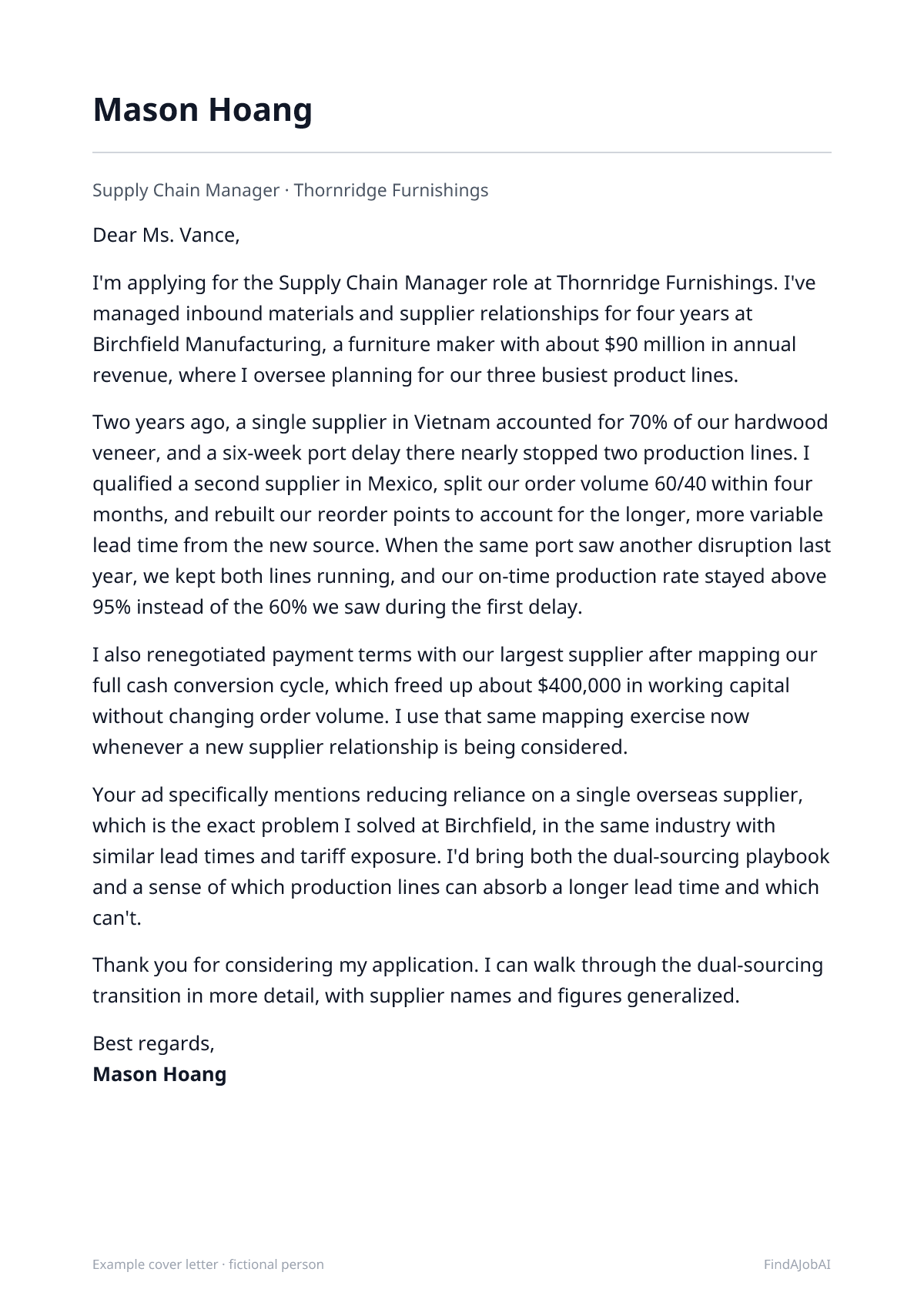
This letter as a one-page template: an opening that names the job and your strongest fact, proof that answers the ad, a reason for this employer and a short close.
After you sign up, FindAJobAI drafts your own letter for a real job from your CV in this format, and you edit it before you send it.
Example 1 · Experienced
Supply chain manager applying to a furniture manufacturer
Mason manages inbound materials and a key supplier relationship at a mid-size manufacturer. The ad mentions reducing reliance on a single overseas supplier.
Example letter · fictional
Dear Ms. Vance,
I'm applying for the Supply Chain Manager role at Thornridge Furnishings. I've managed inbound materials and supplier relationships for four years at Birchfield Manufacturing, a furniture maker with about $90 million in annual revenue, where I oversee planning for our three busiest product lines.
Two years ago, a single supplier in Vietnam accounted for 70% of our hardwood veneer, and a six-week port delay there nearly stopped two production lines. I qualified a second supplier in Mexico, split our order volume 60/40 within four months, and rebuilt our reorder points to account for the longer, more variable lead time from the new source. When the same port saw another disruption last year, we kept both lines running, and our on-time production rate stayed above 95% instead of the 60% we saw during the first delay.
I also renegotiated payment terms with our largest supplier after mapping our full cash conversion cycle, which freed up about $400,000 in working capital without changing order volume. I use that same mapping exercise now whenever a new supplier relationship is being considered.
Your ad specifically mentions reducing reliance on a single overseas supplier, which is the exact problem I solved at Birchfield, in the same industry with similar lead times and tariff exposure. I'd bring both the dual-sourcing playbook and a sense of which production lines can absorb a longer lead time and which can't.
Thank you for considering my application. I can walk through the dual-sourcing transition in more detail, with supplier names and figures generalized.
Best regards,
Mason Hoang
Example 2 · Career changer
Warehouse supervisor moving into supply chain management
Renata fixed a recurring stockout problem using data before she had a planning title. The ad mentions demand forecasting and coordination with sales.
Example letter · fictional
Dear Hiring Manager,
I'm applying for the Supply Chain Analyst role at Castlebridge Distribution. For five years I've supervised a 40-person warehouse team for a regional grocery distributor, and the work that pushed me toward supply chain planning was a stockout problem I solved mostly on my own.
Our fastest-moving products were going out of stock almost every week, and the standing explanation was unreliable trucking. I pulled two years of order history into Excel, built a simple weekly forecast by product, and compared it against our actual reorder timing. The real problem was that reorder points hadn't been updated since a 20% volume increase the year before. I proposed new reorder points to our planning team, and stockouts on our top 50 SKUs fell from an average of six per week to one.
Since then I've completed a supply chain management certificate through APICS/ASCM and started learning the demand planning module in our ERP system, which our planners use but our warehouse team never touches. I'm comfortable with Excel-based forecasting and I understand the warehouse floor constraints that planning decisions run into.
Your posting mentions demand forecasting and coordination with sales on promotions. I've seen firsthand how a promotion that isn't communicated to the warehouse in time creates a stockout days later, so I'd bring both the forecasting instinct and an operator's sense of what breaks on the floor when a plan changes late.
Thank you for your time. I'd welcome the chance to discuss the reorder point project in more detail.
Kind regards,
Renata Alves
Example 3 · Senior or lead
Director of supply chain applying to oversee a multi-site network
Harold runs supply chain for three distribution centers at an electronics company. The ad is for a director of a network combined after an acquisition.
Example letter · fictional
Dear Ms. Fairweather,
I'm applying for the Director of Supply Chain role at Calderwood Electronics. For the last four years I've overseen supply chain planning across three distribution centers at Ridgeline Devices, and before that I managed a single site for six years. I'd like to bring that multi-site experience to a network that's newly combined after an acquisition.
Your ad mentions integrating two supply chain teams with different systems and no shared inventory visibility. Ridgeline faced a similar problem after acquiring a competitor two years ago, with two separate ERP instances and warehouse teams that didn't trust each other's numbers. I led the migration to a single ERP instance, built a shared inventory dashboard both teams could see in real time, and standardized our reorder logic across all three sites. Total inventory carrying cost fell 12% in the first year, mostly from eliminating duplicate safety stock neither team realized the other was also holding.
A director earns trust by making tradeoffs visible across sites, not just within one. When one site wanted to keep a higher safety stock than the network model recommended, I showed them the actual stockout history behind the recommendation, and we agreed on a compromise level that held through the next two peak seasons without a single site-level stockout.
I've built out planning teams at two of our three sites, but I haven't yet managed a network with international distribution centers, which your ad mentions for the APAC facility. I'd want to learn the customs and freight forwarding details there carefully, likely leaning on your current logistics lead.
A conversation about which systems and processes you're most concerned about reconciling first between the two legacy teams would be a good place to start.
Sincerely,
Harold Mensah
All three letters, and the short version below, are fictional: the people, employers and numbers are invented. Borrow the structure, never the facts.
- Prefer to write it yourself? Use the free cover letter template.
- Check your CV against the job first: the free CV score shows the missing keywords.
Why the first letter works, paragraph by paragraph
Paragraph 1: Opening
Names the scope (inbound materials, supplier relationships) and the business's size. Supply chain hires are judged on what they were responsible for, so scope matters before any story.
Paragraph 2: The disruption and the fix
A clear risk (70% single-source dependency), the action (qualifying a second supplier, splitting volume), and the proof it worked when a second disruption hit, measured in on-time production rate.
Paragraph 3: A financial result
Renegotiating payment terms and freeing working capital shows the writer thinks beyond logistics into cash flow, which separates a manager from a coordinator.
Paragraph 4: Why this company
Mirrors the ad's stated goal (reducing single-supplier reliance) and ties it to direct, recent, same-industry experience.
Paragraph 5: Close
Offers to go deeper on the transition with details generalized, a concrete next step that respects supplier confidentiality.
What the career changer's letter does differently
The career changer's letter starts from a stockout problem solved with warehouse data before the job title, with a measurable result (six stockouts a week down to one). A certificate and hands-on ERP learning show the planning skills are being built formally, and the letter connects warehouse-floor experience directly to the ad's forecasting and sales-coordination needs.
What the senior letter does differently
A director letter reports network-level habits: an ERP migration across sites, inventory carrying cost down 12 percent, a cross-site conflict resolved with stockout data instead of authority. The example shows the writer managing a merger integration, and the gap, international distribution, is named directly.
Short supply chain manager cover letter: an email-ready version
Many applications arrive as an email or a small text box, and a full page doesn't fit. This version runs 120 to 150 words and keeps only what a reader needs to decide whether to reply. A supply chain manager answers a food distributor's short online application form, sent as an email because the portal's resume parser kept failing.
Short version · email · fictional130 words
Subject: Supply Chain Manager application – cold chain and vendor consolidation – Felix Dagher
Hello Mr. Okafor,
I'm applying for the Supply Chain Manager role at Mornington Foods. I've managed inbound logistics and vendor relationships for a frozen foods distributor for four years, most recently consolidating a fragmented vendor base for cold storage.
We were using six regional cold storage vendors with inconsistent rates and service levels. I consolidated to two vendors with volume-based contracts, standardized our temperature monitoring requirements across both, and cut cold storage costs by 18% while reducing temperature excursion incidents from an average of four per month to under one.
Cold chain reliability is where I do my strongest work, and I'd like to bring that focus to your distribution network. My resume is attached, and I can share the vendor consolidation details with contract terms generalized.
Best,
Felix Dagher
A short application keeps one vendor consolidation project and its two clearest results, cost and reliability, since a cold chain employer will recognize both immediately. Offering generalized contract details signals discretion without slowing down a fast online form.
Opening lines that work for supply chain manager cover letters
The first sentence decides whether the second gets read. Here are six openings, one for each situation you might be in. Pick the one that matches yours and swap in your own facts: every name and number below is invented.
1. You have a standout result
One vendor consolidation project I led last year cut cold storage costs by 18% and cut temperature excursions from four a month to under one. I'd like to bring that same focus to your distribution network.
2. The ad names a problem you've solved
Your ad says the network is dealing with inconsistent service levels across regional vendors. I solved a similar problem at my current company by consolidating to two vendors with standardized contracts, and I'd like to look at whether the same approach fits here.
3. Someone referred you
Your operations director, Teodora Ilić, worked with me for two years on a supplier transition from the planning side. She mentioned you need someone who can manage a dual-sourcing project end to end, which is exactly what prompted this application.
4. You admire what they build
I've tracked your company's product availability as a category manager for a retail partner for two years, and the consistency of your fill rates made me curious about the planning behind them; I'd like to help maintain that from the inside.
5. You're new to the field or switching into it
I spent five years supervising a warehouse floor before I taught myself forecasting to fix a recurring stockout problem. Supply chain planning is where I'd like to keep solving problems like that, with more influence over the plan itself.
6. You have senior scope or a specialism
As supply chain manager for a $90 million manufacturer for four years, I built the dual-sourcing playbook the company still uses after a near-shutdown from a single supplier's delay. I'm looking for a network where I can apply that at a larger scale.
How to write a supply chain manager cover letter
Five steps, in the order you'd write them. The shape stays the same for every job (a short opening, proof, a reason for this employer, a close), and what goes into each part is what changes with the role.
Identify the risk this ad is really about
Read between the lines for what's at stake: a single-source dependency, a demand forecasting gap, rising freight costs, or a merger integration. Then pick a story from your experience where you managed that same kind of risk, even in a different industry.
Open with the disruption, not your job title
State what went wrong or almost went wrong, in one or two sentences, before naming your role. A reader who sees a real operational risk in your opening keeps reading past the title and years of experience.
Show the decision, not just the process you followed
Describe the specific call you made, qualifying a second supplier, changing reorder points, consolidating vendors, and who you had to convince to make it happen. Process descriptions without a decision read as job description, not experience.
Quantify the operational and financial result together
Tie your story to both an operational metric (on-time rate, stockouts, lead time) and a financial one (cost, working capital, carrying cost) when you can. Avoid listing systems implemented without a result attached. If a result is still unfolding, say what you're tracking and when you'll know.
Name the cross-functional coordination
Mention how you worked with sales, production or finance when a supply decision affected them, and how you handled disagreement. Close with a question about the employer's network or supplier base, so the reader sees what you'd investigate first.
Supply Chain Manager cover letter do's and don'ts
Do
- Name the risk or disruption you managed (a supplier delay, a demand spike, a cost increase) and the metric that proved your fix worked.
- Mention the systems the ad names (an ERP, a forecasting tool, an EDI setup) inside a specific story about using them.
- Show how you coordinated with another function, sales, production or finance, and what changed because of that coordination.
Don't
- Don't call yourself a "results-driven supply chain professional"; show it with one disruption you planned around.
- Don't count the number of suppliers or SKUs you manage; one relationship that prevented a stockout or cut cost beats a long list.
- Don't share confidential supplier pricing or contract terms from your current employer; use percentages or generalized figures.
Common supply chain manager cover letter mistakes
Each one is easy to make and quick to fix before you send the letter.
Describing systems implemented, not problems solved
'Implemented a new ERP module' tells the reader about a project, not a result. Say what the module let you see or do that you couldn't before, and what changed because of it.
Leaving a cost or rate claim without a baseline
'Reduced freight costs' means little without the starting point and the time frame. State the before, the after, and what caused the change, so the claim can be checked.
Treating a single disruption as proof of a repeatable skill
One supplier crisis handled well is a good story, but claiming broad risk management expertise from it overreaches. Show the fix held up over time, such as surviving a second disruption, or describe more than one instance.
Skipping the industry's actual constraints
A letter that could apply to any distribution network misses the chance to show relevant judgment. Name what makes this industry's supply chain hard, such as cold chain, tariffs, or seasonal demand spikes, and how you've handled it.
Writing 'strong communicator across departments' as a claim
Every applicant for a planning role writes some version of this. Replace it with the specific disagreement you resolved between two departments and how the data settled it.
Email subject lines for supply chain manager applications
Applying by email? Put the job title, any reference number and your name in the subject line.
- Supply Chain Manager application – dual-sourcing and furniture manufacturing – Mason Hoang
- Supply Chain Analyst – warehouse background, reorder point project – Renata Alves
- Application: Supply Chain Manager, Procurement (Req. 3317) – Mason Hoang
Everything for Supply Chain Managers
- Supply Chain Manager resume exampleA full resume, plus bullet and summary examples
- Supply Chain Manager interview questions30 questions with sample answers
- Supply Chain Manager job descriptionDuties, skills and requirements
- Career change cover letter: template + examples
Other cover letter examples
Supply Chain Manager cover letter FAQ
What should I write in a supply chain manager cover letter?
One disruption or risk you managed: what could have gone wrong, what you did (a second supplier, new reorder points, a renegotiated contract), and the result in the business's own metric. Your ERP and forecasting skills belong on your resume.
How do I write a supply chain manager cover letter with no direct title?
Use a warehouse, logistics or procurement role where you solved a planning or supplier problem with data, then name the result. Add a certificate such as APICS/ASCM to show the skills are becoming formal.
Should a supply chain manager cover letter mention specific suppliers?
Name the country, region or type of supplier rather than the company itself if the relationship is still active with a current employer. The decision and result matter more than the supplier's name.
How we built this page
The FindAJobAI team wrote the three example letters, the short email version, the opening lines and the advice for supply chain manager roles. The people, employers and numbers in the letters are invented; the structure, the kind of evidence and the order of the paragraphs are the parts to copy.
Once we track enough live supply chain manager job ads, this page also shows the skills they ask for most, counted the same way as our in-demand skills report.
Last reviewed on November 1, 2026.