Technical Program Manager Cover Letter Example (2026)
By FindAJobAI team Updated How we built this page
Technical program manager ads blur together because most list the same tools: Jira, a roadmap, cross-functional stakeholders. The letter earns attention when it names a program that was actually at risk, the dependency or disagreement that threatened it, and how the writer got it back on track.
Technical Program Manager cover letter template
This letter as a one-page template: an opening that names the job and your strongest fact, proof that answers the ad, a reason for this employer and a short close.
After you sign up, FindAJobAI drafts your own letter for a real job from your CV in this format, and you edit it before you send it.
Example 1 · Experienced
platform TPM applying to a logistics software company
Dorin runs a multi-team migration at a routing software company. The ad asks for dependency management across three engineering orgs.
Example letter · fictional
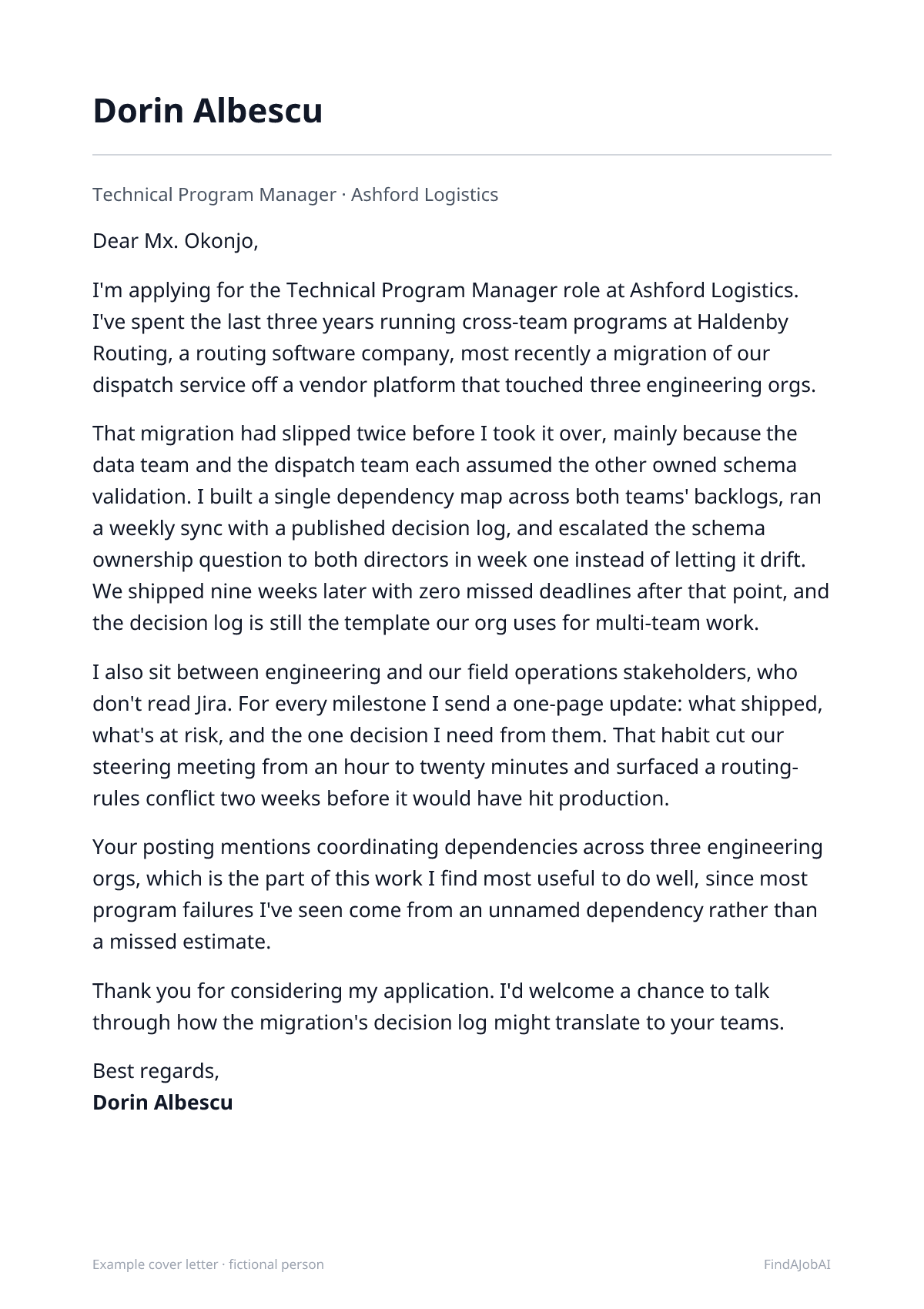
Dear Mx. Okonjo,
I'm applying for the Technical Program Manager role at Ashford Logistics. I've spent the last three years running cross-team programs at Haldenby Routing, a routing software company, most recently a migration of our dispatch service off a vendor platform that touched three engineering orgs.
That migration had slipped twice before I took it over, mainly because the data team and the dispatch team each assumed the other owned schema validation. I built a single dependency map across both teams' backlogs, ran a weekly sync with a published decision log, and escalated the schema ownership question to both directors in week one instead of letting it drift. We shipped nine weeks later with zero missed deadlines after that point, and the decision log is still the template our org uses for multi-team work.
I also sit between engineering and our field operations stakeholders, who don't read Jira. For every milestone I send a one-page update: what shipped, what's at risk, and the one decision I need from them. That habit cut our steering meeting from an hour to twenty minutes and surfaced a routing-rules conflict two weeks before it would have hit production.
Your posting mentions coordinating dependencies across three engineering orgs, which is the part of this work I find most useful to do well, since most program failures I've seen come from an unnamed dependency rather than a missed estimate.
Thank you for considering my application. I'd welcome a chance to talk through how the migration's decision log might translate to your teams.
Best regards,
Dorin Albescu
Example 2 · Career changer
backend engineer moving into technical program management
Rebecca ran a cross-team release as an engineer before the title existed. The ad wants someone comfortable reading architecture docs.
Example letter · fictional
Dear Hiring Manager,
I'm applying for the Associate Technical Program Manager role at Kestrel Fintech. I've spent four years as a backend engineer at Mossgate Payments, and the part of my job I've grown to like best is the one without a ticket: getting three teams to agree on a plan and then keeping it honest.
Last year our ledger service needed a breaking API change that touched the mobile, reporting and risk teams, and no one was coordinating it. I wrote the migration plan myself, mapped which teams needed to move in what order, and ran biweekly check-ins to track it, since I understood the architecture well enough to know where it would break. We shipped on the date I set, with one risk-team slip of three days that I caught in a check-in before it affected the mobile team's release.
Being an engineer first means I can read a design doc and tell when a stated two-week dependency is actually a two-month one, and I know which questions make an engineer tell me the real risk instead of the optimistic one. I'm now looking to do that work full time rather than as an unpaid extra on top of a ticket queue.
Your posting asks for someone comfortable reading architecture docs and talking directly to engineers about tradeoffs, which is exactly how I ran the ledger migration, and I'd bring both that technical grounding and a genuine interest in the coordination work itself.
Thank you for your time. I'm glad to walk through the migration plan and what I'd do differently with more authority to set it.
Sincerely,
Rebecca Estrada
Example 3 · Senior or lead
senior TPM applying to lead a newly formed program org
Yusuke manages three TPMs at a cloud storage company. The ad is for a lead who will set up program management as a new discipline.
Example letter · fictional
Dear Ms. Fontayne,
I'm applying for the Senior Technical Program Manager role at Marlowick Cloud. I've managed a team of three TPMs at Dunstable Storage for the last two years, and before that spent five years running programs individually. I'd like to build a program management function from its first hire.
Your ad says engineering leadership currently tracks major programs in separate spreadsheets that disagree with each other by the time a program is halfway done. Dunstable had the same problem before I joined. I introduced one program intake process, a shared status format reviewed weekly across all active programs, and a rule that any program behind schedule got a named recovery plan within a week, not a vague note. Our on-time delivery for programs over one quarter long went from roughly half to nearly all within two quarters, and the format is still used for every program over six weeks.
Programs earn trust through recovered timelines, not status reports. When our storage-tier migration was six weeks from a hard compliance deadline and behind schedule, I found that two sub-teams were each waiting on the other for a spec, re-sequenced the work so neither blocked the other, and we hit the deadline with four days to spare. That re-sequencing is now how we open any program with a hard external date.
I've hired and coached all three TPMs on my team, but I haven't yet set up a program function from zero, including the intake and prioritization rules a growing team needs, and at Marlowick I'd expect to build that carefully with your engineering directors in the first quarter.
A conversation about which programs currently worry your leadership team most, and how they're tracked today, would be a good place to start.
Sincerely,
Yusuke Hamada
All three letters, and the short version below, are fictional: the people, employers and numbers are invented. Borrow the structure, never the facts.
- Prefer to write it yourself? Use the free cover letter template.
- Check your CV against the job first: the free CV score shows the missing keywords.
Why the first letter works, paragraph by paragraph
Paragraph 1: Opening
Names the specific program (a multi-team vendor migration) and how many orgs it touched, which tells the reader the scale of coordination the writer is used to.
Paragraph 2: The program that was at risk
States the real cause of the earlier slips (an unowned dependency), the fix (a dependency map, a weekly sync, early escalation), and the result in the program's own terms: zero missed deadlines after the handoff.
Paragraph 3: Working with non-technical stakeholders
The one-page update and the cut steering meeting show communication discipline, and naming a conflict caught early demonstrates the judgment a senior TPM is hired for.
Paragraph 4: Why this company
Mirrors the ad's own phrase about dependencies across three orgs and explains why that specific skill matters to the writer.
Paragraph 5: Close
Offers a concrete next step, the decision log, rather than a general statement of enthusiasm.
What the career changer's letter does differently
The engineer-to-TPM letter starts from a real cross-team migration run without the title, with a dated, measurable result (one three-day slip caught early rather than a clean story). It explains why engineering depth helps the coordination work, and ties that directly to the ad's own requirement.
What the senior letter does differently
A lead-level TPM letter reports an organization's habits, not a single project: one intake process, a status format used across every active program, and an on-time rate that moved. The compliance-deadline example shows the writer's judgment under real pressure, and the gap, building a function from zero, is named honestly.
Short technical program manager cover letter: an email-ready version
Many applications arrive as an email or a small text box, and a full page doesn't fit. This version runs 120 to 150 words and keeps only what a reader needs to decide whether to reply. A TPM answers a healthcare software company's short-form application after a referral mentioned the role was open.
Short version · email · fictional130 words
Subject: Technical Program Manager – cross-team releases – Odalys Marchetti
Hello Mr. Baptiste,
I'm applying for the Technical Program Manager role at Brightfern Health. I have four years running release programs at a clinical scheduling company, most recently coordinating a six-team rollout of a new intake workflow.
That rollout was behind schedule when I took it over because two teams were blocked on an unresolved data-ownership question. I escalated it in the first week, rebuilt the plan around the answer, and we shipped five weeks later with no missed team handoffs.
I'd like to bring that kind of early, direct escalation to Brightfern's release programs. My resume is attached, and I'm glad to share the recovery plan I used. I can also walk through how I run the weekly dependency review and what I escalate after it.
Best,
Odalys Marchetti
A short email keeps one program, the specific thing that was blocking it, and the dated result, cutting the broader resume of programs run in favor of a single clear example a referral or recruiter can act on quickly.
Opening lines that work for technical program manager cover letters
The first sentence decides whether the second gets read. Here are six openings, one for each situation you might be in. Pick the one that matches yours and swap in your own facts: every name and number below is invented.
1. You have a standout result
A six-team rollout I took over last year was five weeks behind because of an unresolved data-ownership question. I escalated it in week one, and we shipped on the revised date with no missed handoffs.
2. The ad names a problem you've solved
Your ad mentions engineering leadership tracking major programs in separate spreadsheets that disagree by delivery time. I replaced that setup with one shared status format at my current company, and it's still in use two years later.
3. Someone referred you
Your engineering director, Soraya Linde, worked with me on a platform migration two years ago, from the program side. She mentioned Marlowick was looking for someone who escalates early, which prompted this application.
4. You admire what they build
I've followed Brightfern's engineering blog for a year, and the way your team describes its release process made me want to help run it rather than just read about it.
5. You're new to the field or switching into it
I spent four years as a backend engineer before I started coordinating cross-team releases as an unofficial extra duty. Program management is where I'd like to keep doing that work, with the authority to do it properly.
6. You have senior scope or a specialism
As the TPM for platform migrations for six years, I've learned that most program failures trace back to one unnamed dependency. I'm looking for a role where I can set that discipline up from the start.
How to write a technical program manager cover letter
Five steps, in the order you'd write them. The shape stays the same for every job (a short opening, proof, a reason for this employer, a close), and what goes into each part is what changes with the role.
Find the program at risk this ad is hinting at
Ads for TPMs usually describe a symptom: missed dates, disagreeing teams, unclear ownership. Read for that symptom, then choose a program of yours with a similar cause, whether it was a dependency, a disagreement, or an unclear deadline, so the letter answers the actual hiring need.
Open with what was at risk, not your title
Say what was behind schedule or in conflict before you say who you are. A reader who sees a real program and a real risk in the first two sentences will keep reading to find out how it resolved, which is more useful than a sentence introducing your years of experience.
Name the mechanism you used, not just the outcome
'We shipped on time' is a claim. 'I built a dependency map and escalated the ownership question in week one' is a mechanism a hiring manager can picture using themselves. Pick one mechanism per program and describe it in one or two sentences.
Quantify the recovery, not the activity
Tie the program to a dated result: shipped by a specific deadline, a missed-handoff count, a time saved in a recurring meeting. Avoid counting meetings run or documents written. If the program is still active, describe what changed in how the team now works.
Show how you handle non-technical stakeholders
One sentence on your update cadence or format, and what it replaced. Close with a specific question about how the company tracks programs today, so the reader sees exactly what you'd investigate first if hired.
Technical Program Manager cover letter do's and don'ts
Do
- Name the program, how many teams or orgs it touched, and the dependency or disagreement that put it at risk.
- State the fix you used (a dependency map, a decision log, an escalation) and the dated result, not just that the program 'shipped on time.'
- Show how you communicate to non-engineering stakeholders: one artifact, one cadence, one example of what it changed.
Don't
- Don't describe yourself as a 'natural organizer' or 'detail-oriented'; show one program you kept from slipping.
- Don't list every tool (Jira, Asana, Confluence, Smartsheet) without attaching one to a specific program.
- Don't take sole credit for engineering decisions that weren't yours; credit the teams and name your own contribution precisely.
Common technical program manager cover letter mistakes
Each one is easy to make and quick to fix before you send the letter.
Describing meetings instead of outcomes
'Ran weekly cross-team syncs' says nothing about whether the program shipped. Say what the syncs caught or changed, and what happened to the timeline as a result.
Taking credit for engineering decisions
A TPM letter that reads like an engineering letter raises doubt. Credit the engineers for the technical call and describe precisely what you did: the sequencing, the escalation, the plan.
Vague claims about being 'on time'
State the original date, what threatened it, and the date you actually hit. A program that slipped once and recovered is more credible than one that supposedly never slipped at all.
Listing tools without a program attached
Naming Jira, Confluence and Smartsheet in a row shows nothing. Attach the one tool the ad mentions to the specific program where you used it, and say what it was tracking.
Writing 'strong communicator' as a claim
Every TPM applicant writes this. Replace it with the one artifact you use, such as a one-page update or a decision log, and what it changed about how a stakeholder meeting ran.
Email subject lines for technical program manager applications
Applying by email? Put the job title, any reference number and your name in the subject line.
- Technical Program Manager application – multi-team migrations – Dorin Albescu
- Associate TPM – backend engineer with cross-team release experience – Rebecca Estrada
- Application: Senior TPM, Platform (Req. 2240) – Dorin Albescu
Everything for Technical Program Managers
- Technical Program Manager resume exampleA full resume, plus bullet and summary examples
- Technical Program Manager interview questions30 questions with sample answers
- Technical Program Manager job descriptionDuties, skills and requirements
- Career change cover letter: template + examples
Other cover letter examples
Technical Program Manager cover letter FAQ
What should I write in a technical program manager cover letter?
One program that was at risk: the dependency or disagreement behind it, how you resolved it, and the dated result. Then one sentence on how you keep non-technical stakeholders informed. Your tool list belongs on your resume, not here.
How do I write a technical program manager cover letter with no formal TPM title?
Use a cross-team effort you coordinated as an engineer, designer or analyst: who was involved, what you planned, and what shipped. Say plainly that you're moving into the title, and let the story carry the qualification.
Should a TPM cover letter mention specific tools like Jira or Confluence?
Only inside an example, and only the one the ad names if it names one. A tool attached to a real program reads as fluency; a list of tools on its own reads as a resume you've already submitted.
How we built this page
The FindAJobAI team wrote the three example letters, the short email version, the opening lines and the advice for technical program manager roles. The people, employers and numbers in the letters are invented; the structure, the kind of evidence and the order of the paragraphs are the parts to copy.
Once we track enough live technical program manager job ads, this page also shows the skills they ask for most, counted the same way as our in-demand skills report.
Last reviewed on November 1, 2026.