Technical Writer Cover Letter Example (2026)
By FindAJobAI team Updated How we built this page
Technical writer ads often ask for a writing sample before anything else, so the cover letter's job is to point at the right one and explain what you did to make it clear. Name the audience you wrote for, the tool you worked in, and a confusion your docs removed.
Technical Writer cover letter template
This letter as a one-page template: an opening that names the job and your strongest fact, proof that answers the ad, a reason for this employer and a short close.
After you sign up, FindAJobAI drafts your own letter for a real job from your CV in this format, and you edit it before you send it.
Example 1 · Experienced
Senior technical writer applying to a developer tools company
Owen writes API reference and guides for a payments platform. The ad asks for someone who can work directly with engineers and cut support load.
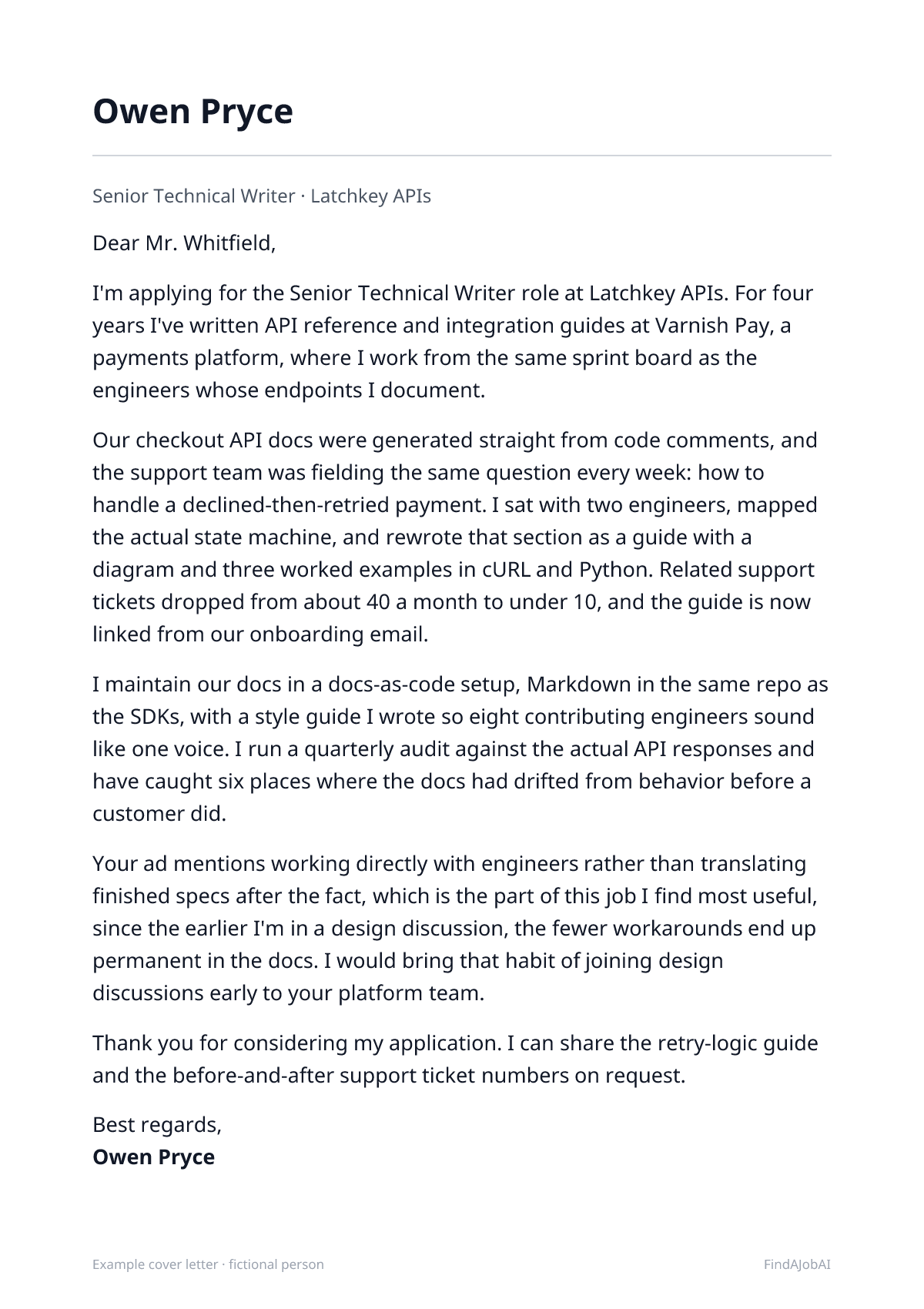
Example letter · fictional
Dear Mr. Whitfield,
I'm applying for the Senior Technical Writer role at Latchkey APIs. For four years I've written API reference and integration guides at Varnish Pay, a payments platform, where I work from the same sprint board as the engineers whose endpoints I document.
Our checkout API docs were generated straight from code comments, and the support team was fielding the same question every week: how to handle a declined-then-retried payment. I sat with two engineers, mapped the actual state machine, and rewrote that section as a guide with a diagram and three worked examples in cURL and Python. Related support tickets dropped from about 40 a month to under 10, and the guide is now linked from our onboarding email.
I maintain our docs in a docs-as-code setup, Markdown in the same repo as the SDKs, with a style guide I wrote so eight contributing engineers sound like one voice. I run a quarterly audit against the actual API responses and have caught six places where the docs had drifted from behavior before a customer did.
Your ad mentions working directly with engineers rather than translating finished specs after the fact, which is the part of this job I find most useful, since the earlier I'm in a design discussion, the fewer workarounds end up permanent in the docs. I would bring that habit of joining design discussions early to your platform team.
Thank you for considering my application. I can share the retry-logic guide and the before-and-after support ticket numbers on request.
Best regards,
Owen Pryce
Example 2 · Career changer
Technical support agent moving into technical writing
Priya wrote the internal knowledge base her support team actually used, without the title. The ad mentions help center articles and release notes.
Example letter · fictional
Dear Hiring Manager,
I'm applying for the Associate Technical Writer role at Hemlock Software. For three years I've worked technical support at a project management tool, and the part of that job I was best at was writing down the answer clearly enough that I never had to give it twice.
Our internal knowledge base was a dumping ground of half-finished notes, and new agents took weeks to get fast on tickets. I rewrote the 30 most-used articles as step-by-step guides with screenshots, added a short troubleshooting tree for our top five issues, and trained new hires on them. Average time to resolve a first ticket fell from about nine minutes to five, and two other support teams adopted my article template.
Since then I've completed a technical writing certificate, learned Markdown and basic Git, and built a portfolio with three samples: a rewritten help center article, a short API quickstart for a public API, and a set of release notes for a fictional app update, all linked on my resume.
Your posting mentions help center articles and release notes, which is exactly the kind of writing I've already been doing from the support side, just without the title. I understand where users get stuck because I've answered their tickets. Last quarter I drafted the customer-facing notes for two minor releases from the changelog and a short conversation with the product manager, and support saw fewer 'is this a bug?' tickets afterward.
Thank you for your time. I'd welcome the chance to walk through my portfolio samples with you.
Kind regards,
Priya Anand
Example 3 · Senior or lead
Documentation lead applying to build a first docs team
Grace manages three writers at a logistics software company. The ad is for a documentation lead who will set standards and grow the team.
Example letter · fictional
Dear Mr. Odom,
I'm applying for the Documentation Lead role at Ferrymark Logistics. For the last three years I've managed a team of three writers at Corvine Freight, a logistics software company, covering API docs, admin guides and release notes, and before that I spent five years as a senior writer.
Your ad says docs are scattered across a wiki, a help center and outdated PDFs, with no one owning consistency. Corvine had the same mess when I joined. I ran an audit of all 200-plus pages, retired or merged half of them, and moved the rest into one docs-as-code repo with a single style guide. New writer ramp-up time fell from about six weeks to two, and engineering support requests tagged "docs unclear" dropped by a third within two quarters.
Documentation earns its keep by changing what support and sales have to explain. When we launched a new routing feature, I noticed the beta docs assumed users already understood zone overlap, which they didn't; I added a worked example and a short video, and related onboarding calls for that feature fell by half. That walkthrough is now the template for every new feature launch.
I hired two of my three writers and run a monthly peer-review rotation so no one document has a single point of failure. I haven't yet managed a globalization or translation workflow, and at Ferrymark I'd want to set that up carefully with your localization vendor.
A conversation about which three support categories you'd most like better docs to shrink, and how writers currently get access to engineering, would be a good place to start.
Sincerely,
Grace Whitfield
All three letters, and the short version below, are fictional: the people, employers and numbers are invented. Borrow the structure, never the facts.
- Prefer to write it yourself? Use the free cover letter template.
- Check your CV against the job first: the free CV score shows the missing keywords.
Why the first letter works, paragraph by paragraph
Paragraph 1: Opening
Names the product area (API reference for a payments platform) and the working relationship with engineers. Technical writers are hired to document something specific, so naming it grounds the whole letter.
Paragraph 2: The confusion removed
A real support problem, the writer's actual process (sitting with engineers, mapping the state machine), and a measurable drop in tickets. This is the technical writer's version of a shipped feature.
Paragraph 3: Process and ownership
Docs-as-code, a style guide for other contributors, and a quarterly accuracy audit show the writer treats documentation as a maintained product, not a one-time task.
Paragraph 4: Why this company
Mirrors the ad's emphasis on working with engineers early and gives a concrete reason that matters to the writer, fewer permanent workarounds.
Paragraph 5: Close
Offers a specific writing sample tied to a result, which is more useful to a hiring manager than a general portfolio link.
What the career changer's letter does differently
The career changer's letter starts from real support work, rewriting the knowledge base that new agents actually used, with a measurable result (time to first resolution down from nine minutes to five). A certificate and three portfolio samples show the craft is now deliberate, and the letter ties support experience directly to the ad's own terms, help center articles and release notes.
What the senior letter does differently
A documentation lead letter reports a team's habits and a consolidation story: 200-plus pages audited, ramp-up time cut from six weeks to two, one style guide instead of scattered formats. The feature-launch example shows writing changing support load directly, and the gap, a translation workflow, is named plainly.
Short technical writer cover letter: an email-ready version
Many applications arrive as an email or a small text box, and a full page doesn't fit. This version runs 120 to 150 words and keeps only what a reader needs to decide whether to reply. A technical writer answers a cybersecurity company's short-form application question, sent as an email because the portal rejected the file format of their portfolio PDF.
Short version · email · fictional132 words
Subject: Technical Writer (API docs, Markdown) – portfolio attached – Theo Marsh
Hello Ms. Calloway,
I'm applying for the Technical Writer role at Ironleaf Security. I have four years of experience writing API reference and integration guides for a logging platform, maintained in Markdown alongside the engineering team's codebase.
My most useful project was rewriting our authentication guide after noticing it caused a third of our support tickets. I added a sequence diagram and two worked examples, and related tickets fell from about 25 a month to under 8 within a quarter.
Security products live or die on whether engineers trust the docs enough to skip calling support, and that's the kind of writing I want to keep doing. My portfolio is attached as a PDF this time, and I'm glad to send individual sample links if that's easier to review.
Best,
Theo Marsh
A short-form question forces one example, so this version keeps the authentication guide and its ticket drop, since security buyers care most about trustworthy docs. Offering sample links as a backup is a small, practical fix for the stated portal problem.
Opening lines that work for technical writer cover letters
The first sentence decides whether the second gets read. Here are six openings, one for each situation you might be in. Pick the one that matches yours and swap in your own facts: every name and number below is invented.
1. You have a standout result
One guide I rewrote last year, after noticing it caused a third of our support tickets, cut related tickets by two-thirds within a quarter. I'd like to do similar work on your API docs.
2. The ad names a problem you've solved
Engineers wait days for doc reviews, according to your ad. At my current company I moved docs into the same repo as the code, and review time for a doc change dropped from three days to same-day.
3. Someone referred you
Your engineering manager, Felix Ryu, has reviewed two of my pull requests on your public API docs as an open-source contributor. He suggested I apply, which prompted this letter.
4. You admire what they build
I've used your developer docs for two years to build against your API, and a few gaps I ran into myself made me curious about helping close them from the inside.
5. You're new to the field or switching into it
I worked technical support for three years, then taught myself Markdown and Git to fix our broken internal knowledge base. Technical writing is where I'd like to keep solving problems like that.
6. You have senior scope or a specialism
As lead writer for a developer platform for seven years, I wrote the style guide the team still follows. I'm looking for a role that sets documentation standards for a larger team.
How to write a technical writer cover letter
Five steps, in the order you'd write them. The shape stays the same for every job (a short opening, proof, a reason for this employer, a close), and what goes into each part is what changes with the role.
Identify who reads this documentation
Technical writer jobs differ by audience: developers calling an API, end users clicking through a product, or internal teams following a runbook. Read the ad for the audience it names, then pick a writing sample you have for a similar reader, in a similar format.
Open with the confusion you removed, not the doc type
Say what readers were getting wrong or asking repeatedly, and what you wrote to fix it, in one or two sentences. Mention the guide, reference page, or release note only after naming the problem it solved.
Quantify the effect on support or onboarding, not word count
Tie one piece of writing to a number: support tickets down, ramp-up time shortened, a release note that stopped a wave of questions. Avoid listing how many pages or articles you've written. If you can't measure the result, describe what readers stopped asking once the doc existed.
Name your tools and workflow in the context of one project
Work Markdown, Git, a docs-as-code pipeline, or a CMS into the story of what you built, and mention how you kept it accurate, such as a quarterly audit or a review step with engineers. Tools are credible when attached to a real document.
Show how you work with the people who hold the knowledge
One sentence on how you get information out of engineers or subject matter experts, pairing sessions, sitting in on sprint planning, or a standing review. Close by naming a document or gap you'd like to tackle first, so the reader sees what you'd work on in your first weeks.
Technical Writer cover letter do's and don'ts
Do
- Name the confusion or support ticket your writing resolved, then the number that moved because of it.
- Mention the tools the ad names (Markdown, Git, a docs-as-code setup, a CMS like MadCap or Confluence) inside an example.
- Point to one writing sample and say in a sentence what to notice in it, rather than linking a full portfolio with no guidance.
Don't
- Don't call yourself a "clear communicator who simplifies complex topics"; show one piece of writing that did that.
- Don't count pages or articles written; one guide that cut support tickets beats fifty pages nobody reads.
- Don't submit a sample under NDA from your current employer; use a public doc, a rewritten personal project, or a redacted excerpt.
Common technical writer cover letter mistakes
Each one is easy to make and quick to fix before you send the letter.
Describing writing output, not reader outcomes
'Wrote 40 help articles' tells the reader about volume. Say what readers stopped struggling with because of one article, and what that was worth in tickets or time. One fixed confusion beats a stack of pages.
Leaving tool names without a project attached
A list of Markdown, Git, MadCap Flare, Confluence and DITA suggests surface familiarity with each. Name the one the ad uses and describe the actual document you built in it, including its size and audience.
Submitting a portfolio link with no guidance
A bare link to ten samples asks the reader to guess what matters. Name one or two specific samples and say in a sentence what to notice, such as how you explained an error state or restructured a confusing procedure.
Writing as if the product doesn't matter
A letter that could apply to any software company misses the chance to show research. Name something specific about this product, its API, its users, or its support load, and what a writer could improve there.
Calling yourself a strong communicator without proof
Every applicant claims clarity. Replace the claim with one sentence describing a specific confusing topic you made clear, and for whom.
Email subject lines for technical writer applications
Applying by email? Put the job title, any reference number and your name in the subject line.
- Senior Technical Writer application – API docs and developer guides – Owen Pryce
- Associate Technical Writer – support background, writing portfolio attached – Priya Anand
- Application: Technical Writer, Platform Docs (Req. 2214) – Owen Pryce
Everything for Technical Writers
- Technical Writer jobs186 open roles, updated hourly
- Technical Writer salary in the United StatesAdvertised pay in real job ads
- Technical Writer resume exampleA full resume, plus bullet and summary examples
- Technical Writer interview questions30 questions with sample answers
- Technical Writer job descriptionDuties, skills and requirements
- Career change cover letter: template + examples
Other cover letter examples
Technical Writer cover letter FAQ
What should I write in a technical writer cover letter?
One piece of documentation you wrote, who it was for, and what changed because of it, fewer support tickets, faster onboarding, or an engineer who stopped answering the same question. Then a sentence on the tools or workflow you used. Point to one sample rather than a whole portfolio.
How do I write a technical writer cover letter with no experience?
Use adjacent writing, support articles, training materials, or documentation you wrote informally at another job, then add a certificate and one or two portfolio samples on a public or fictional product. Name the audience for each sample and what you simplified.
Should a technical writer include a writing sample link in the cover letter?
Yes, one or two, named specifically rather than a general portfolio link. Say in a sentence what to look at, such as how you structured a complex procedure or handled a messy API response.
How technical does a technical writer cover letter need to sound?
Technical enough to show you understood what you documented, a real API behavior, a workflow, an error state, but the letter itself should read plainly. If a non-technical hiring manager can follow your example, it's doing its job.
How we built this page
The FindAJobAI team wrote the three example letters, the short email version, the opening lines and the advice for technical writer roles. The people, employers and numbers in the letters are invented; the structure, the kind of evidence and the order of the paragraphs are the parts to copy.
Once we track enough live technical writer job ads, this page also shows the skills they ask for most, counted the same way as our in-demand skills report.
Last reviewed on November 1, 2026.