Title Examiner Cover Letter Example (2026)
By FindAJobAI Team Updated How we built this page
Title managers and underwriting counsel read title examiner cover letters for proof of accuracy at volume. A strong letter gives your weekly file count, the counties and property types you know, one defect you caught before it reached closing and how rarely your work needs correcting.
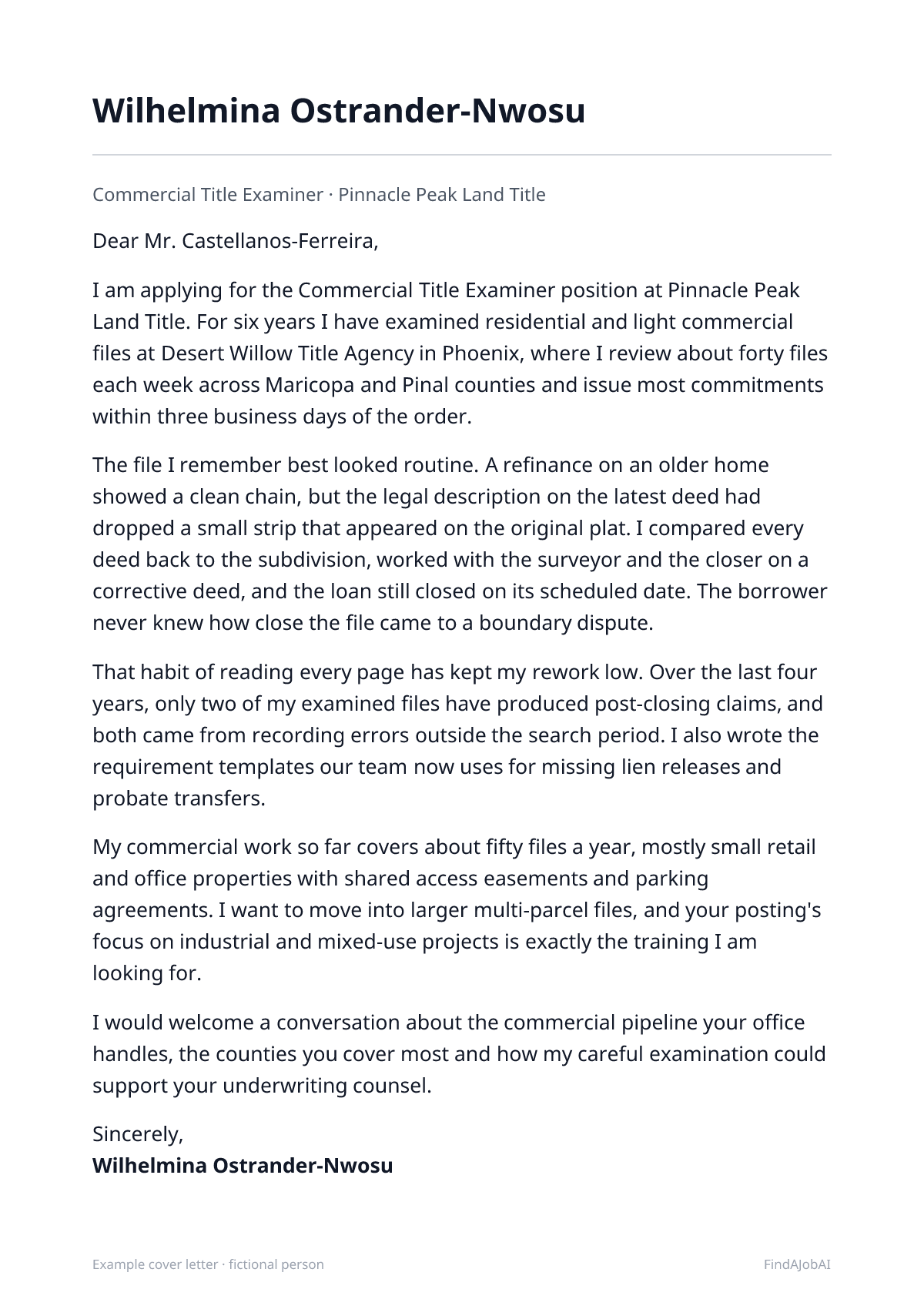
Title Examiner cover letter template
This letter as a one-page template: an opening that names the job and your strongest fact, proof that answers the ad, a reason for this employer and a short close.
After you sign up, FindAJobAI drafts your own letter for a real job from your CV in this format, and you edit it before you send it.
Example 1 · Experienced
Residential examiner applying for a commercial title role
Wilhelmina examines about forty residential files a week. The ad is for a commercial title examiner at a regional underwriter's direct office.
Example letter · fictional
Dear Mr. Castellanos-Ferreira,
I am applying for the Commercial Title Examiner position at Pinnacle Peak Land Title. For six years I have examined residential and light commercial files at Desert Willow Title Agency in Phoenix, where I review about forty files each week across Maricopa and Pinal counties and issue most commitments within three business days of the order.
The file I remember best looked routine. A refinance on an older home showed a clean chain, but the legal description on the latest deed had dropped a small strip that appeared on the original plat. I compared every deed back to the subdivision, worked with the surveyor and the closer on a corrective deed, and the loan still closed on its scheduled date. The borrower never knew how close the file came to a boundary dispute.
That habit of reading every page has kept my rework low. Over the last four years, only two of my examined files have produced post-closing claims, and both came from recording errors outside the search period. I also wrote the requirement templates our team now uses for missing lien releases and probate transfers.
My commercial work so far covers about fifty files a year, mostly small retail and office properties with shared access easements and parking agreements. I want to move into larger multi-parcel files, and your posting's focus on industrial and mixed-use projects is exactly the training I am looking for.
I would welcome a conversation about the commercial pipeline your office handles, the counties you cover most and how my careful examination could support your underwriting counsel.
Sincerely,
Wilhelmina Ostrander-Nwosu
Example 2 · Career changer
Title abstractor moving into examination
Thelonius has two years searching records for an abstract company. The ad is for an entry-level examiner at a title agency with training.
Example letter · fictional
Dear Ms. Lindenbaum-Afolayan,
I am writing to apply for the entry-level Title Examiner role at Copper Basin Title Group. For two years I have worked as a title abstractor at an abstract company in Tucson, searching about thirty-five residential properties each week in county recorder, court and tax records.
Searching has already taught me where problems hide. I flag name variations, missing releases and judgments against owners with common names, and the examiners I work with now ask me to note likely requirements on each package. Last autumn I spotted a divorce decree that changed vesting on a property listed under the husband alone, which kept a sale from closing with the wrong seller.
Over the past six months, a senior examiner has reviewed fifteen practice commitments I drafted, and I completed the ALTA course on examination basics in the evenings. Her notes taught me to write requirements as plain actions a closer can follow, to quote the exact recording reference for every exception and to ask for help early when a probate or trust transfer looks incomplete. By the last few drafts, she was returning them with only small wording changes, and two of my requirements went into her own template set.
Your posting mentions a structured training program for new examiners. I would arrive knowing the local records well and ready to learn your requirement style and underwriting rules.
I can start within two weeks, and I would be glad to meet at a time that suits you or to complete a sample file examination as part of your process.
Best regards,
Thelonius Abernathy-Quaye
Example 3 · Senior or lead
Senior examiner applying to lead a title examination team
Augustina is the senior commercial examiner at a title agency. The ad is for a title operations lead managing seven examiners.
Example letter · fictional
Dear Mrs. Halvorsen-Mbatha,
I am applying for the Title Operations Lead role at Mesa Verde Abstract and Title. I have worked in title for thirteen years, and for the last five I have been the senior commercial examiner at Ocotillo Springs Title, where I review escalated files and train every new examiner we hire.
When I took on training, new examiners needed about six months before working alone, and underwriters sent back many of their commitments. I wrote a short standards manual with sample requirements, set up weekly file reviews and paired each new hire with an experienced examiner. New examiners now work independently in about three months, and rework on their files has dropped noticeably.
I also work closely with underwriting counsel. I prepare written summaries for high-risk files and helped design a probate checklist after a claim on a trust transfer. The checklist asks examiners to confirm court orders, trustee authority and estate tax status before releasing any estate file. In the three years since we adopted it, we have had no further claims on probate or trust files, and closers say the requirements are much easier to act on.
Leading the full team would be new for me. In my first month I would review each examiner's recent files, agree turnaround and quality goals with you and look for the order types that slow the team most.
I would welcome a conversation about your team's volume, the order types that cause the most delays and the improvements you most want to see from the examination team this year.
Kind regards,
Augustina Pellegrini-Darko
All three letters, and the short version below, are fictional: the people, employers and numbers are invented. Borrow the structure, never the facts.
- Prefer to write it yourself? Use the free cover letter template.
- Check your CV against the job first: the free CV score shows the missing keywords.
Why the first letter works, paragraph by paragraph
Paragraph 1: Opening with volume and counties
Gives weekly files, counties and turnaround at once, which is how title managers size up an examiner.
Paragraph 2: The missing strip story
Shows careful comparison back to the plat and a corrective deed that saved the closing date, real examination work.
Paragraph 3: Accuracy record
Claims and rework numbers prove reliability, the quality an underwriter cares about most.
Paragraph 4: Commercial experience so far
States the commercial work already done and links the move to the office's industrial and mixed-use focus.
Paragraph 5: Close
Keeps attention on the office's pipeline and its underwriting counsel rather than on the writer.
What the career changer's letter does differently
The abstractor's letter turns record searching into examination language: vesting, releases, judgments and requirements. Practice commitments and an ALTA course show the step up has already started.
What the senior letter does differently
A lead examiner letter talks about the whole team: training time, standards, rework and work with underwriting. It names the step up honestly and gives a first-month plan.
Short title examiner cover letter: an email-ready version
Many applications arrive as an email or a small text box, and a full page doesn't fit. This version runs 120 to 150 words and keeps only what a reader needs to decide whether to reply. An examiner replies by email to a title agency owner who posted a remote examiner opening covering several counties.
Short version · email · fictional126 words
Subject: Remote Title Examiner – 5 years, 4 Arizona counties, SoftPro – Gideon Marchbanks-Oyelowo
Hi Ms. Brightwater-Lundgren,
I saw your opening for a Remote Title Examiner and would like to apply. For five years I have examined residential files remotely for an agency covering Maricopa, Pinal, Yavapai and Coconino counties, handling about forty files a week in SoftPro.
Rural Yavapai and Coconino files often bring unrecorded access roads and old mining claims. I keep notes on how each county indexes those records, which helps me catch issues early and keep commitments moving on time. Over the last two years my underwriter rework rate has stayed below two percent of files.
My resume is attached, and references from two closers are available. I am free for a call any morning this week and could start in two weeks.
Thanks,
Gideon Marchbanks-Oyelowo
The short email leads with remote experience, counties, volume and software, then adds one rural detail that shows real local knowledge, which suits an owner hiring across several counties.
Opening lines that work for title examiner cover letters
The first sentence decides whether the second gets read. Here are six openings, one for each situation you might be in. Pick the one that matches yours and swap in your own facts: every name and number below is invented.
1. You have a standout result
I examine about forty residential files a week across two Arizona counties and issue most commitments within three days of the order.
2. The ad names a problem you've solved
A routine refinance once hid a missing strip of land in its legal description, and catching it is the kind of careful work I would bring to your office.
3. Someone referred you
After two years searching county records as an abstractor, I am ready to decide insurability and write requirements myself.
4. You admire what they build
Your underwriting counsel, Florentyna Achebe-Gustafsson, suggested I apply after we met at a state land title association meeting.
5. You're new to the field or switching into it
Only two of my examined files have led to claims in four years, and I can explain exactly what caused each one.
6. You have senior scope or a specialism
As senior commercial examiner, I train every new examiner on our team and review our most complex files.
How to write a title examiner cover letter
Five steps, in the order you'd write them. The shape stays the same for every job (a short opening, proof, a reason for this employer, a close), and what goes into each part is what changes with the role.
Open with volume and counties
In your first lines, give the number of files you examine each week, your usual turnaround and the counties or states you know. Title managers compare examiners on pace and local knowledge, so these facts should appear before anything else in the letter.
Tell one defect story
Choose a file where you found a missing release, a vesting problem or a legal description error. Explain how you found it, who you worked with to cure it and whether the closing stayed on schedule. A clear story proves careful reading better than adjectives.
Show your accuracy record
Mention claims, corrections or underwriter rework on your files with real numbers. Accuracy is the heart of title examination, and a short honest record, including what you changed after any claim, gives a hiring manager real confidence in your work.
Match the property types
If the posting focuses on commercial, probate or rural files, say how much of that work you have done. If it is new, describe the closest files you have examined and what you are already reading or studying to prepare for the change.
Finish with availability and software
End by naming the title production software you use, whether you can work remotely or on site and when you could start. Many title offices hire around closing volume, so a clear start date helps a manager plan staffing and training.
Title Examiner cover letter do's and don'ts
Do
- Give your weekly file count and turnaround in the first paragraph.
- Tell one story about a defect you caught and how it was cured before closing.
- Name the counties, states and property types you know well.
Don't
- Don't call yourself detail oriented without an example of a defect you found.
- Don't blur searching and examining; say which you did.
- Don't hide claims history; explain any claims briefly and what you changed.
Common title examiner cover letter mistakes
Each one is easy to make and quick to fix before you send the letter.
Writing only about being detail oriented
Replace the claim with one defect you found and cured, plus your rework or claims record.
Leaving out counties and property types
Name the counties, states and residential or commercial work you know, since records differ by place.
Confusing searching with examining
Be clear about whether you searched records, examined files or both, so the manager can place you correctly.
Forgetting turnaround
Add your usual commitment turnaround, because closers and lenders depend on it.
Email subject lines for title examiner applications
Applying by email? Put the job title, any reference number and your name in the subject line.
- Commercial Title Examiner – 6 years, 40 files a week, Maricopa – Wilhelmina Ostrander-Nwosu
- Entry-Level Title Examiner – abstractor, Pima County records – Thelonius Abernathy-Quaye
- Title Operations Lead – 13 years, team of 7 examiners – Augustina Pellegrini-Darko
Everything for Title Examiners
- Title Examiner resume exampleA full resume, plus bullet and summary examples
- Title Examiner interview questions30 questions with sample answers
- Title Examiner job descriptionDuties, skills and requirements
- Career change cover letter: template + examples
Other cover letter examples
Title Examiner cover letter FAQ
What should a title examiner cover letter include?
Your weekly file volume, turnaround, the counties and property types you know, one defect you caught and cured, your accuracy or claims record and the title software you use. Keep it to one page.
How do I write a title examiner cover letter with no examining experience?
Lead with abstracting, title processing or real estate paralegal work. Show the defects you flagged, any practice commitments you drafted and title industry courses you finished.
Should I mention title claims in my cover letter?
A low claims or rework record is a strong point, so mention it briefly with numbers. If a claim happened, explain what caused it and what check you added afterwards.
How we built this page
The FindAJobAI team wrote the three example letters, the short email version, the opening lines and the advice for title examiner roles. The people, employers and numbers in the letters are invented; the structure, the kind of evidence and the order of the paragraphs are the parts to copy.
Once we track enough live title examiner job ads, this page also shows the skills they ask for most, counted the same way as our in-demand skills report.
Last reviewed on November 1, 2026.