UX Researcher Cover Letter Example (2026)
By FindAJobAI Team Updated How we built this page
A UX research cover letter is a small research readout: a question, the method you chose, what you found and what the team did with it. Hiring managers already expect you to know interviews and usability tests, so spend the letter on one study whose findings changed a product decision, and on how you got skeptical stakeholders to act on it.
UX Researcher cover letter template
This letter as a one-page template: an opening that names the job and your strongest fact, proof that answers the ad, a reason for this employer and a short close.
After you sign up, FindAJobAI drafts your own letter for a real job from your CV in this format, and you edit it before you send it.
Example 1 · Experienced
Product UX researcher applying to a fintech company
Saoirse is the sole researcher at a B2B payroll startup. The ad asks for mixed methods, stakeholder influence and a regulated domain.
Example letter · fictional
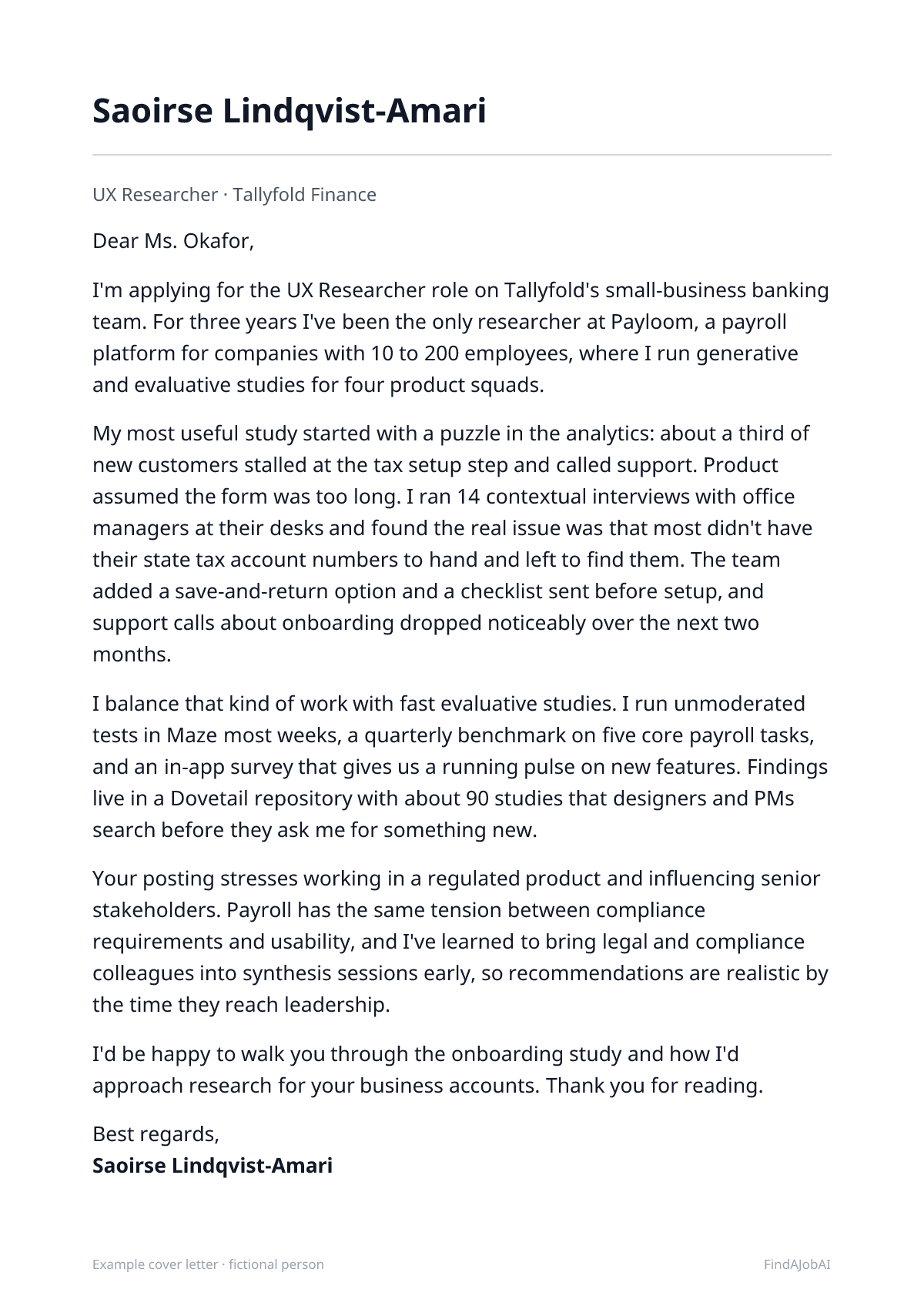
Dear Ms. Okafor,
I'm applying for the UX Researcher role on Tallyfold's small-business banking team. For three years I've been the only researcher at Payloom, a payroll platform for companies with 10 to 200 employees, where I run generative and evaluative studies for four product squads.
My most useful study started with a puzzle in the analytics: about a third of new customers stalled at the tax setup step and called support. Product assumed the form was too long. I ran 14 contextual interviews with office managers at their desks and found the real issue was that most didn't have their state tax account numbers to hand and left to find them. The team added a save-and-return option and a checklist sent before setup, and support calls about onboarding dropped noticeably over the next two months.
I balance that kind of work with fast evaluative studies. I run unmoderated tests in Maze most weeks, a quarterly benchmark on five core payroll tasks, and an in-app survey that gives us a running pulse on new features. Findings live in a Dovetail repository with about 90 studies that designers and PMs search before they ask me for something new.
Your posting stresses working in a regulated product and influencing senior stakeholders. Payroll has the same tension between compliance requirements and usability, and I've learned to bring legal and compliance colleagues into synthesis sessions early, so recommendations are realistic by the time they reach leadership.
I'd be happy to walk you through the onboarding study and how I'd approach research for your business accounts. Thank you for reading.
Best regards,
Saoirse Lindqvist-Amari
Example 2 · Career changer
Market researcher moving into UX research
Thaddeus runs consumer surveys and focus groups at an agency. The ad is for a UX researcher at a retail app who can handle quant and qual.
Example letter · fictional
Dear Hiring Team,
I'm applying for the UX Researcher role at Basketline. I've spent five years as a research manager at a consumer insights agency, designing surveys and moderating focus groups for grocery and household brands, and I want to move closer to the product decisions those insights should feed.
Much of my agency work already overlaps with UX research. I write screeners, moderate groups and in-depth interviews, and design surveys with samples of 1,000 to 3,000 shoppers, weighting results and reporting confidence intervals. Last year a grocery client asked why its loyalty app had low repeat use; I ran a survey of 2,000 members and 10 follow-up interviews and found that most didn't understand how points converted to discounts. The client simplified the rewards screen based on that report.
To build product research skills, I completed a UX research certificate this year and ran an independent usability study of a public library's mobile app with 8 participants, which the library used to reorganise its account menu. I've also learned Figma prototype testing and Maze, and my case study is linked below my signature.
I'm aware that I haven't yet worked inside a product team, with its sprint rhythm and quick turnarounds. I'd expect to adapt my longer agency studies into smaller, faster cycles, and I'd lean on your designers to learn how decisions get made.
Your ad asks for someone comfortable with both surveys and interviews. That mix is what I do every week, and I'd like to bring it to your shoppers' experience.
Kind regards,
Thaddeus Okoro-Brandt
Example 3 · Senior or lead
Senior researcher applying to lead a research practice
Margarethe leads research for one product area at a large SaaS company. The ad is for a Lead UX Researcher to build a team of four.
Example letter · fictional
Dear Mr. Haldane,
I'm applying for the Lead UX Researcher role at Cindermoor. Over nine years in research, the last four as senior researcher for the collaboration product area at Quillstone, I've moved from running studies myself to deciding which questions deserve a study at all. Your role would let me build that practice from the beginning.
When I joined Quillstone's collaboration area, research requests arrived through hallway conversations and Slack messages, and about half the studies answered questions the team had already decided. I introduced a quarterly research plan agreed with the three product directors, a short intake form and a rule that every study names the decision it will inform. Within two quarters, every study in the plan led to a documented roadmap or design change.
I also built the operations behind the work: a participant panel of 700 customers, consent templates reviewed by our privacy team, and a repository where findings are tagged by product area and user segment. Recruitment that used to take a month now takes about ten days, which made it realistic for the team to run research inside a sprint.
I mentor two researchers through weekly study reviews and have trained around 20 designers and PMs to run simple interviews with a shared guide. Your ad says the first year includes hiring four researchers. I've interviewed for my current team and would want to agree a skills mix with you before writing the first job description.
I'd welcome a conversation about where research sits in your planning cycle today and what you'd want the team to own first.
Sincerely,
Margarethe Osei-Whitlock
All three letters, and the short version below, are fictional: the people, employers and numbers are invented. Borrow the structure, never the facts.
- Prefer to write it yourself? Use the free cover letter template.
- Check your CV against the job first: the free CV score shows the missing keywords.
Why the first letter works, paragraph by paragraph
Paragraph 1: Opening
Names the team in the ad, the writer's role as sole researcher and the scale of her current company, which tells the reader she is used to prioritising without a research manager.
Paragraph 2: The study that changed a decision
Analytics raised the question, interviews answered it, and the product change followed. The finding overturned the team's assumption, which is exactly the value a research hire is meant to add.
Paragraph 3: Everyday research practice
Shows a steady cadence of evaluative work and a repository others use, proving research is a habit at her company rather than a one-off project.
Paragraph 4: Fit with the regulated domain
Matches the ad's two stated needs, regulation and stakeholder influence, with a concrete working habit instead of an adjective.
Paragraph 5: Close
Offers to walk through the study and connect it to the new product, inviting a portfolio-style conversation rather than a generic interview request.
What the career changer's letter does differently
The career changer treats survey design and moderation as transferable skills rather than apologising for them, then shows a client decision his research shaped. A certificate and a small independent usability study prove intent, and he names the product-team gap directly, which is more credible than pretending agency and in-house research are the same.
What the senior letter does differently
A lead's letter focuses on systems: a planning process that tied every study to a decision, a panel and repository that made research faster, and coaching that spread research skills beyond the research team. It ends with a question about the company's planning cycle, which is where a research lead's influence begins.
Short UX researcher cover letter: an email-ready version
Many applications arrive as an email or a small text box, and a full page doesn't fit. This version runs 120 to 150 words and keeps only what a reader needs to decide whether to reply. A UX researcher answers a recruiter's LinkedIn message about a contract role studying a healthcare scheduling app.
Short version · email · fictional126 words
Subject: UX Researcher contract – patient scheduling studies – Rafferty Nakagawa
Hi Ms. Vance,
Thanks for reaching out about the six-month UX Researcher contract at Clearpath Clinics. Patient scheduling is close to work I've done for the last two years, and I'd like to be considered.
At a telehealth company I ran 30 interviews with patients and front-desk staff about booking and rescheduling, then two rounds of usability tests on a redesigned booking flow. The design team cut the steps to book a follow-up from seven to four, and I set up a monthly test so changes kept being checked with real patients, including older adults using screen magnifiers.
I can start in early January and work your clinic hours across time zones. My portfolio includes the booking case study with patient details removed.
Best,
Rafferty Nakagawa
A reply to a recruiter can skip the formal opening and get to the most relevant study fast. This version keeps one study with its scale and outcome, adds an accessibility detail that suits healthcare, and answers the practical questions about start date and hours.
Opening lines that work for UX researcher cover letters
The first sentence decides whether the second gets read. Here are six openings, one for each situation you might be in. Pick the one that matches yours and swap in your own facts: every name and number below is invented.
1. You have a standout result
Our analytics said new payroll customers stalled at tax setup, and 14 interviews at their desks showed us why: the numbers they needed were in a filing cabinet across the room.
2. The ad names a problem you've solved
For five years I've designed surveys and moderated focus groups for grocery brands, and I now want those insights to shape a product directly rather than a quarterly report.
3. Someone referred you
At Quillstone I changed one rule, that every study must name the decision it will inform, and within two quarters every planned study led to a documented change.
4. You admire what they build
Your recruiter's note mentioned patient scheduling, which is where I've spent the last two years running interviews and usability tests with patients and front-desk staff.
5. You're new to the field or switching into it
I've been the only researcher at a payroll startup for three years, which taught me to choose studies carefully and make each one easy for four squads to act on.
6. You have senior scope or a specialism
Your engineering director, Priyanka Sethi, saw my talk on research repositories at a local meetup and suggested I apply for your senior researcher opening.
How to write a UX researcher cover letter
Five steps, in the order you'd write them. The shape stays the same for every job (a short opening, proof, a reason for this employer, a close), and what goes into each part is what changes with the role.
Pick one study that changed a decision
Choose a study where the finding surprised the team or overturned an assumption, and where you can name what changed afterwards. Tell it as question, method, finding and decision in one paragraph. That paragraph does more work than any list of methods you could add.
Explain why you chose the method
Research managers care about judgement. Say why interviews, a diary study or a survey suited the question, and what you traded off, such as speed against depth. One sentence of reasoning shows you choose methods deliberately rather than by habit.
Show how your findings get used
Describe the mechanics of influence: synthesis sessions with designers, short readouts, highlight clips, a searchable repository. Hiring managers have often seen good research ignored, so evidence that your work reaches decisions is often the deciding factor.
Connect to the product and its users
Mention the company's domain, users or constraints from the ad, like a regulated industry or a mix of consumer and business customers, and link one of your habits to it. This proves you read the posting and thought about the research problems ahead.
Point to the portfolio and close briefly
End by offering to walk through a case study and note where the portfolio lives. Keep the close to two sentences; the portfolio carries the detail, and the letter's job is to make the reader want to open it.
UX Researcher cover letter do's and don'ts
Do
- Build the letter around one study: the question, the method, the finding and the decision that followed.
- Mention the research tools named in the ad, such as Dovetail, Maze or Qualtrics, while describing real work.
- Show how you get findings acted on, through readouts, synthesis sessions or a repository others use.
Don't
- Don't claim revenue or conversion gains as your own; say the team shipped a change informed by your research.
- Don't list every method you know; the ad's readers assume the basics.
- Don't share confidential product details; describe the problem and the type of user instead.
Common UX researcher cover letter mistakes
Each one is easy to make and quick to fix before you send the letter.
Turning the letter into a methods inventory
Listing interviews, card sorts, surveys and diary studies says nothing a hiring manager doesn't already assume. Replace the list with one study and the reasoning behind its method.
Claiming the team's metrics as your own
Research informs decisions; designers and engineers ship them. Say your study led to a change and describe the result the team saw, so the claim survives a portfolio review.
Leaving out stakeholder influence
Research that nobody acts on has little value. Add one sentence on how you brought product managers or engineers into the work so the findings stuck.
Writing in research jargon
Terms like triangulated empathy-driven insights make the letter hard to read. Use plain words: who you talked to, what you learned and what the team did next.
Email subject lines for UX researcher applications
Applying by email? Put the job title, any reference number and your name in the subject line.
- UX Researcher application – B2B payroll research, mixed methods – Saoirse Lindqvist-Amari
- UX Researcher – market research background, survey and interview skills – Thaddeus Okoro-Brandt
- Application: Lead UX Researcher (Job 4471) – Margarethe Osei-Whitlock
Everything for UX Researchers
- UX Researcher resume exampleA full resume, plus bullet and summary examples
- UX Researcher interview questions30 questions with sample answers
- UX Researcher job descriptionDuties, skills and requirements
- Career change cover letter: template + examples
Other cover letter examples
UX Researcher cover letter FAQ
What should a UX researcher cover letter include?
One study told from question to decision, the methods and tools you used for it, and how you got stakeholders to act. Link your portfolio so the hiring manager can read the full case study after the letter.
How do I write a UX research cover letter with no UX job experience?
Draw on adjacent research, such as market research, academic studies or customer interviews in another role, and add a small independent usability study. Be clear about the product-team experience you don't have yet.
Should I mention specific metrics in a UX researcher cover letter?
Mention participant numbers and study length freely, since they are yours. For product outcomes, describe the decision your research informed and credit the team that shipped it, rather than claiming a business metric alone.
How we built this page
The FindAJobAI team wrote the three example letters, the short email version, the opening lines and the advice for UX researcher roles. The people, employers and numbers in the letters are invented; the structure, the kind of evidence and the order of the paragraphs are the parts to copy.
Once we track enough live UX researcher job ads, this page also shows the skills they ask for most, counted the same way as our in-demand skills report.
Last reviewed on November 1, 2026.