Industrial Engineer Resume Example (2026)
By FindAJobAI team Updated How we built this page
Industrial engineering job ads usually ask for Lean or Six Sigma experience, a simulation or statistics tool, and comfort walking the floor with time studies. What separates strong resumes is a before-and-after number: a cycle time, a defect rate, a changeover time. An industrial engineer resume should say which line or process changed and by how much.
The example below has four years split between an automotive supplier and a consumer goods plant. Each bullet names the method, the line or process and the measured result, instead of listing tools with no project attached.
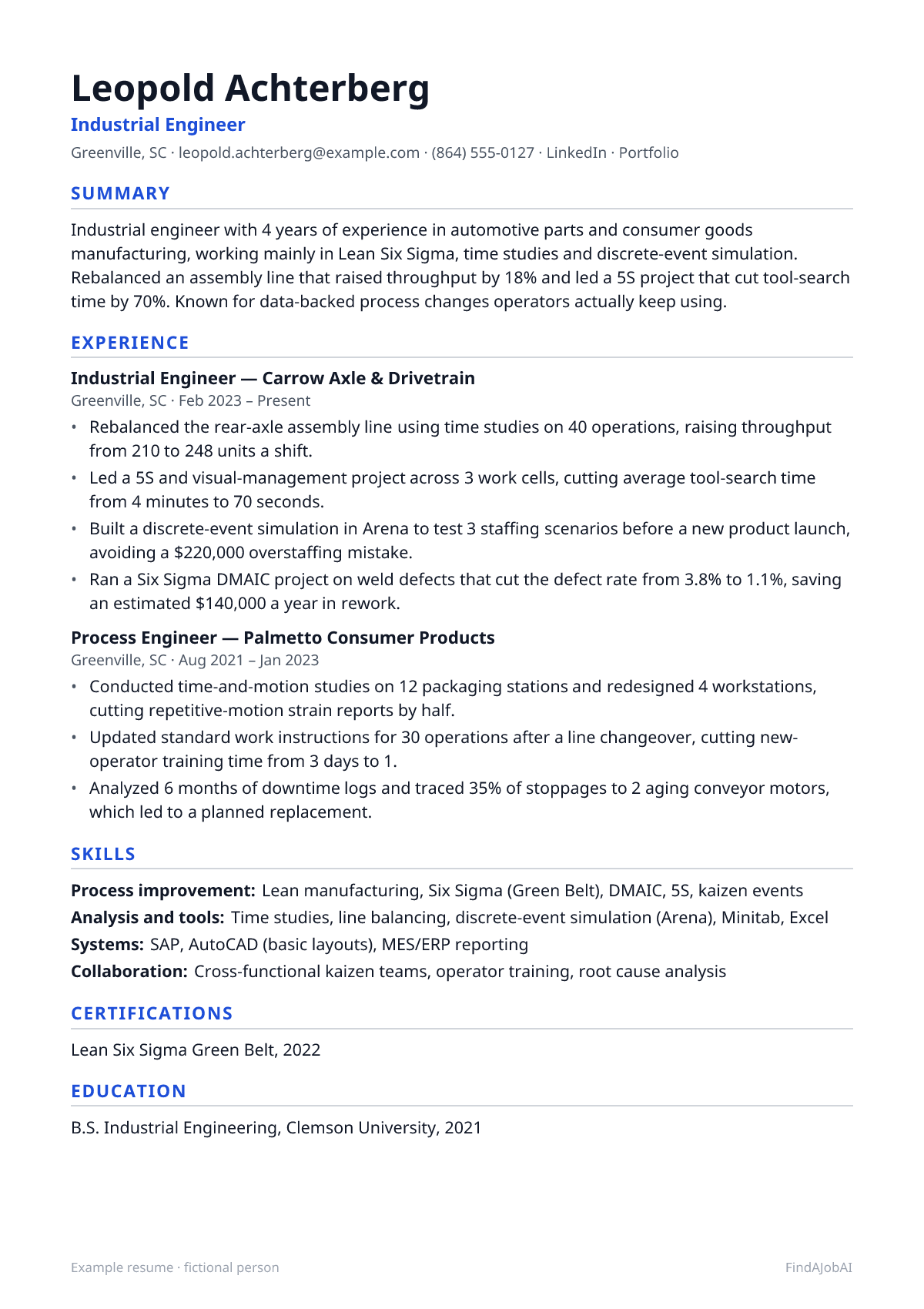
Industrial Engineer resume template
This example as a one-page template: one column, standard headings and plain text, the format applicant tracking systems read most reliably.
After you sign up, Create my CV builds your own resume in this same one-column layout, from your real experience.
Mid-level industrial engineer resume example
A complete one-page example for a fictional industrial engineer: every bullet pairs an action with what changed because of it.
Example resume · fictional person
Leopold Achterberg
Industrial Engineer
Greenville, SC · [email protected] · (864) 555-0127 · LinkedIn · Portfolio
Summary
Industrial engineer with 4 years of experience in automotive parts and consumer goods manufacturing, working mainly in Lean Six Sigma, time studies and discrete-event simulation. Rebalanced an assembly line that raised throughput by 18% and led a 5S project that cut tool-search time by 70%. Known for data-backed process changes operators actually keep using.
Experience
Industrial Engineer, Carrow Axle & Drivetrain
Greenville, SC · Feb 2023 – Present
- Rebalanced the rear-axle assembly line using time studies on 40 operations, raising throughput from 210 to 248 units a shift.
- Led a 5S and visual-management project across 3 work cells, cutting average tool-search time from 4 minutes to 70 seconds.
- Built a discrete-event simulation in Arena to test 3 staffing scenarios before a new product launch, avoiding a $220,000 overstaffing mistake.
- Ran a Six Sigma DMAIC project on weld defects that cut the defect rate from 3.8% to 1.1%, saving an estimated $140,000 a year in rework.
Process Engineer, Palmetto Consumer Products
Greenville, SC · Aug 2021 – Jan 2023
- Conducted time-and-motion studies on 12 packaging stations and redesigned 4 workstations, cutting repetitive-motion strain reports by half.
- Updated standard work instructions for 30 operations after a line changeover, cutting new-operator training time from 3 days to 1.
- Analyzed 6 months of downtime logs and traced 35% of stoppages to 2 aging conveyor motors, which led to a planned replacement.
Skills
- Process improvement: Lean manufacturing, Six Sigma (Green Belt), DMAIC, 5S, kaizen events
- Analysis and tools: Time studies, line balancing, discrete-event simulation (Arena), Minitab, Excel
- Systems: SAP, AutoCAD (basic layouts), MES/ERP reporting
- Collaboration: Cross-functional kaizen teams, operator training, root cause analysis
Certifications
- Lean Six Sigma Green Belt, 2022
Education
- B.S. Industrial Engineering, Clemson University, 2021
Fictional example by the FindAJobAI team: the person, employers and numbers are invented. Keep the structure; use your own work and numbers you can explain in an interview.
Entry-level industrial engineer resume example
A recent graduate with one co-op rotation and a lab assistant job standing in for full-time experience. Education sits right under the summary, and two projects on real layouts end with a before-and-after number rather than a list of software used.
Entry-level example resume · fictional person
Wendeline Kowalczyk
Industrial Engineer
Peoria, IL · [email protected] · (309) 555-0162 · LinkedIn · Portfolio
Summary
Entry-level industrial engineer with a B.S. in Industrial Engineering and a co-op rotation in process engineering at a heavy-equipment plant. Ran time studies, built a line-balancing spreadsheet model and assisted a Six Sigma Green Belt project on scrap reduction. Looking for a first full-time engineering role in manufacturing.
Education
- B.S. Industrial Engineering, Bradley University, 2026
Experience
Process Engineering Co-op, Ironvale Heavy Equipment
Peoria, IL · Jan 2026 – May 2026
- Timed 30 work elements on the loader-assembly line and built a line-balancing model that cut the slowest station's cycle time from 140 to 112 seconds.
- Assisted a Six Sigma Green Belt project on paint-booth scrap, helping cut scrap from 5.5% to 3.9% of painted parts over one quarter.
- Built a Minitab control chart for weld-torque data that flagged 1 out-of-spec gun before it produced bad welds.
Manufacturing Lab Assistant, Bradley University, Industrial Engineering Department
Peoria, IL · Sep 2023 – Dec 2025
- Maintained 8 lab simulation stations and set up Arena models for 3 course sections, supporting about 60 students a semester.
- Graded and gave feedback on 40 student time-study reports a semester, flagging common data-collection errors.
Skills
- Process improvement: Lean basics, 5S, time studies, line balancing
- Analysis and tools: Minitab, Arena simulation (coursework), Excel, basic SQL
- Systems: AutoCAD (basic), SAP (coursework)
Certifications
- Lean Six Sigma Yellow Belt, 2025
Projects
- Senior capstone (Arena, Minitab): simulated 3 staffing scenarios for a local bakery's packing line and recommended a layout that cut projected wait time by 20%.
- Student organization 5S project: reorganized the IE department's shared workshop, cutting average tool-search time from 5 minutes to under 2.
Senior industrial engineer resume example
A lead engineer ten years in, now managing a small team across plants. The bullets move from balancing one line to setting standards and capital decisions, and the summary names the plant count and dollar scale of the work.
Senior example resume · fictional person
Summary
Lead industrial engineer with 10 years across automotive, appliance and aerospace-parts manufacturing, managing 3 engineers and the Lean deployment across 4 plants. Built the changeover-reduction program that cut average changeover time by 40% plantwide, and leads capital-project analysis behind $6M in annual equipment spend.
Experience
Lead Industrial Engineer, Vandermark Appliance Group
Dayton, OH · May 2021 – Present
- Lead a team of 3 engineers across 4 plants, setting the Lean roadmap and reviewing each plant's kaizen pipeline monthly.
- Built the SMED-based changeover program adopted at all 4 plants, cutting average changeover time from 75 to 45 minutes.
- Led the capital-project analysis behind $6M in annual equipment spend, rejecting 2 proposals whose payback exceeded 4 years.
- Standardized time-study methods across plants, cutting the variance between engineers' estimates on the same job from 18% to 5%.
Senior Industrial Engineer, Rutherglen Aerospace Components
Dayton, OH · Jun 2016 – Apr 2021
- Owned line balancing for a 12-station composite-parts cell, raising throughput from 60 to 85 parts a shift.
- Ran a Six Sigma DMAIC project on bonding defects, cutting the defect rate from 4.2% to 1.3% and avoiding an estimated $300,000 in scrap a year.
- Mentored 2 junior engineers on time studies and simulation, reviewing their models before they went to plant management.
Industrial Engineer, Carden Motors Powertrain Plant
Troy, OH · Jul 2013 – May 2016
- Rebalanced 2 engine-assembly lines using time studies on 60 operations, raising combined output by 110 units a day.
- Built Arena simulation models to test 4 layout options for a new line, selecting the option projected to cut WIP by 30%.
Skills
- Process and strategy: Lean deployment, Six Sigma Black Belt, SMED, capital-project analysis
- Analysis and tools: Arena and FlexSim simulation, Minitab, line balancing, time studies
- Leadership: Hiring and coaching engineers, multi-plant standards, kaizen facilitation
Education
- B.S. Industrial Engineering, Ohio State University, 2013
How to write an industrial engineer resume
Five steps, in the order a recruiter reads the page. The format around them stays plain for every job: one column, standard headings, newest role first.
Header: name, target title and links
Use the title "Industrial Engineer" even if yours was Process Engineer or Continuous Improvement Engineer, and name the industry (automotive, food, aerospace) in your headline or summary. Plant metrics vary by industry, and hiring managers look for their own.
Summary: what you do and your best proof
Name your core methods (Lean, Six Sigma, line balancing), your simulation or statistics tool, and the industry, then one result: a throughput, defect rate or changeover time you changed. Skip lines like "process-improvement minded"; every applicant could claim that.
Experience: newest first, a result in every bullet
Open each bullet with the line, cell or process, then the method and the before-and-after number: cycle time, defect rate, changeover time or cost. Listing "Lean Six Sigma" with no project attached says little; one DMAIC project with a measured drop says a lot.
Skills: grouped, in the ad's words
Group them into process-improvement methods, analysis tools and plant systems. Name the simulation or statistics software you used, and only list a belt level (Green, Black) if you can point to a project where you used it.
Education and certifications
List your degree with the year, plus a Lean Six Sigma belt if you hold one. Without full-time experience, add a Projects section with 1-2 analyses from a co-op or capstone, each ending in a before-and-after number.
Skills to put on an industrial engineer resume
Hard skills are the tools and methods of the job; soft skills are how you work with people. Each comes with one way to prove it, because a skill named only in a list counts for little. Add the ones you really have.
Hard skills
- Time studies
- Name the number of operations or elements you timed and the staffing or cycle-time decision it informed.
- Line balancing
- Give the before-and-after throughput or cycle time on the line you rebalanced.
- Six Sigma (DMAIC)
- Name the defect you targeted and the rate before and after the project.
- 5S and visual management
- Point to a workspace you reorganized and the search or setup time it cut.
- Discrete-event simulation (Arena, FlexSim)
- Describe the scenario you modeled and the decision it supported before anything was built.
- Statistical analysis (Minitab)
- Name the control chart or hypothesis test you ran and what it caught or confirmed.
- SMED / changeover reduction
- Give the changeover time before and after and how many lines or machines it covered.
- Root cause analysis
- Name the defect or downtime issue and the root cause your analysis found.
- CAD (AutoCAD, SolidWorks)
- Mention a layout or fixture you drew and the floor-space or cycle-time change it enabled.
- ERP/MES systems (SAP)
- Point to a report or data pull from the system that fed a staffing or inventory decision.
- Kaizen facilitation
- Give the team size and what the event removed, such as steps, travel distance or waste.
- Cost-benefit and capital analysis
- Name a proposal you evaluated and the payback period or dollar figure behind the decision.
Soft skills
- Cross-functional collaboration
- Name the departments on a project team and what the project changed on the floor.
- Operator training
- Count the operators trained on a new process and a metric that held steady or improved after.
- Change management
- Describe a process change operators resisted at first and how you got it adopted.
- Data-driven communication
- Describe presenting a finding to plant leadership with a chart that led to a specific decision.
- Attention to safety
- Mention an ergonomic or safety issue your analysis caught before it caused an injury.
- Project management
- Give the number of improvement projects you ran at once and how you kept them on schedule.
- Mentoring
- Count the engineers or operators you trained and what they could do independently afterward.
Industrial Engineer resume bullet examples: weak vs strong
The same work, written two ways. The strong version names the tool, the scope and a result; the numbers are examples, yours must be real.
Weak: Improved production efficiency.
Strong: Resequenced 8 stations on the trim line, cutting cycle time from 95 to 74 seconds and raising daily output by 90 units.
Specific stations, before-and-after times and a unit count.
Weak: Conducted time studies.
Strong: Timed 25 work elements across 2 shifts and used the data to rebalance the line, eliminating 1 full operator position without cutting output.
Shows the analysis leading to a concrete staffing result.
Weak: Used Six Sigma tools.
Strong: Ran a Six Sigma project on scrap in the stamping department, cutting scrap weight from 6% to 2.5% of material input over 2 quarters.
Names the methodology, the defect and the measured drop.
Weak: Worked on process improvement projects.
Strong: Led a kaizen event with 7 operators that removed 3 non-value-added steps from the packing process, cutting pack time by 22%.
Shows leadership of the event and a specific time result.
Weak: Reduced costs.
Strong: Redesigned the fixture for a drilling operation, cutting cycle time by 12 seconds per part and saving about $85,000 a year in labor.
Ties a design change to both a time and a dollar figure.
Weak: Familiar with Lean manufacturing.
Strong: Applied 5S to the tool crib serving 40 technicians, cutting average part retrieval time from 6 minutes to under 2.
Turns a Lean buzzword into a measured workplace change.
15 more industrial engineer resume bullet examples
Grouped by area of the job, so you can find the ones closest to your work. Keep the shape (action, scope, result) and replace the invented numbers with your own.
Line balancing and throughput
- Rebalanced a 10-station fender-stamping line, raising throughput from 340 to 390 parts a shift without adding labor.
- Resequenced 6 assembly operations after a product redesign, cutting the bottleneck station's cycle time from 58 to 41 seconds.
- Timed 45 work elements across 3 shifts and used the data to justify adding 1 operator, raising daily output by 12%.
- Rebalanced a packaging line after a SKU change, keeping output flat while cutting headcount by 2 through the shift.
Six Sigma and quality
- Led a Six Sigma DMAIC project on paint defects, cutting the defect rate from 6.1% to 2.4% within 2 quarters.
- Built a Minitab control chart on torque data that caught a drifting tool before it caused 200 bad assemblies.
- Ran a root cause analysis on a packaging line stoppage, tracing 60% of downtime to a single misadjusted sensor.
- Reduced scrap on a machining cell from 4.5% to 1.8% of parts by tightening fixture tolerances identified in a DOE.
Lean and 5S
- Led a 5S project across 4 work cells, cutting average part-retrieval time from 3 minutes to 45 seconds.
- Applied SMED principles to a die-change process, cutting changeover time from 65 to 38 minutes.
- Mapped the value stream for a 12-step order fulfillment process and removed 3 non-value-added steps, cutting lead time by 2 days.
- Standardized work instructions for 20 operations after a line redesign, cutting new-operator training time from 3 days to 2.
Simulation and planning
- Built a discrete-event simulation to test 3 layout options for a new line, selecting the layout projected to cut WIP by 25%.
- Modeled staffing needs for a seasonal volume increase, recommending a schedule that avoided $90,000 in planned overtime.
- Forecasted the capacity impact of a new product launch using a simulation model, flagging a bottleneck 2 months before it occurred.
Industrial Engineer resume summary examples
Two or three lines on what you do and your strongest proof. Start from the one closest to your level and use your own facts.
Industrial engineer with a B.S. in Industrial Engineering and a co-op rotation in a tier-1 automotive supplier's process team. Built a line-balancing project that cut a bottleneck station's cycle time by 15%, and ran time studies for a capstone project with a local manufacturer. Comfortable with Minitab and basic Arena simulation.
Industrial engineer with 4 years in food and beverage manufacturing, working in Lean Six Sigma, line balancing and SAP. Led the changeover-reduction project that cut average line changeover time from 90 to 52 minutes across 3 production lines.
Senior industrial engineer with 9 years leading continuous improvement for a multi-plant appliance manufacturer. Owns the Lean deployment across 4 plants and the capital-project analysis behind $6M in equipment spend, and mentors 3 engineers in DMAIC and simulation.
Common industrial engineer resume mistakes
Each one is easy to make and quick to fix before you apply.
Naming methods with no project behind them
Lean and Six Sigma in Skills show training; the bullets must show a line or defect rate those methods actually changed.
Using vague verbs like "improved" or "optimized"
Replace them with the before-and-after number: cycle time, throughput, defect rate or changeover time.
Leaving out the scale of the line or plant
Say how many stations, shifts or units a day the process ran, so the reader can judge the size of the result.
Treating simulation as a skill, not evidence
Name the scenario you modeled and the decision it supported before equipment was bought or a line was built.
Skipping the cost or safety angle
Translate a time or defect change into a dollar figure or an injury-reduction number when you can calculate one.
ATS tips for an industrial engineer resume
Applicant tracking systems turn your file into text that recruiters search, mostly for the skills and titles in the ad. They rarely reject a resume on their own; one that parses badly or misses the ad's words just doesn't come up.
- Name the methodology you used (Lean, Six Sigma, DMAIC, 5S) and the specific defect, cost or time it targeted.
- Report cycle times, throughput or defect rates as before-and-after numbers, not just "improved" or "optimized".
- Mention the simulation or statistics tool you used (Arena, Minitab, Excel) next to the decision it supported.
- State the scale of the line, plant or process you worked on (stations, shifts, units a day) so the result has context.
- If you led a kaizen event or cross-functional team, say how many people were on it and what the event removed or fixed.
For the format itself, run the free ATS resume checklist.
Everything for Industrial Engineers
- Industrial Engineer cover letter examplesThree example letters and a short email version
- Industrial Engineer interview questions30 questions with sample answers
- Industrial Engineer job descriptionDuties, skills and requirements
- How to tailor your resume without lying
Other resume examples
Industrial Engineer resume FAQ
What skills should an industrial engineer put on a resume?
Lean and Six Sigma methods, time studies or line balancing, a simulation or statistics tool such as Arena or Minitab, and evidence you used them to change a cycle time, defect rate or cost.
How do I get an industrial engineering job with no experience?
Count co-ops, internships and capstone projects as experience, and describe them with the same before-and-after numbers you'd use for a full-time role: cycle time, throughput or scrap rate.
Should I list a Six Sigma belt on my resume even without full certification?
List training in progress as "Lean Six Sigma Green Belt (in progress)" and describe one project where you applied the DMAIC steps, even without the final certificate.
How technical should an industrial engineering resume be?
Specific enough to show real tool and method use, but each bullet should end in a result a non-engineer manager would understand, like units a shift or dollars saved.
How we built this page
The FindAJobAI team wrote the three example resumes, the bullets, the skills and the advice for industrial engineer roles. The people, employers and numbers in the examples are invented; the structure, the tools and the way each bullet is built are the parts to copy.
Once we track enough live industrial engineer job ads, this page also shows the skills they ask for most, counted the same way as our in-demand skills report.
Last reviewed on November 1, 2026.