Manufacturing Engineer Resume Example (2026)
By FindAJobAI team Updated How we built this page
Manufacturing engineer postings usually name the same ground: process improvement, CAD or PLM tools, root cause problem solving and some flavor of lean or Six Sigma. The resumes that stand out are the ones that attach a line, a defect rate or a changeover time to each claim, instead of listing "process improvement" as a skill with no proof behind it.
The example below spent three years split between an automotive supplier and a contract electronics manufacturer. Each bullet names the line or process, the change made, and the measured result, so a hiring manager can picture the shop floor instead of guessing at it.
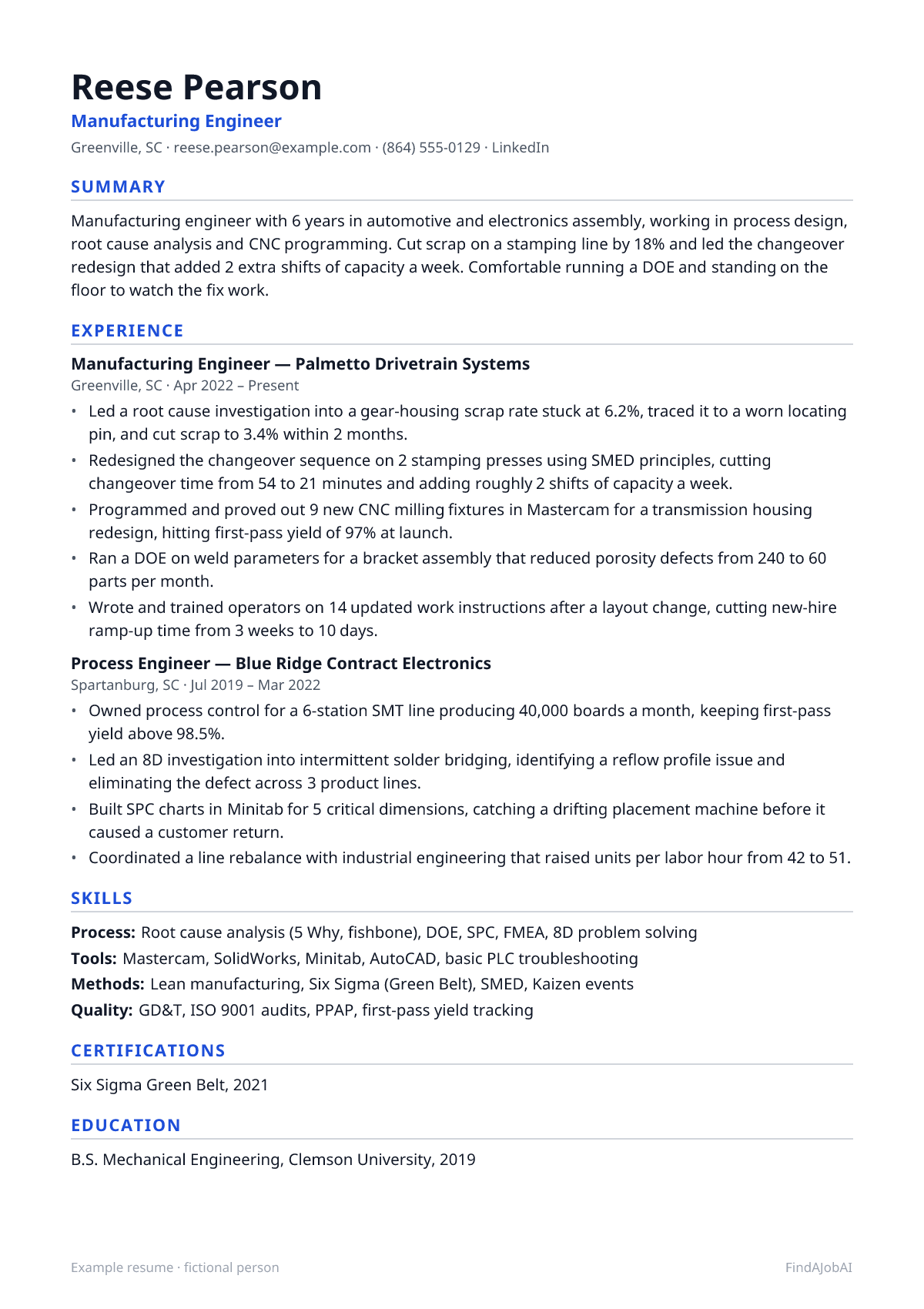
Manufacturing Engineer resume template
This example as a one-page template: one column, standard headings and plain text, the format applicant tracking systems read most reliably.
After you sign up, Create my CV builds your own resume in this same one-column layout, from your real experience.
Mid-level manufacturing engineer resume example
A complete one-page example for a fictional manufacturing engineer: every bullet pairs an action with what changed because of it.
Example resume · fictional person
Summary
Manufacturing engineer with 6 years in automotive and electronics assembly, working in process design, root cause analysis and CNC programming. Cut scrap on a stamping line by 18% and led the changeover redesign that added 2 extra shifts of capacity a week. Comfortable running a DOE and standing on the floor to watch the fix work.
Experience
Manufacturing Engineer, Palmetto Drivetrain Systems
Greenville, SC · Apr 2022 – Present
- Led a root cause investigation into a gear-housing scrap rate stuck at 6.2%, traced it to a worn locating pin, and cut scrap to 3.4% within 2 months.
- Redesigned the changeover sequence on 2 stamping presses using SMED principles, cutting changeover time from 54 to 21 minutes and adding roughly 2 shifts of capacity a week.
- Programmed and proved out 9 new CNC milling fixtures in Mastercam for a transmission housing redesign, hitting first-pass yield of 97% at launch.
- Ran a DOE on weld parameters for a bracket assembly that reduced porosity defects from 240 to 60 parts per month.
- Wrote and trained operators on 14 updated work instructions after a layout change, cutting new-hire ramp-up time from 3 weeks to 10 days.
Process Engineer, Blue Ridge Contract Electronics
Spartanburg, SC · Jul 2019 – Mar 2022
- Owned process control for a 6-station SMT line producing 40,000 boards a month, keeping first-pass yield above 98.5%.
- Led an 8D investigation into intermittent solder bridging, identifying a reflow profile issue and eliminating the defect across 3 product lines.
- Built SPC charts in Minitab for 5 critical dimensions, catching a drifting placement machine before it caused a customer return.
- Coordinated a line rebalance with industrial engineering that raised units per labor hour from 42 to 51.
Skills
- Process: Root cause analysis (5 Why, fishbone), DOE, SPC, FMEA, 8D problem solving
- Tools: Mastercam, SolidWorks, Minitab, AutoCAD, basic PLC troubleshooting
- Methods: Lean manufacturing, Six Sigma (Green Belt), SMED, Kaizen events
- Quality: GD&T, ISO 9001 audits, PPAP, first-pass yield tracking
Certifications
- Six Sigma Green Belt, 2021
Education
- B.S. Mechanical Engineering, Clemson University, 2019
Fictional example by the FindAJobAI team: the person, employers and numbers are invented. Keep the structure; use your own work and numbers you can explain in an interview.
Entry-level manufacturing engineer resume example
A new mechanical engineering graduate with one co-op rotation on a factory floor. The resume leans on a senior design project and a co-op that gave him real fixture and time-study work, with each bullet ending in a measured result rather than a task list.
Entry-level example resume · fictional person
Baxter Thorne
Manufacturing Engineer
Dayton, OH · [email protected] · (937) 555-0164 · LinkedIn · Portfolio
Summary
Entry-level manufacturing engineer with a B.S. in Mechanical Engineering and a 6-month co-op building fixtures and running time studies at an auto parts supplier. Comfortable in SolidWorks, basic Minitab and reading GD&T drawings. Senior project cut a mock assembly line's cycle time by 15% through a 2-station rebalance.
Education
- B.S. Mechanical Engineering, University of Dayton, 2026
Experience
Manufacturing Engineering Co-op, Miami Valley Auto Components
Dayton, OH · Jan 2026 – Jun 2026
- Ran time studies on 3 assembly stations and found that a fixture handoff step added 9 seconds per part, leading to a redesign that removed it.
- Built a SolidWorks fixture for a sensor bracket that cut operator setup time from 40 to 15 seconds.
- Logged 6 weeks of scrap data by defect code and presented the top 3 causes to the plant quality team.
Lab Assistant, Manufacturing Processes Course, University of Dayton
Dayton, OH · Sep 2024 – Dec 2025
- Set up and calibrated a benchtop CNC mill for 40 students each semester, cutting setup wait time from 20 to 8 minutes per group.
- Graded and gave feedback on 25 student GD&T drawings per semester, catching tolerance stack-up errors before machining.
Skills
- Design: SolidWorks, AutoCAD, GD&T, basic FEA
- Process: Time studies, line balancing, 5 Why root cause analysis
- Data: Minitab (basic SPC), Excel, basic Python for data logging
Projects
- Mock assembly line rebalance (senior design): used time studies and a 2-station rebalance to cut a 5-station line's cycle time from 60 to 51 seconds.
- 3D-printed jig redesign: reworked a hand-assembly jig for a capstone team, cutting misalignment defects from 1 in 8 parts to 1 in 40.
Senior manufacturing engineer resume example
A plant-level lead engineer with twelve years across two industries, now owning capital spend and a small team. The bullets shift from running studies himself to setting standards, approving tooling budgets and mentoring engineers, with the summary naming the dollar figures he's accountable for.
Senior example resume · fictional person
Summary
Senior manufacturing engineer with 12 years in automotive stamping and assembly, leading process improvement and mentoring 3 engineers. Owns capital planning for a $6M annual tooling budget and led the Six Sigma project that raised plant-wide first-pass yield from 91% to 97%. Reports process health directly to the plant manager each month.
Experience
Senior Manufacturing Engineer, Ironwood Stamping & Assembly
Detroit, MI · May 2020 – Present
- Lead a team of 3 manufacturing engineers across 4 stamping and 2 assembly lines, setting quarterly priorities with the plant manager.
- Led a plant-wide Six Sigma project on first-pass yield, raising it from 91% to 97% over 18 months and avoiding roughly $1.1M a year in rework.
- Own a $6M annual capital budget for tooling and fixturing, prioritizing requests by payback period and safety impact.
- Standardized changeover procedures across 6 presses using SMED, cutting average changeover time from 50 to 22 minutes plant-wide.
- Built the FMEA review process now required before any new fixture launch, catching 11 high-risk failure modes before production in its first year.
Manufacturing Engineer, Lakeshore Metal Forming
Toledo, OH · Aug 2016 – Apr 2020
- Owned process control for a 4-press stamping line producing 60,000 parts a month, keeping scrap under 2.5%.
- Led the launch of 5 new tool sets for a model-year changeover, hitting production-rate yield within 3 days of start-up on 4 of them.
- Mentored 2 junior engineers on root cause methods, reviewing their 8D reports before submission to customers.
Process Engineer, Hollow Creek Auto Parts
Toledo, OH · Jun 2013 – Jul 2016
- Ran DOEs on weld and stamping parameters for 3 chassis parts, cutting combined defect rate from 5.1% to 2.3%.
- Wrote standard work and trained 30 operators across 2 shifts on a new assembly cell layout.
Skills
- Process: Six Sigma (Black Belt), DOE, FMEA, SMED, capital planning
- Tools: SolidWorks, Mastercam, Minitab, AutoCAD
- Leadership: Mentoring engineers, cross-shift standardization, plant-manager reporting
Certifications
- Six Sigma Black Belt, 2019
Education
- B.S. Mechanical Engineering, University of Michigan, 2013
How to write a manufacturing engineer resume
Five steps, in the order a recruiter reads the page. The format around them stays plain for every job: one column, standard headings, newest role first.
Header: name, target title and links
Use the title "Manufacturing Engineer" even if your company called it Process Engineer or Manufacturing/Industrial Engineer, since that's the title recruiters search. List the industries you've worked in (automotive, medical device, electronics) right away since quality standards and tools differ a lot between them.
Summary: what you do and your best proof
Name your core method (root cause analysis, DOE, lean) and the type of line you worked on, then one measured result like a scrap rate drop or capacity gain. Skip phrases like "detail-oriented engineer"; they don't tell a hiring manager what you fixed.
Experience: newest first, a result in every bullet
Open each bullet with the defect or process, then the method you used and the measured before-and-after. A line like "improved processes" says nothing; a scrap rate that halved after a specific fixture change says everything.
Skills: grouped, in the ad's words
Group tools into design (SolidWorks, AutoCAD), process methods (DOE, SPC, FMEA) and programming (Mastercam, PLC). Put your belt level, if you have one, in a certifications line rather than burying it in a skills list.
Education and certifications
List your engineering degree with the year, plus any Lean or Six Sigma belt and the year earned. Without manufacturing experience, add a Projects section with a senior design or capstone project that states the line, the change and the measured result.
Skills to put on a manufacturing engineer resume
Hard skills are the tools and methods of the job; soft skills are how you work with people. Each comes with one way to prove it, because a skill named only in a list counts for little. Add the ones you really have.
Hard skills
- Root cause analysis
- Name the method (5 Why, fishbone, 8D) and give the defect you traced plus the before-and-after count.
- SPC
- Say how many critical dimensions you charted and one drift or shift you caught before it became a customer issue.
- DOE
- Name the parameters you varied and the defect rate or yield change the result produced.
- SolidWorks
- Point to a fixture or part you designed and the setup time or defect rate it improved.
- Mastercam
- Name the machine type (3-axis, 5-axis) and the part, with the cycle time before and after your program.
- Minitab
- Mention the specific chart or test you ran and the issue it surfaced.
- GD&T
- Reference a tolerance stack-up you caught or a drawing you corrected before it reached the floor.
- FMEA
- Count the failure modes reviewed and how many were caught before launch.
- Lean manufacturing
- Name the specific waste removed (motion, handling, waiting) and the time or labor hours it saved.
- SMED
- Give the changeover time before and after, and how many presses or lines it applied to.
Soft skills
- Floor presence
- Describe a problem you caught by walking the line rather than from a report.
- Cross-team coordination
- Name the other teams (quality, maintenance, industrial engineering) you coordinated a fix with.
- Operator training
- Count how many operators you trained and the drop in early defects or ramp-up time that followed.
- Prioritization
- Give your open issue count and how you decided which one to tackle first.
- Clear documentation
- Mention work instructions or standard work you wrote and how it changed training time.
- Urgency under downtime
- State how fast you diagnosed a stoppage and got the line back up.
- Mentoring
- Count the engineers or operators you coached and what they took over afterward.
Manufacturing Engineer resume bullet examples: weak vs strong
The same work, written two ways. The strong version names the tool, the scope and a result; the numbers are examples, yours must be real.
Weak: Improved manufacturing processes.
Strong: Redesigned the fixture sequence on an injection molding cell, cutting cycle time from 48 to 36 seconds and adding 4,000 units of monthly capacity.
Names the process, the change and the capacity gained.
Weak: Reduced scrap.
Strong: Traced a recurring crack defect to an over-torqued clamp and adjusted the fixture, cutting scrap on that part from 420 to 90 units a month.
Gives the cause, the fix and the before-and-after count.
Weak: Responsible for quality.
Strong: Ran weekly SPC reviews on 6 critical dimensions and caught a tooling wear trend 2 weeks before it would have triggered a customer complaint.
Shows quality ownership as a specific catch, not a title.
Weak: Worked on lean initiatives.
Strong: Led a 3-day Kaizen event on a packaging line that removed 2 redundant handling steps and cut labor hours per shift by 1.5.
Turns a lean label into an event with a measured outcome.
Weak: Programmed CNC machines.
Strong: Programmed a 5-axis CNC mill in Mastercam for a new aluminum bracket, reducing machining time per part from 11 to 7 minutes.
Names the tool, the part and the time saved.
Weak: Trained operators.
Strong: Wrote and trained 18 operators on updated standard work for a new assembly cell, cutting first-week defects from 40 to 9 units.
Counts who was trained and the result on defects.
15 more manufacturing engineer resume bullet examples
Grouped by area of the job, so you can find the ones closest to your work. Keep the shape (action, scope, result) and replace the invented numbers with your own.
Scrap and yield
- Traced a recurring flash defect on an injection molded part to a worn mold insert, cutting scrap from 310 to 70 units a month after replacement.
- Raised first-pass yield on an assembly cell from 93% to 98% by adding a vision inspection step after the press station.
- Reduced porosity defects on a die-cast bracket from 180 to 40 parts a month after adjusting fill speed and venting.
- Cut rework hours on a weld line from 60 to 15 a month by retraining 2 welders on a revised fixture sequence.
Cycle time and capacity
- Rebalanced a 6-station assembly line, cutting cycle time from 72 to 58 seconds and adding 1,200 units of weekly capacity.
- Redesigned a CNC fixture to allow 2-part loading instead of 1, cutting machining time per part from 9 to 6 minutes.
- Shortened changeover on a blow-molding line from 70 to 30 minutes by pre-staging tooling carts, adding roughly 3 hours of run time a week.
- Automated a manual inspection step with a camera system, freeing 1 operator per shift for other tasks.
Quality and compliance
- Prepared and submitted PPAP packages for 8 new parts in one model year, with all 8 approved on the first submission.
- Led an internal ISO 9001 audit covering 4 production cells, closing all 6 findings within the 30-day deadline.
- Built an FMEA for a new assembly process that identified a fixture clamping risk later confirmed during pilot runs.
- Reduced customer complaints on a connector line from 14 to 3 a quarter after tightening incoming inspection criteria.
Tooling and equipment
- Specified and commissioned a new robotic welding cell, reaching target cycle time within 2 weeks of installation.
- Extended average tool life on a stamping die from 80,000 to 140,000 hits by adjusting lubrication schedule and die clearance.
- Diagnosed a recurring PLC fault on a conveyor system, cutting unplanned downtime from 4 hours to 45 minutes a week.
Manufacturing Engineer resume summary examples
Two or three lines on what you do and your strongest proof. Start from the one closest to your level and use your own facts.
Manufacturing engineer with a mechanical engineering degree and a co-op building fixtures and running time studies at a parts supplier. Comfortable in SolidWorks and basic Minitab, with a senior project that cut a mock assembly line's cycle time by 15%.
Manufacturing engineer with 6 years in automotive and electronics assembly, working in root cause analysis, CNC programming and SPC. Cut scrap on a stamping line by 18% and led a changeover redesign that added 2 shifts of weekly capacity.
Senior manufacturing engineer with 12 years leading process improvement for a tier-1 automotive supplier. Owns capital planning for a $6M tooling budget and led the Six Sigma project that raised plant-wide first-pass yield from 91% to 97%.
Common manufacturing engineer resume mistakes
Each one is easy to make and quick to fix before you apply.
Listing methods without a result
DOE, FMEA and SPC on their own don't show impact. Pair each method with the defect it addressed and the before-and-after number.
Vague process improvement claims
"Improved manufacturing efficiency" could mean anything. Name the line, the specific change, and the cycle time, scrap rate or yield it affected.
No mention of industry or product type
Automotive stamping and medical device assembly use different standards and tolerances. State the industry so a hiring manager can judge the fit at a glance.
Burying CNC or CAD depth under one word
"CAD" or "CNC" alone hides whether you design fixtures or just view drawings. Name the specific tool and what you built or programmed with it.
Treating safety and compliance as an afterthought
In regulated industries, mention PPAP, ISO audits or FMEA work explicitly; ignoring them can read as inexperience with the full process, not just an oversight.
ATS tips for a manufacturing engineer resume
Applicant tracking systems turn your file into text that recruiters search, mostly for the skills and titles in the ad. They rarely reject a resume on their own; one that parses badly or misses the ad's words just doesn't come up.
- Name the specific process or line you improved, not just "manufacturing processes" in general.
- Give before-and-after numbers for scrap rate, cycle time or first-pass yield wherever you can.
- List the CAD, CAM or statistics tools you actually used (SolidWorks, Mastercam, Minitab) by name.
- If you hold a Lean or Six Sigma belt, put it near the top; many ATS systems search for it directly.
- Mention the industry (automotive, electronics, medical device) since quality standards differ a lot between them.
For the format itself, run the free ATS resume checklist.
Everything for Manufacturing Engineers
- Manufacturing Engineer cover letter examplesThree example letters and a short email version
- Manufacturing Engineer interview questions30 questions with sample answers
- Manufacturing Engineer job descriptionDuties, skills and requirements
- How to tailor your resume without lying
Other resume examples
Manufacturing Engineer resume FAQ
What certifications matter most for a manufacturing engineer resume?
A Six Sigma Green or Black Belt and, in regulated industries, familiarity with ISO 9001 or IATF 16949 audits carry the most weight. List the belt level and the year you earned it.
How do I show process improvement without exact company numbers?
Use rates and ratios instead of dollar figures if your employer is strict about disclosure: a scrap rate that fell from 6 parts per hundred to 3, or a cycle time cut from 48 to 36 seconds, still proves the point.
Should I list CNC programming experience separately from CAD skills?
Yes. CAD tools like SolidWorks design the part; CAM tools like Mastercam program the machine. Listing both separately shows the full range from design to the shop floor.
Is a manufacturing engineer resume different from an industrial engineer resume?
They overlap, but manufacturing engineering leans toward the process and tooling for a specific part, while industrial engineering leans toward line layout, staffing and overall throughput. Match your bullets to whichever the job ad emphasizes.
How we built this page
The FindAJobAI team wrote the three example resumes, the bullets, the skills and the advice for manufacturing engineer roles. The people, employers and numbers in the examples are invented; the structure, the tools and the way each bullet is built are the parts to copy.
Once we track enough live manufacturing engineer job ads, this page also shows the skills they ask for most, counted the same way as our in-demand skills report.
Last reviewed on November 1, 2026.