Pharmacist Resume Example (2026)
By FindAJobAI team Updated How we built this page
Pharmacist job ads ask for the same baseline: an active license, accuracy under volume, and clinical judgment when something looks off on a prescription. What separates candidates is evidence of catching problems before they reached a patient. A pharmacist resume should say what you caught, what you changed, and how many patients it touched.
The example below is a pharmacist with five years at a regional retail chain and a hospital outpatient pharmacy. Notice how each bullet names the setting, the volume, and the clinical or safety outcome, instead of listing duties like "filled prescriptions."
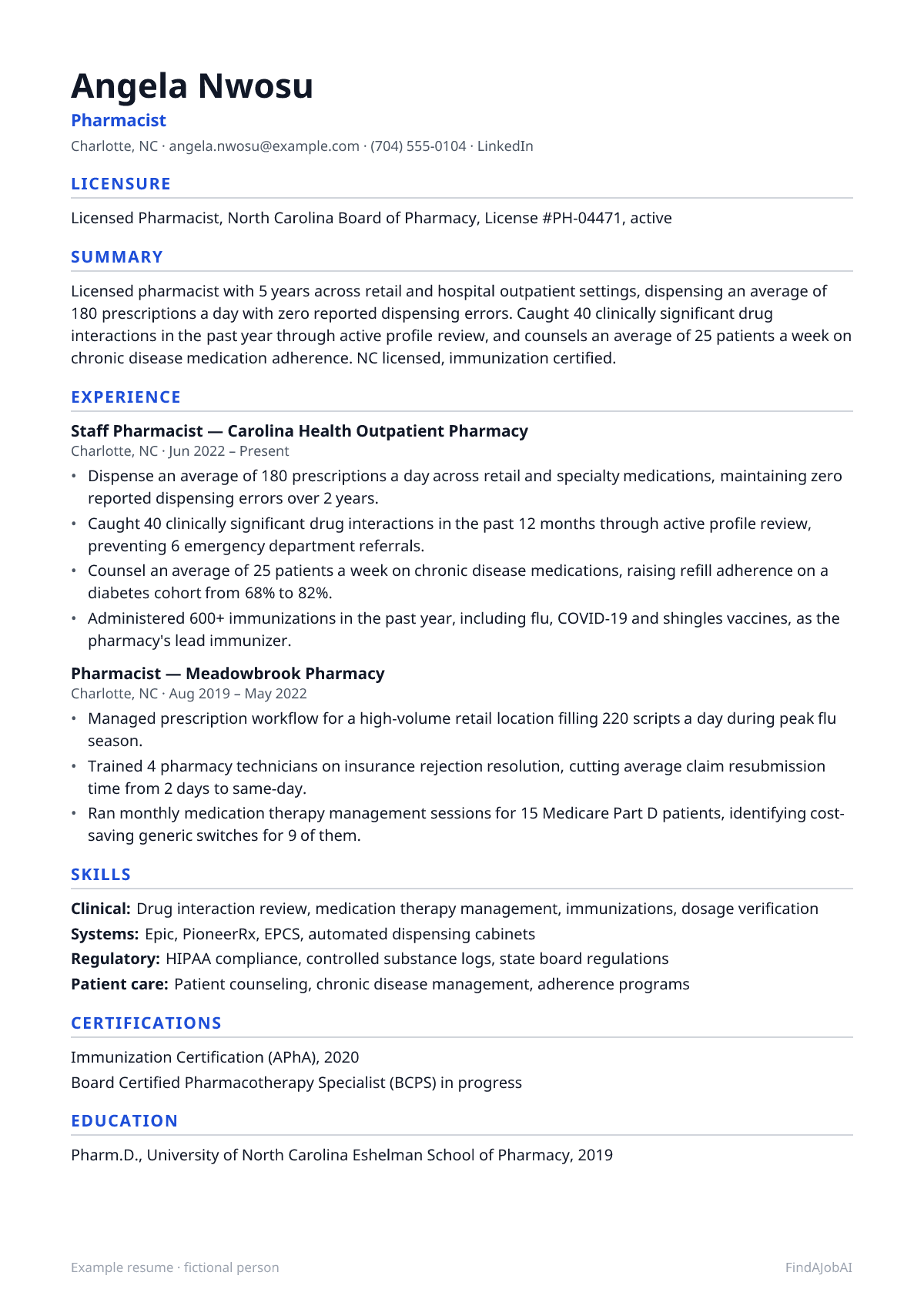
Pharmacist resume template
This example as a one-page template: one column, standard headings and plain text, the format applicant tracking systems read most reliably.
After you sign up, Create my CV builds your own resume in this same one-column layout, from your real experience.
Mid-level pharmacist resume example
A complete one-page example for a fictional pharmacist: every bullet pairs an action with what changed because of it.
Example resume · fictional person
Licensure
- Licensed Pharmacist, North Carolina Board of Pharmacy, License #PH-04471, active
Summary
Licensed pharmacist with 5 years across retail and hospital outpatient settings, dispensing an average of 180 prescriptions a day with zero reported dispensing errors. Caught 40 clinically significant drug interactions in the past year through active profile review, and counsels an average of 25 patients a week on chronic disease medication adherence. NC licensed, immunization certified.
Experience
Staff Pharmacist, Carolina Health Outpatient Pharmacy
Charlotte, NC · Jun 2022 – Present
- Dispense an average of 180 prescriptions a day across retail and specialty medications, maintaining zero reported dispensing errors over 2 years.
- Caught 40 clinically significant drug interactions in the past 12 months through active profile review, preventing 6 emergency department referrals.
- Counsel an average of 25 patients a week on chronic disease medications, raising refill adherence on a diabetes cohort from 68% to 82%.
- Administered 600+ immunizations in the past year, including flu, COVID-19 and shingles vaccines, as the pharmacy's lead immunizer.
Pharmacist, Meadowbrook Pharmacy
Charlotte, NC · Aug 2019 – May 2022
- Managed prescription workflow for a high-volume retail location filling 220 scripts a day during peak flu season.
- Trained 4 pharmacy technicians on insurance rejection resolution, cutting average claim resubmission time from 2 days to same-day.
- Ran monthly medication therapy management sessions for 15 Medicare Part D patients, identifying cost-saving generic switches for 9 of them.
Skills
- Clinical: Drug interaction review, medication therapy management, immunizations, dosage verification
- Systems: Epic, PioneerRx, EPCS, automated dispensing cabinets
- Regulatory: HIPAA compliance, controlled substance logs, state board regulations
- Patient care: Patient counseling, chronic disease management, adherence programs
Certifications
- Immunization Certification (APhA), 2020
- Board Certified Pharmacotherapy Specialist (BCPS) in progress
Education
- Pharm.D., University of North Carolina Eshelman School of Pharmacy, 2019
Fictional example by the FindAJobAI team: the person, employers and numbers are invented. Keep the structure; use your own work and numbers you can explain in an interview.
Entry-level pharmacist resume example
A new Pharm.D. graduate with rotations standing in for work experience. Licensure sits at the top as a pending item since it's the first thing a hiring manager checks, and each rotation bullet names the setting and a specific contribution rather than a general description of duties.
Entry-level example resume · fictional person
Licensure
- Virginia Board of Pharmacy License: pending, NAPLEX scheduled for next month, MPJE passed
Summary
Recent Pharm.D. graduate with clinical rotations in community and hospital inpatient pharmacy, completed APhA immunization certification, and NAPLEX exam scheduled. Dispensed under supervision at an average volume of 150 prescriptions a day and contributed to a medication reconciliation project that caught 12 discrepancies across 60 patient charts.
Experience
Pharm.D. Candidate, Community Pharmacy Rotation, Oakwood Family Pharmacy
Richmond, VA · Jan 2026 – Apr 2026
- Dispensed under supervision at an average volume of 150 prescriptions a day, maintaining accuracy on every verified fill.
- Counseled 8 to 10 patients a day on new prescriptions and chronic medication refills, including 20 diabetes patients on insulin technique.
- Administered 45 flu and COVID-19 vaccinations during the rotation as part of the pharmacy's immunization clinic.
Pharm.D. Candidate, Hospital Inpatient Rotation, Riverside Regional Medical Center
Richmond, VA · Sep 2025 – Dec 2025
- Contributed to a medication reconciliation project across 60 patient charts, identifying 12 discrepancies flagged to the attending team.
- Presented 3 case reviews to the clinical pharmacy team on anticoagulation dosing adjustments for renally impaired patients.
- Shadowed daily rounds with 2 attending pharmacists, documenting interventions in the shared electronic health record.
Skills
- Clinical: Medication reconciliation, dosage verification, drug interaction screening
- Systems: Epic, PioneerRx (rotation exposure), EPCS
- Patient care: Patient counseling, immunizations, chronic disease basics
Certifications
- Immunization Certification (APhA), 2025
Education
- Pharm.D., Virginia Commonwealth University School of Pharmacy, 2026
Senior pharmacist resume example
A senior clinical pharmacist twelve years in, now leading a pharmacy team and building protocols rather than only dispensing. The bullets shift from individual accuracy toward program outcomes, staff leadership and system-wide safety numbers.
Senior example resume · fictional person
Patricia Alvarado
Senior Clinical Pharmacist
San Antonio, TX · [email protected] · (210) 555-0195 · LinkedIn
Licensure
- Licensed Pharmacist, Texas State Board of Pharmacy, License #PH-09213, active
Summary
Senior clinical pharmacist with 12 years in hospital and ambulatory care, leading a team of 6 staff pharmacists across 2 outpatient clinics. Built the anticoagulation monitoring protocol now used clinic-wide and reduced 30-day readmissions tied to medication errors by 18% through a discharge counseling program. BCPS certified.
Experience
Senior Clinical Pharmacist, Alamo Heights Medical Group
San Antonio, TX · May 2019 – Present
- Lead a team of 6 staff pharmacists across 2 outpatient clinics, setting dispensing protocols and reviewing complex cases weekly.
- Built the anticoagulation monitoring protocol now used across all clinic locations, reducing warfarin-related ED visits by 25%.
- Designed a discharge medication counseling program that reduced 30-day readmissions tied to medication errors by 18% across 400 discharges a year.
- Audit 500+ high-risk prescriptions a month for interaction and dosage errors, catching 60 requiring physician follow-up.
Clinical Pharmacist, South Texas Regional Hospital
San Antonio, TX · Jul 2014 – Apr 2019
- Rounded daily with 3 inpatient care teams, recommending dosage adjustments that were accepted in 90% of cases.
- Managed the hospital's antimicrobial stewardship reviews, cutting broad-spectrum antibiotic use by 15% over 2 years.
- Trained 10 pharmacy residents annually on clinical rounding and renal dosing adjustments.
Staff Pharmacist, Westgate Community Pharmacy
Austin, TX · Jun 2012 – Jun 2014
- Dispensed an average of 170 prescriptions a day with zero reported dispensing errors across 2 years.
- Ran a monthly diabetes medication therapy management clinic for 20 patients, improving A1C control in 14 of them.
Skills
- Clinical: Anticoagulation management, antimicrobial stewardship, medication therapy management, renal dosing
- Leadership: Staff scheduling, protocol development, resident training, case review
- Systems: Epic, Cerner, EPCS, automated dispensing cabinets
Certifications
- Board Certified Pharmacotherapy Specialist (BCPS), 2016
Education
- Pharm.D., University of Texas at Austin College of Pharmacy, 2012
How to write a pharmacist resume
Five steps, in the order a recruiter reads the page. The format around them stays plain for every job: one column, standard headings, newest role first.
Header: name, target title and links
Put your license number and status right under your contact information, not buried in the body. Hiring managers and compliance teams check license status before reading anything else.
Summary: what you do and your best proof
State your years of experience, your practice setting (retail, hospital, specialty) and one measurable outcome: an error rate, an adherence improvement or an intervention count. Avoid lines like "dedicated to patient care"; every pharmacist claims that.
Experience: newest first, a result in every bullet
Open each bullet with your setting and volume, then the specific clinical action and its outcome. "Dispensed prescriptions accurately" says nothing without a volume and an error rate attached to it.
Skills: grouped, in the ad's words
Group skills into clinical practice, pharmacy systems and regulatory knowledge. Name the exact system (Epic, PioneerRx, QS/1) and certification (BCPS, immunization, MTM) rather than generic terms like "pharmacy software."
Education and certifications
List your Pharm.D., the school and graduation year, plus board certifications like BCPS if held. New graduates should list rotations like work experience, each with the setting and one specific contribution.
Skills to put on a pharmacist resume
Hard skills are the tools and methods of the job; soft skills are how you work with people. Each comes with one way to prove it, because a skill named only in a list counts for little. Add the ones you really have.
Hard skills
- Drug interaction review
- Give the number of clinically significant interactions you caught in a set period and what harm it prevented.
- Medication therapy management
- Name the chronic condition and patient count in an MTM session you ran, with one outcome like a cost saving or dosage change.
- Immunizations
- State the number of vaccinations you administered in a year and whether you led the immunization program.
- Dosage verification
- Point to a specific error you caught, such as a pediatric or renal dosing issue, before it reached the patient.
- Patient counseling
- Give your weekly patient count and a measurable outcome, like an adherence rate improvement.
- Pharmacy systems (Epic, PioneerRx, QS/1)
- Name the system you used daily and a workflow you improved with it.
- Controlled substance management
- Mention your experience with EPCS or DEA compliance logs and the volume of controlled prescriptions you handled.
- Anticoagulation management
- Describe a monitoring protocol you followed or built and the number of patients it covered.
- Antimicrobial stewardship
- Give a specific reduction in inappropriate antibiotic use tied to your review process.
- Insurance and prior authorization
- State the volume of claims or rejections you resolved and your average turnaround time.
- Sterile compounding
- If applicable, mention the setting (hospital, specialty pharmacy) and your USP 797/800 compliance experience.
- Clinical rounding
- Name the care team you rounded with and your dosage recommendation acceptance rate.
Soft skills
- Attention to detail
- Describe a dispensing or dosage error you caught before it reached the patient, with the volume you review daily.
- Patient communication
- Give an example of explaining a complex regimen in plain language and a resulting adherence improvement.
- Working under pressure
- Mention your daily prescription volume during a peak period, like flu season, and your accuracy record.
- Team leadership
- Count the technicians or pharmacists you trained or supervised and what they went on to handle independently.
- Clinical judgment
- Give one case where you recommended a therapy change that a physician accepted.
- Empathy
- Describe a difficult patient conversation, such as a medication cost barrier, and how you resolved it.
- Time management
- State your daily volume and how you prioritize verification against counseling time.
Pharmacist resume bullet examples: weak vs strong
The same work, written two ways. The strong version names the tool, the scope and a result; the numbers are examples, yours must be real.
Weak: Filled prescriptions accurately.
Strong: Dispensed an average of 180 prescriptions a day with zero reported dispensing errors over 2 years.
Gives the daily volume and a concrete safety record instead of a general claim.
Weak: Counseled patients on medications.
Strong: Counseled an average of 25 patients a week on chronic disease medications, raising refill adherence on a diabetes cohort from 68% to 82%.
Shows counseling through a measurable adherence outcome.
Weak: Caught medication errors.
Strong: Intercepted 3 dosing errors on pediatric liquid prescriptions in one quarter by rechecking every weight-based dose before sign-off.
Quantifies clinical vigilance and the safety check behind it.
Weak: Gave vaccinations.
Strong: Ran the pharmacy's immunization program, giving 600+ flu, COVID-19 and shingles vaccines in a year and training 2 technicians to assist.
Turns a routine task into a volume and a leadership role.
Weak: Worked with insurance claims.
Strong: Taught 4 pharmacy technicians to resolve insurance rejections, so same-day resubmission replaced a 2-day average.
Shows operational impact and a training responsibility.
Weak: Managed pharmacy inventory.
Strong: Reduced expired medication waste by 30% by implementing a first-expired-first-out rotation system across 3,000 SKUs.
Names the system change and its measurable cost impact.
15 more pharmacist resume bullet examples
Grouped by area of the job, so you can find the ones closest to your work. Keep the shape (action, scope, result) and replace the invented numbers with your own.
Dispensing accuracy and safety
- Verified an average of 200 prescriptions a day across retail and specialty medications with zero reported errors over 3 years.
- Caught a pediatric dosing error on a liquid antibiotic prescription before dispensing, preventing a 10x overdose.
- Flagged 25 duplicate therapy orders across electronic health records in a single quarter, each resolved with the prescribing physician.
- Audited 300 high-alert medication orders a month, catching 18 requiring dosage clarification before administration.
Clinical interventions
- Recommended a switch from a brand-name to generic equivalent for 40 patients, saving an average of $65 a month per patient.
- Identified a drug-drug interaction between a new anticoagulant prescription and an existing antiplatelet medication, preventing a bleeding risk.
- Ran a monthly hypertension medication review for 30 patients, adjusting dosages for 12 after coordinating with their physicians.
- Consulted on 50 complex polypharmacy cases for patients over 65, discontinuing an average of 2 unnecessary medications per case.
Patient counseling and adherence
- Counseled 200 new-to-therapy patients a year on insulin administration technique, with a 90% correct self-administration rate at follow-up.
- Built a refill reminder call program for 80 chronic disease patients, raising on-time refill rates from 70% to 88%.
- Ran a smoking cessation medication counseling session for 25 patients, with 9 reporting successful quit attempts at 3-month follow-up.
Operations and team leadership
- Reduced prescription wait times from 25 to 12 minutes during peak hours by restructuring the verification workflow for 4 technicians.
- Trained 6 new pharmacy technicians on insurance adjudication, cutting rejected claim resubmission time by half.
- Led the transition to a new pharmacy management system for a 2-location chain, maintaining dispensing accuracy through the changeover.
- Set up a weekly 30-minute huddle with 2 technicians to review near-miss reports, cutting dispensing near-misses from 14 a quarter to 6.
Pharmacist resume summary examples
Two or three lines on what you do and your strongest proof. Start from the one closest to your level and use your own facts.
Recent Pharm.D. graduate with a community pharmacy rotation and a hospital inpatient rotation completed during school. Dispensed under supervision at an average volume of 150 prescriptions a day and completed APhA immunization certification. NC license pending, exam scheduled.
Pharmacist with 5 years across retail and hospital outpatient settings, dispensing an average of 180 prescriptions a day with zero reported dispensing errors. Caught 40 clinically significant drug interactions in the past year and counsels an average of 25 patients a week on medication adherence.
Senior clinical pharmacist with 12 years in hospital and ambulatory care, now leading a team of 6 staff pharmacists. Built the anticoagulation monitoring protocol used across 3 clinics and reduced readmissions tied to medication errors by 18% through a discharge counseling program.
Common pharmacist resume mistakes
Each one is easy to make and quick to fix before you apply.
License status missing or buried
A pharmacist resume without a visible license number and status raises an immediate question. Put it at the top, even if it says "pending, exam scheduled."
No prescription volume given
"Dispensed prescriptions accurately" doesn't say whether that's 50 a day or 250. State your daily or weekly volume to show the pace you're used to.
Clinical interventions left out
Listing "drug interaction review" as a skill without an example hides your clinical judgment. Give a specific interaction you caught and what it prevented.
Counseling described without an outcome
"Counseled patients on medications" is a duty, not a result. Pair it with an adherence rate, a cost saving or a follow-up outcome.
Rotations treated as less important than jobs
New graduates sometimes shrink rotation descriptions to a single line. Write them like work experience, with setting, responsibilities and one specific contribution.
ATS tips for a pharmacist resume
Applicant tracking systems turn your file into text that recruiters search, mostly for the skills and titles in the ad. They rarely reject a resume on their own; one that parses badly or misses the ad's words just doesn't come up.
- State your license number and status (active, in good standing) near the top; many pharmacy ATS filters check for this directly.
- Give your daily or weekly prescription volume; it tells a hiring manager the pace you're used to working at.
- Quantify clinical interventions, like drug interactions caught or dosage corrections made, rather than saying "ensured patient safety."
- Name the pharmacy system you used (Epic, PioneerRx, QS/1) since job ads often require experience with a specific platform.
- If you hold specialty certifications (BCPS, immunization, MTM), list them clearly; they often filter candidates before a resume is read in full.
For the format itself, run the free ATS resume checklist.
Everything for Pharmacists
- Pharmacist cover letter examplesThree example letters and a short email version
- Pharmacist interview questions30 questions with sample answers
- Pharmacist job descriptionDuties, skills and requirements
- How to tailor your resume without lying
Other resume examples
Pharmacist resume FAQ
What should go at the top of a pharmacist resume?
Your name, contact information and license number and status. Hiring managers and compliance teams need to confirm your license is active before reading further.
How do I show clinical judgment on a pharmacist resume?
Give specific examples: a drug interaction you caught, a dosage you corrected, or a therapy change you recommended, each with the number of patients or cases involved.
Should a new pharmacy graduate include rotations on their resume?
Yes. List clinical rotations like work experience, with the setting, your responsibilities and one specific contribution, such as a patient case you worked up or a protocol you followed.
How important is prescription volume on a pharmacist resume?
It matters because it signals the pace of the environment you're used to. A pharmacist used to 220 scripts a day at a busy retail location brings different experience than one used to a slower specialty setting.
How we built this page
The FindAJobAI team wrote the three example resumes, the bullets, the skills and the advice for pharmacist roles. The people, employers and numbers in the examples are invented; the structure, the tools and the way each bullet is built are the parts to copy.
Once we track enough live pharmacist job ads, this page also shows the skills they ask for most, counted the same way as our in-demand skills report.
Last reviewed on November 1, 2026.