Demand Planner Cover Letter Example (2026)
By FindAJobAI Team Updated How we built this page
Demand planning ads ask for forecasting skills, a planning system and S&OP experience, and most applicants repeat those words. A stronger letter explains one forecast you made better, why it was wrong before, who you had to convince and what happened to inventory or service afterwards.
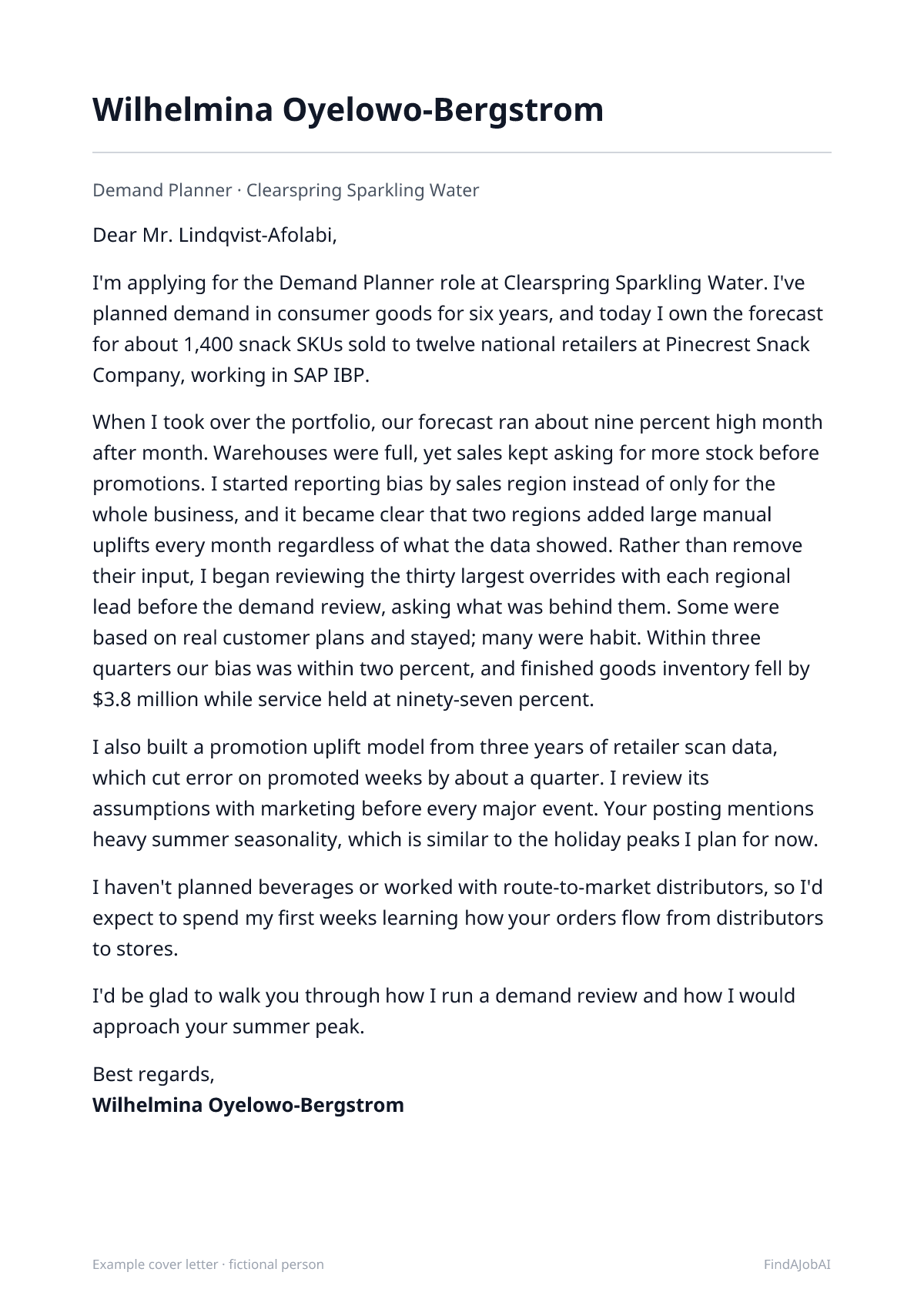
Demand Planner cover letter template
This letter as a one-page template: an opening that names the job and your strongest fact, proof that answers the ad, a reason for this employer and a short close.
After you sign up, FindAJobAI drafts your own letter for a real job from your CV in this format, and you edit it before you send it.
Example 1 · Experienced
Consumer goods demand planner applying to a beverage company
Wilhelmina forecasts 1,400 snack SKUs in SAP IBP. The ad wants a planner to reduce bias and lead the demand review for a growing drinks brand.
Example letter · fictional
Dear Mr. Lindqvist-Afolabi,
I'm applying for the Demand Planner role at Clearspring Sparkling Water. I've planned demand in consumer goods for six years, and today I own the forecast for about 1,400 snack SKUs sold to twelve national retailers at Pinecrest Snack Company, working in SAP IBP.
When I took over the portfolio, our forecast ran about nine percent high month after month. Warehouses were full, yet sales kept asking for more stock before promotions. I started reporting bias by sales region instead of only for the whole business, and it became clear that two regions added large manual uplifts every month regardless of what the data showed. Rather than remove their input, I began reviewing the thirty largest overrides with each regional lead before the demand review, asking what was behind them. Some were based on real customer plans and stayed; many were habit. Within three quarters our bias was within two percent, and finished goods inventory fell by $3.8 million while service held at ninety-seven percent.
I also built a promotion uplift model from three years of retailer scan data, which cut error on promoted weeks by about a quarter. I review its assumptions with marketing before every major event. Your posting mentions heavy summer seasonality, which is similar to the holiday peaks I plan for now.
I haven't planned beverages or worked with route-to-market distributors, so I'd expect to spend my first weeks learning how your orders flow from distributors to stores.
I'd be glad to walk you through how I run a demand review and how I would approach your summer peak.
Best regards,
Wilhelmina Oyelowo-Bergstrom
Example 2 · Entry level
New supply chain graduate applying for an entry-level demand planner role
Thaddeus finished a planning internship at a home goods company. The ad is for an associate demand planner at a pet food manufacturer.
Example letter · fictional
Dear Ms. Okafor-Rasmussen,
I'm applying for the Associate Demand Planner position at Prairie Tail Pet Foods. I graduated in June with a degree in supply chain management, after a six-month demand planning internship at a home goods company, and I'm now studying for my APICS CPIM while practising on public retail data sets.
During the internship my first task was to clean two years of shipment history for around 300 SKUs. It sounded dull, but it taught me the most. I noticed that several items showed sudden drops followed by large spikes, and when I checked inventory records, those dips matched periods when the warehouse had run out of stock. Customers hadn't stopped buying; we simply couldn't ship. I flagged forty-five such periods and showed my manager how they were dragging the baseline down, and the team corrected them before the next forecast run. After that, I built a weekly accuracy and bias report in Excel that the planners used in every weekly meeting until I left.
For my capstone project, I forecast weekly demand for a campus store's 120 items in Python and beat the store's manual forecast error by eighteen percent. Presenting the results to store managers taught me that a good forecast also needs a clear explanation, so I wrote a one-page summary for each manager showing which items needed more stock and why.
I haven't used a full planning system like the Oracle tool your posting mentions, but I learn software quickly and understand the logic behind it. I'd be grateful for the chance to start learning your process with the team.
Sincerely,
Thaddeus Nakagawa-Brennan
Example 3 · Senior or lead
Demand planning manager applying to lead planning at a medical supplies company
Cordelia leads six planners in consumer health and ran a Kinaxis rollout. The ad is for a head of demand planning at a medical supplies firm.
Example letter · fictional
Dear Dr. Ramaswamy-Hale,
I'd like to apply for the Head of Demand Planning role at Brightwell Medical Supplies. I've worked in demand planning for eleven years, and for the last five I've led a team of six planners covering about 2,800 SKUs across North America and Europe at Hollins Consumer Health.
When I took the role, every planner kept their own spreadsheet and the monthly demand review was mostly an argument about whose numbers were right. I proposed moving to Kinaxis, secured budget by showing finance how much safety stock our forecast error was forcing us to hold, and led the project with IT and a small group of planners. We went live in nine months with nearly all SKUs on statistical baselines. Accuracy at portfolio level has risen from sixty-eight to seventy-nine percent over three years, and we released about $11 million of safety stock.
The change I'm proudest of is cultural. I introduced forecast value added reporting, which showed that about a third of manual overrides made forecasts worse. Instead of banning overrides, we shared the results openly each month, and within a year the number of harmful changes had halved. Sales leaders now ask for the report before they adjust their numbers.
I haven't planned demand for hospitals or worked with tender-based contracts, which your posting mentions. I'd want to learn from your commercial team how those contracts are won and renewed before changing how they are forecast.
I'd welcome a conversation about where your planning process is today and where you'd like it to be.
Kind regards,
Cordelia Ferreira-Okoye
All three letters, and the short version below, are fictional: the people, employers and numbers are invented. Borrow the structure, never the facts.
- Prefer to write it yourself? Use the free cover letter template.
- Check your CV against the job first: the free CV score shows the missing keywords.
Why the first letter works, paragraph by paragraph
Paragraph 1: Opening
Gives years, industry, the size of the portfolio, the customers and the planning system, so the reader can place her in seconds.
Paragraph 2: The bias story
Starts from a business symptom, full warehouses, and shows how she found the cause in the data and changed behaviour with people rather than deleting their input.
Paragraph 3: Results
Bias, inventory and service figures together prove the change helped the whole business, not just a forecast metric.
Paragraph 4: Honest gap
Admits she hasn't worked with drinks distributors, which makes the matching experience more believable.
Paragraph 5: Close
Offers to discuss the demand review and the employer's seasonal peak, both directly tied to the job.
What the entry-level letter does differently
The graduate's letter turns a data cleaning task into evidence of planning judgment: spotting stockout periods that were distorting history. Adding a capstone with a measured result and an honest note about the planning system he hasn't used keeps it credible.
What the senior letter does differently
A manager's letter is about changes to how a whole team plans: a system rollout won with a financial case, and a reporting habit that shifted sales behaviour. The gap, hospital tenders, is specific and paired with a sensible first step.
Short demand planner cover letter: an email-ready version
Many applications arrive as an email or a small text box, and a full page doesn't fit. This version runs 120 to 150 words and keeps only what a reader needs to decide whether to reply. A demand planner replies to a recruiter who asked for a few lines by email about an opening at a garden products company.
Short version · email · fictional123 words
Subject: Demand Planner – seasonal CPG forecasting, Logility, new launches – Ignatius Mbeki-Sorensen
Hi Ms. Thorvaldsen-Quaye,
Thanks for contacting me about the Demand Planner opening at Greenfold Garden Products. I've spent four years forecasting about 600 seasonal SKUs for a lawn and outdoor brand, using Logility and Excel.
Our biggest problem was new product launches, which often left us with unsold stock after the spring season. I built a simple method based on five similar past launches and adjusted it by retailer commitment, and first-year write-offs on launches dropped by about a third. I also review the largest forecast changes with sales every month before they reach supply.
Your role mentions a short spring peak, which is the part of planning I know best. I'm available for a call any afternoon this week.
Thanks,
Ignatius Mbeki-Sorensen
The short version keeps one seasonal launch problem, the method used and the result, then connects to the employer's spring peak and offers a time to talk.
Opening lines that work for demand planner cover letters
The first sentence decides whether the second gets read. Here are six openings, one for each situation you might be in. Pick the one that matches yours and swap in your own facts: every name and number below is invented.
1. You have a standout result
Our forecast ran nine percent high every month when I took over the portfolio; three quarters later it was within two percent, and $3.8 million of stock left the warehouse.
2. The ad names a problem you've solved
I forecast 1,400 snack SKUs in SAP IBP and run the demand review that feeds our S&OP meeting, and I'd like to bring that work to your drinks brand.
3. Someone referred you
During my internship I found forty-five stockout periods hiding in our sales history, and fixing them changed the baseline for a whole product range.
4. You admire what they build
I led the move from spreadsheets to Kinaxis for a team of six planners, and accuracy has risen eleven points since.
5. You're new to the field or switching into it
Your posting asks for a planner who can handle a short, sharp seasonal peak, which describes every spring I've worked for the past four years.
6. You have senior scope or a specialism
I measure whether every manual forecast change helps or hurts, and sharing those results has halved the overrides that made our forecasts worse.
How to write a demand planner cover letter
Five steps, in the order you'd write them. The shape stays the same for every job (a short opening, proof, a reason for this employer, a close), and what goes into each part is what changes with the role.
Open with your portfolio and system
Say which industry you plan for, how many SKUs and customers you cover, and which planning system you use. A supply chain manager wants to know in two lines whether your experience matches the size and complexity of their range.
Tell one forecast improvement story
Pick a problem like bias, poor promotion forecasts or failed launches. Explain how you found the cause, who you worked with to change it, and the accuracy or bias figures before and after. A specific case shows method better than a list of models.
Connect the forecast to inventory and service
Leaders care about stock, write-offs and customer service, not forecast metrics alone. Add what happened to inventory value, days of supply or fill rate after your work, even if other teams also played a part in the result.
Show how you work with sales and supply
Demand planning depends on input from other teams. Mention how you run or prepare the demand review, how you challenge overrides and how you share risks, because hiring managers look for planners who can hold a firm, polite position.
Be honest about new industries or systems
If you haven't planned in their industry or used their software, say so and describe the closest experience. Planning interviews often test your understanding of their market, so a clear and modest statement protects your credibility later.
Demand Planner cover letter do's and don'ts
Do
- Name the size of your portfolio, your industry and the planning system you use in the first paragraph.
- Tell one story about improving a forecast, with accuracy or bias figures before and after.
- Link your forecast work to inventory, service or write-offs.
Don't
- Don't list forecasting methods without saying where they improved a real forecast.
- Don't present a forecast as exact; show you understand error and ranges.
- Don't claim experience with a planning system you've only seen in a demo.
Common demand planner cover letter mistakes
Each one is easy to make and quick to fix before you send the letter.
Accuracy figures with no context
Say which metric you use and at what level, such as SKU by month, so the number means something to the reader.
Talking only about models
Models matter less than judgment and process. Show how you cleaned data, challenged inputs or changed a meeting.
No business result
Add inventory, service or write-off figures so the reader sees what your forecasts changed in the business.
Blaming sales for bad forecasts
Describe how you worked with sales to improve inputs instead. Planners who build trust are easier to hire than planners who complain.
Email subject lines for demand planner applications
Applying by email? Put the job title, any reference number and your name in the subject line.
- Demand Planner application – CPG, 1,400 SKUs, bias cut to 2% – Wilhelmina Oyelowo-Bergstrom
- Associate Demand Planner – 2025 supply chain graduate, planning intern – Thaddeus Nakagawa-Brennan
- Application: Demand Planning Manager, Kinaxis rollout lead – Cordelia Ferreira-Okoye
Everything for Demand Planners
- Demand Planner resume exampleA full resume, plus bullet and summary examples
- Demand Planner interview questions30 questions with sample answers
- Demand Planner job descriptionDuties, skills and requirements
- Cover letter with no experience: templates
Other cover letter examples
Demand Planner cover letter FAQ
What should a demand planner cover letter include?
Your industry, portfolio size and planning system, one story about improving accuracy or bias with numbers, the effect on inventory or service, and any honest gap against the posting.
How do I write a demand planner cover letter as a new graduate?
Use an internship, capstone or analytics project. Describe a data problem you found, a forecast you built or a report people used, and give a number where you can.
Should a demand planner mention S&OP in a cover letter?
Yes, if you've taken part. Say what you prepared or presented in the demand review and one decision it supported, rather than just naming the process.
How we built this page
The FindAJobAI team wrote the three example letters, the short email version, the opening lines and the advice for demand planner roles. The people, employers and numbers in the letters are invented; the structure, the kind of evidence and the order of the paragraphs are the parts to copy.
Once we track enough live demand planner job ads, this page also shows the skills they ask for most, counted the same way as our in-demand skills report.
Last reviewed on November 1, 2026.