ETL Developer Cover Letter Example (2026)
By FindAJobAI Team Updated How we built this page
Teams hiring an ETL developer want proof that loads finish on time, that bad data gets caught before it reaches a report, and that you can own a feed when it breaks at two in the morning. A good letter picks one pipeline story with real volumes and run times, and shows how you work with the analysts who depend on your tables.
ETL Developer cover letter template
This letter as a one-page template: an opening that names the job and your strongest fact, proof that answers the ad, a reason for this employer and a short close.
After you sign up, FindAJobAI drafts your own letter for a real job from your CV in this format, and you edit it before you send it.
Example 1 · Experienced
Warehouse ETL developer applying to a healthcare analytics team
Cosimo maintains SSIS and Data Factory loads for a distributor. The ad asks for incremental loading, reconciliation habits and on-call support.
Example letter · fictional
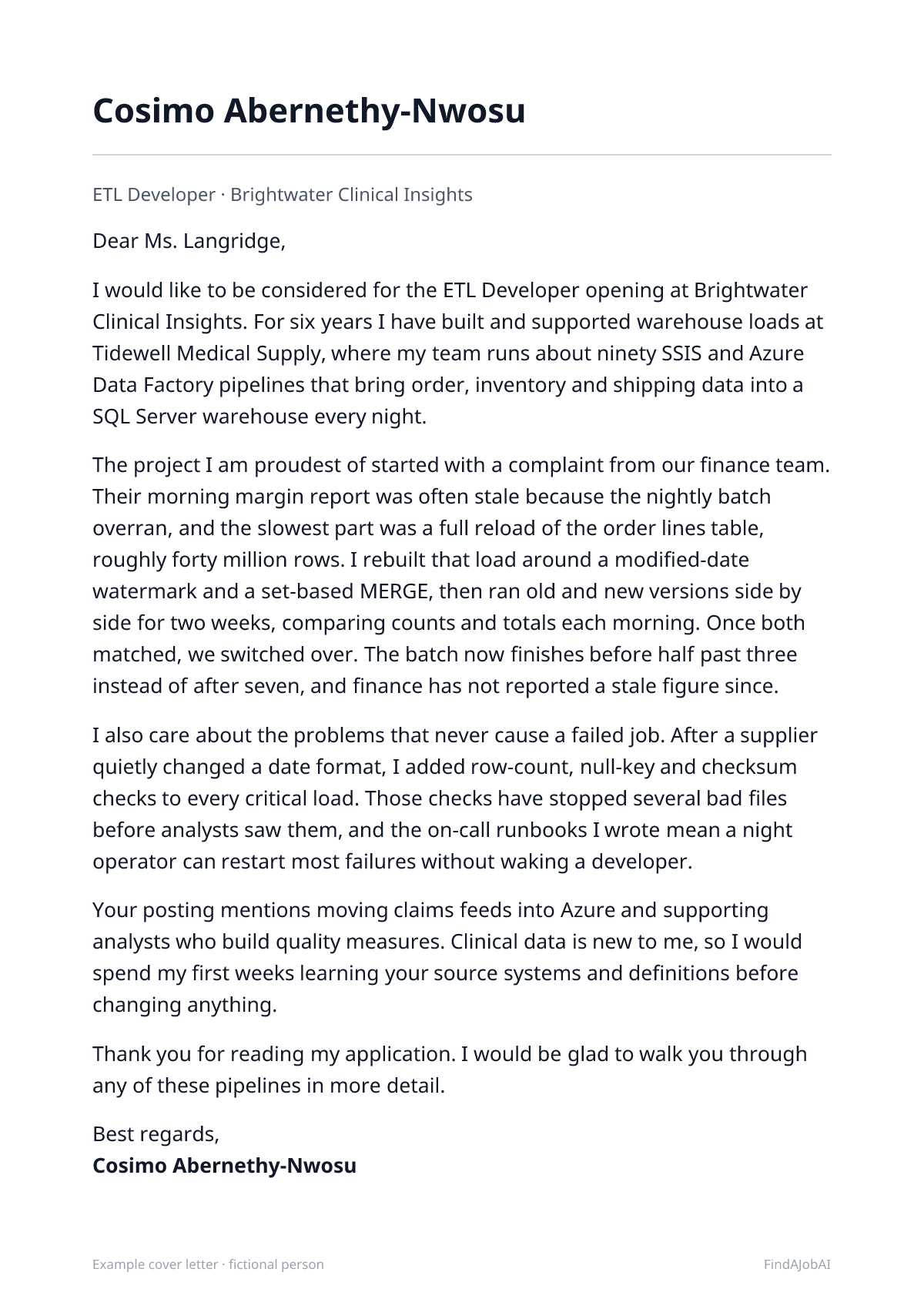
Dear Ms. Langridge,
I would like to be considered for the ETL Developer opening at Brightwater Clinical Insights. For six years I have built and supported warehouse loads at Tidewell Medical Supply, where my team runs about ninety SSIS and Azure Data Factory pipelines that bring order, inventory and shipping data into a SQL Server warehouse every night.
The project I am proudest of started with a complaint from our finance team. Their morning margin report was often stale because the nightly batch overran, and the slowest part was a full reload of the order lines table, roughly forty million rows. I rebuilt that load around a modified-date watermark and a set-based MERGE, then ran old and new versions side by side for two weeks, comparing counts and totals each morning. Once both matched, we switched over. The batch now finishes before half past three instead of after seven, and finance has not reported a stale figure since.
I also care about the problems that never cause a failed job. After a supplier quietly changed a date format, I added row-count, null-key and checksum checks to every critical load. Those checks have stopped several bad files before analysts saw them, and the on-call runbooks I wrote mean a night operator can restart most failures without waking a developer.
Your posting mentions moving claims feeds into Azure and supporting analysts who build quality measures. Clinical data is new to me, so I would spend my first weeks learning your source systems and definitions before changing anything.
Thank you for reading my application. I would be glad to walk you through any of these pipelines in more detail.
Best regards,
Cosimo Abernethy-Nwosu
Example 2 · Entry level
Reporting analyst applying for a first ETL developer role
Ingrid writes SQL reports for a utility and has built a few scheduled loads. The ad is for a junior ETL developer with SQL Server skills.
Example letter · fictional
Dear Mr. Okafor-Heath,
I am writing about the Junior ETL Developer role at Quarry Lane Energy Cooperative. I have spent two years as a reporting analyst at Fernhill Water Authority, writing T-SQL queries and SSRS reports for billing and field operations, and over the last year I have started building the loads that feed those reports myself.
That shift happened because I kept finding the same problems in our data. Meter readings sometimes arrived twice, and my reports would double-count usage for a few hundred accounts. Instead of patching each report, I asked our database lead if I could fix the problem at the source. With her guidance I built an SSIS package that stages the daily meter file, removes duplicates by meter and reading time, and logs how many rows it rejected. It has run every night for eight months, and the duplicate complaints from billing have stopped.
Since then I have built four more small loads, each with logging and a row-count check that emails me if a file is empty or unusually short. I keep the packages in Git, and I have learned a great deal from having my code reviewed, especially about set-based logic and indexing.
I know I still have a lot to learn about larger warehouses, scheduling tools and cloud services. What I can offer is solid SQL, a habit of checking data before trusting it, and a clear sense of what analysts need from the tables you build.
I appreciate you taking the time to read this, and I would welcome the chance to talk with your team.
Kind regards,
Ingrid Tavakoli-Reyes
Example 3 · Senior or lead
Lead ETL developer applying to run an integration team
Lucan has twelve years in data integration and leads five developers at a bank. The ad is for an integration lead who will set standards.
Example letter · fictional
Dear Ms. Wexford-Ibe,
I am applying for the Data Integration Lead position at Northgate Mutual Assurance. I have twelve years of ETL work behind me, and for the last four I have led a team of five developers at Lindenhall Savings Bank, where we run about three hundred Informatica jobs that feed finance, risk and regulatory reporting.
When I took over the team, every developer built feeds in a personal style, and onboarding a new source took close to a month. Reviews were rare, and when a job failed only its author could fix it with confidence. I introduced shared naming rules, a reusable load template with built-in logging and reconciliation, and peer review for every change. New feeds now take about a week and a half, and any developer on the team can support any job during on-call.
I have also worked closely with auditors. Our regulatory reports have passed four external reviews without data findings, partly because we keep a lineage register that traces each reported figure back to its source table. I see that kind of record as part of the job, not paperwork added at the end.
Your posting mentions moving policy and claims loads to a cloud warehouse. I have led part of a similar move, about eighty jobs to Snowflake, but not a full platform change. I would want to plan it with your architects and finance users, phase by phase, with parallel runs before each switch.
Thank you for your time. I would be happy to discuss how I could help your team grow its standards and its platform.
Sincerely,
Lucan Mbatha-Sorensen
All three letters, and the short version below, are fictional: the people, employers and numbers are invented. Borrow the structure, never the facts.
- Prefer to write it yourself? Use the free cover letter template.
- Check your CV against the job first: the free CV score shows the missing keywords.
Why the first letter works, paragraph by paragraph
Paragraph 1: Opening
States years of experience, the tools and the scale of the pipelines in two sentences, which answers the hiring manager's first questions.
Paragraph 2: The overrunning batch
A stale finance report, a clear technical fix and a careful parallel run show both skill and caution, with a run time anyone can understand.
Paragraph 3: Quiet data problems
Checks that catch bad files and runbooks for night operators show the writer thinks about reliability beyond a green job status.
Paragraph 4: Honest fit with clinical data
Admitting clinical data is new and offering to learn the sources first is honest and reassures a manager about risk.
Paragraph 5: Close
Offers a technical walk-through, which suits a role where interviews often go deep into real pipelines.
What the entry-level letter does differently
The analyst's letter turns reporting work into a reason to move into ETL: the writer fixed duplicates at the source rather than in each report. Mentioning code review, Git and logging shows good habits early, and the honest list of gaps keeps the letter believable.
What the senior letter does differently
The lead's letter shows leadership through a concrete change, shared templates and reviews that cut build time and spread support across the team. Audit results and lineage show maturity, and the writer is honest that their cloud migration experience covers only part of a platform.
Short ETL developer cover letter: an email-ready version
Many applications arrive as an email or a small text box, and a full page doesn't fit. This version runs 120 to 150 words and keeps only what a reader needs to decide whether to reply. An ETL developer replies by email to a recruiter who posted a six-month contract for a Talend migration on a job board.
Short version · email · fictional123 words
Subject: Talend contract – 5 years ETL, Snowflake loads, available in 2 weeks – Perpetua Galloway-Ikeda
Hi Mr. Penhaligon,
I saw your post about the six-month Talend contract with Saltmarsh Logistics Group and would like to be considered. I have five years of ETL work, the last three building Talend jobs that load shipment and billing data into Snowflake for a freight broker.
In my current contract I moved forty jobs from an old scheduler into Talend with parallel runs and reconciliation reports, and we switched over with no differences in the monthly billing totals. I write runbooks for each job, so support can continue after I leave.
I can start in two weeks and work remotely, or on site two days a week if the team prefers. My resume and two references are attached.
Thank you,
Perpetua Galloway-Ikeda
The short version answers a contract recruiter's questions first, tools, years and start date, then gives one migration result and a note on handover, which matters for any fixed-term role.
Opening lines that work for ETL developer cover letters
The first sentence decides whether the second gets read. Here are six openings, one for each situation you might be in. Pick the one that matches yours and swap in your own facts: every name and number below is invented.
1. You have a standout result
Our finance team's margin report used to arrive stale. Rebuilding one forty-million-row load as an incremental merge moved the whole batch finish from after seven to before half past three.
2. The ad names a problem you've solved
I started building ETL loads because my reports kept double-counting meter readings, and fixing the data at the source turned out to be the work I enjoy most.
3. Someone referred you
Daria Vellacott, a senior developer on your data team, suggested I apply after we worked together on a supplier data feed last year.
4. You admire what they build
I lead five developers who run about three hundred integration jobs for a bank, which is close to the platform your lead posting describes.
5. You're new to the field or switching into it
Your posting asks for someone who treats reconciliation as part of every load. That has been my habit since a silent date-format change taught me why.
6. You have senior scope or a specialism
I have spent the last three years building Talend jobs into Snowflake, and your six-month migration contract matches that work closely.
How to write an ETL developer cover letter
Five steps, in the order you'd write them. The shape stays the same for every job (a short opening, proof, a reason for this employer, a close), and what goes into each part is what changes with the role.
Lead with tools and scale
Open with your years in ETL, the tools you use in production and the size of what you run, such as job counts, rows per night or sources. These are the details a hiring manager scans for first, so state them plainly in one or two sentences.
Tell one pipeline story
Choose a load you built, sped up or repaired, and explain the problem, your approach and how you checked the result. Give a measured outcome, such as minutes saved, failed runs avoided or bad rows caught, so the story is easy to trust and remember.
Show how you protect data quality
Mention the checks you add to loads, such as row counts, totals, null keys or checksums, and one problem they caught. Managers worry about bad data reaching reports more than about a job that fails loudly, so this paragraph carries real weight.
Connect your work to its users
Name the teams that depend on your tables, such as finance, operations or analysts, and how you help them. A sentence on how you handle late loads or questions shows you can be trusted with a shared platform, not just a single job.
Name the tools you have not used
If the posting names a tool or industry you have not worked with, say so and explain how you would learn it, perhaps through a similar tool you picked up. An honest gap reads better than a claim that collapses in a technical interview.
ETL Developer cover letter do's and don'ts
Do
- Give the volume, tools and schedule of the loads you run in the first paragraph.
- Tell one pipeline story with a before-and-after run time or error count.
- Show how you check data quality and handle failures at night.
Don't
- Don't list every tool you have touched without saying what you built with it.
- Don't claim a whole migration if you led only part of it.
- Don't skip the people who use your data; managers want to know you work well with analysts.
Common ETL developer cover letter mistakes
Each one is easy to make and quick to fix before you send the letter.
Listing tools with no results
A row of tool names tells a manager little. Pick one or two and describe what you built with them and what improved.
Ignoring data quality
Add a sentence on the checks you build into loads and a problem they caught, since that is what managers fear missing.
Overstating your part in a migration
Say which jobs or subject areas you moved yourself. Interviewers will ask, and a clear scope keeps your letter credible.
Writing only for engineers
Hiring managers often share letters with analysts or business leads. Explain the result in terms they understand, like reports arriving on time.
Repeating the ETL posting word for word
Repeating the requirements adds nothing. Match two or three of them with a short, specific example from your own work.
Email subject lines for ETL developer applications
Applying by email? Put the job title, any reference number and your name in the subject line.
- ETL Developer application – SSIS and Data Factory, 6 years – Cosimo Abernethy-Nwosu
- Junior ETL Developer – SQL Server reporting analyst with SSIS loads – Ingrid Tavakoli-Reyes
- Application: Data Integration Developer (Req. 4471) – Cosimo Abernethy-Nwosu
Everything for ETL Developers
- ETL Developer resume exampleA full resume, plus bullet and summary examples
- ETL Developer interview questions30 questions with sample answers
- ETL Developer job descriptionDuties, skills and requirements
- Cover letter with no experience: templates
Other cover letter examples
ETL Developer cover letter FAQ
What should an ETL developer cover letter include?
Your main tools, the scale of the loads you run and one story about a pipeline you built or fixed, with a measured result. Add a line on how you check data quality and support failed jobs.
How do I write an ETL developer cover letter without ETL experience?
Show the SQL and data work you already do, such as reporting or database tasks, and any small loads or scripts you have built. Explain what pushed you toward ETL and what you have learned so far.
Should I mention specific tools like SSIS or Informatica?
Yes. Name the tools from the posting that you have used in production, and say what you built with them. If you have not used one, mention a similar tool and how quickly you learned it.
How we built this page
The FindAJobAI team wrote the three example letters, the short email version, the opening lines and the advice for ETL developer roles. The people, employers and numbers in the letters are invented; the structure, the kind of evidence and the order of the paragraphs are the parts to copy.
Once we track enough live ETL developer job ads, this page also shows the skills they ask for most, counted the same way as our in-demand skills report.
Last reviewed on November 1, 2026.