Ironworker Cover Letter Example (2026)
By FindAJobAI Team Updated How we built this page
Most ironworker hiring happens by phone, through a union hall or by word of mouth, but contractors still ask for a letter on many open-shop jobs and for apprenticeship applications. A good one is short and concrete: the structures you have built, your role on the crew, the cards you carry, and your safety record in plain numbers.
Ironworker cover letter template
This letter as a one-page template: an opening that names the job and your strongest fact, proof that answers the ad, a reason for this employer and a short close.
After you sign up, FindAJobAI drafts your own letter for a real job from your CV in this format, and you edit it before you send it.
Example 1 · Experienced
Journeyman connector applying to a steel erection contractor
Rafferty is a lead connector on hospital and office frames. The posting is for a journeyman at an erector building a stadium expansion.
Example letter · fictional
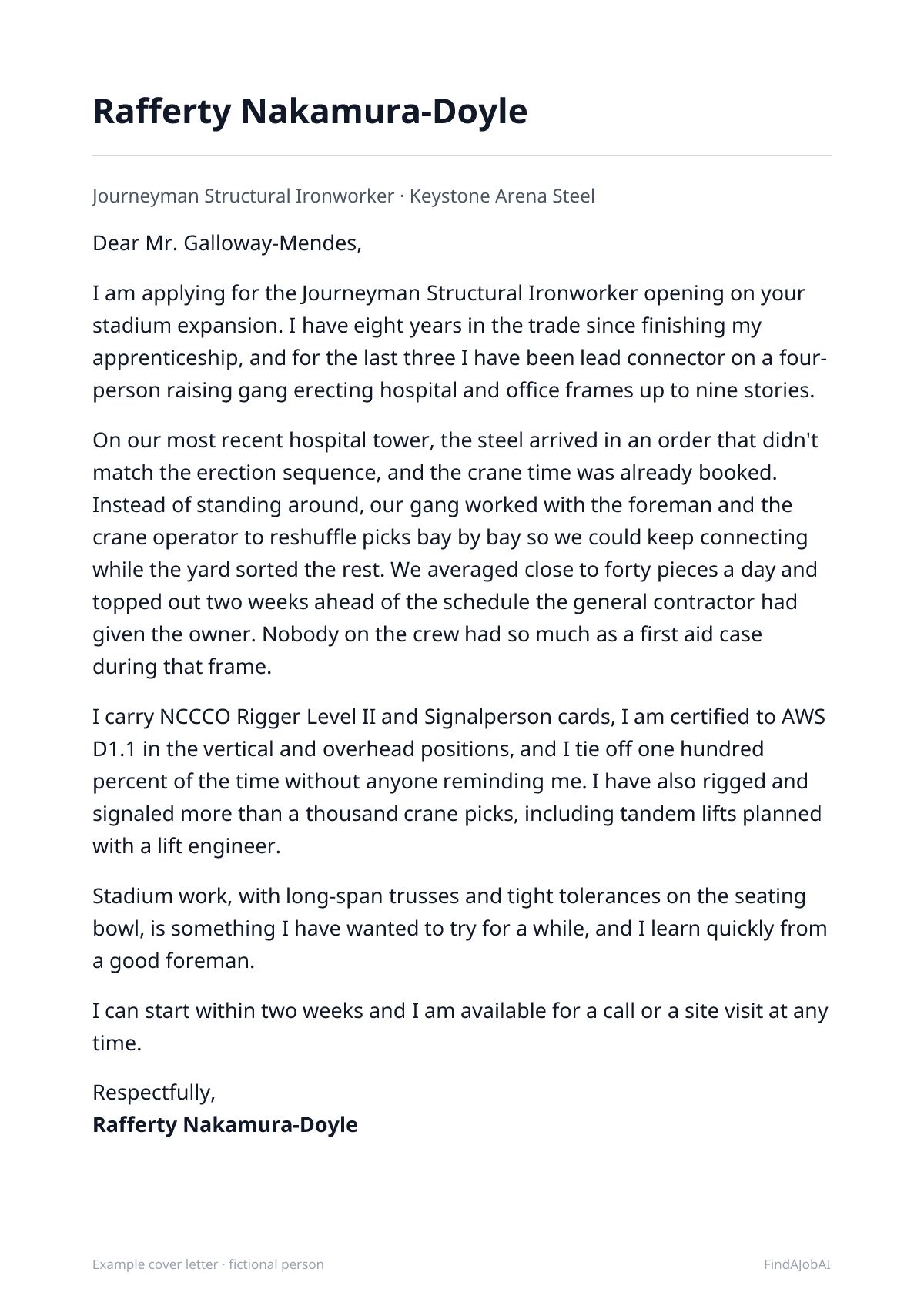
Dear Mr. Galloway-Mendes,
I am applying for the Journeyman Structural Ironworker opening on your stadium expansion. I have eight years in the trade since finishing my apprenticeship, and for the last three I have been lead connector on a four-person raising gang erecting hospital and office frames up to nine stories.
On our most recent hospital tower, the steel arrived in an order that didn't match the erection sequence, and the crane time was already booked. Instead of standing around, our gang worked with the foreman and the crane operator to reshuffle picks bay by bay so we could keep connecting while the yard sorted the rest. We averaged close to forty pieces a day and topped out two weeks ahead of the schedule the general contractor had given the owner. Nobody on the crew had so much as a first aid case during that frame.
I carry NCCCO Rigger Level II and Signalperson cards, I am certified to AWS D1.1 in the vertical and overhead positions, and I tie off one hundred percent of the time without anyone reminding me. I have also rigged and signaled more than a thousand crane picks, including tandem lifts planned with a lift engineer.
Stadium work, with long-span trusses and tight tolerances on the seating bowl, is something I have wanted to try for a while, and I learn quickly from a good foreman.
I can start within two weeks and I am available for a call or a site visit at any time.
Respectfully,
Rafferty Nakamura-Doyle
Example 2 · Entry level
Warehouse worker applying for an ironworker apprenticeship
Shayla has three years in a warehouse and wants to enter the trade. The letter goes with an apprenticeship application to a regional training program.
Example letter · fictional
Dear Apprenticeship Committee,
I am writing to apply for a place in the ironworker apprenticeship at the Tri-County Ironworkers Training Center. For three years I have worked at a building supply warehouse, where I load trucks, run forklifts and handle steel lintels, rebar bundles and joist packages every day.
What drew me to ironwork was watching our customers' crews unload steel at a job site down the street from the warehouse. Over a few months I saw an empty lot turn into a four-story frame, and I started asking the crew questions on my lunch breaks. One of the journeymen explained how the connectors work with the crane, and he encouraged me to apply here.
My warehouse work has given me a few habits that I think will carry over. I check every load before it moves, I have not had a damage claim or injury in three years, and I trained five new hires on securing loads safely. I am comfortable working outdoors in the cold, I am not bothered by heights, and I already completed my OSHA 10 card on my own time last month.
I know the first years of an apprenticeship mean carrying, bolting and learning from the ground up. I am ready for that, and I would like to finish the full program and work toward connecting and rigging. My family and my current supervisor both support this change, and I have arranged reliable transport to the training center and to job sites across the three counties.
Thank you for reviewing my application. I can attend an interview or aptitude test on any date you choose.
Sincerely,
Shayla Brennan-Okoye
Example 3 · Senior or lead
Ironworker foreman applying to run bridge erection crews
Augustin runs steel crews on buildings and a highway bridge. The ad is for a foreman at a heavy civil contractor with several bridge jobs.
Example letter · fictional
Dear Ms. Thorsdottir-Banks,
I would like to apply for the Ironworker Foreman position on your bridge program. I have sixteen years in the trade, the last seven as a foreman running crews of eight to fourteen ironworkers on hospitals, a stadium and, most recently, a two-span highway bridge.
The bridge taught me how different heavy civil work is from buildings. All girder setting had to happen during three weekend closures, with the state inspector, the traffic crew and two cranes all depending on our sequence. I worked with the lift engineer for weeks beforehand on crane positions, rigging for each girder and a fallback plan if wind shut us down. We set every girder inside the closures, and the road reopened on time each Monday morning.
Across nine projects as foreman my crews have worked without a lost-time injury. I write site-specific erection safety plans, run the morning toolbox talk myself, and I added a daily connection check with the inspector that cut our bolt-up rework from about six percent to under one.
I have only one bridge behind me, so I would expect to learn from your senior superintendents on the larger spans and on the state paperwork that comes with them. I bring strong lift planning and a crew culture that takes tie-off seriously. I also keep my own lift notes from every job, which I would happily share with your planning team.
I would welcome the chance to talk about your upcoming bridge schedule and how you staff crews across several sites.
Best regards,
Augustin Pellegrini-Asante
All three letters, and the short version below, are fictional: the people, employers and numbers are invented. Borrow the structure, never the facts.
- Prefer to write it yourself? Use the free cover letter template.
- Check your CV against the job first: the free CV score shows the missing keywords.
Why the first letter works, paragraph by paragraph
Paragraph 1: Opening
States years, crew role and structure types in two sentences, which is what an erection superintendent screens for first.
Paragraph 2: The sequencing story
Reshuffling picks with the foreman and operator shows practical judgment, and the topping-out date and clean safety record give hard results.
Paragraph 3: Cards and tie-off
Lists the rigging, signaling and welding cards a contractor needs to see, plus a direct statement about fall protection.
Paragraph 4: Interest in the project
Connects to long-span trusses on the stadium without overstating experience the writer does not have.
Paragraph 5: Start date and site visit
Gives a start date and offers a site visit, which matters more in the trades than a formal closing line.
What the entry-level letter does differently
The apprenticeship letter has no trade history, so it shows interest through a real moment on a job site, habits from warehouse work and an OSHA card earned unprompted. It is honest about starting at the bottom, which committees respect.
What the senior letter does differently
A foreman's letter reports crew size, planning and safety results, not personal tonnage. The weekend closure story shows coordination with engineers and inspectors, and the writer admits limited bridge experience honestly.
Short ironworker cover letter: an email-ready version
Many applications arrive as an email or a small text box, and a full page doesn't fit. This version runs 120 to 150 words and keeps only what a reader needs to decide whether to reply. A journeyman ironworker replies by email to a contractor's project manager who posted a short-term job for a warehouse frame.
Short version · email · fictional124 words
Subject: Journeyman ironworker for warehouse frame – rigger and AWS D1.1 – Lucinda Abernethy-Kamau
Hi Mr. Szabo-Ellison,
I saw your post about the warehouse frame starting next month at Flatwater Steel Builders. I am a journeyman ironworker with six years on steel erection and metal deck, mostly warehouses, distribution centers and parking structures across the region.
On my last job I connected and bolted the frame for a large distribution center, then laid deck and welded shear studs ahead of the concrete crews. I hold NCCCO Rigger Level I, AWS D1.1 structural welding and OSHA 30, and I have worked five years without a recordable injury.
I am free from the first of the month and have my own harness, tools and reliable transport. You can reach me at (402) 555-0177 most evenings after six.
Thanks,
Lucinda Abernethy-Kamau
A reply to a short-term job needs matching experience, cards and availability. The distribution center example fits a warehouse frame, and the phone number makes the next step easy.
Opening lines that work for ironworker cover letters
The first sentence decides whether the second gets read. Here are six openings, one for each situation you might be in. Pick the one that matches yours and swap in your own facts: every name and number below is invented.
1. You have a standout result
I have spent three years as lead connector on hospital frames, and your stadium expansion is the kind of long-span work I want next.
2. The ad names a problem you've solved
Our raising gang topped out a nine-story tower two weeks early without a single injury, and I'd like to bring that pace and care to your crew.
3. Someone referred you
Watching a crew raise a four-story frame next to my warehouse is what made me want to become an ironworker.
4. You admire what they build
I carry NCCCO rigger and signalperson cards and an AWS D1.1 welding certification, and your posting lists all three.
5. You're new to the field or switching into it
A journeyman from your last parking structure job, who I worked beside for two years, suggested I contact you.
6. You have senior scope or a specialism
As a foreman I have set every girder of a highway bridge inside three weekend closures, and I'm ready for a larger bridge program.
How to write an ironworker cover letter
Five steps, in the order you'd write them. The shape stays the same for every job (a short opening, proof, a reason for this employer, a close), and what goes into each part is what changes with the role.
Lead with status and role
Open with whether you are an apprentice, journeyman or foreman, how many years you have, and your usual role on the crew, such as connector, bolter or rigger. A superintendent decides in seconds whether to call you, and these facts are what that decision rests on.
Describe one job with results
Pick a recent structure and say what you built, how big it was and how it went, such as finishing ahead of schedule or setting a difficult pick. One real example from the iron tells the reader more than a long list of general construction duties ever will.
List your cards clearly
Name your NCCCO rigging and signaling cards, welding certifications and OSHA training, ideally with the year. Contractors often need specific cards to staff a job legally, so making them easy to spot can move you straight to the call list.
Prove your tie-off record
Give your safety record in hours or years without a recordable injury, and mention fall protection in plain words. Ironwork is high-risk, and superintendents want crew members who protect themselves and the people working around and below them.
End with a start date and phone
Close with when you can start and the best number to reach you. Many contractors hire by phone within a day or two, so a clear start date and contact details often matter more than a polished final sentence.
Ironworker cover letter do's and don'ts
Do
- Name the structures you have built and your role on the crew.
- List your rigging, signaling, welding and OSHA cards with current status.
- State your safety record plainly in hours or years.
Don't
- Don't write a long letter; contractors want the key facts quickly.
- Don't claim connecting or rigging experience you haven't done yourself.
- Don't forget a phone number and a start date.
Common ironworker cover letter mistakes
Each one is easy to make and quick to fix before you send the letter.
Writing a generic construction letter
Use ironwork terms such as connecting, bolting up, rigging and decking, and name the structures you have worked on.
Hiding cards at the end
Put rigging, signaling and welding cards in the body where a superintendent will see them within a few lines.
Saying you are safety minded without proof
Give hours or years without injury, and mention tie-off practice or a safety rep role.
Overstating an apprentice's skills
Describe tasks you actually did under supervision. Committees and foremen respect honesty about experience.
Leaving out your start date
Contractors staff jobs quickly. State your start date, transport and tools so they can plan you onto a crew.
Email subject lines for ironworker applications
Applying by email? Put the job title, any reference number and your name in the subject line.
- Journeyman Structural Ironworker – lead connector, NCCCO rigger – Rafferty Nakamura-Doyle
- Apprenticeship application – Shayla Brennan-Okoye
- Ironworker Foreman application – bridges and long-span steel – Augustin Pellegrini-Asante
Everything for Ironworkers
- Ironworker resume exampleA full resume, plus bullet and summary examples
- Ironworker interview questions30 questions with sample answers
- Ironworker job descriptionDuties, skills and requirements
- Cover letter with no experience: templates
Other cover letter examples
Ironworker cover letter FAQ
Do ironworkers need a cover letter?
Not always. Union dispatch and phone hiring are common, but open-shop contractors and apprenticeship programs often ask for one, and a short letter helps you stand out.
What should an ironworker cover letter include?
Your status, the structures and crew roles you have worked, your cards, your safety record, your start date and a phone number.
How do I write an ironworker apprenticeship cover letter?
Explain why you want the trade, show habits from past work such as safety and reliability, mention any cards you already hold, and say you are ready to start at the bottom.
How long should an ironworker cover letter be?
Under one page, about 250 to 350 words. Superintendents read quickly and care most about experience, cards and safety.
How we built this page
The FindAJobAI team wrote the three example letters, the short email version, the opening lines and the advice for ironworker roles. The people, employers and numbers in the letters are invented; the structure, the kind of evidence and the order of the paragraphs are the parts to copy.
Once we track enough live ironworker job ads, this page also shows the skills they ask for most, counted the same way as our in-demand skills report.
Last reviewed on November 1, 2026.