Localization Specialist Cover Letter Example (2026)
By FindAJobAI Team Updated How we built this page
Companies hire a localization specialist when they need products and campaigns to work in new markets without slowing releases or blowing the budget. A strong localization specialist cover letter shows the scale you have handled in languages and words, one workflow or quality improvement you made, and a result in turnaround, cost, quality scores or in-market performance.
Localization Specialist cover letter template
This letter as a one-page template: an opening that names the job and your strongest fact, proof that answers the ad, a reason for this employer and a short close.
After you sign up, FindAJobAI drafts your own letter for a real job from your CV in this format, and you edit it before you send it.
Example 1 · Experienced
App localization specialist applying to a travel booking company
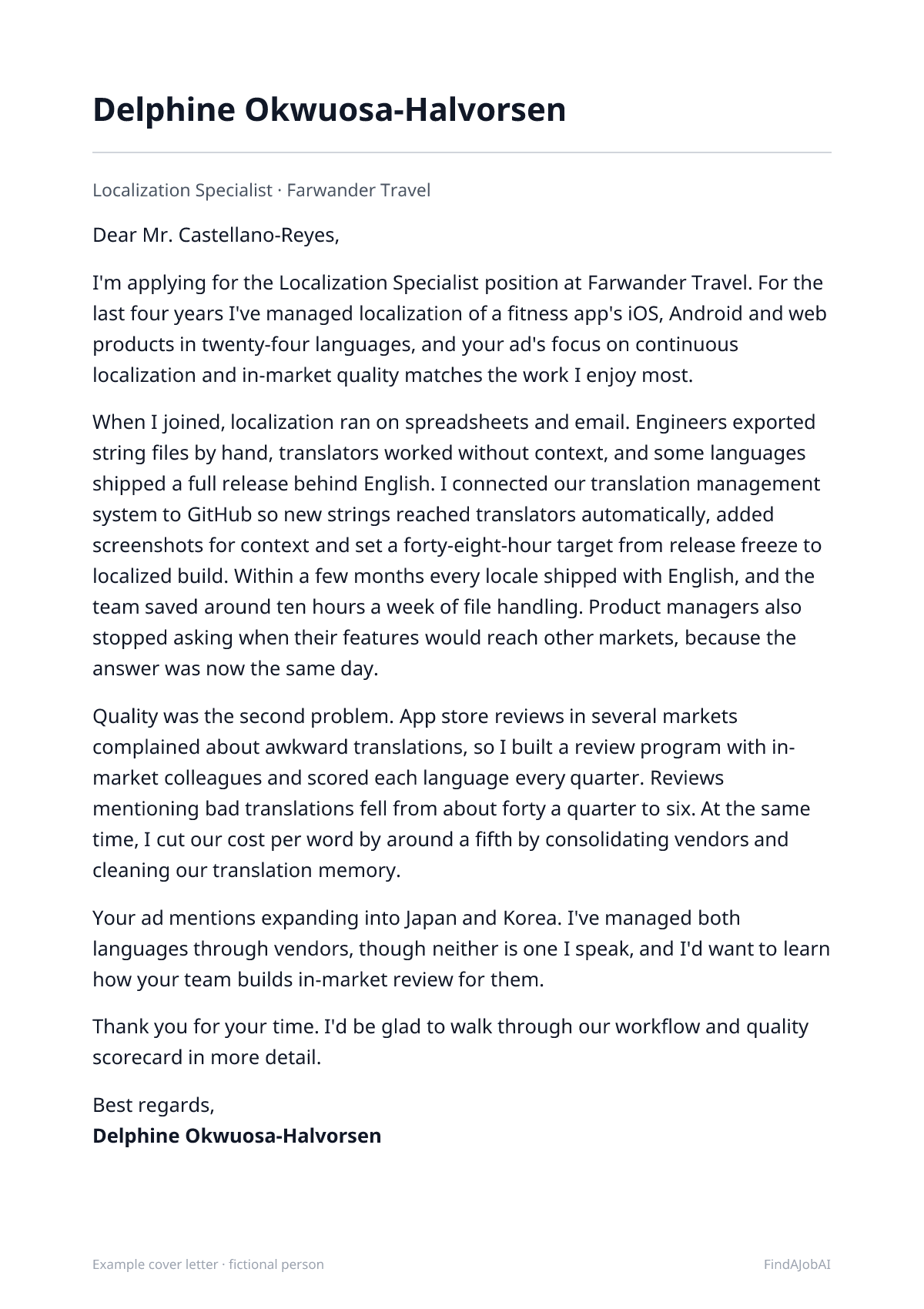
Delphine manages localization of a fitness app in 24 languages. The ad asks for continuous localization, vendor management and in-market QA.
Example letter · fictional
Dear Mr. Castellano-Reyes,
I'm applying for the Localization Specialist position at Farwander Travel. For the last four years I've managed localization of a fitness app's iOS, Android and web products in twenty-four languages, and your ad's focus on continuous localization and in-market quality matches the work I enjoy most.
When I joined, localization ran on spreadsheets and email. Engineers exported string files by hand, translators worked without context, and some languages shipped a full release behind English. I connected our translation management system to GitHub so new strings reached translators automatically, added screenshots for context and set a forty-eight-hour target from release freeze to localized build. Within a few months every locale shipped with English, and the team saved around ten hours a week of file handling. Product managers also stopped asking when their features would reach other markets, because the answer was now the same day.
Quality was the second problem. App store reviews in several markets complained about awkward translations, so I built a review program with in-market colleagues and scored each language every quarter. Reviews mentioning bad translations fell from about forty a quarter to six. At the same time, I cut our cost per word by around a fifth by consolidating vendors and cleaning our translation memory.
Your ad mentions expanding into Japan and Korea. I've managed both languages through vendors, though neither is one I speak, and I'd want to learn how your team builds in-market review for them.
Thank you for your time. I'd be glad to walk through our workflow and quality scorecard in more detail.
Best regards,
Delphine Okwuosa-Halvorsen
Example 2 · Career changer
Freelance translator moving into an in-house localization role
Benedetta has freelanced as an Italian–English translator for seven years. The ad is for a localization coordinator at a SaaS company.
Example letter · fictional
Dear Clearloop Localization Team,
I'm writing about the Localization Coordinator opening at Clearloop Software. I've worked as a freelance Italian–English translator for seven years, mostly on software and e-commerce content, and I'm ready to move from translating strings to running the process around them.
Over those years I've seen localization from the translator's side of the screen. The projects that went well had clear context, a maintained glossary and a quick way to ask questions. The ones that went badly sent bare strings with placeholders and no screenshots, and the errors showed up after release. Two years ago, one software client asked me to help fix exactly that. I built their first Italian termbase, wrote a short style guide and set up QA checks in Xbench. Their reviewers' corrections dropped by about half over the next six months, and they asked me to do the same for two more languages with other translators.
Since then I've completed a localization project management course and learned Phrase and Lokalise, the tools most of my clients use. I also manage my own schedule, invoicing and deadlines across several clients each month, so coordination is already part of my working week.
Your ad says Clearloop wants to improve translator context and quality. That is the problem I understand best, because I lived with it for years, and I know which small changes make the biggest difference to a translator working against a deadline.
I'd welcome the chance to talk about how I'd support your translators and reviewers.
Kind regards,
Benedetta Mwangi-Sorensen
Example 3 · Senior or lead
Localization program manager applying to lead global expansion
Leopoldine leads a five-person localization team covering 35 languages. The ad is for a head of localization to support expansion into new countries.
Example letter · fictional
Dear Ms. Underwood-Nkemelu,
I'm applying for the Head of Localization role at Northfare Marketplace. I've worked in localization for fourteen years, and for the last six I've led a team of five supporting forty product teams in thirty-five languages at a retail group.
Your ad says localization has become a bottleneck as the company enters new countries. We were in the same place when I took over. Each new market meant weeks of manual work, so product teams treated localization as a final step rather than part of building features. I built a continuous localization platform on our TMS and CI pipelines, so strings flow to translators as soon as they are merged and come back automatically. Time from freeze to localized release fell from about three weeks to two days, and we went from eight localized countries to twenty-two in four years.
I've also had to defend budgets. Rather than reporting words translated, I began reporting localization spend next to revenue from each market, which changed the conversation with finance. That evidence helped us add machine translation with human post-editing for support content and translate three times more articles on the same budget.
I haven't localized for a two-sided marketplace, and I'd expect seller-generated content to raise quality and moderation questions I'll need to learn. I would start by sitting with your trust and safety team before changing anything in the workflow.
I'd like to hear which markets are next on your roadmap and where localization currently slows them down.
Sincerely,
Leopoldine Achebe-Varga
All three letters, and the short version below, are fictional: the people, employers and numbers are invented. Borrow the structure, never the facts.
- Prefer to write it yourself? Use the free cover letter template.
- Check your CV against the job first: the free CV score shows the missing keywords.
Why the first letter works, paragraph by paragraph
Paragraph 1: Opening
States language count, product types and a direct match to two parts of the ad, so the reader immediately sees relevant scale.
Paragraph 2: Workflow change
Describes the broken process, the specific changes (integration, context, a turnaround target) and two results. That is the core evidence of a strong localization specialist.
Paragraph 3: Quality and cost
Adds a measurable quality program and a cost result, showing the writer improves outcomes, not just speed.
Paragraph 4: Honest scope
Addresses the ad's new markets honestly, separating vendor management from personal language skills, which builds trust.
Paragraph 5: Close
Offers a concrete walkthrough of the workflow and scorecard, an easy next step for the hiring manager.
What the career changer's letter does differently
The career changer's letter turns freelance translation into an advantage by explaining what makes localization succeed from the translator's side, then shows coordination work she already did for a client with a measurable result. The course, tool skills and self-managed workload fill the gaps a hiring manager might worry about.
What the senior letter does differently
A senior letter connects localization to business growth: a platform that removed the bottleneck, market expansion that followed and budget reporting tied to revenue. The honest note about seller-generated content shows awareness of what will be new.
Short localization specialist cover letter: an email-ready version
Many applications arrive as an email or a small text box, and a full page doesn't fit. This version runs 120 to 150 words and keeps only what a reader needs to decide whether to reply. A localization specialist replies to a startup's head of growth who posted the role in a localization community group with an email address.
Short version · email · fictional124 words
Subject: Localization Specialist – app and marketing localization, 12 languages – Florian Okeke-Johansson
Hi Ms. Fairbanks,
I saw your post for a localization specialist at Brightquay Learning. I've spent five years localizing apps and marketing for a language-learning company, most recently managing twelve languages with a small vendor team.
My most useful project was localizing our app store listings and onboarding emails with in-market copywriters instead of straight translation. Installs and email open rates in our non-English markets both rose over the following quarter, and the copywriters still work with us today.
Your post mentions launching in Latin America next year. I've managed Mexican and Brazilian launches before and would enjoy helping plan yours. My resume is attached, and I'd be glad to set up a call for any afternoon that works for you.
Thanks,
Florian Okeke-Johansson
The short email gives scale, one project with clear results and a direct link to the startup's planned Latin American launch, which is all a head of growth needs to decide on a call.
Opening lines that work for localization specialist cover letters
The first sentence decides whether the second gets read. Here are six openings, one for each situation you might be in. Pick the one that matches yours and swap in your own facts: every name and number below is invented.
1. You have a standout result
Last year I set up continuous localization for an app in twenty-four languages so every locale shipped with English. I'd like to bring that workflow to your product.
2. The ad names a problem you've solved
Your ad says localized releases often lag weeks behind English. I closed that gap at my current company by connecting our TMS to GitHub and setting a forty-eight-hour target.
3. Someone referred you
Your localization lead, Tomasz Ferreira-Oduya, and I worked together at a language services provider for two years. He mentioned you need someone who knows both vendors and tools, which is why I'm writing.
4. You admire what they build
I've used your company's app in French and Spanish for years and noticed how natural the translations feel, so I'd like to help keep that quality as you add languages.
5. You're new to the field or switching into it
After seven years as a freelance Italian–English translator, I want to move in-house and run the localization process that supports translators like me.
6. You have senior scope or a specialism
I've led a localization team covering thirty-five languages and helped grow localized markets from eight countries to twenty-two, and I'm ready to lead a global expansion.
How to write a localization specialist cover letter
Five steps, in the order you'd write them. The shape stays the same for every job (a short opening, proof, a reason for this employer, a close), and what goes into each part is what changes with the role.
Show your localization scale
Open with the number of languages, the type of content and the rough volume you handle. Product, marketing and support localization need different skills, so naming yours helps a hiring manager judge your fit quickly and see where you would contribute first.
Describe one process you improved
Pick a workflow problem you fixed, such as manual file handling, missing context or slow vendor turnaround. Explain what you changed, whether an integration, a glossary or a new review step, and keep it concrete enough that a reader can picture the before and after.
Prove quality with a measure
Localization quality is easy to claim and hard to show. Mention LQA scores, fewer reviewer corrections, fewer app store complaints or support tickets, and say how you measured them. A single honest number builds more trust than words like flawless.
Be precise about your languages
Say which languages you speak and at what level, and which you manage through vendors or reviewers. Hiring managers respect the distinction, and it avoids awkward moments if someone tests your fluency in a language you only coordinate.
Connect to their markets
Close by naming a market, tool or challenge from the ad, such as a launch in a new region, and what you would want to learn first. This shows you read the posting and gives the reader an easy opening question for the interview.
Localization Specialist cover letter do's and don'ts
Do
- Give the number of languages and the type of content you have localized.
- Describe one workflow, tooling or quality change with a measured result.
- Be clear about which languages you speak and which you manage through vendors.
Don't
- Don't write only about loving languages; show what you improved.
- Don't claim quality gains without saying how quality was measured.
- Don't overstate fluency in languages you would need to review yourself.
Common localization specialist cover letter mistakes
Each one is easy to make and quick to fix before you send the letter.
Writing about passion for languages only
Love of languages is common among applicants. Show a workflow, quality or market result instead so the reader sees what you deliver.
No sense of scale
Without languages, volume or content types, the reader cannot place you. Add those details in the opening paragraph.
Quality claims without evidence
Words like accurate and polished mean little alone. Use LQA scores, error counts or in-market feedback to back them up.
Blurring spoken and managed languages
Claiming fluency you lack can backfire in an interview. Separate languages you speak from those you manage through vendors.
Ignoring tools and integrations
Modern localization depends on TMS and developer workflows. Mention the tools you have set up or run, not just used as a translator.
Email subject lines for localization specialist applications
Applying by email? Put the job title, any reference number and your name in the subject line.
- Localization Specialist – continuous localization in 24 languages – Delphine Okwuosa-Halvorsen
- Localization Coordinator – freelance Italian–English translator – Benedetta Mwangi-Sorensen
- Application: Localization Program Manager (Req. 4417) – 35-language program
Everything for Localization Specialists
- Localization Specialist resume exampleA full resume, plus bullet and summary examples
- Localization Specialist interview questions30 questions with sample answers
- Localization Specialist job descriptionDuties, skills and requirements
- Career change cover letter: template + examples
Other cover letter examples
Localization Specialist cover letter FAQ
What should I write in a localization specialist cover letter?
Describe the languages and content you have handled, one process or quality improvement you made and its result, and how you work with product, marketing and vendors. Link it to the markets or tools mentioned in the ad and close with a specific next step.
How do I move from translator to localization specialist?
Show coordination work you have already done, such as building termbases, managing other translators or setting up QA checks. Add tool skills and any project management training, and explain how your translator experience helps you support linguists well.
Should I mention machine translation in a localization cover letter?
Yes, if you have used it with a clear review process. Explain where it fit, such as support content, how quality was checked and what it did for volume or cost, so the reader sees thoughtful use rather than shortcuts.
How we built this page
The FindAJobAI team wrote the three example letters, the short email version, the opening lines and the advice for localization specialist roles. The people, employers and numbers in the letters are invented; the structure, the kind of evidence and the order of the paragraphs are the parts to copy.
Once we track enough live localization specialist job ads, this page also shows the skills they ask for most, counted the same way as our in-demand skills report.
Last reviewed on November 1, 2026.