Mason Cover Letter Example (2026)
By FindAJobAI Team Updated How we built this page
Masonry ads mostly list a trade level, brick or block, and scaffold work. A cover letter gives you room to say what kind of walls you lay, how many units a day you keep up, and one moment where you protected the work from weather, water or a bad detail on the drawings. Those are the things a masonry foreman asks about on the phone anyway.
Mason cover letter template
This letter as a one-page template: an opening that names the job and your strongest fact, proof that answers the ad, a reason for this employer and a short close.
After you sign up, FindAJobAI drafts your own letter for a real job from your CV in this format, and you edit it before you send it.
Example 1 · Experienced
Veneer bricklayer applying to a commercial masonry contractor
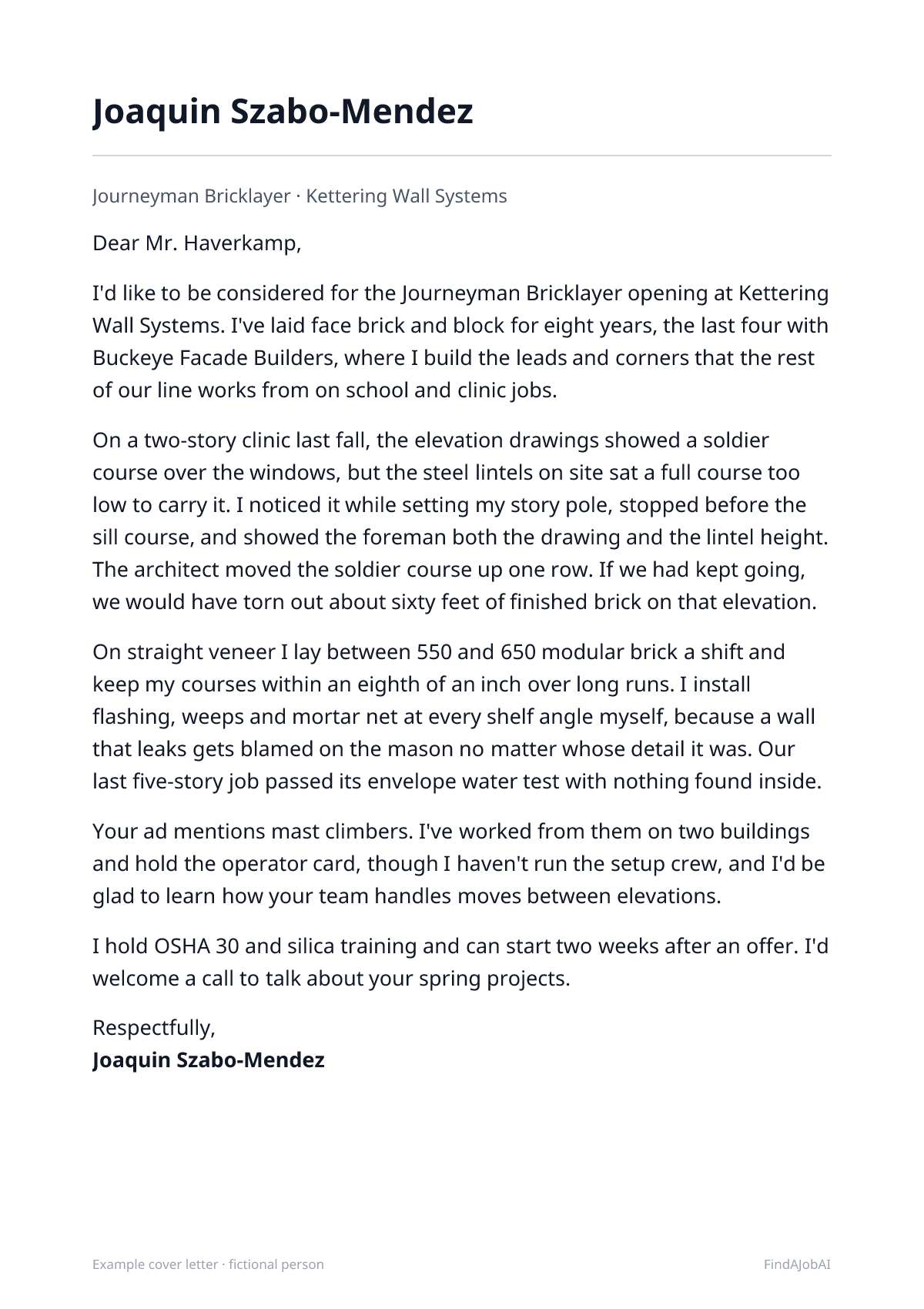
Joaquin lays face brick on schools and clinics. The ad asks for a journeyman who can build corners and work from a mast climber.
Example letter · fictional
Dear Mr. Haverkamp,
I'd like to be considered for the Journeyman Bricklayer opening at Kettering Wall Systems. I've laid face brick and block for eight years, the last four with Buckeye Facade Builders, where I build the leads and corners that the rest of our line works from on school and clinic jobs.
On a two-story clinic last fall, the elevation drawings showed a soldier course over the windows, but the steel lintels on site sat a full course too low to carry it. I noticed it while setting my story pole, stopped before the sill course, and showed the foreman both the drawing and the lintel height. The architect moved the soldier course up one row. If we had kept going, we would have torn out about sixty feet of finished brick on that elevation.
On straight veneer I lay between 550 and 650 modular brick a shift and keep my courses within an eighth of an inch over long runs. I install flashing, weeps and mortar net at every shelf angle myself, because a wall that leaks gets blamed on the mason no matter whose detail it was. Our last five-story job passed its envelope water test with nothing found inside.
Your ad mentions mast climbers. I've worked from them on two buildings and hold the operator card, though I haven't run the setup crew, and I'd be glad to learn how your team handles moves between elevations.
I hold OSHA 30 and silica training and can start two weeks after an offer. I'd welcome a call to talk about your spring projects.
Respectfully,
Joaquin Szabo-Mendez
Example 2 · Career changer
Mason tender asking to start a bricklayer apprenticeship
Tamsin has worked three years as a mason tender. She wants a contractor to sponsor her bricklayer apprenticeship and move her onto the line.
Example letter · fictional
Dear Ms. Ferrante,
I'm writing about the first-year Bricklayer Apprentice position at Greystone Brick Partners. For three years I've been a mason tender for a residential contractor, and I'm ready to move from feeding the wall to building it.
As a tender I mix mortar for a line of three or four bricklayers, stock units within reach on the scaffold boards and keep the plank heights right as the wall climbs. I've learned what a good batch looks like, how quickly it stiffens in August, and why a mason gets annoyed when the brick are stacked on the wrong side. I also build and inspect frame scaffold every morning with the foreman, which has made me careful about planks, pins and guardrails.
During lunch breaks the journeymen have let me lay practice courses on the back side of foundation walls, and last month our foreman had me run a short straight section between two corners on a garage. It passed his level check, and he signed the form recommending me for the apprenticeship program, which accepted me in October.
I know first-year pay is a step down from experienced tending, and I'm fine with that, because I want to learn veneer and block properly instead of picking up habits. Your crews work on both houses and light commercial jobs, so I'd see a wider range than I would with my current employer, who only builds homes. I'd also like to learn block foundations and simple arches from someone patient enough to correct my hand position early.
Thank you for reading this. I have an OSHA 10 card, my own trowels and level, and a reliable truck.
Sincerely,
Tamsin Achterberg
Example 3 · Senior or lead
Masonry foreman applying to run crews on a hospital expansion
Bartholomew has run brick and block crews for six years. The ad is for a masonry foreman on a phased hospital addition with winter work.
Example letter · fictional
Dear Mrs. Pemberton,
Please accept this letter for the Masonry Foreman role on your hospital expansion. I've run brick and block crews of eight to fourteen for six years at Wabash Masonry, after thirteen years laying brick myself, and most of that time has been on schools and healthcare buildings.
Your posting says the brick schedule runs through the winter. On a medical office building two years ago, we laid the north and east elevations between December and February. I had the scaffold tented and heated one lift ahead of the crew, kept mortar and units warm overnight, and logged mortar and air temperatures twice a day for the general contractor's file. The architect's spring walk found no cracked joints or efflorescence on either elevation, and the GC used my logs as the template for their next winter job.
I plan the work in two-week look-aheads, stage material so the telehandler never blocks a fire lane, and walk scaffold with the competent person every morning before anyone climbs. My crews have gone four years without a lost-time injury, and I run every saw wet to keep silica down.
I haven't worked inside an operating hospital with infection-control barriers, only on new additions beside one. I'd want to sit down with your safety manager before the first phase and learn your rules for dust, noise and patient areas. I'd also ask to meet the window and roofing foremen early, since flashing laps between our trades are where most addition leaks start.
I'd be glad to meet and walk through how I'd sequence the brick on your addition.
Kind regards,
Bartholomew Nwachukwu
All three letters, and the short version below, are fictional: the people, employers and numbers are invented. Borrow the structure, never the facts.
- Prefer to write it yourself? Use the free cover letter template.
- Check your CV against the job first: the free CV score shows the missing keywords.
Why the first letter works, paragraph by paragraph
Paragraph 1: Opening
Names his level, years and the fact that he builds corners, which tells a foreman he is trusted with lead work, not only straight runs.
Paragraph 2: The lintel catch
A drawing-versus-site conflict he spotted at the story pole, confirmed with the foreman and fixed before the brick went up. It shows he reads elevations against reality.
Paragraph 3: Production and water
A daily brick count, a tolerance and a passed envelope test: three numbers a masonry contractor can check with a reference.
Paragraph 4: Honest limit
Says he has worked from mast climbers but never run the setup crew, which is more believable than claiming full experience.
Paragraph 5: Close
Safety cards, silica training and a start date, the practical facts a contractor needs before scheduling a call.
What the career changer's letter does differently
The tender's letter is built on real time next to the wall: mixing for a line, keeping scaffold safe, practice courses at lunch, and a foreman's signed recommendation. She addresses the pay cut directly, which removes a worry the reader would otherwise have about a tender leaving after a few months.
What the senior letter does differently
A foreman's letter is about protecting other people's work: a heated tent one lift ahead, temperature logs the GC reused, and a staging plan that kept a fire lane open. The admitted gap, no infection-control work inside a live hospital, is specific enough to sound honest without disqualifying him.
Short mason cover letter: an email-ready version
Many applications arrive as an email or a small text box, and a full page doesn't fit. This version runs 120 to 150 words and keeps only what a reader needs to decide whether to reply. A stone mason answers a landscape stone shop's post that asked for a short email and a few photos instead of a full letter.
Short version · email · fictional129 words
Subject: Stone Mason application – dry-laid walls and patios, photos attached – Evander Quist
Hi Ms. Arvidsson,
I'm interested in the Stone Mason position at Ledgerock Stoneworks. For seven years I've built fieldstone walls, flagstone patios and outdoor fireplaces for a residential landscape company, mostly fitting and shaping stone by hand.
This summer I rebuilt a 90-foot dry-laid retaining wall on a sloped lot after frost had pushed half of it over. I dug out the old base, added a compacted gravel footing and drainage, and battered the new face back about an inch per foot. It has come through its first heavy rains without moving. Photos of that wall and two patios are attached.
Your post mentions natural stone veneer on new homes, which I'd like to do more of. I'm free to talk any weekday after three.
Thank you,
Evander Quist
The short version keeps one wall, the reason it failed and what was done differently, with photos as proof. It drops the full job history and ends with an easy next step.
Opening lines that work for mason cover letters
The first sentence decides whether the second gets read. Here are six openings, one for each situation you might be in. Pick the one that matches yours and swap in your own facts: every name and number below is invented.
1. You have a standout result
While setting my story pole on a clinic job, I noticed the steel lintels sat a full course below the soldier course on the drawings, and I stopped before laying the sill course.
2. The ad names a problem you've solved
Your posting says the brick runs through winter. Two years ago my crew laid two elevations of a medical office between December and February without a single cracked joint.
3. Someone referred you
Your superintendent, Wendell Okonjo, and I worked on a library addition together, and he told me your crews are short a corner lead for the spring.
4. You admire what they build
The brick entrance your company built for the county courthouse is the cleanest arch work I've seen in this city, and it's why I'm applying to lay brick for you.
5. You're new to the field or switching into it
After three years mixing mortar and building scaffold for a bricklaying crew, I've been accepted into the apprenticeship and want to spend my first year on your line.
6. You have senior scope or a specialism
I've led masonry crews of up to fourteen for six years with no lost-time injuries, and I'm ready to run brick and block on a larger healthcare project.
How to write a mason cover letter
Five steps, in the order you'd write them. The shape stays the same for every job (a short opening, proof, a reason for this employer, a close), and what goes into each part is what changes with the role.
State your level, material and building type up front
Say whether you're an apprentice, journeyman or foreman, whether you lay brick, block or stone, and on houses, schools or mid-rise buildings. A masonry foreman reading twenty letters needs to know in one sentence which crew and which wall you would fit.
Tell one story where you protected the wall
Pick a drawing conflict, a weather problem or a water detail you caught before it was built in. Describe how you confirmed it, who you told and what tearing out the finished brick would have cost. One clear example says more about judgment than a list of skills.
Give a production figure you can actually keep
Name a daily brick or block count for the wall type you lay most, along with a tolerance or inspection result. Contractors compare masons on output and accuracy together, and a believable number held for weeks beats a record day.
Name the gaps honestly
If the ad asks for stone, mast climber setup or work in an occupied hospital and you haven't done it, say so in a sentence and point to the closest work you have done. Contractors prefer a clear limit to finding out on the scaffold.
Close with cards, tools and a start date
List OSHA, scaffold and silica training, mention your own trowels and level and reliable transport, and give a start date. These are the details a contractor checks before booking a site visit or practical test.
Mason cover letter do's and don'ts
Do
- Say whether you lay brick, block or stone, and on what kind of building, in the first paragraph.
- Give one story about weather, water or a drawing conflict you caught before it was built in.
- List your scaffold, mast climber and silica training, since commercial contractors screen on them.
Don't
- Don't claim a daily brick count you can't keep up across a full week; foremen will test it on day one.
- Don't list every trowel and jointer you own; mention tools only if the ad asks.
- Don't skip your apprenticeship status; the contractor needs it to set your rate.
Common mason cover letter mistakes
Each one is easy to make and quick to fix before you send the letter.
Writing 'quality workmanship' with no proof
Every masonry applicant uses the phrase. Swap it for a tolerance you hold, a sample panel approved on the first walk or an envelope test with no water found.
Hiding whether you lay brick, block or stone
These are different crews at many contractors. Lead with your main material so the reader doesn't have to guess where to put you.
An inflated daily brick count
Foremen know what a realistic shift looks like on veneer versus corners. Give a range for straight walls and say what kind of wall it was.
Leaving out scaffold and silica training
Commercial masonry is almost all scaffold work with cut units. Name your scaffold, mast climber and silica training so the contractor can put you on site quickly.
Email subject lines for mason applications
Applying by email? Put the job title, any reference number and your name in the subject line.
- Journeyman Bricklayer application – veneer and corner lead – Joaquin Szabo-Mendez
- Bricklayer Apprentice – mason tender, accepted to program – Tamsin Achterberg
- Application: Masonry Foreman, Hospital Expansion (Req 4471) – Joaquin Szabo-Mendez
Everything for Masons
- Mason resume exampleA full resume, plus bullet and summary examples
- Mason interview questions30 questions with sample answers
- Mason job descriptionDuties, skills and requirements
- Career change cover letter: template + examples
Other cover letter examples
Mason cover letter FAQ
What should a mason cover letter include?
Your trade level, whether you lay brick, block or stone, the building types you work on, a realistic daily production figure, one problem you prevented, and your safety and scaffold training with a start date.
How does a mason tender write a cover letter for an apprenticeship?
Describe the work you already do beside the wall, such as mixing, stocking and scaffold setup, any practice courses you've laid, and a foreman's recommendation or program acceptance if you have one.
Should a stone mason send photos with a cover letter?
Yes, if the employer accepts attachments or links. Two or three photos of walls, fireplaces or patios you set show fit and pattern in a way that words cannot.
How we built this page
The FindAJobAI team wrote the three example letters, the short email version, the opening lines and the advice for mason roles. The people, employers and numbers in the letters are invented; the structure, the kind of evidence and the order of the paragraphs are the parts to copy.
Once we track enough live mason job ads, this page also shows the skills they ask for most, counted the same way as our in-demand skills report.
Last reviewed on November 1, 2026.