Orthodontist Cover Letter Example (2026)
By FindAJobAI Team Updated How we built this page
Practice owners hiring an orthodontist want to know three things fast: how many cases you can start and finish, how you treat patients and families, and whether you will help the practice grow. A good letter answers those with one or two real numbers and a short story from your clinic, then leaves the full detail to your resume.
Orthodontist cover letter template
This letter as a one-page template: an opening that names the job and your strongest fact, proof that answers the ad, a reason for this employer and a short close.
After you sign up, FindAJobAI drafts your own letter for a real job from your CV in this format, and you edit it before you send it.
Example 1 · Experienced
Associate orthodontist moving to a growing aligner-heavy practice
Wilhelmina has been an associate for five years in a two-office practice. The ad is from a practice adding a third office and many adult aligner patients.
Example letter · fictional
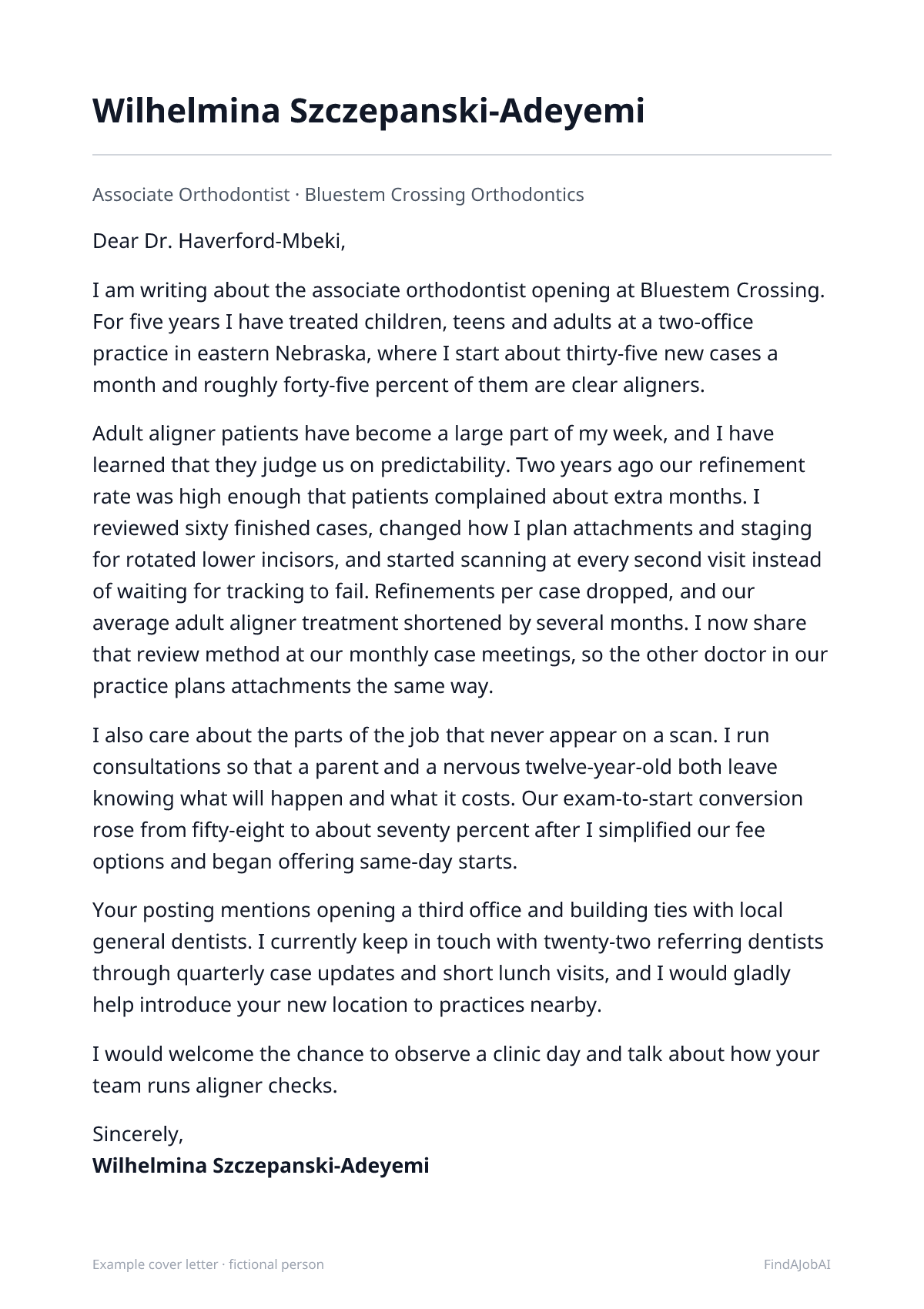
Dear Dr. Haverford-Mbeki,
I am writing about the associate orthodontist opening at Bluestem Crossing. For five years I have treated children, teens and adults at a two-office practice in eastern Nebraska, where I start about thirty-five new cases a month and roughly forty-five percent of them are clear aligners.
Adult aligner patients have become a large part of my week, and I have learned that they judge us on predictability. Two years ago our refinement rate was high enough that patients complained about extra months. I reviewed sixty finished cases, changed how I plan attachments and staging for rotated lower incisors, and started scanning at every second visit instead of waiting for tracking to fail. Refinements per case dropped, and our average adult aligner treatment shortened by several months. I now share that review method at our monthly case meetings, so the other doctor in our practice plans attachments the same way.
I also care about the parts of the job that never appear on a scan. I run consultations so that a parent and a nervous twelve-year-old both leave knowing what will happen and what it costs. Our exam-to-start conversion rose from fifty-eight to about seventy percent after I simplified our fee options and began offering same-day starts.
Your posting mentions opening a third office and building ties with local general dentists. I currently keep in touch with twenty-two referring dentists through quarterly case updates and short lunch visits, and I would gladly help introduce your new location to practices nearby.
I would welcome the chance to observe a clinic day and talk about how your team runs aligner checks.
Sincerely,
Wilhelmina Szczepanski-Adeyemi
Example 2 · Entry level
Orthodontic resident applying for a first associate position
Benedikt finishes residency next summer after two years as a general dentist. The ad is for a new-graduate associate with mentoring from the owner.
Example letter · fictional
Dear Dr. Quintanilla-Rourke,
I am applying for the new-graduate associate position at Larkfield Prairie. I will complete my orthodontic certificate next June, and before residency I spent two years in general practice in a small town where I referred children for orthodontic care almost every week.
My residency caseload is just over one hundred patients. It includes twelve orthognathic surgery cases planned with two oral surgeons, eighteen Phase I expansion cases and a growing number of adult aligner starts. I have placed about forty temporary anchorage devices under supervision, and I present my cases at weekly reviews where faculty question every decision. Those reviews have taught me to defend a plan with records rather than habit, and to change it quickly when the records say I am wrong. I also keep a log of every case I would plan differently today.
General practice taught me lessons that residency alone would not. I learned to stay on time with a full schedule, to explain care to families without jargon, and to respect how much a referring dentist needs clear updates. I still send short notes to the dentist I worked for whenever I see one of our former patients.
Your ad mentions a year of mentoring with the owner, which is exactly what I am looking for. I want to build good finishing habits early and become board certified within my first two years in practice, and I would value working beside someone who reviews cases closely.
I would be glad to visit for a working interview and to share a few of my finished residency cases with you.
Kind regards,
Benedikt Ferreira-Lindqvist
Example 3 · Senior or lead
Lead orthodontist applying to direct clinical care for a multi-office group
Cordelia has led clinical work at a four-office practice for seven years. The ad is for a clinical director at a group of nine orthodontic offices.
Example letter · fictional
Dear Mr. Trelawney-Mussa,
I am applying for the Clinical Director role at Ironweed Valley Orthodontic Group. For seven years I have been the lead orthodontist at a four-office practice in central Iowa, where I set clinical protocols for five associates and still start about thirty cases of my own each month.
When I took the lead role, each office finished cases differently, and average treatment time varied by almost six months between our fastest and slowest locations. I wrote shared protocols for wire sequences, aligner staging and retention, then reviewed thirty associate cases every quarter against them. The gap between offices narrowed to about two months, and patients moving between locations stopped noticing a change in how they were treated.
Growth matters as much as consistency. I started a referral program with forty general dentists, built around quarterly case updates and short evening study clubs, and group case starts rose by about a quarter over two years. I also mentor every new associate for six months, and our three most recent hires each reached a full schedule within their first year. Each of them still sends me a difficult case now and then, which I take as the best sign that the mentoring worked.
Your posting describes nine offices that have joined the group at different times and still use different systems. I would begin by spending a clinic day in each one, listening to the doctors and assistants before writing anything, then agree a short set of standards with the associates themselves.
I would be pleased to discuss what your first year of clinical goals looks like and how I could help reach them.
Best regards,
Cordelia Vanterpool-Hashemi
All three letters, and the short version below, are fictional: the people, employers and numbers are invented. Borrow the structure, never the facts.
- Prefer to write it yourself? Use the free cover letter template.
- Check your CV against the job first: the free CV score shows the missing keywords.
Why the first letter works, paragraph by paragraph
Paragraph 1: Opening
Names the role, years in practice, monthly case starts and the aligner share, which is the first thing an aligner-heavy practice wants to know.
Paragraph 2: Aligner refinement story
One real clinical problem with the steps taken and the result shows judgment and care for adult patients who value predictability.
Paragraph 3: Consultations and conversion
Connects patient communication to a measurable business result, exam-to-start conversion, which owners track every month.
Paragraph 4: Fit with the new office
Answers the posting's goal of opening a third office and offers a concrete way to help through referral relationships.
Paragraph 5: Close
Asks to observe a clinic day, a natural next step that lets the owner see how the doctor works with the team.
What the entry-level letter does differently
The resident's letter turns residency into numbers: caseload, surgical cases, expansion cases and TADs placed. Two years in general practice add schedule discipline and referral awareness, and the request for mentoring matches the ad.
What the senior letter does differently
The senior letter moves from personal case numbers to group results: protocols that narrowed the gap between offices, a referral program and associate mentoring. It ends with a listening-first plan that suits a group formed from many practices.
Short orthodontist cover letter: an email-ready version
Many applications arrive as an email or a small text box, and a full page doesn't fit. This version runs 120 to 150 words and keeps only what a reader needs to decide whether to reply. An orthodontist replies by email to a short posting for a part-time associate two days a week.
Short version · email · fictional138 words
Subject: Part-time associate orthodontist, two days a week – Ignatius Moreau-Kipkemboi
Hi Dr. Pemberton-Oduya,
I'm writing about the part-time associate role at Wapsipinicon Smile. I am a board-certified orthodontist with eight years of practice, and I currently work three days a week at a group office in Cedar Rapids, so Tuesdays and Thursdays are open.
On my clinic days I see sixty to eighty patients with three assistants and start around twenty new cases a month, split between brackets and aligners. I keep notes simple and consistent, so the doctor who sees my patients on other days can follow them easily. I also keep a few slots at the end of each day for broken wires and loose brackets, so those patients never wait until the following week.
My resume is attached. I'd be happy to visit for a clinic day whenever it suits your schedule.
Thanks,
Ignatius Moreau-Kipkemboi
The short email states availability first, then gives patient volume, case starts and a note on hand-offs, which is the main worry for a practice sharing patients between doctors.
Opening lines that work for orthodontist cover letters
The first sentence decides whether the second gets read. Here are six openings, one for each situation you might be in. Pick the one that matches yours and swap in your own facts: every name and number below is invented.
1. You have a standout result
I start about thirty-five new cases a month, and nearly half of them are adult aligner patients who expect predictable finishes.
2. The ad names a problem you've solved
After two years in general practice and three years of residency, I am ready to treat patients as your next associate.
3. Someone referred you
When our offices finished cases six months apart on average, I wrote the protocols that brought them within two months.
4. You admire what they build
Our exam-to-start conversion rose from fifty-eight to seventy percent once I simplified fee options and offered same-day starts.
5. You're new to the field or switching into it
Twenty-two local dentists send patients to our practice, and I keep each of them updated on every case they refer.
6. You have senior scope or a specialism
Your plan to open a third office caught my attention, because building referrals for a new location is work I enjoy.
How to write an orthodontist cover letter
Five steps, in the order you'd write them. The shape stays the same for every job (a short opening, proof, a reason for this employer, a close), and what goes into each part is what changes with the role.
Lead with case starts and your appliance mix
An owner reading your letter first wants to know whether you can carry a full schedule. Give your monthly case starts, or your residency caseload if you are new, and say roughly how your cases split between brackets and aligners so they can compare it with their own patient base.
Tell one treatment story with a measured result
Choose a clinical problem you actually solved, such as long aligner refinements or slow finishes, and explain what you reviewed, what you changed and how much time it saved patients. A short story like this shows clinical judgment better than a list of techniques and gives the owner a topic for the interview.
Connect chairside manner to case acceptance
Practices live on new-patient exams turning into treatment. Describe how you explain options to parents and teens or to nervous adults, and give a conversion figure if you track one. This shows you understand the business without sounding like a salesperson.
Show you will grow the referral base
Many associate postings mention practice growth. Say how many general dentists refer to you now and how you keep in touch with them, such as case updates or study clubs, and offer to do the same for the practice you are applying to.
State licensing and board status plainly
Mention the state where you are licensed and whether you are board certified or board eligible, with dates. Owners need to know when you can start treating patients, and answering it in the letter saves a round of emails before they invite you in.
Orthodontist cover letter do's and don'ts
Do
- Give your monthly case starts or residency caseload in the first paragraph.
- Tell one clinical story with the problem, what you changed and the outcome.
- Show how you talk with patients and parents, not only how you treat them.
Don't
- Don't list every appliance you know; your resume already does that.
- Don't skip board status; owners will ask about it anyway.
- Don't ignore referral work if the posting mentions practice growth.
Common orthodontist cover letter mistakes
Each one is easy to make and quick to fix before you send the letter.
Reciting the residency curriculum
Replace course lists with your own caseload numbers, complex cases and one patient story that shows how you think.
No mention of patient communication
Add a sentence on how you run consultations with families, since case acceptance depends on it as much as on clinical skill.
Silence on licensing timelines
State your license state and board status with expected dates, so the owner can plan your start and credentialing.
Treating the letter as a second resume
Keep the letter to one story and two or three numbers, and leave appliance lists and full dates to the resume.
Generic praise for the practice
Mention something specific from the posting, such as a new office or an aligner focus, and link it to what you have done.
Email subject lines for orthodontist applications
Applying by email? Put the job title, any reference number and your name in the subject line.
- Associate Orthodontist – 5 years, 35 starts a month – Wilhelmina Szczepanski-Adeyemi
- New-graduate associate application – resident finishing June – Benedikt Ferreira-Lindqvist
- Application: Associate Orthodontist, Bluestem Crossing – Wilhelmina Szczepanski-Adeyemi
Everything for Orthodontists
- Orthodontist resume exampleA full resume, plus bullet and summary examples
- Orthodontist interview questions30 questions with sample answers
- Orthodontist job descriptionDuties, skills and requirements
- Cover letter with no experience: templates
Other cover letter examples
Orthodontist cover letter FAQ
What should an orthodontist cover letter include?
Your years in practice or residency caseload, monthly case starts, the appliances you use most, one clinical story with a result, and why the specific practice fits you.
How long should an orthodontist cover letter be?
One page, about 250 to 350 words. Owners read it quickly before looking at your resume, so keep the numbers early and the story short.
Should a new orthodontic graduate mention board certification?
Yes. Say whether you are board eligible and when you plan to sit the clinical exam. Many practices support new associates through the process.
How we built this page
The FindAJobAI team wrote the three example letters, the short email version, the opening lines and the advice for orthodontist roles. The people, employers and numbers in the letters are invented; the structure, the kind of evidence and the order of the paragraphs are the parts to copy.
Once we track enough live orthodontist job ads, this page also shows the skills they ask for most, counted the same way as our in-demand skills report.
Last reviewed on November 1, 2026.