Tailor Cover Letter Example (2026)
By FindAJobAI Team Updated How we built this page
Tailoring shop owners usually decide after a practical test, so the letter's job is to earn that test. Say what garments you work on, how many a week, whether you run fittings yourself and how you handle busy seasons. One short story about a difficult fit you solved tells the owner more than a list of stitches.
Tailor cover letter template
This letter as a one-page template: an opening that names the job and your strongest fact, proof that answers the ad, a reason for this employer and a short close.
After you sign up, FindAJobAI drafts your own letter for a real job from your CV in this format, and you edit it before you send it.
Example 1 · Experienced
Alterations tailor moving to a menswear shop with made-to-measure work
Florentyna has done alterations and some suit construction for seven years. The ad is from a menswear shop expanding its made-to-measure service.
Example letter · fictional
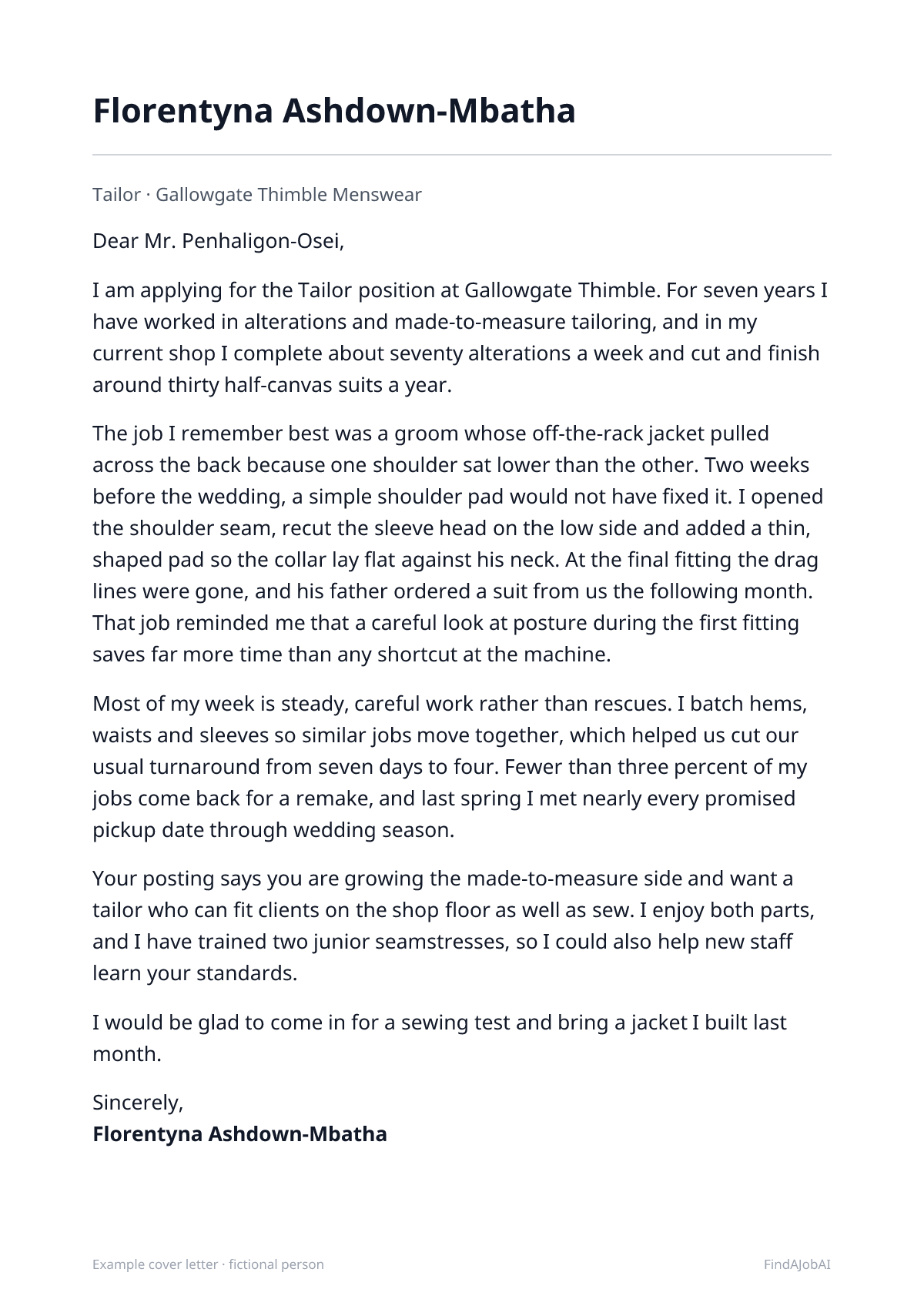
Dear Mr. Penhaligon-Osei,
I am applying for the Tailor position at Gallowgate Thimble. For seven years I have worked in alterations and made-to-measure tailoring, and in my current shop I complete about seventy alterations a week and cut and finish around thirty half-canvas suits a year.
The job I remember best was a groom whose off-the-rack jacket pulled across the back because one shoulder sat lower than the other. Two weeks before the wedding, a simple shoulder pad would not have fixed it. I opened the shoulder seam, recut the sleeve head on the low side and added a thin, shaped pad so the collar lay flat against his neck. At the final fitting the drag lines were gone, and his father ordered a suit from us the following month. That job reminded me that a careful look at posture during the first fitting saves far more time than any shortcut at the machine.
Most of my week is steady, careful work rather than rescues. I batch hems, waists and sleeves so similar jobs move together, which helped us cut our usual turnaround from seven days to four. Fewer than three percent of my jobs come back for a remake, and last spring I met nearly every promised pickup date through wedding season.
Your posting says you are growing the made-to-measure side and want a tailor who can fit clients on the shop floor as well as sew. I enjoy both parts, and I have trained two junior seamstresses, so I could also help new staff learn your standards.
I would be glad to come in for a sewing test and bring a jacket I built last month.
Sincerely,
Florentyna Ashdown-Mbatha
Example 2 · Entry level
Fashion program graduate applying for a first full-time tailor job
Desmond just finished a fashion degree and does part-time alterations at a dry cleaner. The ad is for a junior tailor at a bridal shop.
Example letter · fictional
Dear Ms. Fairweather-Nnamdi,
I am applying for the Junior Tailor position at Briar Lantern Bridal and Formal. This spring I finished an associate degree in fashion design and production, and for the past two years I have done part-time alterations at a busy dry cleaner while studying.
At the cleaner I complete about thirty hems, waist adjustments and zipper repairs a week, and I pin and mark ten or more fittings under our head tailor. She taught me to check a hem with the customer's actual shoes and to mark both sides before cutting anything, habits that have saved me from more than one mistake. I also keep a small notebook of every alteration I find difficult, with sketches of how she solved it, and I review it before busy weekends.
In school I built four fully lined jackets with hand-sewn buttonholes and drafted six pairs of trousers from my own patterns. My final project was an evening dress in silk crepe, which taught me how slowly delicate fabric must be handled and pressed. I would be eager to learn bustles and bodice work from your team. Beading and lace repairs interest me as well, since I know they are common requests before a wedding.
Your ad mentions that wedding season brings long weeks and many nervous customers. Working at a counter for two years has taught me to stay calm and friendly when someone is worried about a big day, and I am available for Saturdays and extra hours from March to October.
I have attached photos of my school garments and would welcome the chance to complete a sewing test at your shop.
Kind regards,
Desmond Kowalewski-Achebe
Example 3 · Senior or lead
Head tailor applying to run a bespoke house's workroom
Ambrose has been head tailor in a small bespoke workroom for eight years. The ad is for a workroom director at a larger bespoke house opening a second city.
Example letter · fictional
Dear Ms. Holloway-Adebanjo,
I am applying for the Workroom Director role at Merriwether Cloth and Needle. I have spent fifteen years in bespoke menswear, the last eight as head tailor of a five-person workroom in Manhattan, where I draft patterns for about sixty suits and twenty overcoats a year.
When I took over the workroom, almost a third of our orders needed a third fitting, which frustrated clients and pushed delivery past ten weeks. I wrote a baste fitting checklist covering posture, shoulder slope and sleeve pitch, and I began recording each client's quirks on their pattern card. Third fittings fell to about one order in ten, and our first suits now reach clients in eight to ten weeks.
Running the room also means scheduling three coat makers and two trouser makers so no one waits for work, ordering cloth and linings ahead of each season, and training apprentices. Two of the apprentices I trained now make full-canvas jackets on their own. I review their work every Friday, and we keep a shared list of faults so the whole room learns from each one.
Your posting says the house will open a second workroom next year and run trunk shows in three more cities. I currently run four trunk shows a year and measure about forty clients per trip, so I understand how pattern cards and fitting notes must travel with the client. I would start by agreeing one fitting record that both rooms use from the first day.
I would welcome the chance to meet your cutters and see the workroom before we discuss the plans in detail.
Best regards,
Ambrose Takahashi-Okoro
All three letters, and the short version below, are fictional: the people, employers and numbers are invented. Borrow the structure, never the facts.
- Prefer to write it yourself? Use the free cover letter template.
- Check your CV against the job first: the free CV score shows the missing keywords.
Why the first letter works, paragraph by paragraph
Paragraph 1: Opening
Gives years of experience, weekly alteration volume and yearly suit count, so the owner sees both alteration speed and construction skill.
Paragraph 2: Difficult fit story
A groom's uneven shoulder fixed close to the wedding shows real technique, calm under deadline and a business result through a new order.
Paragraph 3: Volume and reliability
Batching, a faster turnaround, a low remake rate and on-time pickups answer an owner's main worries about a new tailor.
Paragraph 4: Fit with the shop's plans
Connects the posting's made-to-measure growth with shop-floor fitting and training experience.
Paragraph 5: Close
Offers a sewing test and a recent jacket to inspect, which is how most shops decide.
What the entry-level letter does differently
The graduate's letter uses weekly repair counts from part-time work, habits learned from a head tailor and specific school garments to prove skill. It answers the shop's concern about busy wedding weeks with counter experience and clear availability.
What the senior letter does differently
The senior letter moves from personal sewing to running a room: fewer third fittings, shorter delivery, scheduling, cloth ordering and apprentices. It ties trunk show experience to the house's expansion and proposes one concrete first step.
Short tailor cover letter: an email-ready version
Many applications arrive as an email or a small text box, and a full page doesn't fit. This version runs 120 to 150 words and keeps only what a reader needs to decide whether to reply. A tailor answers a short online posting from a department store alterations room by email.
Short version · email · fictional133 words
Subject: Alterations Tailor, department store – 5 years, menswear and dresses – Henrike Moyo-Castellane
Hi Mr. Ravensworth-Chukwu,
I'm applying for the Alterations Tailor role in your store's alterations room. I have five years of experience at an independent alteration shop, working on suits, dresses, coats and casual wear, and I pin and mark my own fittings.
I complete about sixty alterations a week and keep my remake rate low by marking both sides and checking hems with the customer's shoes. I'm used to graduation and wedding rushes, when we often double our usual workload for several weeks. I'm also comfortable on industrial blind-stitch machines and sergers, and I keep my station tidy so tickets never go missing.
I'm available for weekends and extra hours in busy months. My resume and a few photos are attached, and I'm happy to do a sewing test.
Thank you,
Henrike Moyo-Castellane
The short email covers garment mix, fitting experience, weekly volume, a quality habit and busy-season availability, which are what a store alterations manager checks first.
Opening lines that work for tailor cover letters
The first sentence decides whether the second gets read. Here are six openings, one for each situation you might be in. Pick the one that matches yours and swap in your own facts: every name and number below is invented.
1. You have a standout result
Two weeks before his wedding, a groom's jacket pulled across the back, and recutting the low shoulder fixed it for good.
2. The ad names a problem you've solved
I complete about seventy alterations a week and fewer than three percent come back for a remake.
3. Someone referred you
This spring I finished a fashion production degree after two years of part-time alterations at a busy dry cleaner.
4. You admire what they build
When almost a third of our bespoke orders needed a third fitting, I wrote the checklist that brought it to one in ten.
5. You're new to the field or switching into it
Your plan to grow made-to-measure work is the reason I'm writing, because I enjoy fitting clients as much as sewing.
6. You have senior scope or a specialism
I have trained two junior seamstresses in linings and sleeves, and I would like to bring that care to your workroom.
How to write a tailor cover letter
Five steps, in the order you'd write them. The shape stays the same for every job (a short opening, proof, a reason for this employer, a close), and what goes into each part is what changes with the role.
Say which garments you sew and how many
An owner needs to know whether you mostly hem trousers, alter bridal gowns or build full suits. Name the garment mix in your first paragraph with a weekly alteration count or a yearly number of garments built, so they can match you to the work their customers bring in.
Describe one difficult fit you corrected
Pick a real job, such as an uneven shoulder, a gown that would not sit right or a coat with a twisted sleeve, and explain what you saw, what you changed and how the customer reacted. This shows technique and judgment in a way a list of stitches never can.
Show you are reliable on pickup dates
Customers often need garments for a fixed event. Mention how you track jobs, how you handle busy seasons and any figure you have, such as on-time pickups or a faster turnaround, so the owner trusts you with wedding and graduation work.
Mention fittings and customer contact
Many tailoring roles include pinning and marking customers on the shop floor. Say whether you run fittings yourself and how you explain what an alteration can and cannot achieve, because clear expectations prevent most complaints.
Invite a sewing test and bring work
Close by offering to complete a practical test and to bring a finished garment. Owners judge tailors by hand and eye, so making it easy for them to see your work gives your letter a natural next step.
Tailor cover letter do's and don'ts
Do
- Name the garments you alter or build and give a weekly or yearly count.
- Describe one fitting problem you solved and how it ended.
- Offer to take a practical test and bring finished work.
Don't
- Don't write only about loving fashion; show the sewing you have done.
- Don't skip fittings if the role involves customers on the shop floor.
- Don't forget busy-season availability for wedding and graduation months.
Common tailor cover letter mistakes
Each one is easy to make and quick to fix before you send the letter.
A letter about style with no sewing
Replace general comments about fashion with garments you altered or built, the techniques used and how many you complete.
No sign you can run fittings
Add a sentence on pinning and marking customers yourself, or say clearly that you have worked under a fitter.
Overlooking busy seasons
State your availability for wedding, prom and graduation months, when most alteration shops need extra hours.
Claiming perfection with no evidence
Give a remake rate, on-time pickup figure or a specific fix instead of calling your work flawless.
Forgetting to offer finished work
Mention photos or a garment you can bring, since owners want to see linings, seams and pressing up close.
Email subject lines for tailor applications
Applying by email? Put the job title, any reference number and your name in the subject line.
- Tailor application – 7 years, alterations and made-to-measure – Florentyna Ashdown-Mbatha
- Junior Tailor, bridal and formal – fashion graduate – Desmond Kowalewski-Achebe
- Application: Tailor, Gallowgate Thimble – Florentyna Ashdown-Mbatha
Everything for Tailors
- Tailor resume exampleA full resume, plus bullet and summary examples
- Tailor interview questions30 questions with sample answers
- Tailor job descriptionDuties, skills and requirements
- Cover letter with no experience: templates
Other cover letter examples
Tailor cover letter FAQ
What should a tailor cover letter include?
The garments you work on, your weekly volume, whether you run fittings, one example of a difficult fit you solved, and your availability for busy seasons.
How do I write a tailor cover letter with no shop experience?
Use school projects, part-time repair work or sewing you do for others. Describe specific garments you built and offer to complete a practical test.
Should I attach photos to a tailor application?
Yes. Photos of finished garments and inside details like linings and buttonholes help an owner judge your skill before meeting you.
How we built this page
The FindAJobAI team wrote the three example letters, the short email version, the opening lines and the advice for tailor roles. The people, employers and numbers in the letters are invented; the structure, the kind of evidence and the order of the paragraphs are the parts to copy.
Once we track enough live tailor job ads, this page also shows the skills they ask for most, counted the same way as our in-demand skills report.
Last reviewed on November 1, 2026.