Travel Agent Cover Letter Example (2026)
By FindAJobAI Team Updated How we built this page
Travel agency managers read cover letters looking for two things: proof you can build a trip that fits a real client, and proof you stay calm when that trip falls apart. A letter that only says you love to travel tells them nothing; one that describes a rebooked honeymoon after a cancelled connection tells them a lot.
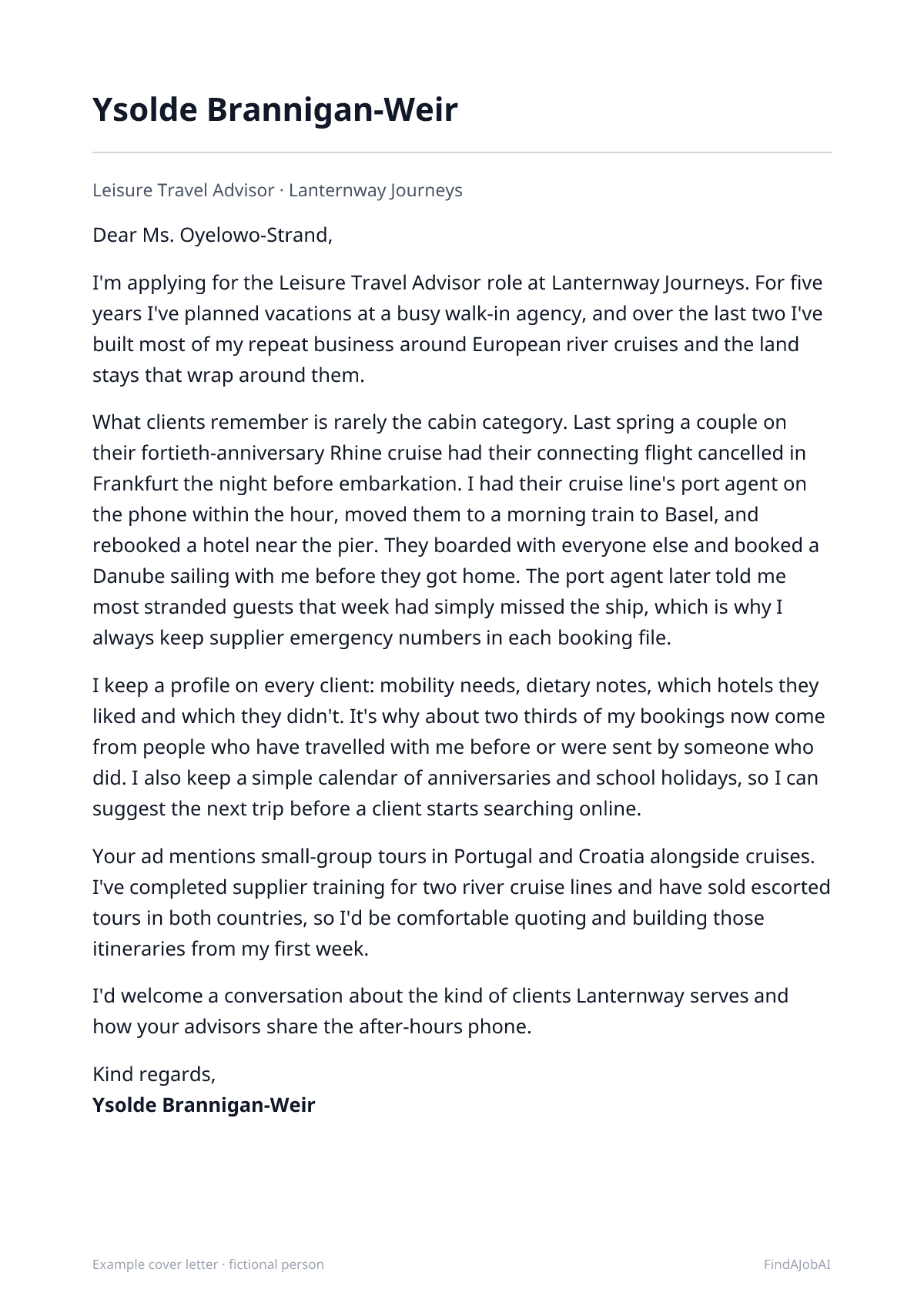
Travel Agent cover letter template
This letter as a one-page template: an opening that names the job and your strongest fact, proof that answers the ad, a reason for this employer and a short close.
After you sign up, FindAJobAI drafts your own letter for a real job from your CV in this format, and you edit it before you send it.
Example 1 · Experienced
Leisure travel agent applying to a boutique agency
Rosalind books leisure trips at a mall-based agency. The ad wants an agent for European river cruises and tours.
Example letter · fictional
Dear Ms. Oyelowo-Strand,
I'm applying for the Leisure Travel Advisor role at Lanternway Journeys. For five years I've planned vacations at a busy walk-in agency, and over the last two I've built most of my repeat business around European river cruises and the land stays that wrap around them.
What clients remember is rarely the cabin category. Last spring a couple on their fortieth-anniversary Rhine cruise had their connecting flight cancelled in Frankfurt the night before embarkation. I had their cruise line's port agent on the phone within the hour, moved them to a morning train to Basel, and rebooked a hotel near the pier. They boarded with everyone else and booked a Danube sailing with me before they got home. The port agent later told me most stranded guests that week had simply missed the ship, which is why I always keep supplier emergency numbers in each booking file.
I keep a profile on every client: mobility needs, dietary notes, which hotels they liked and which they didn't. It's why about two thirds of my bookings now come from people who have travelled with me before or were sent by someone who did. I also keep a simple calendar of anniversaries and school holidays, so I can suggest the next trip before a client starts searching online.
Your ad mentions small-group tours in Portugal and Croatia alongside cruises. I've completed supplier training for two river cruise lines and have sold escorted tours in both countries, so I'd be comfortable quoting and building those itineraries from my first week.
I'd welcome a conversation about the kind of clients Lanternway serves and how your advisors share the after-hours phone.
Kind regards,
Ysolde Brannigan-Weir
Example 2 · Career changer
Hotel front desk clerk moving into travel booking
Tobiah has worked hotel front desks for four years. The ad is an entry-level travel consultant role at a host agency.
Example letter · fictional
Dear Copperleaf Recruiting Team,
I'm applying for the Junior Travel Consultant position at Copperleaf Travel Collective. I've spent four years at the front desk of a 220-room airport hotel, and a large part of that job has been helping stranded travelers put their trips back together.
On a winter night when a snowstorm grounded most departures, our desk had more than ninety walk-ins in three hours. I set up a queue by flight number, called the airline desk to confirm which passengers had vouchers, and kept a printed list of nearby hotels with rooms left so nobody was sent out into the storm without a place to go. My manager now uses that list format for every disruption night. Several of those guests later wrote to the hotel to thank the desk team by name.
I've since finished an introductory course on airline ticketing and fare rules and practiced building sample itineraries in a training booking system. I know I still need to learn your supplier relationships and commission structure, and I'd like to learn them from agents who've built a real book of clients.
What I bring is patience with tired, anxious travelers and a habit of double-checking names, dates and confirmation numbers before anyone leaves the desk. I also speak conversational Spanish, which has helped with many guests and would help with your Latin America bookings.
Thank you for considering me. I'd be glad to talk about how new consultants are trained at Copperleaf. I'm available to start within two weeks.
Sincerely,
Tobiah Lindqvist
Example 3 · Senior or lead
Corporate travel team lead applying to run an account team
Marisol leads a six-person corporate travel desk. The ad wants a manager for a team serving several mid-size company accounts.
Example letter · fictional
Dear Mr. Quillfeather,
I'm applying for the Corporate Travel Account Manager role at Northgate Business Travel. I currently lead a six-person desk handling travel for three engineering firms, after seven years as a corporate agent, and I'd like to take on a larger set of accounts with the team you describe.
When I took over the desk, each agent handled policy exceptions differently, so one traveler got a business class upgrade approved while a colleague on the same route was refused. I wrote a one-page exception guide for each account, agreed it with the clients' travel managers, and set up a weekly review of exceptions with the team. Complaints from travelers about inconsistent answers dropped to a handful a quarter, and two of the three firms renewed their contracts early.
The hardest week was a regional airline strike that hit forty travelers on one account mid-trip. We split the list by return date, rebooked on rail where it was faster than waiting for seats, and sent the client's travel manager a status sheet twice a day until everyone was home. Nobody missed more than one extra night away, and the client asked us to write the same process into their travel policy.
I have not yet managed accounts in the pharmaceutical sector your ad mentions, and I'd want to understand their meeting and congress travel patterns before setting service targets. I'm used to learning a new account's habits quickly, and I'd start by sitting with the agents who already serve them.
I'd welcome a conversation about the accounts the team supports today and where clients feel service falls short.
Sincerely,
Marisol Okonkwo-Brandt
All three letters, and the short version below, are fictional: the people, employers and numbers are invented. Borrow the structure, never the facts.
- Prefer to write it yourself? Use the free cover letter template.
- Check your CV against the job first: the free CV score shows the missing keywords.
Why the first letter works, paragraph by paragraph
Paragraph 1: Opening
Names the agency type, the years of experience and the specialty the ad asks for, river cruises and their land stays, so the reader sees relevance in two sentences.
Paragraph 2: A trip that went wrong
A cancelled connection the night before embarkation, fixed with a train and a hotel near the pier, proves the writer can handle disruption, which is the real test of a travel agent.
Paragraph 3: Repeat business
Client profiles and referral-driven bookings show the writer builds a book of clients, which agencies pay for directly.
Paragraph 4: Fit with this agency
Responds to the ad's escorted tours in two named countries with supplier training and past sales, so the reader can picture week one.
Paragraph 5: Close
Asks about the agency's clients and after-hours coverage, a practical question that shows the writer understands the job.
What the career changer's letter does differently
The career changer's letter turns hotel disruption nights into booking-relevant evidence: queueing travelers by flight, checking voucher status, and keeping alternatives ready. A ticketing course makes the move concrete, and the letter names what he still needs to learn instead of pretending to know supplier relationships already.
What the senior letter does differently
A senior travel letter reports what the writer fixed for a team and its accounts: a written exception guide, a weekly review habit, and early contract renewals. The strike story shows calm coordination at scale, and the letter names an honest gap in sector experience rather than claiming every kind of account.
Short travel agent cover letter: an email-ready version
Many applications arrive as an email or a small text box, and a full page doesn't fit. This version runs 120 to 150 words and keeps only what a reader needs to decide whether to reply. A cruise specialist replies to an agency owner's job post in a travel industry forum by email.
Short version · email · fictional121 words
Subject: Cruise Specialist application – Caribbean and Alaska sailings – Gwendolyn Ferraro
Hello Ms. Rasmussen,
I'm writing about the Cruise Specialist opening at Bluehaven Voyages. For six years I've sold Caribbean and Alaska sailings for a home-based agency, including family groups of up to thirty cabins. Most of my clients are returning families who book a year ahead.
Last summer a family group's ship changed its itinerary and skipped Juneau. I arranged a replacement shore excursion in Skagway for every cabin within two days and kept the group's onboard credit intact, so nobody cancelled. The group leader has since booked next summer's sailing with me.
I'd enjoy helping your agency grow its group cruise business. I've attached my resume and can call at a time that works for you.
Best wishes,
Gwendolyn Ferraro
The email keeps one group story with a clear outcome, nobody cancelled, rather than listing every cruise line the writer has sold. That's enough for an agency owner to decide whether to call.
Opening lines that work for travel agent cover letters
The first sentence decides whether the second gets read. Here are six openings, one for each situation you might be in. Pick the one that matches yours and swap in your own facts: every name and number below is invented.
1. You have a standout result
The night a couple's connection to their river cruise was cancelled, I had them on a morning train and a hotel near the pier within the hour. That's the kind of work I'd like to keep doing at your agency.
2. The ad names a problem you've solved
Two thirds of my bookings last year came from returning clients or people they sent to me, and I'd like to bring that habit of follow-up to your team.
3. Someone referred you
Your ad asks for someone comfortable on the after-hours phone. I've covered that phone for five years and still answer it the same way: name, booking reference, and what the traveler needs right now.
4. You admire what they build
I've spent four years at a hotel front desk helping stranded travelers rebuild their plans, and I'd like to do that work before the trip instead of after it goes wrong.
5. You're new to the field or switching into it
Your agency's focus on small-group tours in southern Europe is exactly the product I've been selling most over the last two seasons.
6. You have senior scope or a specialism
As lead of a corporate travel desk serving three firms, I wrote the exception guide my team still uses. I'm looking for a larger set of accounts to run the same way.
How to write a travel agent cover letter
Five steps, in the order you'd write them. The shape stays the same for every job (a short opening, proof, a reason for this employer, a close), and what goes into each part is what changes with the role.
Lead with the product you sell
Agencies hire for a market: cruises, escorted tours, luxury, family, or corporate. Name yours in the first paragraph and match it to the ad, so the manager can see where you'd fit on the team before reading further.
Tell one disruption story
Pick a cancelled flight, a missed connection or a supplier change you handled. Describe what happened, the steps you took with airlines or suppliers, and how the trip ended for the client. This shows the judgment that matters most once travelers are away from home.
Show repeat and referral business
If returning clients or referrals make up a meaningful share of your bookings, say so in plain terms. Agencies value agents who keep clients coming back, since it costs far less than finding new ones through advertising.
Name your systems and training in context
Mention the booking system or supplier portals you use and any destination or cruise line training, tied to a real booking. A system name on its own reads like a checklist; a booking you made in it reads like experience.
Close with a practical question
Ask about the agency's client mix, after-hours coverage or how leads are shared. A practical question shows you already think about the daily work, and gives the manager an easy reason to reply and set up a call.
Travel Agent cover letter do's and don'ts
Do
- Describe one disruption you resolved, with the steps and how the trip ended.
- Name the products or destinations you actually sell, matched to the ad.
- Mention repeat or referral business if you have it, since agencies value a loyal client base.
Don't
- Don't open with how much you love to travel; every applicant says it.
- Don't list every destination you've visited personally as if it were booking experience.
- Don't share client names or trip details that could identify a real traveler.
Common travel agent cover letter mistakes
Each one is easy to make and quick to fix before you send the letter.
Writing about your own holidays
Personal travel shows interest, not skill. Replace it with a trip you planned for a client and the problem you solved along the way.
No mention of disruptions
Every agent faces cancellations and schedule changes. Leaving them out makes the letter sound untested, so include one real example and its outcome.
Listing destinations without products
Twenty country names say little. Name the product types you sell there, such as river cruises, rail tours or villas, and who your typical client is.
Naming real travelers in trip stories
Keep client stories anonymous: describe the trip type and the problem, not names, dates or anything that could identify a real traveler.
Ignoring the sales side of the job
Many agency roles depend on commission or service fees. Mention repeat bookings or group sales so the manager sees you can bring in revenue, not only service it.
Email subject lines for travel agent applications
Applying by email? Put the job title, any reference number and your name in the subject line.
- Leisure Travel Advisor application – river cruise specialist – Ysolde Brannigan-Weir
- Junior Travel Consultant – hotel front desk background – Tobiah Lindqvist
- Application: Corporate Travel Consultant – Ysolde Brannigan-Weir
Everything for Travel Agents
- Travel Agent resume exampleA full resume, plus bullet and summary examples
- Travel Agent interview questions30 questions with sample answers
- Travel Agent job descriptionDuties, skills and requirements
- Career change cover letter: template + examples
Other cover letter examples
Travel Agent cover letter FAQ
What should a travel agent cover letter include?
The products and destinations you sell, one example of a trip you rescued or built well for a client, and any evidence of repeat business. Close with a practical question about the agency's clients or workflow.
How do I write a travel agent cover letter with no agency experience?
Use customer-facing work where you solved travel problems, such as hotel, airline or call center roles, and add any ticketing or destination training you've completed. Be honest about what you still need to learn.
Should I mention the booking systems I know?
Yes, inside an example. Saying you rebooked a group in Sabre after a schedule change is stronger than listing the system name on its own.
Is it worth mentioning trips I've taken myself?
Only briefly and only if it relates to what the agency sells, such as having sailed a river cruise line they promote. Personal travel is not a substitute for booking experience.
How we built this page
The FindAJobAI team wrote the three example letters, the short email version, the opening lines and the advice for travel agent roles. The people, employers and numbers in the letters are invented; the structure, the kind of evidence and the order of the paragraphs are the parts to copy.
Once we track enough live travel agent job ads, this page also shows the skills they ask for most, counted the same way as our in-demand skills report.
Last reviewed on November 1, 2026.