Aerospace Engineer Resume Example (2026)
By FindAJobAI Team Updated How we built this page
Aerospace employers, from airframers and engine makers to space startups and defense primes, hire engineers for a specific discipline: structures, aerodynamics, propulsion, systems, flight test or manufacturing. Recruiters scan an aerospace engineer resume for that discipline first, then for the tools, the hardware you've worked on and evidence that your analysis held up in test or certification.
The example below is a structures engineer with seven years at an aerostructures supplier, moving from detail stress analysis to leading analysis for a composite wing component. Each bullet names the part, the method (hand calcs, FEA, test correlation) and the result, such as weight saved, margins closed or a test passed first time.
Aerospace Engineer resume template
This example as a one-page template: one column, standard headings and plain text, the format applicant tracking systems read most reliably.
After you sign up, Create my CV builds your own resume in this same one-column layout, from your real experience.
Mid-level aerospace engineer resume example
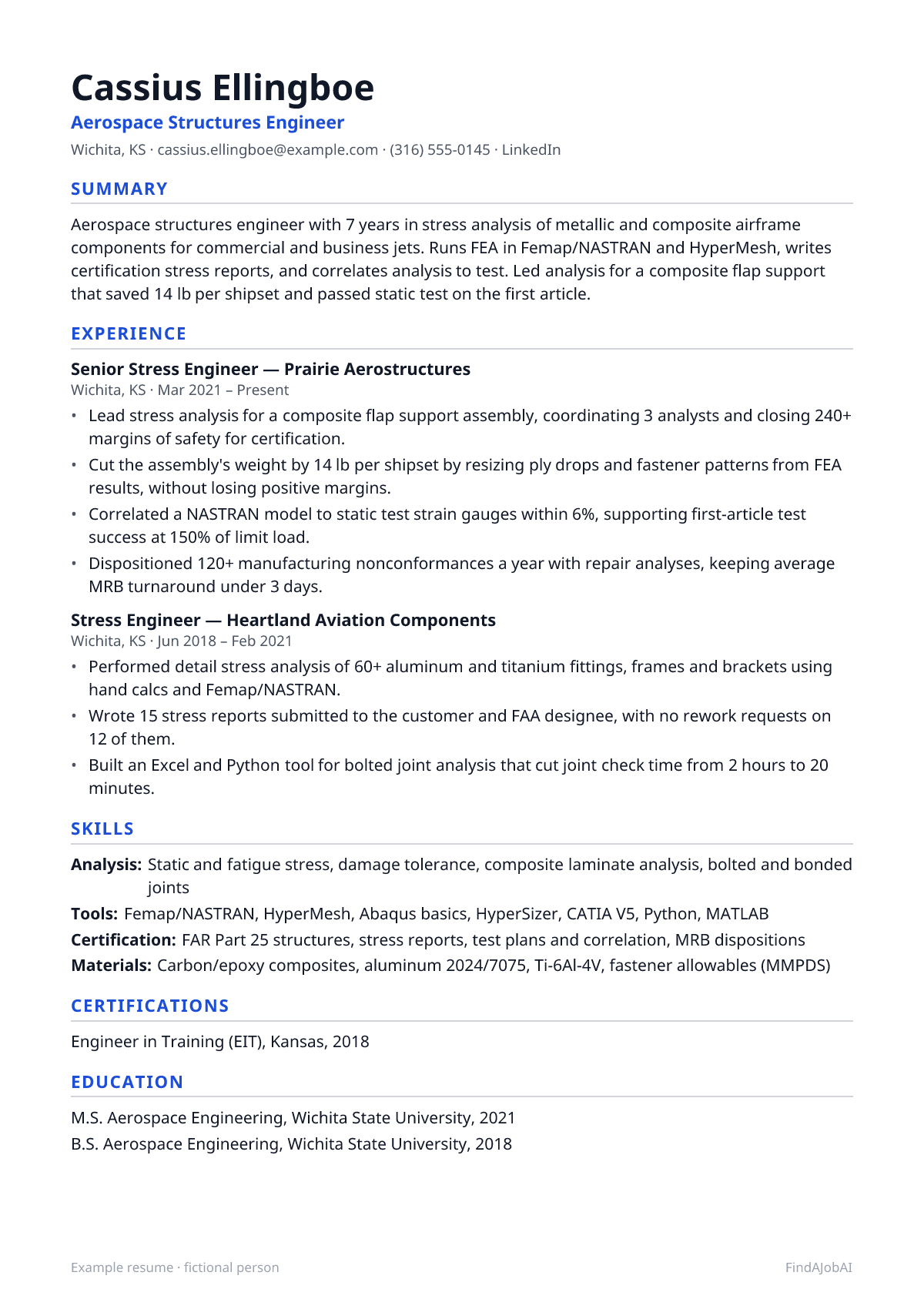
A complete one-page example for a fictional aerospace engineer: every bullet pairs an action with what changed because of it.
Example resume · fictional person
Cassius Ellingboe
Aerospace Structures Engineer
Wichita, KS · [email protected] · (316) 555-0145 · LinkedIn
Summary
Aerospace structures engineer with 7 years in stress analysis of metallic and composite airframe components for commercial and business jets. Runs FEA in Femap/NASTRAN and HyperMesh, writes certification stress reports, and correlates analysis to test. Led analysis for a composite flap support that saved 14 lb per shipset and passed static test on the first article.
Experience
Senior Stress Engineer, Prairie Aerostructures
Wichita, KS · Mar 2021 – Present
- Lead stress analysis for a composite flap support assembly, coordinating 3 analysts and closing 240+ margins of safety for certification.
- Cut the assembly's weight by 14 lb per shipset by resizing ply drops and fastener patterns from FEA results, without losing positive margins.
- Correlated a NASTRAN model to static test strain gauges within 6%, supporting first-article test success at 150% of limit load.
- Dispositioned 120+ manufacturing nonconformances a year with repair analyses, keeping average MRB turnaround under 3 days.
Stress Engineer, Heartland Aviation Components
Wichita, KS · Jun 2018 – Feb 2021
- Performed detail stress analysis of 60+ aluminum and titanium fittings, frames and brackets using hand calcs and Femap/NASTRAN.
- Wrote 15 stress reports submitted to the customer and FAA designee, with no rework requests on 12 of them.
- Built an Excel and Python tool for bolted joint analysis that cut joint check time from 2 hours to 20 minutes.
Skills
- Analysis: Static and fatigue stress, damage tolerance, composite laminate analysis, bolted and bonded joints
- Tools: Femap/NASTRAN, HyperMesh, Abaqus basics, HyperSizer, CATIA V5, Python, MATLAB
- Certification: FAR Part 25 structures, stress reports, test plans and correlation, MRB dispositions
- Materials: Carbon/epoxy composites, aluminum 2024/7075, Ti-6Al-4V, fastener allowables (MMPDS)
Certifications
- Engineer in Training (EIT), Kansas, 2018
Education
- M.S. Aerospace Engineering, Wichita State University, 2021
- B.S. Aerospace Engineering, Wichita State University, 2018
Fictional example by the FindAJobAI team: the person, employers and numbers are invented. Keep the structure; use your own work and numbers you can explain in an interview.
Entry-level aerospace engineer resume example
A new aerospace graduate with one internship and a student team. Education leads, and the bullets describe models built, calculations checked and tests supported, with numbers, without claiming certification ownership.
Entry-level example resume · fictional person
Ophelia Ranganathan
Aerospace Engineer
Seattle, WA · [email protected] · (206) 555-0180 · LinkedIn · Portfolio
Summary
Aerospace engineering graduate with a structures internship at an aircraft interiors supplier and three years on a student design-build-fly team. Built FEA models in Femap/NASTRAN, ran hand calculations for brackets and supported a static test. Comfortable in CATIA V5 and MATLAB. Seeking an entry-level structures or design role.
Education
- B.S. Aerospace Engineering, University of Washington, 2026
Experience
Structures Engineering Intern, Cascade Cabin Systems
Everett, WA · Jun 2025 – Sep 2025
- Built 6 FEA models of seat track fittings and monument brackets in Femap/NASTRAN, reviewed by a senior stress engineer.
- Checked 30+ hand calculations for fastener and lug strength against MMPDS allowables, finding 2 errors in a draft report.
- Installed strain gauges and recorded data during a 16g dynamic seat test, then compared results to model predictions.
Structures Lead, Design-Build-Fly Team, University of Washington
Seattle, WA · Sep 2022 – May 2025
- Led wing structure design for a 5 kg competition aircraft, cutting wing weight by 18% with a carbon spar and foam ribs.
- Ran a wing bending test to 2.5 times the flight load, matching hand-calculated deflection within 10%.
Skills
- Analysis: Hand stress calculations, Femap/NASTRAN, beam and lug analysis, MATLAB
- Design: CATIA V5, SolidWorks, GD&T basics
- Test: Strain gauge installation, data acquisition, test correlation
- Programming: Python, MATLAB scripting
Senior aerospace engineer resume example
A principal engineer seventeen years in who now leads a group and owns certification strategy. The bullets shift from analyses to substantiation plans, test campaigns, team size and regulator relationships, and the summary states that scope.
Senior example resume · fictional person
Thelonius Abara-Lindqvist
Principal Aerospace Engineer, Structures
Melbourne, FL · [email protected] · (321) 555-0197 · LinkedIn
Summary
Principal aerospace engineer with 17 years in structural analysis and certification for business jets and launch vehicles. Leads a 12-engineer structures group, owns the structural substantiation plan for a new composite wing, and works directly with FAA designees. Has taken 2 major structural components through full-scale certification testing.
Experience
Principal Engineer, Structures, Space Coast Aircraft Company
Melbourne, FL · Jan 2019 – Present
- Lead 12 stress and design engineers on a new business jet composite wing, setting analysis methods and reviewing all certification reports.
- Wrote the structural substantiation plan accepted by the FAA, covering 400+ analysis and test deliverables.
- Directed a full-scale wing static and fatigue test campaign that met ultimate load and 2 lifetimes of fatigue with no structural failures.
- Recovered 5 weeks of schedule by splitting analysis work into parallel packages and adding a second review shift.
Lead Stress Engineer, Atlantic Launch Systems
Cape Canaveral, FL · Apr 2013 – Dec 2018
- Led structural analysis of a launch vehicle interstage and payload adapter, closing margins for 6 successful flights.
- Developed buckling knockdown methods for composite cylinders that reduced interstage mass by 9%.
- Mentored 5 engineers, 3 of whom became analysis leads.
Stress Engineer, Sunshine Aero Engineering
Orlando, FL · Jun 2008 – Mar 2013
- Performed static and fatigue analysis on 100+ metallic airframe parts for Part 25 modification programs.
- Supported 4 STC certification projects through FAA conformity and test witnessing.
Skills
- Leadership: Engineering group lead, certification planning, schedule recovery, mentoring
- Certification: FAR Part 25, substantiation plans, FAA designee coordination, full-scale test
- Analysis: Composite and metallic structures, buckling, fatigue and damage tolerance, NASTRAN, Abaqus
- Space systems: Launch vehicle structures, payload adapters, NASA-STD-5001 factors of safety
Certifications
- Professional Engineer (PE), Florida, 2013
Education
- M.S. Aerospace Engineering, Georgia Institute of Technology, 2008
- B.S. Aerospace Engineering, University of Florida, 2006
How to write an aerospace engineer resume
Five steps, in the order a recruiter reads the page. The format around them stays plain for every job: one column, standard headings, newest role first.
Header: name, target title and links
Write 'Aerospace Engineer' plus your discipline, such as Structures, Propulsion or Systems, matching the posting. If clearance or citizenship is required, a short line near the top saves the recruiter a question.
Summary: what you do and your best proof
Give years of experience, discipline, the vehicles or hardware you work on, key tools and one result with a number, such as weight saved or a certification test passed. Keep it to three or four lines.
Experience: newest first, a result in every bullet
Write bullets that name the part or system, the method and the result: margins closed, weight saved, test outcomes, reports accepted or schedule recovered. Avoid lines like 'responsible for analysis', which say nothing about the quality of your work.
Skills: grouped, in the ad's words
Group skills into analysis, tools, certification and materials or systems. Name software and standards precisely, such as NASTRAN, CATIA V5, FAR Part 25 or DO-160, because aerospace recruiters search for those exact terms.
Education and certifications
List degrees with schools and years, then a PE or EIT if held. New graduates should put education first and add student projects like design-build-fly, rocketry or CubeSat teams with their role and results.
Skills to put on an aerospace engineer resume
Hard skills are the tools and methods of the job; soft skills are how you work with people. Each comes with one way to prove it, because a skill named only in a list counts for little. Add the ones you really have.
Hard skills
- Finite element analysis
- Name the solver, the part modeled and how the model was checked against test or hand calcs.
- Composite structures
- Mention laminate design or analysis work and a weight or strength result.
- Fatigue and damage tolerance
- Give the component, the method and the life or inspection interval you showed.
- Aerodynamics and CFD
- Name the tool and a configuration change your results drove.
- Propulsion analysis
- Mention the engine or thruster, the analysis type and a performance outcome.
- CAD (CATIA, NX)
- Say what you modeled and how it fed manufacturing or analysis.
- Certification (FAR Part 25 or 23)
- Mention reports, compliance findings or tests you supported for certification.
- Test planning and correlation
- Give a test you planned or supported and how well results matched predictions.
- Systems engineering
- Mention requirements you owned and how you verified them.
- Python or MATLAB tools
- Describe a tool you built and the time it saved the team.
- GD&T and drawings
- Mention drawing release or tolerance studies you completed.
- MRB and repair analysis
- Give the number of dispositions and your turnaround time.
Soft skills
- Technical writing
- Show reports accepted by customers, designees or reviewers without major rework.
- Cross-team coordination
- Name the groups you aligned, such as design, manufacturing and test, on a decision.
- Judgment under uncertainty
- Describe a conservative call you made when data was incomplete and how it played out.
- Schedule ownership
- Mention a deliverable you protected or a delay you recovered.
- Mentoring
- Count engineers you coached and what they went on to own.
- Attention to detail
- Point to an error you caught in a report, model or drawing before release.
- Communicating with non-specialists
- Mention explaining a technical risk to program managers or customers.
Aerospace Engineer resume bullet examples: weak vs strong
The same work, written two ways. The strong version names the tool, the scope and a result; the numbers are examples, yours must be real.
Weak: Did stress analysis.
Strong: Closed 240+ margins of safety on a composite flap support assembly for certification, leading 3 analysts through the report.
Shows scope, ownership and the certification context.
Weak: Reduced weight.
Strong: Saved 14 lb per shipset on a flap support by resizing ply drops and fastener patterns from FEA results, keeping all margins positive.
Weight is the currency of aerospace; this gives method and amount.
Weak: Worked on testing.
Strong: Correlated a NASTRAN model to static test strain gauges within 6%, and the first article passed static test at 150% of limit load.
Ties analysis quality to a test outcome.
Weak: Supported manufacturing.
Strong: Dispositioned 120+ nonconformances a year with repair analyses, holding MRB turnaround under 3 days to keep the line moving.
Connects engineering work to production impact.
Weak: Wrote reports.
Strong: Wrote 15 certification stress reports for customer and FAA designee review, with 12 accepted without rework requests.
Report acceptance is a real quality measure.
Weak: Created tools.
Strong: Built a Python bolted-joint tool that cut each joint check from 2 hours to 20 minutes across a 4-person stress group.
Quantifies a productivity gain for the team.
15 more aerospace engineer resume bullet examples
Grouped by area of the job, so you can find the ones closest to your work. Keep the shape (action, scope, result) and replace the invented numbers with your own.
Analysis and design
- Sized a titanium engine mount fitting with hand calcs and FEA, achieving positive margins with 11% less mass than the baseline.
- Ran buckling analysis on 8 fuselage skin panels, adding 2 stringers that closed negative margins found late in design.
- Modeled a bonded composite joint in Abaqus and matched coupon test failure loads within 8%.
- Completed fatigue analysis for 25 wing fittings, setting inspection intervals approved by the customer.
Test and certification
- Wrote the test plan for a landing gear attachment static test and supported witnessing by the FAA designee.
- Installed and reviewed data from 140 strain gauges during a fuselage pressure test, flagging 1 sensor fault before test day.
- Prepared 10 compliance reports for an STC program, all accepted in the first review cycle.
- Correlated a flutter model to ground vibration test results, supporting clearance of the flight envelope.
Manufacturing support
- Dispositioned 90 composite porosity nonconformances in a year, accepting 70 with analysis and saving scrap costs.
- Worked with the shop floor to redesign a drill fixture that ended repeated edge-distance violations on a spar.
- Updated 30 drawings to clarify fastener callouts after recurring assembly questions from production.
- Supported first-article inspection of 12 machined fittings, resolving 3 tolerance conflicts with design.
Tools and team
- Automated margin-of-safety summaries with Python, saving about 6 hours on every report revision.
- Trained 4 new analysts on company stress methods and NASTRAN post-processing in their first 3 months.
- Led weekly peer reviews for a 6-person group, cutting customer comments on reports by about half.
Aerospace Engineer resume summary examples
Two or three lines on what you do and your strongest proof. Start from the one closest to your level and use your own facts.
Aerospace engineering graduate with internship experience in structural analysis and test support at an aircraft supplier. Built FEA models in Femap/NASTRAN, ran hand calcs for brackets and supported a static test campaign. Member of a design-build-fly team. Seeking an entry-level structures or design engineering role.
Aerospace structures engineer with 7 years in metallic and composite stress analysis for business and commercial jets. Leads analysis on certification hardware, correlates FEA to test and saved 14 lb per shipset on a composite flap support.
Principal aerospace engineer with 17 years in structures and certification, leading a 12-engineer analysis group. Owns structural substantiation for a new business jet wing, works directly with FAA designees and has taken 2 major components through certification test.
Common aerospace engineer resume mistakes
Each one is easy to make and quick to fix before you apply.
Not stating your discipline
Aerospace covers structures, aero, propulsion, systems and more. Put yours in the headline so recruiters don't have to guess from the bullets.
Listing tools without results
A long list of software says little. Show one result each tool supported, such as a model that matched test or a design that saved weight.
Ignoring weight and test outcomes
Weight saved and tests passed are what aerospace managers remember. Add them wherever your work contributed.
Hiding clearance or citizenship status
Many defense and space roles need it. If the posting asks, state your status clearly so your application isn't set aside.
Writing student projects too vaguely
Say what you designed, the tools used and the test result. A wing that held its design load is evidence; 'participated in a team' is not.
ATS tips for an aerospace engineer resume
Applicant tracking systems turn your file into text that recruiters search, mostly for the skills and titles in the ad. They rarely reject a resume on their own; one that parses badly or misses the ad's words just doesn't come up.
- Name your discipline (structures, aerodynamics, propulsion, systems, flight test) in the headline so recruiters place you at once.
- List analysis and CAD tools exactly, such as NASTRAN, Abaqus, ANSYS, CATIA or NX, since postings filter on them.
- Give results in weight saved, margins closed, tests passed or schedule kept, the measures aerospace managers use.
- Mention certification context such as FAR Part 25, Part 23 or DO-160 when it applies.
- State U.S. citizenship or clearance status if the posting requires it, because many roles fall under ITAR.
For the format itself, run the free ATS resume checklist.
Everything for Aerospace Engineers
- Aerospace Engineer cover letter examplesThree example letters and a short email version
- Aerospace Engineer interview questions30 questions with sample answers
- Aerospace Engineer job descriptionDuties, skills and requirements
- How to tailor your resume without lying
Other resume examples
Aerospace Engineer resume FAQ
What should an aerospace engineer resume focus on?
Your discipline, the hardware or vehicles you've worked on, the analysis and design tools you use, and results such as weight saved, test success, certification milestones or schedule recovered.
Should I list security clearance on an aerospace resume?
Yes, if you hold one and the role is in defense or space. State the level and status. For ITAR-controlled roles, note U.S. citizenship or permanent residency if the posting asks for it.
How do I write an aerospace engineer resume with no experience?
Lead with your degree and relevant projects: design-build-fly, rocketry, CubeSat or senior design teams. Describe your role, the tools you used and test results, and add any internships or co-ops with specific tasks.
How we built this page
The FindAJobAI team wrote the three example resumes, the bullets, the skills and the advice for aerospace engineer roles. The people, employers and numbers in the examples are invented; the structure, the tools and the way each bullet is built are the parts to copy.
Once we track enough live aerospace engineer job ads, this page also shows the skills they ask for most, counted the same way as our in-demand skills report.
Last reviewed on November 1, 2026.