MRI Technologist Resume Example (2026)
By FindAJobAI Team Updated How we built this page
MRI technologist postings almost always ask for ARRT registration in MR, experience on a named scanner platform, and strict safety screening habits. Those lines appear on nearly every applicant's resume, so they don't separate anyone. What does is evidence: how many exams you run a shift, which body regions and advanced studies you handle, how you keep repeat scans down, and how you deal with anxious or claustrophobic patients.
The example below is an MRI technologist with six years across a hospital department and an outpatient imaging center. Each bullet pairs a scan type or safety task with a count or a result, so a radiology manager can see throughput, image quality and safety judgment at once.
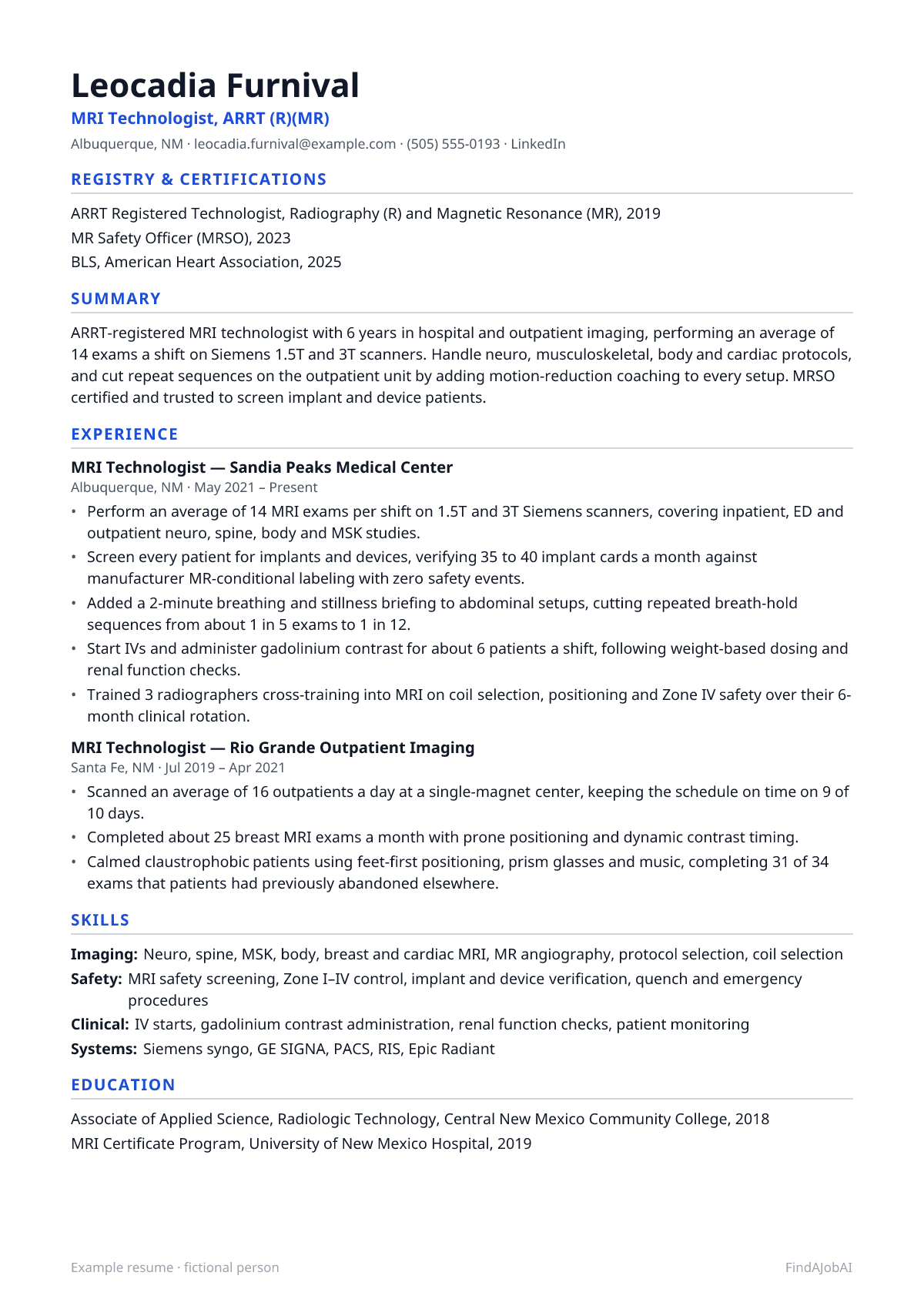
MRI Technologist resume template
This example as a one-page template: one column, standard headings and plain text, the format applicant tracking systems read most reliably.
After you sign up, Create my CV builds your own resume in this same one-column layout, from your real experience.
Mid-level MRI technologist resume example
A complete one-page example for a fictional MRI technologist: every bullet pairs an action with what changed because of it.
Example resume · fictional person
Leocadia Furnival
MRI Technologist, ARRT (R)(MR)
Albuquerque, NM · [email protected] · (505) 555-0193 · LinkedIn
Registry & Certifications
- ARRT Registered Technologist, Radiography (R) and Magnetic Resonance (MR), 2019
- MR Safety Officer (MRSO), 2023
- BLS, American Heart Association, 2025
Summary
ARRT-registered MRI technologist with 6 years in hospital and outpatient imaging, performing an average of 14 exams a shift on Siemens 1.5T and 3T scanners. Handle neuro, musculoskeletal, body and cardiac protocols, and cut repeat sequences on the outpatient unit by adding motion-reduction coaching to every setup. MRSO certified and trusted to screen implant and device patients.
Experience
MRI Technologist, Sandia Peaks Medical Center
Albuquerque, NM · May 2021 – Present
- Perform an average of 14 MRI exams per shift on 1.5T and 3T Siemens scanners, covering inpatient, ED and outpatient neuro, spine, body and MSK studies.
- Screen every patient for implants and devices, verifying 35 to 40 implant cards a month against manufacturer MR-conditional labeling with zero safety events.
- Added a 2-minute breathing and stillness briefing to abdominal setups, cutting repeated breath-hold sequences from about 1 in 5 exams to 1 in 12.
- Start IVs and administer gadolinium contrast for about 6 patients a shift, following weight-based dosing and renal function checks.
- Trained 3 radiographers cross-training into MRI on coil selection, positioning and Zone IV safety over their 6-month clinical rotation.
MRI Technologist, Rio Grande Outpatient Imaging
Santa Fe, NM · Jul 2019 – Apr 2021
- Scanned an average of 16 outpatients a day at a single-magnet center, keeping the schedule on time on 9 of 10 days.
- Completed about 25 breast MRI exams a month with prone positioning and dynamic contrast timing.
- Calmed claustrophobic patients using feet-first positioning, prism glasses and music, completing 31 of 34 exams that patients had previously abandoned elsewhere.
Skills
- Imaging: Neuro, spine, MSK, body, breast and cardiac MRI, MR angiography, protocol selection, coil selection
- Safety: MRI safety screening, Zone I–IV control, implant and device verification, quench and emergency procedures
- Clinical: IV starts, gadolinium contrast administration, renal function checks, patient monitoring
- Systems: Siemens syngo, GE SIGNA, PACS, RIS, Epic Radiant
Education
- Associate of Applied Science, Radiologic Technology, Central New Mexico Community College, 2018
- MRI Certificate Program, University of New Mexico Hospital, 2019
Fictional example by the FindAJobAI team: the person, employers and numbers are invented. Keep the structure; use your own work and numbers you can explain in an interview.
Entry-level MRI technologist resume example
A newly registered MRI technologist who trained through a primary MRI pathway program. Education leads because the program and its clinical rotations are his main evidence, and the supervised exam count stands in for paid work.
Entry-level example resume · fictional person
Bartholomew Quinlivan
MRI Technologist, ARRT (MR)
El Paso, TX · [email protected] · (915) 555-0158 · LinkedIn
Summary
Newly registered MRI technologist with ARRT (MR) certification and 1,000 clinical hours at a hospital and an outpatient center, completing about 300 supervised exams on GE and Siemens scanners. Comfortable with neuro, spine and MSK protocols, MRI safety screening and IV starts. Looking for a first staff MRI technologist role.
Education
- Associate of Applied Science, Magnetic Resonance Imaging, El Paso Community College, 2026
Experience
MRI Clinical Rotation, Westside Diagnostic Imaging
El Paso, TX · Feb 2026 – Apr 2026
- Performed about 100 supervised outpatient exams on a 3T Siemens scanner, mostly MSK and neuro.
- Coached about 10 anxious patients a week through scans with breathing cues and frequent check-ins over the intercom.
MRI Clinical Rotation, Franklin Mountain Regional Hospital
El Paso, TX · Jan 2025 – Dec 2025
- Completed about 200 supervised MRI exams on a 1.5T GE scanner, including brain, cervical and lumbar spine, and knee studies.
- Screened about 15 patients a day under a registered technologist, flagging 3 implant cards that needed radiologist review.
- Started 40 supervised IVs for contrast exams with a first-attempt success rate tracked by my clinical instructor.
Skills
- Imaging: Neuro, spine and MSK protocols, coil selection, patient positioning
- Safety: MRI screening forms, Zone control, implant card review
- Clinical: IV starts, contrast preparation, vital signs, patient transfers
Certifications
- ARRT Registered Technologist, Magnetic Resonance (MR), 2026
- BLS, American Heart Association, 2025
Senior MRI technologist resume example
A lead MRI technologist thirteen years in who now runs a section and its safety program. The bullets move from daily scan counts to the systems she owns: staffing, a scanner installation, a safety policy and protocol work with radiologists.
Senior example resume · fictional person
Saoirse Vandermolen
Lead MRI Technologist, ARRT (R)(MR), MRSO
Denver, CO · [email protected] · (720) 555-0141 · LinkedIn
Summary
Lead MRI technologist with 13 years of experience, now running a 9-technologist MRI section across 3 scanners at a teaching hospital. Led a new 3T scanner installation, wrote the department's implant screening policy, and worked with radiologists to shorten neuro and MSK protocols while keeping image quality steady. Still scans 2 shifts a week, including cardiac studies.
Experience
Lead MRI Technologist, Front Range University Hospital
Denver, CO · Mar 2018 – Present
- Run a 9-technologist MRI section across 3 scanners performing about 70 exams a day, covering scheduling, competencies and on-call coverage.
- Led the installation and go-live of a new 3T scanner, building 45 protocols with radiologists and training 9 technologists before first patient.
- Wrote the department's implant screening policy and MR-conditional device workflow, used for about 900 device patients a year with zero adverse events.
- Shortened core neuro and MSK protocols with 4 radiologists, raising daily capacity by about 8 exams without adding staff hours.
Senior MRI Technologist, Cherry Creek Imaging Partners
Denver, CO · Jun 2014 – Feb 2018
- Performed about 15 exams a day, including cardiac and breast MRI, at a busy outpatient center.
- Precepted 7 MRI students through clinical rotations, all of whom passed ARRT MR.
- Started a weekly image quality review with the reading radiologist, cutting callback rescans from 6 a month to 2.
Radiologic Technologist, Platte Valley Community Hospital
Brighton, CO · Aug 2012 – May 2014
- Performed about 40 radiography exams a shift across ED, inpatient and outpatient areas.
- Cross-trained into MRI over 10 months, completing 250 supervised exams before earning ARRT MR.
Skills
- Leadership: Staffing and scheduling, competency programs, student precepting, vendor coordination
- Advanced Imaging: Cardiac MRI, breast MRI, MR angiography, spectroscopy, protocol design
- Safety: MRSO program, implant policy, device workflows, Zone IV access control
Certifications
- ARRT (R), 2012
- ARRT (MR), 2014
- MR Safety Officer (MRSO), 2019
Education
- Bachelor of Science, Radiologic Sciences, University of Northern Colorado, 2012
How to write a MRI technologist resume
Five steps, in the order a recruiter reads the page. The format around them stays plain for every job: one column, standard headings, newest role first.
Header: name, target title and links
Put your ARRT credentials right after your title, such as "MRI Technologist, ARRT (R)(MR)". Add MRSO or another safety credential if you hold one, since many hospitals screen for it before reading further.
Summary: what you do and your best proof
Name your registry, years of MRI experience, scanner vendors and field strengths, and the body regions you cover. Add one result, such as fewer repeat sequences or a safety record, so the summary shows judgment as well as experience.
Experience: newest first, a result in every bullet
Begin each bullet with the exam type, scanner or safety task, then add a count and an outcome. Exams per shift, implants screened, repeats reduced or protocols shortened all tell a radiology manager more than a list of duties.
Skills: grouped, in the ad's words
Group skills into imaging, safety, clinical and systems. Name scanner software, PACS and RIS by brand, since departments search for the platforms they already run and want people who can start without long vendor training.
Education and certifications
List your radiography or MRI program, the clinical sites and the year, then your ARRT credentials. If you cross-trained from radiography or CT, show the supervised MRI exam count you completed before sitting the MR exam.
Skills to put on a MRI technologist resume
Hard skills are the tools and methods of the job; soft skills are how you work with people. Each comes with one way to prove it, because a skill named only in a list counts for little. Add the ones you really have.
Hard skills
- MRI safety screening
- Give your monthly screening volume and one implant or device catch you made before Zone IV.
- Zone I–IV access control
- Describe how you control entry and who you stop, such as staff with oxygen tanks or tools.
- Implant and device verification
- Mention checking MR-conditional labeling and working with radiologists on uncertain devices.
- Neuro and spine protocols
- State the exams you run independently and any advanced sequences, such as diffusion or perfusion.
- Musculoskeletal imaging
- Name the joints you scan most and any protocol time you helped cut.
- Body and abdominal MRI
- Mention breath-hold coaching and how you reduced repeat sequences.
- Cardiac MRI
- Include it if you perform it, with gating method and the number of studies a month.
- Breast MRI
- Mention prone positioning and dynamic contrast timing, with a monthly volume.
- IV starts and contrast administration
- Note weight-based dosing, renal checks and your contrast safety record.
- Coil selection and positioning
- Show how coil choice improved image quality or cut table time.
- Scanner platforms
- Name vendors and field strengths, for example Siemens 3T or GE 1.5T; managers search for them.
- PACS and RIS
- List the systems you use for image transfer and scheduling, such as Epic Radiant.
- Artifact recognition
- Mention spotting motion, susceptibility or wrap artifacts and the fix you applied.
Soft skills
- Calming anxious patients
- Describe a technique for claustrophobic patients and how many exams it helped complete.
- Clear instructions
- Show how simple coaching on stillness or breath holds reduced repeats.
- Safety vigilance
- Describe stopping someone at the Zone IV door or pausing an exam for a screening doubt.
- Teamwork
- Mention coordinating with nurses, anesthesia or radiologists on complex or sedated cases.
- Time management
- Give a measure of schedule adherence on a busy outpatient list.
- Attention to detail
- Point to a wrong protocol, wrong side or missing screening form you caught.
- Composure
- Describe handling a patient emergency or scanner fault calmly and by protocol.
MRI Technologist resume bullet examples: weak vs strong
The same work, written two ways. The strong version names the tool, the scope and a result; the numbers are examples, yours must be real.
Weak: Performed MRI scans.
Strong: Performed 12 to 16 MRI exams a shift on 1.5T and 3T scanners across neuro, spine and MSK protocols, keeping the outpatient schedule on time on most days.
Adds volume, field strengths and body regions.
Weak: Responsible for MRI safety.
Strong: Screened about 300 patients a month and caught 4 unreported implants in one quarter, including a neurostimulator the patient had forgotten, before anyone entered Zone IV.
Turns a duty into real catches with a count.
Weak: Worked with claustrophobic patients.
Strong: Completed 28 exams in a year for patients who had previously stopped mid-scan elsewhere, using feet-first positioning, prism glasses and short sequence breaks.
Shows a technique and a result instead of a trait.
Weak: Gave contrast injections.
Strong: Started IVs and administered weight-based gadolinium for about 30 patients a week after checking eGFR, with no extravasation incidents in 2 years.
Names the clinical steps and a safety record.
Weak: Made images look better.
Strong: Rebuilt the knee and shoulder protocols with the MSK radiologist, cutting average table time from 32 minutes to 24 without lowering image ratings.
Pairs a protocol change with a time saving and quality check.
Weak: Helped train new staff.
Strong: Trained 3 radiographers moving into MRI, each passing ARRT MR on the first attempt and scanning independently within 6 months.
Training shown with a measurable outcome.
15 more MRI technologist resume bullet examples
Grouped by area of the job, so you can find the ones closest to your work. Keep the shape (action, scope, result) and replace the invented numbers with your own.
Scan volume and image quality
- Performed an average of 15 exams a shift across 2 scanners, keeping the outpatient schedule within 10 minutes of time on most days.
- Cut repeat sequences on lumbar spine exams by about half after adding foam immobilization and a stillness briefing to every setup.
- Completed about 20 MR angiography studies a month, including time-of-flight and contrast-enhanced techniques.
- Scanned 8 to 10 pediatric patients a week, coordinating with child life staff to avoid sedation for 3 of every 4 children aged 6 and up.
Safety and screening
- Screened about 280 patients a month and escalated 12 uncertain implants to the radiologist and MRSO in a year, with no safety events.
- Stopped 3 staff members from entering Zone IV with ferromagnetic equipment in one quarter, then helped set up a ferromagnetic detector at the door.
- Ran 4 quench and emergency evacuation drills a year for 20 staff across radiology and the ED.
- Called about 40 device patients a month before their exam to collect implant cards, so screening questions were settled before arrival.
Patient care and contrast
- Completed 30 exams in a year for claustrophobic patients who had stopped scans elsewhere, using feet-first positioning and short breaks.
- Started about 25 IVs a week for contrast studies with a first-stick success rate above 9 in 10.
- Monitored 4 to 6 sedated patients a week alongside anesthesia staff, using MR-conditional monitoring equipment.
- Checked eGFR for every contrast patient and flagged 9 in a year for radiologist review before injection.
Training and process
- Trained 4 technologists on a new 3T scanner over 8 weeks, each signing off on 20 core protocols.
- Built a laminated coil and positioning guide for 12 common exams, cutting setup time for new staff by several minutes per patient.
- Reduced same-day cancellations from 7 a week to 3 by calling device patients 48 hours ahead to collect implant cards.
MRI Technologist resume summary examples
Two or three lines on what you do and your strongest proof. Start from the one closest to your level and use your own facts.
Newly registered MRI technologist with ARRT (MR) certification and 1,000 clinical hours across a hospital and an outpatient center, where I completed about 300 supervised exams. Comfortable with neuro, spine and MSK protocols, safety screening and IV starts. Looking for a first staff MRI technologist role.
MRI technologist with 6 years on Siemens and GE scanners, running about 14 exams a shift across neuro, body, MSK and cardiac protocols. MRSO certified, trusted with implant screening, and focused on reducing repeat sequences through patient coaching and protocol tweaks.
Lead MRI technologist with 13 years of experience, now running a 9-technologist MRI section across 3 scanners. Led a 3T installation, wrote the department's implant screening policy, and cut average exam time by tightening protocols with radiologists while keeping image quality steady.
Common MRI technologist resume mistakes
Each one is easy to make and quick to fix before you apply.
Hiding ARRT credentials in the education section
Recruiters look for (MR) in the first few lines. Put your registry in the headline or a certifications block near the top so it is seen immediately.
Writing "ensured MRI safety" with no detail
Every technologist claims safety. Give screening volume, implant catches, Zone IV interventions or MRSO certification so the claim is backed by real practice.
Not naming scanners or field strengths
A manager running Siemens 3T wants to know you've used one. List vendors, software and field strengths you have scanned on independently.
Listing only routine brain and spine exams
If you perform cardiac, breast, angiography or pediatric studies, say so with a monthly volume. Advanced exams are often what fills a hard-to-staff shift.
Leaving out patient comfort work
Claustrophobia and motion cause many failed exams. Show a technique you use and how many difficult exams it helped you complete.
ATS tips for a MRI technologist resume
Applicant tracking systems turn your file into text that recruiters search, mostly for the skills and titles in the ad. They rarely reject a resume on their own; one that parses badly or misses the ad's words just doesn't come up.
- Put your ARRT credentials in the headline, for example (R)(MR) or (MR) primary pathway, since recruiters filter on them.
- Name the scanner vendors and field strengths you've used, such as Siemens 3T or GE 1.5T.
- List the body regions and advanced studies you perform: cardiac, breast, MR angiography or spectroscopy all set you apart.
- Show safety with specifics, such as implant screening volume or MRSO certification, not just the word safety.
- Include IV and contrast skills if you have them; many outpatient centers need technologists who can start their own lines.
For the format itself, run the free ATS resume checklist.
Everything for MRI Technologists
- MRI Technologist cover letter examplesThree example letters and a short email version
- MRI Technologist interview questions30 questions with sample answers
- MRI Technologist job descriptionDuties, skills and requirements
- How to tailor your resume without lying
Other resume examples
MRI Technologist resume FAQ
What certifications should an MRI technologist list on a resume?
List ARRT registration in MR with the year, and radiography (R) if you came through that pathway. Add MRSO or other MRI safety credentials, BLS, and any state license your state requires.
How do I write an MRI technologist resume with no experience?
Lead with your MRI program and clinical rotations, giving the number of supervised exams and the scanner types you trained on. If you're a radiographer cross-training, list your radiography or CT experience and highlight patient care and positioning skills that carry over.
Should I list specific MRI protocols on my resume?
Yes. Name the body regions and advanced exams you run independently, such as cardiac, breast or MR angiography. Hiring managers use this to judge where you can work on day one.
How we built this page
The FindAJobAI team wrote the three example resumes, the bullets, the skills and the advice for MRI technologist roles. The people, employers and numbers in the examples are invented; the structure, the tools and the way each bullet is built are the parts to copy.
Once we track enough live MRI technologist job ads, this page also shows the skills they ask for most, counted the same way as our in-demand skills report.
Last reviewed on November 1, 2026.