Customer Experience Manager Cover Letter Example (2026)
By FindAJobAI Team Updated How we built this page
A customer experience manager is hired to make other teams change things, so your cover letter should show exactly that. Pick one journey you fixed, explain how you found the problem and who you convinced, and give the before-and-after number. That single story says more than a list of survey tools.
Customer Experience Manager cover letter template
This letter as a one-page template: an opening that names the job and your strongest fact, proof that answers the ad, a reason for this employer and a short close.
After you sign up, FindAJobAI drafts your own letter for a real job from your CV in this format, and you edit it before you send it.
Example 1 · Experienced
CX lead applying to a subscription software company
Ignatius runs voice of customer at an online retailer and wants a CX manager role at a software company. The ad stresses churn and onboarding.
Example letter · fictional
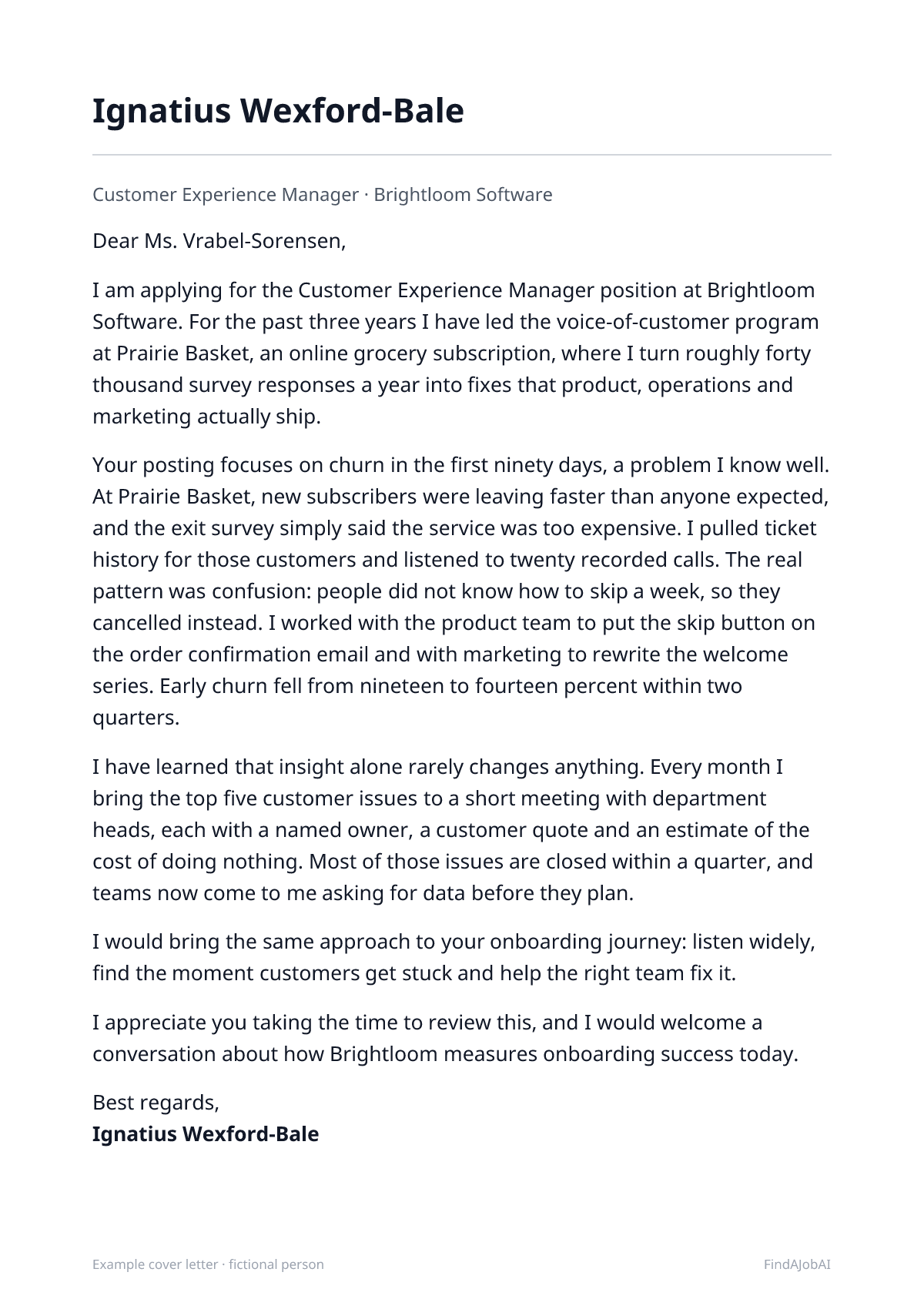
Dear Ms. Vrabel-Sorensen,
I am applying for the Customer Experience Manager position at Brightloom Software. For the past three years I have led the voice-of-customer program at Prairie Basket, an online grocery subscription, where I turn roughly forty thousand survey responses a year into fixes that product, operations and marketing actually ship.
Your posting focuses on churn in the first ninety days, a problem I know well. At Prairie Basket, new subscribers were leaving faster than anyone expected, and the exit survey simply said the service was too expensive. I pulled ticket history for those customers and listened to twenty recorded calls. The real pattern was confusion: people did not know how to skip a week, so they cancelled instead. I worked with the product team to put the skip button on the order confirmation email and with marketing to rewrite the welcome series. Early churn fell from nineteen to fourteen percent within two quarters.
I have learned that insight alone rarely changes anything. Every month I bring the top five customer issues to a short meeting with department heads, each with a named owner, a customer quote and an estimate of the cost of doing nothing. Most of those issues are closed within a quarter, and teams now come to me asking for data before they plan.
I would bring the same approach to your onboarding journey: listen widely, find the moment customers get stuck and help the right team fix it.
I appreciate you taking the time to review this, and I would welcome a conversation about how Brightloom measures onboarding success today.
Best regards,
Ignatius Wexford-Bale
Example 2 · Career changer
Support specialist moving into a CX analyst role
Rosamund has spent three years in customer support and has started analysing ticket trends. The ad is for a junior customer experience role.
Example letter · fictional
Dear Mr. Quarshie-Lund,
I am writing to apply for the Customer Experience Analyst role at Tidewater Outfitters. I have worked in customer support for three years at Copperleaf Home, answering around nine thousand chats and emails, and over the past year I have spent more and more of my time on the question behind every ticket: why did this customer need to contact us at all?
That question led to my favourite project. I noticed that many return requests came from people who could not read our printed return label. Nobody had flagged it, because each agent saw only a few cases a day. I created a simple tagging guide so the whole team labelled tickets the same way, and within a month the numbers showed about three hundred label tickets every month. I shared screenshots and customer quotes with the product team, who reworded the label. Those tickets dropped by more than half.
Since then I have built a weekly CSAT and top-issues report in Zendesk Explore that four team leads use to plan coaching. I am teaching myself SQL in the evenings and recently finished a short course on survey design, because I want to understand feedback beyond the support queue.
Your listing mentions journey mapping and customer interviews, which I have not done formally yet. I would be glad to learn from your senior team, and I can bring a frontline view of where customers get frustrated.
I am grateful for your time and would love to talk about how your CX team works with support today.
Kind regards,
Rosamund Adebayo-Kerr
Example 3 · Senior or lead
Head of CX applying to lead customer experience at a bank
Evander leads CX at a regional insurer and wants to run customer experience for a larger bank. The ad stresses governance and NPS.
Example letter · fictional
Dear Mr. Whitcombe,
Please consider me for the Head of Customer Experience role at Northgate Federal Bank. I have spent fourteen years in customer experience and service operations, and for the last five I have led CX at Keystone Mutual, an insurer with about two million customers, where my team of thirty covers insight, service design and complaint handling.
Your posting says customer metrics are reported but rarely acted on. I inherited the same situation at Keystone: a quarterly NPS deck that executives skimmed and then forgot. I replaced it with a monthly CX council of nine leaders, where every top issue has an owner, a deadline and a cost estimate. We also agreed to tie part of each executive's bonus to NPS and complaint goals, which changed the tone of those meetings within one quarter. Over four years our transactional NPS rose from eighteen to thirty-seven, and complaint volume fell by nearly a third.
The biggest gains came from unglamorous journeys. Claims updates, billing letters and renewal notices drove far more frustration than any new feature, so we rewrote them with customers in small test groups before rolling them out. Fewer surprises meant fewer calls, and the operations team saw their workload fall too.
Banking would be a new industry for me, with its own regulators and product complexity. I would spend my first months listening to branch staff, contact centre agents and customers before proposing any program changes, and I would lean on your risk and compliance colleagues early.
I would welcome the opportunity to discuss your plans for customer experience at Northgate.
Sincerely,
Evander Brightwater-Osei
All three letters, and the short version below, are fictional: the people, employers and numbers are invented. Borrow the structure, never the facts.
- Prefer to write it yourself? Use the free cover letter template.
- Check your CV against the job first: the free CV score shows the missing keywords.
Why the first letter works, paragraph by paragraph
Paragraph 1: Opening
Names the program and its scale, forty thousand responses turned into shipped fixes, so the reader sees a doer rather than a survey administrator.
Paragraph 2: Churn story
Shows real CX method: questioning the obvious survey answer, listening to calls, finding the true cause and getting two teams to act, with a measured result.
Paragraph 3: Making change stick
Describes a repeatable governance habit with owners and costs, which is what hiring managers worry about most in a CX role.
Paragraph 4: Fit for the role
Connects the approach directly to the company's onboarding problem without overpromising a specific result.
Paragraph 5: Close
Asks how onboarding is measured today, a thoughtful question that invites a practical conversation.
What the career changer's letter does differently
The career changer turns support work into CX evidence: noticing a pattern no single agent could see, creating a tagging guide, persuading product with data and building a weekly report. She is honest about missing journey-mapping experience and shows how she is closing that gap on her own time.
What the senior letter does differently
A senior letter talks about systems and incentives: a CX council with owners, bonuses linked to customer metrics and a focus on everyday journeys. It gives multi-year results and treats the industry change as an honest gap with a listening plan.
Short customer experience manager cover letter: an email-ready version
Many applications arrive as an email or a small text box, and a full page doesn't fit. This version runs 120 to 150 words and keeps only what a reader needs to decide whether to reply. A CX manager emails a VP of operations after reading a post about a new customer experience team being formed.
Short version · email · fictional126 words
Subject: CX Manager – journey fixes that cut repeat contacts by 27% – Clementine Vasquez-Orr
Hi Mr. Bellweather-Ng,
I read your post about building a customer experience team at Ridgeway Travel Group and wanted to reach out. I am a CX manager with eight years in support operations and voice of customer, currently working at a fast-growing online retailer in the Midwest.
In my current role I mapped our refund journey, removed two handoffs between support and finance and cut repeat contacts by twenty-seven percent. I also run a monthly issues review with six department heads, so customer problems get real owners and clear deadlines instead of sitting unread in a quarterly report.
My resume is attached. I would be glad to share a short case study and to talk about where travellers struggle most with Ridgeway today.
Best,
Clementine Vasquez-Orr
The short email gives one concrete journey fix with a number and one governance habit, which is exactly what a leader forming a new team wants to see. It ends with an offer to share a case study.
Opening lines that work for customer experience manager cover letters
The first sentence decides whether the second gets read. Here are six openings, one for each situation you might be in. Pick the one that matches yours and swap in your own facts: every name and number below is invented.
1. You have a standout result
Last year our exit survey blamed price for early cancellations, but call recordings showed customers simply could not find the skip button. Fixing that cut early churn by five points.
2. The ad names a problem you've solved
Your posting asks for someone who turns feedback into action. Every month I bring five customer issues to department heads, each with an owner, and most close within a quarter.
3. Someone referred you
Your product director, Anneliese Okoro-Quinn, and I spoke at the same service design meetup in the spring, and she suggested I apply for this role.
4. You admire what they build
As a long-time customer, I have seen your support improve quickly over the past year. I would like to help connect that progress to the rest of the journey.
5. You're new to the field or switching into it
After three years answering about nine thousand support tickets, I am ready to work on why customers contact us, not only on how fast we reply.
6. You have senior scope or a specialism
As head of CX at an insurer, I tied executive bonuses to customer metrics and raised NPS by nineteen points. I am now ready to lead CX at a larger company.
How to write a customer experience manager cover letter
Five steps, in the order you'd write them. The shape stays the same for every job (a short opening, proof, a reason for this employer, a close), and what goes into each part is what changes with the role.
Lead with one fixed journey
Open with a specific customer problem you found and solved, such as a confusing refund flow or a cancellation trap. Give the before-and-after metric. A single concrete story proves more about your CX skills than any summary of programs or tools.
Show how you find root causes
Explain the method behind the fix: ticket tagging, call listening, interviews or survey comments. Hiring managers want to know you look past the obvious answer, because surface-level survey results often point to the wrong problem.
Prove you can move other teams
CX managers rarely own the fix. Describe how you persuaded product, operations or marketing to act, whether through a council, clear evidence or cost estimates. Influence across departments, built on trust and evidence, is the core of the job.
Match the company's problem
Read the posting for clues such as churn, onboarding, complaints or NPS. Tie your example to that exact concern, and explain how you would approach it without promising a specific number before you have seen their data.
Keep metrics honest and clear
Use real CSAT, NPS, CES or churn figures with time frames, and be clear about your role in the result. Inflated or vague claims are easy to spot, while honest numbers build trust before the first interview.
Customer Experience Manager cover letter do's and don'ts
Do
- Tell one story about a journey you fixed and the number that moved.
- Name the teams you persuaded and how you got them to act.
- Mention the metrics you own, such as CSAT, NPS or churn.
- Connect your approach to a problem named in the job ad.
Don't
- Don't list survey tools without saying what changed because of them.
- Don't claim credit for fixes other teams built; show your part clearly.
- Don't fill the letter with CX jargon that hides your actual results.
Common customer experience manager cover letter mistakes
Each one is easy to make and quick to fix before you send the letter.
Listing CX tools instead of results
Qualtrics and Medallia are not achievements. Say what you learned from the data and what changed for customers because of it.
Taking full credit for team fixes
Product or engineering usually builds the change. Describe your part, finding and proving the problem, and credit partners honestly.
Filling the letter with jargon
Phrases like customer-centric transformation say little. Replace them with a plain description of a journey, a fix and a number.
Ignoring the business case
Leaders fund CX work that saves money or keeps customers. Link your results to churn, repeat contacts or revenue where you can.
Writing only about surveys
Feedback is the starting point, not the outcome. Spend most of the letter on what happened after the insight reached the right team.
Email subject lines for customer experience manager applications
Applying by email? Put the job title, any reference number and your name in the subject line.
- CX Manager application – early churn cut from 19% to 14% – Ignatius Wexford-Bale
- CX Analyst – support specialist with ticket-trend projects – Rosamund Adebayo-Kerr
- Application: Customer Experience Manager, Brightloom Software – Ignatius Wexford-Bale
Everything for Customer Experience Managers
- Customer Experience Manager resume exampleA full resume, plus bullet and summary examples
- Customer Experience Manager interview questions30 questions with sample answers
- Customer Experience Manager job descriptionDuties, skills and requirements
- Career change cover letter: template + examples
Other cover letter examples
Customer Experience Manager cover letter FAQ
What should a customer experience manager cover letter focus on?
One clear example of a customer problem you found, the teams you worked with to fix it and the metric that improved. Add a line about how you keep fixes moving across departments.
How long should a CX manager cover letter be?
Keep it to about 250 to 350 words. Hiring managers want one strong story and a sense of your method, not a full list of every survey and dashboard you have built.
Can I move from customer support into a CX role?
Yes. Show that you look beyond single tickets: patterns you spotted, tagging or reports you built and fixes other teams made because of your evidence. That proves you already think like a CX professional.
How we built this page
The FindAJobAI team wrote the three example letters, the short email version, the opening lines and the advice for customer experience manager roles. The people, employers and numbers in the letters are invented; the structure, the kind of evidence and the order of the paragraphs are the parts to copy.
Once we track enough live customer experience manager job ads, this page also shows the skills they ask for most, counted the same way as our in-demand skills report.
Last reviewed on November 1, 2026.