Supply Chain Analyst Cover Letter Example (2026)
By FindAJobAI Team Updated How we built this page
A supply chain analyst cover letter has one job: show a planning or logistics manager that your numbers lead to decisions. Name the scope you supported, one problem you found in the data, what buyers or carriers did about it and the measure that changed. Tools belong in the letter only when they explain how you got there.
Supply Chain Analyst cover letter template
This letter as a one-page template: an opening that names the job and your strongest fact, proof that answers the ad, a reason for this employer and a short close.
After you sign up, FindAJobAI drafts your own letter for a real job from your CV in this format, and you edit it before you send it.
Example 1 · Experienced
Distribution analyst applying to a grocery wholesaler
Thaddeus has four years as an analyst at a hardware distributor. The wholesaler's ad stresses fill rate and too much slow stock.
Example letter · fictional
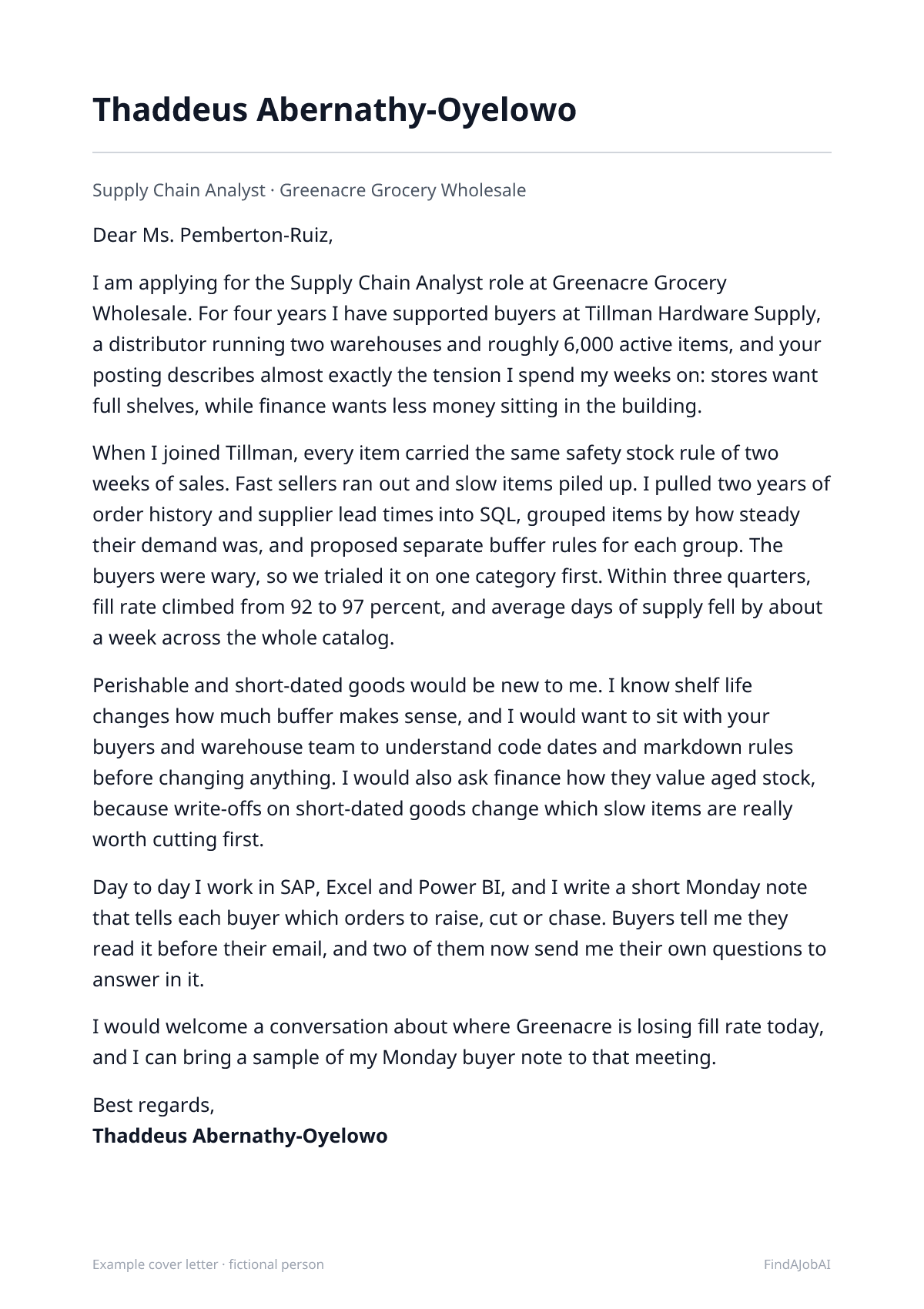
Dear Ms. Pemberton-Ruiz,
I am applying for the Supply Chain Analyst role at Greenacre Grocery Wholesale. For four years I have supported buyers at Tillman Hardware Supply, a distributor running two warehouses and roughly 6,000 active items, and your posting describes almost exactly the tension I spend my weeks on: stores want full shelves, while finance wants less money sitting in the building.
When I joined Tillman, every item carried the same safety stock rule of two weeks of sales. Fast sellers ran out and slow items piled up. I pulled two years of order history and supplier lead times into SQL, grouped items by how steady their demand was, and proposed separate buffer rules for each group. The buyers were wary, so we trialed it on one category first. Within three quarters, fill rate climbed from 92 to 97 percent, and average days of supply fell by about a week across the whole catalog.
Perishable and short-dated goods would be new to me. I know shelf life changes how much buffer makes sense, and I would want to sit with your buyers and warehouse team to understand code dates and markdown rules before changing anything. I would also ask finance how they value aged stock, because write-offs on short-dated goods change which slow items are really worth cutting first.
Day to day I work in SAP, Excel and Power BI, and I write a short Monday note that tells each buyer which orders to raise, cut or chase. Buyers tell me they read it before their email, and two of them now send me their own questions to answer in it.
I would welcome a conversation about where Greenacre is losing fill rate today, and I can bring a sample of my Monday buyer note to that meeting.
Best regards,
Thaddeus Abernathy-Oyelowo
Example 2 · Career changer
Warehouse shift lead moving into a supply chain analyst job
Rosalind ran a pick shift for three years and finished a planning certificate at night. She is applying to an analyst role at a parts distributor.
Example letter · fictional
Dear Mr. Achterhof-Bele,
I am writing to apply for the entry-level Supply Chain Analyst position at Northpoint Auto Parts. For three years I have led the evening pick shift at Brightline Logistics, a third-party warehouse in Indianapolis, and this spring I completed APICS CPIM Part 1 and a community college course in SQL.
Running a shift taught me where planning numbers go wrong on the floor. Last year our client kept reporting stockouts on items our system said we had. I started a simple spreadsheet of every short pick, with location, item and time, and after a month the pattern was clear: most misses came from about forty items stored in two overflow aisles that were never cycle counted. I showed the data to our inventory manager, we added those aisles to the weekly count, and short picks on my shift dropped by more than half. The client noticed too, and it stopped sending weekly complaint emails about missing items.
That project is why I want to work on the analysis side. I enjoy finding the reason behind a number, and I already understand how a reorder decision turns into pallets, labor and trucks.
Since then I have practiced on public sales data, building reorder points and a small Power BI dashboard, which I would be glad to walk you through. I know I still have a lot to learn about forecasting methods and your ERP, and I learn fastest by asking questions of the planners who use the reports.
I would appreciate the chance to talk about the role. I am free to interview any weekday morning, and I can bring the short-pick log and my practice dashboard with me.
Kind regards,
Rosalind Achebe-Kowalczyk
Example 3 · Senior or lead
Senior analyst applying to lead S&OP analytics at a medical device maker
Benedikt leads planning analytics at a building products company. The device maker wants someone to rebuild its monthly S&OP reporting.
Example letter · fictional
Dear Dr. Kessler-Abiola,
I am applying for the Senior Supply Chain Analyst position leading S&OP analytics at Larchmont Medical Devices. Over nine years at Ridgeway Building Products I have grown from inventory analyst to leading a team of three that prepares the monthly planning pack for five plants and about $450 million in annual purchases.
Your posting says the executive meeting spends most of its time arguing about whose numbers are right. I inherited the same problem. Sales, finance and operations each brought their own forecast, built from different extracts. I agreed one data source with each team, rebuilt the pack around a single demand number with clear assumptions, and moved debates about data into a short pre-meeting with planners. Within six months the executive review shrank from three hours to ninety minutes, and leaders started using it to decide capacity and inventory trade-offs instead of reconciling spreadsheets. Planners also gained back most of a week each month that they had spent rebuilding the pack by hand.
I have also built inventory models that freed about $12 million of working capital while holding service above 97 percent, and I coach analysts to write one-page summaries before building dashboards.
Medical devices bring regulation, lot traceability and long qualification times for new suppliers, which I have not managed directly. I would plan to spend my first weeks with quality and regulatory colleagues so the planning rules I propose respect those limits. I would rather learn those constraints early than redesign a process twice.
I would value the chance to discuss how your S&OP process works today and where the debates over numbers start.
Sincerely,
Benedikt Ferreira-Nakagawa
All three letters, and the short version below, are fictional: the people, employers and numbers are invented. Borrow the structure, never the facts.
- Prefer to write it yourself? Use the free cover letter template.
- Check your CV against the job first: the free CV score shows the missing keywords.
Why the first letter works, paragraph by paragraph
Paragraph 1: Opening
Gives the distributor's sites and item count, then names the stock versus service tension the ad describes.
Paragraph 2: Safety stock story
Shows the data used, how buyers were won over with a trial and two measured results.
Paragraph 3: Perishables admission
Admits perishables are new and explains how the writer would learn them before acting.
Paragraph 4: Tools and the Monday note
Lists the tools once, then shows how the analysis reaches buyers every week.
Paragraph 5: Close
Invites a conversation about the employer's own fill rate, which keeps the focus on them.
What the career changer's letter does differently
The career-changer letter turns a warehouse shift into analyst proof: a homemade short-pick log, a pattern found in the data and a measured drop in misses. The certificate and practice dashboard fill the tool gap, and the closing admits what is still to learn.
What the senior letter does differently
This senior letter answers the ad's real complaint, a planning meeting stuck on conflicting numbers, with a fix and a clear before and after. It adds a working capital result and is candid about regulated products being new.
Short supply chain analyst cover letter: an email-ready version
Many applications arrive as an email or a small text box, and a full page doesn't fit. This version runs 120 to 150 words and keeps only what a reader needs to decide whether to reply. An analyst emails a logistics manager who shared an opening on a professional network and asked for short replies.
Short version · email · fictional130 words
Subject: Supply Chain Analyst – 3 years in freight and carrier cost analysis – Henrietta Oduya-Sorensen
Hi Mr. Vasquez-Thorne,
I saw your post about the Supply Chain Analyst opening at Bayline Freight Partners. For three years I have analyzed outbound freight at a furniture retailer that ships about 1,200 orders a day from two warehouses.
Last year I matched eighteen months of carrier invoices to shipment data and found duplicate and misrated charges worth close to $90,000, which our carriers credited back after I shared the matched records with their billing teams. I also built the lane cost model we now use in every annual tender.
You mentioned needing someone strong in SQL and carrier data. That is most of my week. I would be glad to share a sample lane model with real figures removed and talk whenever suits you this week.
Thanks,
Henrietta Oduya-Sorensen
A busy logistics manager wants proof in a few lines. This email gives volume, one audit result with money attached and a direct answer to the skill named in the post.
Opening lines that work for supply chain analyst cover letters
The first sentence decides whether the second gets read. Here are six openings, one for each situation you might be in. Pick the one that matches yours and swap in your own facts: every name and number below is invented.
1. You have a standout result
Last year my safety stock rules lifted fill rate from 92 to 97 percent at a two-warehouse distributor, and I would like to bring that work to your team.
2. The ad names a problem you've solved
Your posting mentions too much slow stock and too many stockouts at once, a problem I have worked on for four years.
3. Someone referred you
Your planning manager, Ingeborg Salazar, and I met at an ASCM chapter event, and she suggested I apply for this analyst role.
4. You admire what they build
I found close to $90,000 in freight billing errors last year by matching invoices to shipment records.
5. You're new to the field or switching into it
After three years running a warehouse shift, I want to work on the planning numbers that decide what my team picks.
6. You have senior scope or a specialism
I lead a small analytics team that turned a three-hour S&OP meeting into a ninety-minute decision session.
How to write a supply chain analyst cover letter
Five steps, in the order you'd write them. The shape stays the same for every job (a short opening, proof, a reason for this employer, a close), and what goes into each part is what changes with the role.
Open with scope and a result
In the first two sentences, say what kind of operation you support, such as warehouses, plants or stores, and how large it is in items, sites or spend. Then add one result, like a fill rate or freight saving, so the reader knows why to keep going.
Tell one analysis story from start to finish
Pick a single problem, describe the data you pulled, what you found and who acted on it. Close the story with the measure that changed and the time it took. One clear story beats a list of five projects with no detail behind any of them.
Show how people used your work
Analysts are judged by decisions, not dashboards. Mention the buyers, planners, carriers or executives who read your reports and what they did differently. A short line about a weekly note or review meeting shows your work reaches the people who order and ship.
Name what is new to you
If the employer's industry, ERP or product type is new to you, say so in one sentence and explain how you would learn it. Hiring managers trust a candidate who knows what perishables, regulated parts or long lead times change about planning rules.
End on the problem in their ad
End by offering to discuss a problem named in the ad, such as stockouts or freight cost. Keep the last paragraph to two sentences, and make sure your email, phone and portfolio link are easy to find in the signature or the application form.
Supply Chain Analyst cover letter do's and don'ts
Do
- Give your scope in items, sites, suppliers or spend.
- Tell one story where buyers or carriers acted on your analysis.
- Name the measure that changed, such as fill rate or freight cost.
Don't
- Don't list every tool you have opened; mention the ones behind your result.
- Don't claim savings you could not explain in an interview.
- Don't send the same letter to a retailer and a manufacturer.
Common supply chain analyst cover letter mistakes
Each one is easy to make and quick to fix before you send the letter.
Listing every software tool you know
Tools are expected. Mention the ones that produced your result and let the outcome carry the letter.
Describing dashboards but no decisions
Say what buyers or managers changed because of your analysis, and what happened next.
Quoting savings with no method
Add one clause on how the saving was measured so the number holds up in an interview.
Ignoring the employer's industry
Grocery, auto parts and medical devices plan differently. Name one difference and how you would handle it.
Writing a long technical essay
Keep it under a page. Save model details for the interview or a portfolio link.
Email subject lines for supply chain analyst applications
Applying by email? Put the job title, any reference number and your name in the subject line.
- Supply Chain Analyst – 4 years, fill rate 92% to 97% – Thaddeus Abernathy-Oyelowo
- Entry-level Supply Chain Analyst – warehouse lead with CPIM Part 1 – Rosalind Achebe-Kowalczyk
- Application: Senior Supply Chain Analyst, S&OP (Req. 7731) – Thaddeus Abernathy-Oyelowo
Everything for Supply Chain Analysts
- Supply Chain Analyst resume exampleA full resume, plus bullet and summary examples
- Supply Chain Analyst interview questions30 questions with sample answers
- Supply Chain Analyst job descriptionDuties, skills and requirements
- Career change cover letter: template + examples
Other cover letter examples
Supply Chain Analyst cover letter FAQ
What should a supply chain analyst cover letter include?
The scope you supported, one analysis that changed a decision, the measure that moved and the tools you used to get there. Close by linking your experience to a problem named in the ad.
How do I write a supply chain analyst cover letter with no analyst experience?
Use warehouse, purchasing, retail or class project work where you collected data and found a pattern. Mention certificates such as CPIM, any SQL or Power BI practice and what you plan to learn first.
How long should a supply chain analyst cover letter be?
About 250 to 350 words. One opening paragraph, one detailed example with numbers, a short note on tools and fit, and a brief closing are enough for most hiring managers.
How we built this page
The FindAJobAI team wrote the three example letters, the short email version, the opening lines and the advice for supply chain analyst roles. The people, employers and numbers in the letters are invented; the structure, the kind of evidence and the order of the paragraphs are the parts to copy.
Once we track enough live supply chain analyst job ads, this page also shows the skills they ask for most, counted the same way as our in-demand skills report.
Last reviewed on November 1, 2026.