Food Scientist Resume Example (2026)
By FindAJobAI Team Updated How we built this page
Food scientist resumes are read by R&D directors, product development managers and quality leads who want to know which products you have taken from bench to plant, how you test shelf life and safety, and whether your recipes survive scale-up. They look for product categories, ingredient knowledge, sensory and analytical methods, and food safety systems such as HACCP and SQF.
The example below belongs to a product development scientist with seven years in snack and beverage companies. Each bullet links a formulation or study to a launch, a cost saving, a shelf-life result or a sensory score, so a hiring manager can see both the science and the commercial outcome.
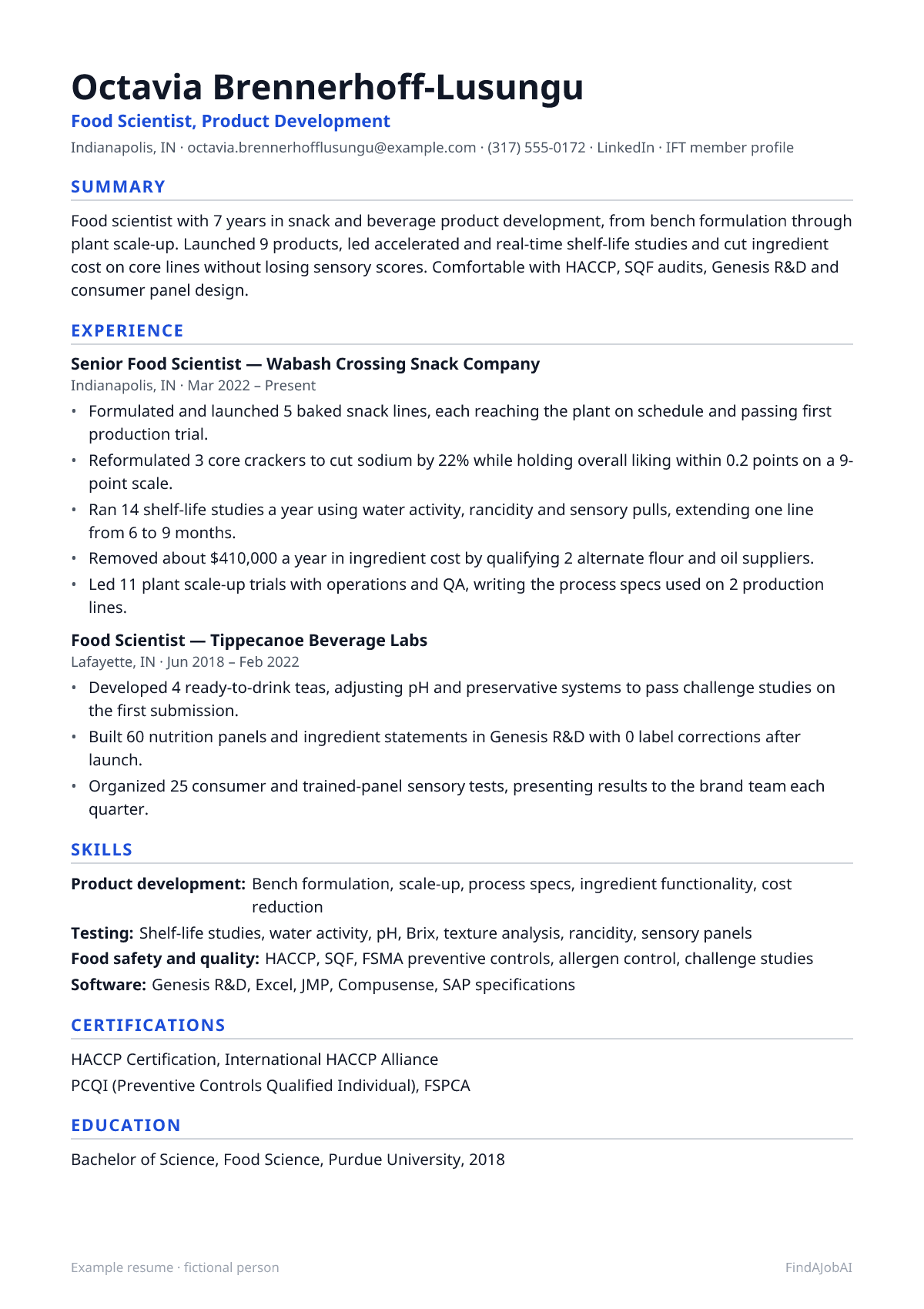
Food Scientist resume template
This example as a one-page template: one column, standard headings and plain text, the format applicant tracking systems read most reliably.
After you sign up, Create my CV builds your own resume in this same one-column layout, from your real experience.
Mid-level food scientist resume example
A complete one-page example for a fictional food scientist: every bullet pairs an action with what changed because of it.
Example resume · fictional person
Octavia Brennerhoff-Lusungu
Food Scientist, Product Development
Indianapolis, IN · [email protected] · (317) 555-0172 · LinkedIn · IFT member profile
Summary
Food scientist with 7 years in snack and beverage product development, from bench formulation through plant scale-up. Launched 9 products, led accelerated and real-time shelf-life studies and cut ingredient cost on core lines without losing sensory scores. Comfortable with HACCP, SQF audits, Genesis R&D and consumer panel design.
Experience
Senior Food Scientist, Wabash Crossing Snack Company
Indianapolis, IN · Mar 2022 – Present
- Formulated and launched 5 baked snack lines, each reaching the plant on schedule and passing first production trial.
- Reformulated 3 core crackers to cut sodium by 22% while holding overall liking within 0.2 points on a 9-point scale.
- Ran 14 shelf-life studies a year using water activity, rancidity and sensory pulls, extending one line from 6 to 9 months.
- Removed about $410,000 a year in ingredient cost by qualifying 2 alternate flour and oil suppliers.
- Led 11 plant scale-up trials with operations and QA, writing the process specs used on 2 production lines.
Food Scientist, Tippecanoe Beverage Labs
Lafayette, IN · Jun 2018 – Feb 2022
- Developed 4 ready-to-drink teas, adjusting pH and preservative systems to pass challenge studies on the first submission.
- Built 60 nutrition panels and ingredient statements in Genesis R&D with 0 label corrections after launch.
- Organized 25 consumer and trained-panel sensory tests, presenting results to the brand team each quarter.
Skills
- Product development: Bench formulation, scale-up, process specs, ingredient functionality, cost reduction
- Testing: Shelf-life studies, water activity, pH, Brix, texture analysis, rancidity, sensory panels
- Food safety and quality: HACCP, SQF, FSMA preventive controls, allergen control, challenge studies
- Software: Genesis R&D, Excel, JMP, Compusense, SAP specifications
Certifications
- HACCP Certification, International HACCP Alliance
- PCQI (Preventive Controls Qualified Individual), FSPCA
Education
- Bachelor of Science, Food Science, Purdue University, 2018
Fictional example by the FindAJobAI team: the person, employers and numbers are invented. Keep the structure; use your own work and numbers you can explain in an interview.
Entry-level food scientist resume example
A recent food science graduate whose internship and capstone product carry the resume. Bullets turn class and internship work into what an R&D manager screens for: tests run, samples made and a product that reached a panel.
Entry-level example resume · fictional person
Evander Quillfeather-Ashdown
Associate Food Scientist
Madison, WI · [email protected] · (317) 555-0123 · LinkedIn
Summary
Entry-level food scientist with a BS in food science and a summer internship in a dairy R&D lab. Prepared about 120 bench samples of yogurt and cheese sauce, ran pH, Brix and viscosity checks and helped run 6 sensory panels. Led a capstone team that built a shelf-stable plant-based dip.
Education
- Bachelor of Science, Food Science, University of Wisconsin–Madison, 2025 (GPA 3.4)
Experience
Product Development Intern, Kettle Moraine Dairy Innovations
Madison, WI · May 2025 – Aug 2025
- Prepared about 120 bench samples of yogurt and cheese sauce for 3 reformulation projects.
- Measured pH, Brix and viscosity on 30 samples a week and logged every result in the project tracker.
- Helped run 6 sensory panels of 25 tasters, setting up coded samples and entering scores.
- Wrote 4 bench procedures so later interns could repeat the work with the same results.
Skills
- Testing: pH, Brix, viscosity, water activity, colorimetry, sensory panel setup
- Food safety: GMP basics, allergen handling, sanitation, HACCP coursework
- Software: Genesis R&D basics, Excel, JMP, PowerPoint
Projects
- Capstone: led a 4-person team that built a shelf-stable chickpea dip, reaching a water activity of 0.85 or below in 5 test batches.
- Placed second of 11 teams in the university product development competition, 2025.
Senior food scientist resume example
An R&D manager with fifteen years who now leads a product development team. Bullets cover pipeline results, team leadership, scale-up standards and work with suppliers and marketing.
Senior example resume · fictional person
Philippa Achterberg-Nwosu
R&D Manager, Packaged Foods
Minneapolis, MN · [email protected] · (317) 555-0131 · LinkedIn
Summary
R&D manager with 15 years in packaged foods, leading a 10-person product development team across frozen meals and sauces. Owns the innovation pipeline, sets scale-up standards and partners with marketing, operations and suppliers to launch on time and on cost.
Experience
R&D Manager, Nicollet Table Foods
Minneapolis, MN · Feb 2020 – Present
- Lead 10 food scientists and technicians delivering 12 to 15 launches a year across 2 brands.
- Introduced a stage-gate review that cut late-stage formula changes from 9 to 2 per year.
- Delivered $1.8 million in annual savings through reformulation and supplier changes over 3 years.
- Led clean-label work on 22 SKUs, removing artificial colors with no drop in repeat purchase.
Senior Food Scientist, Nicollet Table Foods
Minneapolis, MN · Jul 2014 – Jan 2020
- Developed 7 frozen entrées, each passing plant trial and retail shelf-life review on schedule.
- Mentored 5 associate scientists, 4 of whom were promoted within 3 years.
- Wrote process authority files for 3 retorted sauces with an outside thermal process expert.
Food Scientist, Prairie Hearth Bakeries
St. Paul, MN · Aug 2010 – Jun 2014
- Formulated 6 frozen dough products and supported 20 plant trials.
- Ran texture and moisture testing on about 40 samples a week.
Skills
- Leadership: Team planning, hiring, stage-gate reviews, budget ownership, supplier partnerships
- Technical: Thermal processing, frozen and retorted foods, clean-label reformulation, scale-up
- Food safety: HACCP, FSMA preventive controls, SQF, allergen programs, process authority work
- Systems: Genesis R&D, SAP PLM, Smartsheet, JMP
Certifications
- PCQI, FSPCA
- Better Process Control School
Education
- MS, Food Science, University of Minnesota, 2010
- BS, Biology, Iowa State University, 2008
How to write a food scientist resume
Five steps, in the order a recruiter reads the page. The format around them stays plain for every job: one column, standard headings, newest role first.
Header: name, target title and links
Use “Food Scientist”, “Product Developer” or “R&D Scientist” to match the posting, then your city, phone, email and LinkedIn. Add an IFT profile if you keep one.
Summary: what you do and your best proof
Open with years of experience, the categories you know and where you work in the process, from bench to plant. Add one launch, cost or shelf-life result and your food safety training.
Experience: newest first, a result in every bullet
Write each bullet as product, action and result: launches, savings, shelf-life gains, panel scores or trials passed. Bullets that only say you supported R&D make every candidate look the same.
Skills: grouped, in the ad's words
Group skills into product development, testing, food safety and software. List only methods and systems you use without help.
Education and certifications
List your degree, school and year. Add a thesis or capstone product for early-career roles, and put HACCP, PCQI or Better Process Control School in certifications.
Skills to put on a food scientist resume
Hard skills are the tools and methods of the job; soft skills are how you work with people. Each comes with one way to prove it, because a skill named only in a list counts for little. Add the ones you really have.
Hard skills
- Formulation
- Name the categories and how many products you formulated from concept to launch.
- Shelf-life studies
- Say whether you run accelerated or real-time studies and what life you proved.
- Sensory evaluation
- Give panel types, sizes and the decisions the results drove.
- Scale-up and plant trials
- Mention trials you led and a problem you solved on the line.
- Ingredient functionality
- Name hydrocolloids, starches, proteins or emulsifiers you know well and one use.
- Food safety systems
- List HACCP, PCQI or SQF work and any audit results.
- Nutrition labeling
- Give the number of SKUs and any regulation you labeled to, such as FDA or EU rules.
- Analytical testing
- Name water activity, texture analysis or moisture tests you run yourself.
- Cost reduction
- Put a dollar or percent figure on savings and show quality held.
- Formulation software
- Name Genesis R&D, TraceGains or your PLM system and a task you do in it.
Soft skills
- Collaboration
- Name the teams you work with, such as marketing, operations or suppliers.
- Problem solving
- Describe one scale-up or stability problem you traced to its cause.
- Communication
- Mention results you presented to brand teams or leadership.
- Project management
- Give how many projects you run at once and your on-time record.
- Curiosity
- Show a new ingredient or process you tested on your own initiative.
- Attention to detail
- Show label or spec errors you caught before launch.
- Coaching
- Mention technicians or interns you trained and their progress.
Food Scientist resume bullet examples: weak vs strong
The same work, written two ways. The strong version names the tool, the scope and a result; the numbers are examples, yours must be real.
Weak: Made new recipes.
Strong: Formulated 3 high-protein bars from concept to plant trial in 7 months, hitting the target of 20 g protein per serving.
Adds a count, a timeline and a measurable product target.
Weak: Did shelf-life testing.
Strong: Designed accelerated shelf-life studies for 6 sauces, predicting a 12-month life that real-time pulls later confirmed.
Shows study design skill and proves the prediction held up.
Weak: Worked on cost savings.
Strong: Replaced a costly stabilizer in 2 dressings, saving about $95,000 a year with no change in viscosity or panel scores.
Puts a dollar value on the change and shows quality was protected.
Weak: Helped with plant trials.
Strong: Ran 8 first-production trials with plant operators, solving a dough sticking issue that had stopped 2 earlier attempts.
Shows hands-on scale-up work and a problem the writer actually fixed.
Weak: Ran sensory tests.
Strong: Set up 18 triangle and preference tests with a 40-person panel, giving the brand team clear go or no-go calls.
Gives method, panel size and how the results were used.
Weak: Wrote labels.
Strong: Prepared nutrition facts and allergen statements for 35 SKUs, with 0 recalls or label errors over 3 years.
Turns paperwork into a measurable compliance record.
15 more food scientist resume bullet examples
Grouped by area of the job, so you can find the ones closest to your work. Keep the shape (action, scope, result) and replace the invented numbers with your own.
Formulation and launches
- Built 4 gluten-free bakery items that passed retail buyer tastings on the first presentation.
- Cut added sugar in 2 cereals by 30% using fiber blends, keeping crunch scores within target.
- Created a plant-based cheese sauce that held emulsion through 3 freeze-thaw cycles.
- Moved 6 recipes from bench to pilot plant in under 8 weeks each.
Testing and shelf life
- Ran 9 accelerated shelf-life studies at 3 temperatures, setting code dates for 14 SKUs.
- Tracked water activity and texture on 200 retained samples a quarter to catch drift early.
- Designed challenge studies with an outside lab for 3 refrigerated dips, all passing on first submission.
- Set up rancidity tests that flagged an oil supplier problem 2 months before customer complaints rose.
Food safety and compliance
- Updated HACCP plans for 5 product lines after formula changes, with 0 findings in the next SQF audit.
- Reviewed allergen statements for 40 SKUs during a supplier change, catching 2 missing declarations.
- Prepared EU labeling files for 8 products entering 3 new markets.
Plant and team work
- Trained 12 line operators on new mixing steps, reducing first-run scrap by 18%.
- Ran supplier trials on 7 alternate ingredients, approving 5 with no change in panel scores.
- Coached 3 interns, 2 of whom joined the team full time after graduation.
- Partnered with marketing on 10 concept tests to narrow 30 ideas down to 4 bench projects.
Food Scientist resume summary examples
Two or three lines on what you do and your strongest proof. Start from the one closest to your level and use your own facts.
Entry-level food scientist with a BS in food science, a summer internship in a dairy R&D lab and hands-on pH, Brix and texture testing. Organized, quick with formulation software and ready to support plant trials.
Food scientist with 7 years in snack and beverage development, taking products from bench formulation to plant scale-up. Leads shelf-life studies, reformulates for cost and nutrition targets and works under HACCP and SQF.
R&D manager with 15 years in packaged foods, leading a 10-person product development team. Owns the innovation pipeline, sets technical standards for scale-up and partners with marketing, operations and suppliers on launches.
Common food scientist resume mistakes
Each one is easy to make and quick to fix before you apply.
Describing projects without outcomes
Say whether each product launched, what it saved or what shelf life it reached.
Leaving out scale-up experience
Add plant trials you ran, because bench-only work worries R&D managers.
Listing every lab test from school
Keep the tests you still run and show depth on two or three with numbers.
Hiding food safety training
Place HACCP, PCQI or SQF work near the top so screeners see it quickly.
ATS tips for a food scientist resume
Applicant tracking systems turn your file into text that recruiters search, mostly for the skills and titles in the ad. They rarely reject a resume on their own; one that parses badly or misses the ad's words just doesn't come up.
- Name the product categories you know, such as snacks, dairy or beverages, because R&D teams hire for category depth.
- Connect formulation work to a launch, a cost saving or a nutrition target you could explain in an interview.
- List the tests you run yourself, such as water activity or texture analysis, rather than every lab method you have seen.
- Show food safety knowledge with HACCP, PCQI or SQF experience near the top.
- Include plant trials, because many good bench scientists have never solved a scale-up problem.
For the format itself, run the free ATS resume checklist.
Everything for Food Scientists
- Food Scientist cover letter examplesThree example letters and a short email version
- Food Scientist interview questions30 questions with sample answers
- Food Scientist job descriptionDuties, skills and requirements
- How to tailor your resume without lying
Other resume examples
Food Scientist resume FAQ
What should I put on a food scientist resume?
The product categories you develop, products launched, shelf-life and sensory studies, scale-up trials, cost or nutrition results, and the food safety systems you work under. Add formulation software and any PCQI or HACCP training.
How do I write a food scientist resume with no experience?
Lead with your food science degree, then list internships, product development competitions and lab courses. Name the tests you ran, such as pH or texture analysis, and the product you formulated in class projects.
Should a food scientist resume list certifications?
Yes. HACCP, PCQI and SQF practitioner training are widely requested in US and European food companies, so place them in their own section where screeners can find them quickly.
How we built this page
The FindAJobAI team wrote the three example resumes, the bullets, the skills and the advice for food scientist roles. The people, employers and numbers in the examples are invented; the structure, the tools and the way each bullet is built are the parts to copy.
Once we track enough live food scientist job ads, this page also shows the skills they ask for most, counted the same way as our in-demand skills report.
Last reviewed on November 1, 2026.