Cartographer Cover Letter Example (2026)
By FindAJobAI Team Updated How we built this page
Mapping managers read cartographer cover letters next to your portfolio, so the letter should explain the thinking the maps cannot show. A strong letter names the map products you make, the data you compile them from, one design or data problem you solved and how you keep releases on schedule. It should sound like a careful map maker talking about real sheets, not a list of software.
Cartographer cover letter template
This letter as a one-page template: an opening that names the job and your strongest fact, proof that answers the ad, a reason for this employer and a short close.
After you sign up, FindAJobAI drafts your own letter for a real job from your CV in this format, and you edit it before you send it.
Example 1 · Experienced
Recreation map designer applying to a state survey agency
Wendeline designs folded trail maps at a small publisher. The ad is for a cartographer producing topographic and land ownership sheets at a state agency.
Example letter · fictional
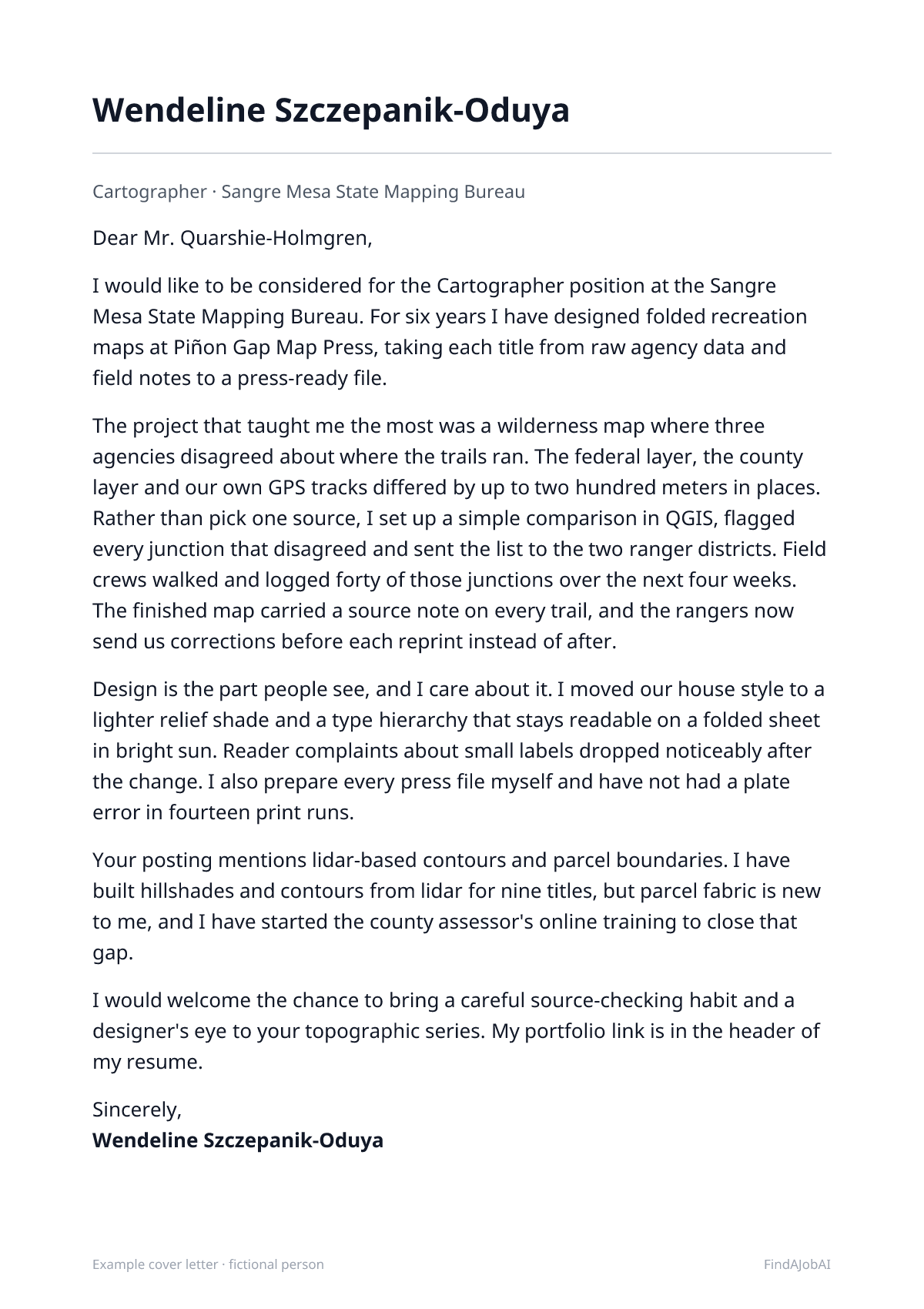
Dear Mr. Quarshie-Holmgren,
I would like to be considered for the Cartographer position at the Sangre Mesa State Mapping Bureau. For six years I have designed folded recreation maps at Piñon Gap Map Press, taking each title from raw agency data and field notes to a press-ready file.
The project that taught me the most was a wilderness map where three agencies disagreed about where the trails ran. The federal layer, the county layer and our own GPS tracks differed by up to two hundred meters in places. Rather than pick one source, I set up a simple comparison in QGIS, flagged every junction that disagreed and sent the list to the two ranger districts. Field crews walked and logged forty of those junctions over the next four weeks. The finished map carried a source note on every trail, and the rangers now send us corrections before each reprint instead of after.
Design is the part people see, and I care about it. I moved our house style to a lighter relief shade and a type hierarchy that stays readable on a folded sheet in bright sun. Reader complaints about small labels dropped noticeably after the change. I also prepare every press file myself and have not had a plate error in fourteen print runs.
Your posting mentions lidar-based contours and parcel boundaries. I have built hillshades and contours from lidar for nine titles, but parcel fabric is new to me, and I have started the county assessor's online training to close that gap.
I would welcome the chance to bring a careful source-checking habit and a designer's eye to your topographic series. My portfolio link is in the header of my resume.
Sincerely,
Wendeline Szczepanik-Oduya
Example 2 · Entry level
Geography graduate applying for a junior cartographer role at a transit agency
Corvin has a new geography degree, a parks internship and a capstone flood map. The ad is for a junior cartographer on a regional transit agency's map team.
Example letter · fictional
Dear Ms. Ostrander-Mwangi,
I am applying for the Junior Cartographer opening at Tri-Lakes Regional Transit Authority. I finished my geography degree at Iowa State University in May, and the work I enjoyed most was making maps that ordinary people had to read quickly, often while standing at a bus stop.
Last summer I interned with a county parks department, updating nine trail and access maps. My first draft of a park map looked tidy on screen, but when we printed it at the real size the trail labels were too small to read in daylight. I rebuilt the type sizes from the printed proof rather than the screen, cut the number of labels by grouping minor trails and tested the new version with two staff who did not know the park. Both found the trailheads within a minute. The parks team kept that type scale for the rest of the series.
For my capstone I built a flood risk map for a small river town from lidar terrain and county parcel data. Choosing what to leave out was the hardest part, and I learned to start each map by writing down the one question a reader needs answered.
Transit maps are new to me, but I have studied several system maps closely and redrawn one as a practice project to understand line spacing and transfer symbols. I am comfortable in ArcGIS Pro, QGIS and Illustrator and keep a source log for every map.
I would be glad to talk about how your team updates maps when routes change. Thank you for your time.
Best regards,
Corvin Afolabi-Strandberg
Example 3 · Senior or lead
Cartography lead applying to manage mapping at a national outdoor publisher
Henrietta leads a small map team at a regional agency. The ad is for a mapping production manager at a national publisher of outdoor and travel maps.
Example letter · fictional
Dear Ms. Valderrama-Okoye,
I am applying for the Mapping Production Manager role at Northbound Compass Publishing. I have worked in cartography for fifteen years, and for the last five I have led a team of six cartographers at the Bitterroot Basin Mapping Service, producing topographic, recreation and web maps for public sale.
When I took over the team, corrections after printing were our biggest cost and embarrassment. Each cartographer checked their own work, and errors that crossed sheet edges slipped through. I set up a three-stage review: the maker checks against the source log, a second cartographer reviews design and labels, and I sign off on edges and legends. The first year was slower, but corrections after printing fell to a few a year, and reprints now carry new content instead of fixes. The review stages also gave newer cartographers a safe way to learn from senior colleagues.
I also led the move of our print catalog to a web map series built on vector tiles. The hardest part was not the technology but agreeing which print rules still made sense on a phone screen. We wrote a short style guide for both, and the web series now reaches far more readers than the printed maps ever did. Sales of the printed titles held steady, which surprised our finance team.
Northbound Compass is expanding into European hiking regions. I would spend my first months learning your data partnerships and production calendar, then agree review stages and style rules that work across countries and languages.
I would welcome a conversation about your plans for the next two seasons and how the team can grow with them.
Kind regards,
Henrietta Obuya-Kristiansen
All three letters, and the short version below, are fictional: the people, employers and numbers are invented. Borrow the structure, never the facts.
- Prefer to write it yourself? Use the free cover letter template.
- Check your CV against the job first: the free CV score shows the missing keywords.
Why the first letter works, paragraph by paragraph
Paragraph 1: Opening
Names the role, the current employer, the map products and the full data-to-press scope in two sentences, which answers the mapping manager's first question.
Paragraph 2: The trail conflict story
Shows a real data problem in order: three sources that disagreed, a method to find every conflict, field checks and a lasting change in how corrections arrive.
Paragraph 3: Design and print
Gives one concrete design decision, its effect on readers and a clean record of press files, which proves craft beyond the portfolio.
Paragraph 4: The parcel gap
Admits a missing skill named in the posting and points to related lidar work and training already started.
Paragraph 5: Close
Links the writer's habits to the agency's series and points the reader to the portfolio.
What the entry-level letter does differently
The graduate's letter turns an internship into production language: a printed proof, a legibility problem, a fix tested with real readers and a type scale the team kept. It shows the writer thinks about the person holding the map.
What the senior letter does differently
A senior cartographer letter is about the team and the catalog: review stages, release reliability, house style and the shift to digital products. It ties the writer's plan to the publisher's next market.
Short cartographer cover letter: an email-ready version
Many applications arrive as an email or a small text box, and a full page doesn't fit. This version runs 120 to 150 words and keeps only what a reader needs to decide whether to reply. A web cartographer replies by email to a newsroom graphics editor who posted an opening for a news map designer.
Short version · email · fictional128 words
Subject: News Map Designer – 4 years web maps on deadline – Leopoldine Nakashima-Arceneaux
Hi Mr. Fairbrook-Obiefuna,
I am writing about the News Map Designer role at the Riverbend Daily Ledger. For four years I have built web maps for a regional emergency management office, often within hours of a storm or wildfire update.
Most of my maps are made under time pressure, so I keep templates for common layers and a checklist for sources and dates on every map. During last year's flood season I published 23 evacuation and road closure maps, each updated within an hour of new official data. I also design for phones first, since that is where most readers saw them.
My portfolio is linked below, and I can start with two weeks' notice. I would be glad to talk whenever suits your desk.
Thanks,
Leopoldine Nakashima-Arceneaux
The short email leads with deadline mapping, which is what a newsroom needs most, then gives one volume and speed result. A busy graphics editor can judge fit in under a minute.
Opening lines that work for cartographer cover letters
The first sentence decides whether the second gets read. Here are six openings, one for each situation you might be in. Pick the one that matches yours and swap in your own facts: every name and number below is invented.
1. You have a standout result
I turn agency data, field notes and lidar into maps people can read in bright sun on a folded sheet.
2. The ad names a problem you've solved
Your posting asks for a cartographer who checks sources carefully, and my most useful project began with three agencies that disagreed about the same trails.
3. Someone referred you
After a summer printing park maps at full size and fixing every label that failed, I am ready to start my career in map production.
4. You admire what they build
Your senior cartographer, Augustus Mbeki-Lindholm, suggested I apply after we met at a regional mapping conference in October.
5. You're new to the field or switching into it
Every map I release carries a source log, a second review and a printed proof before it reaches a reader.
6. You have senior scope or a specialism
As a cartography lead with six map makers, I have learned that most corrections start at the edges between sheets.
How to write a cartographer cover letter
Five steps, in the order you'd write them. The shape stays the same for every job (a short opening, proof, a reason for this employer, a close), and what goes into each part is what changes with the role.
Open with your map products
In the first two sentences, name the kinds of maps you make, such as topographic sheets, trail maps, transit maps or web apps, and whether you handle data, design and release. Mapping managers sort letters by product fit, so make yours easy to see.
Explain one decision behind a map
Pick a map from your portfolio and explain a choice the reader cannot see, such as which source you trusted, what you left out or how you tested labels. One clear decision shows judgment better than a list of software or a general claim about design skill.
Show your data habits
Mention how you check sources, keep logs and confirm content with field staff or partner agencies. Errors on published maps are costly and public, so a cartographer with careful data habits earns trust quickly with a mapping manager.
Mention print or web delivery
Say whether you prepare press-ready files, web layers or both, and give one result such as clean print runs or maps updated on deadline. Delivery skills separate a working cartographer from someone who only makes maps for class or personal projects.
Close by linking your best maps
End by linking your portfolio and naming one map in it that fits the employer's work. Offer a conversation and stop there, so the reader moves straight from your letter to your best maps while your examples are still fresh.
Cartographer cover letter do's and don'ts
Do
- Name the map products you make and the scales you work at.
- Tell one story about a data or design problem and how you solved it.
- Point the reader to your portfolio and explain one choice it shows.
Don't
- Don't list every GIS tool you have opened; managers will test the ones you name.
- Don't describe maps only as attractive; explain accuracy, sources and readers too.
- Don't hide a gap in the posting's required skills; say how you are closing it.
Common cartographer cover letter mistakes
Each one is easy to make and quick to fix before you send the letter.
Spending the cartographer letter on software names
Name your main tools once and spend the letter on maps you made and decisions you took.
Leaving readers without a map sample link
Add the link in the letter and the resume header, because the maps are the main evidence.
Talking about beauty without accuracy
Pair any design point with how you checked sources and confirmed content.
Ignoring the reader of the map
Mention who uses your maps and one change you made so they could read them faster.
Email subject lines for cartographer applications
Applying by email? Put the job title, any reference number and your name in the subject line.
- Cartographer application – 6 years recreation maps, lidar relief – Wendeline Szczepanik-Oduya
- Junior Cartographer – BS Geography 2025, parks mapping internship – Corvin Afolabi-Strandberg
- Mapping Production Manager – 15 years print and web cartography – Henrietta Obuya-Kristiansen
Everything for Cartographers
- Cartographer resume exampleA full resume, plus bullet and summary examples
- Cartographer interview questions30 questions with sample answers
- Cartographer job descriptionDuties, skills and requirements
- Cover letter with no experience: templates
Other cover letter examples
Cartographer cover letter FAQ
What should a cartographer cover letter include?
The map products you design, the data sources you compile from, one design or data problem you solved, how you meet release dates and a link to your portfolio. Keep it to one page.
How do I write a cartographer cover letter with no experience?
Use internships, class projects and volunteer maps. Describe the audience, the data and one decision you made, such as what to leave out, and show that you test maps with real readers.
Should I mention software in a cartographer cover letter?
Briefly. Name the core tools in one sentence and spend the rest of the letter on maps you made with them, because the resume and portfolio already show the full list.
How we built this page
The FindAJobAI team wrote the three example letters, the short email version, the opening lines and the advice for cartographer roles. The people, employers and numbers in the letters are invented; the structure, the kind of evidence and the order of the paragraphs are the parts to copy.
Once we track enough live cartographer job ads, this page also shows the skills they ask for most, counted the same way as our in-demand skills report.
Last reviewed on November 1, 2026.