Assembler Cover Letter Example (2026)
By FindAJobAI Team Updated How we built this page
Most assembler hiring happens fast, and a supervisor may scan dozens of applications for one shift. A cover letter helps when it names the products you have built, your pace and quality numbers, and one problem you caught on the line, so the reader can picture you at a station on day one.
Assembler cover letter template
This letter as a one-page template: an opening that names the job and your strongest fact, proof that answers the ad, a reason for this employer and a short close.
After you sign up, FindAJobAI drafts your own letter for a real job from your CV in this format, and you edit it before you send it.
Example 1 · Experienced
Harness assembler applying to an electronics manufacturer
Rosalind builds wire harnesses for industrial controls. The ad asks for IPC/WHMA-A-620 knowledge and experience with crimp tooling.
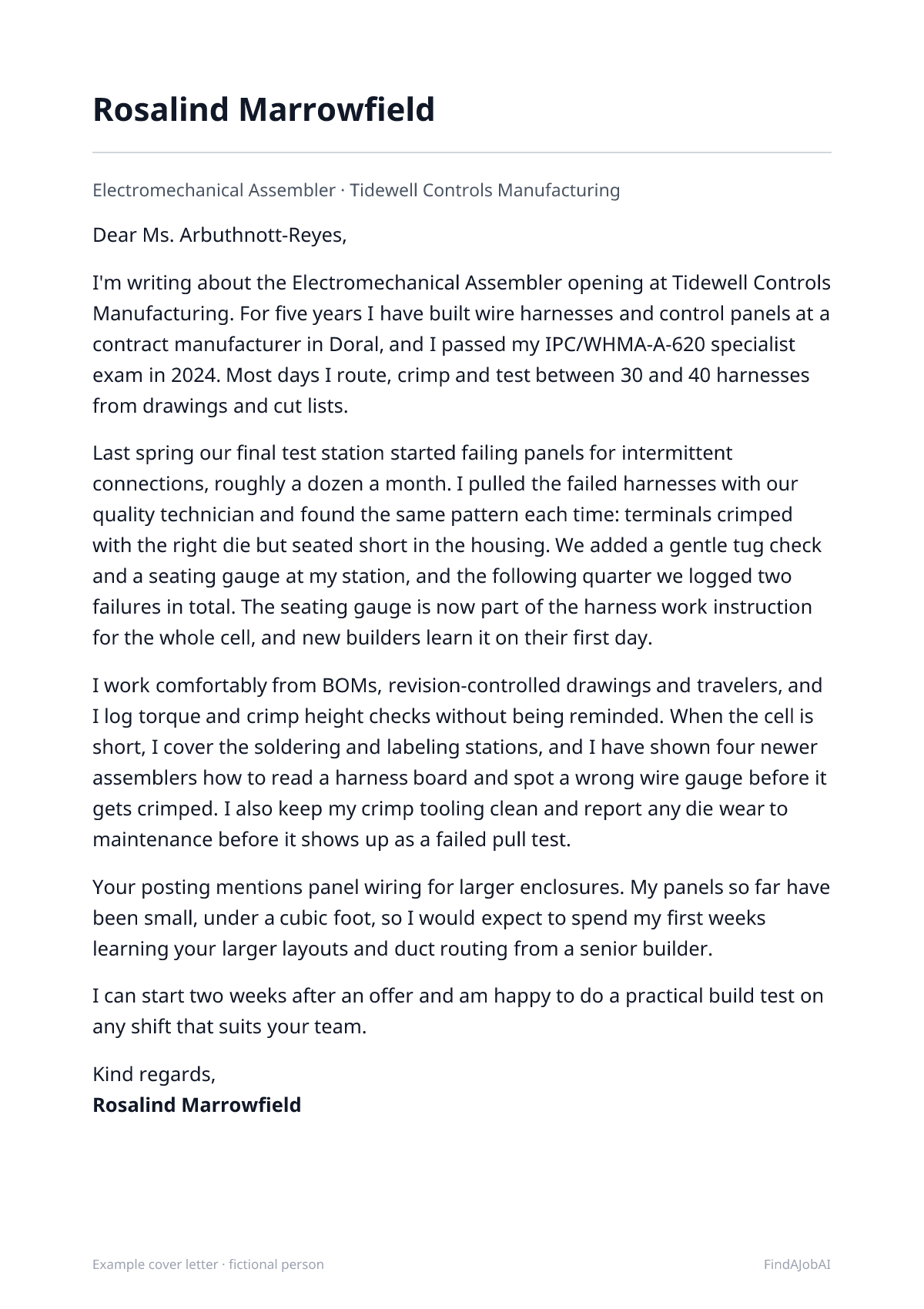
Example letter · fictional
Dear Ms. Arbuthnott-Reyes,
I'm writing about the Electromechanical Assembler opening at Tidewell Controls Manufacturing. For five years I have built wire harnesses and control panels at a contract manufacturer in Doral, and I passed my IPC/WHMA-A-620 specialist exam in 2024. Most days I route, crimp and test between 30 and 40 harnesses from drawings and cut lists.
Last spring our final test station started failing panels for intermittent connections, roughly a dozen a month. I pulled the failed harnesses with our quality technician and found the same pattern each time: terminals crimped with the right die but seated short in the housing. We added a gentle tug check and a seating gauge at my station, and the following quarter we logged two failures in total. The seating gauge is now part of the harness work instruction for the whole cell, and new builders learn it on their first day.
I work comfortably from BOMs, revision-controlled drawings and travelers, and I log torque and crimp height checks without being reminded. When the cell is short, I cover the soldering and labeling stations, and I have shown four newer assemblers how to read a harness board and spot a wrong wire gauge before it gets crimped. I also keep my crimp tooling clean and report any die wear to maintenance before it shows up as a failed pull test.
Your posting mentions panel wiring for larger enclosures. My panels so far have been small, under a cubic foot, so I would expect to spend my first weeks learning your larger layouts and duct routing from a senior builder.
I can start two weeks after an offer and am happy to do a practical build test on any shift that suits your team.
Kind regards,
Rosalind Marrowfield
Example 2 · Career changer
Warehouse picker moving into production assembly
Benedikt has picked and packed orders for four years and wants a day-shift assembler job at an appliance plant that trains new hires.
Example letter · fictional
Dear Coralstone Assembly Hiring Team,
Please accept my application for the Production Assembler role at Coralstone Appliance Group. I have spent four years in a distribution center, and I am ready to move from moving products to building them on a line that trains its people and measures quality carefully.
In the warehouse I pick 140 to 160 order lines an hour on a scanner, and my accuracy has stayed above 99.8% for the last two years. That pace taught me to work to a standard without cutting corners, because every wrong item comes back as a customer complaint with my badge number attached to it. I also learned to check my own work twice, because a mislabeled tote can hold up an entire truck at the dock.
I also assemble things whenever the chance appears. Our returns team asked me to rebuild damaged display shelving and office chairs from parts, and I put together more than 200 of them from manufacturer instructions last year. Earlier this year I finished a six-week evening course in basic manufacturing that covered torque tools, calipers and reading simple drawings.
Your ad says new assemblers start on subassemblies and rotate to the main line after training. That is exactly how I would like to learn, and I am comfortable standing for full shifts, lifting up to fifty pounds and working overtime during busy weeks. I have worked rotating shifts before and have reliable transport to your plant.
I have a forklift certification and a clean safety record, and I can come in for an interview or a skills check any morning.
Sincerely,
Benedikt Ashworth-Mbeki
Example 3 · Senior or lead
Lead assembler applying for an assembly supervisor role
Ottoline leads a final assembly cell for pumps. The ad is for a first-shift assembly supervisor at an HVAC equipment maker.
Example letter · fictional
Dear Mr. Strathearn,
I would like to be considered for the first-shift Assembly Supervisor position at Pelicanbay HVAC Systems. I have worked in assembly for fourteen years and have led a nine-person final assembly cell for commercial pumps for the last four, covering mechanical builds, wiring and end-of-line testing.
When I took over the cell, first-pass yield at test sat around 93% and most failures were blamed on the test bench. I started recording every failure by station and shift on a whiteboard next to the bench. Within a month it was clear that two stations caused most of the problems: a gasket that was easy to pinch and a sensor connector that was not fully latched. We changed the fixture and added a latch check to the work instruction, and yield has held above 98% for eighteen months.
I build the weekly schedule for the cell, run first-article builds for new models with manufacturing engineering, and keep a cross-training matrix so every assembler can cover three stations. I would rather fix a work instruction than repeat the same correction to a person twice. When someone struggles at a station, I watch a few builds with them before deciding whether the problem is the person, the fixture or the instruction.
Your ad mentions coil and cabinet assembly. My background is pumps and motors, so I would spend my first weeks on the floor learning your products from your lead assemblers before changing anything.
I would welcome a conversation about your first-shift goals and how I could support your team in reaching them.
Respectfully,
Ottoline Varnsworth
All three letters, and the short version below, are fictional: the people, employers and numbers are invented. Borrow the structure, never the facts.
- Prefer to write it yourself? Use the free cover letter template.
- Check your CV against the job first: the free CV score shows the missing keywords.
Why the first letter works, paragraph by paragraph
Paragraph 1: Opening
Names the product she builds, her years, the IPC standard the ad asks for and her daily volume, which is what a supervisor screens first.
Paragraph 2: The intermittent failures
A real defect pattern, how she traced it with quality, and a before-and-after count. It shows she understands why units fail, not only how to build them.
Paragraph 3: Station routine
Working from drawings and travelers, logging checks, covering other stations and coaching newer people show she needs little supervision.
Paragraph 4: Large-panel admission
She names her limited large-panel experience instead of overstating it, which makes the rest of the letter easier to trust.
Paragraph 5: Close
Gives a start date and offers a build test, the two practical next steps a plant needs.
What the career changer's letter does differently
The career changer does not pretend to have line experience. He uses his scanner pace and accuracy, the chairs and shelving he rebuilt, and a short evening course to show a supervisor that he can keep a standard and learn the tools. Naming the lifting and shift conditions answers questions a plant would otherwise ask at interview.
What the senior letter does differently
A supervisor letter moves from personal output to the cell's results: a yield problem made visible on a board, two root causes, and a fix written into the work instruction. The cross-training matrix and the honest note about a new product line show how she would manage people, not only parts.
Short assembler cover letter: an email-ready version
Many applications arrive as an email or a small text box, and a full page doesn't fit. This version runs 120 to 150 words and keeps only what a reader needs to decide whether to reply. An assembler replies to a staffing agency post for a night-shift role building medical carts, which asked for a brief email.
Short version · email · fictional134 words
Subject: Night Shift Assembler – 3 years cart and fixture builds – Isidore Penhallow
Hi Ms. Delacroix-Burns,
Your Night Shift Assembler opening at Mangrove Medical Carts caught my eye. For three years I have assembled steel and aluminum carts and workstations at a furniture plant, building about 25 a shift from drawings.
On my current line I suggested labeling caster bolts by length after mixed bolts caused wobbly units at inspection, and those rejects stopped within a month. I use torque drivers, rivet guns and calipers daily and keep my station clean, stocked and ready for the next shift, with a short handover note for the day crew.
I have worked nights for two years and can start next week, including weekend overtime when orders peak. I've attached my resume and would happily do a build test on any evening that suits the line lead.
Thanks,
Isidore Penhallow
The short version keeps the product match, one small fix with a result, and the night-shift availability the post asked about. It leaves the full work history to the attached resume.
Opening lines that work for assembler cover letters
The first sentence decides whether the second gets read. Here are six openings, one for each situation you might be in. Pick the one that matches yours and swap in your own facts: every name and number below is invented.
1. You have a standout result
When our test bench kept failing control panels for loose connections, I traced the problem to terminals seated short in their housings and fixed it at my station.
2. The ad names a problem you've solved
I build 30 to 40 wire harnesses a day to IPC/WHMA-A-620, which matches the harness work described in your posting.
3. Someone referred you
Your line lead, Caspian Whitlowe, trained with me at a contract manufacturer and suggested I apply when your second shift opened.
4. You admire what they build
After four years picking orders at 99.8% accuracy, I'm ready to move from moving products to building them on your line.
5. You're new to the field or switching into it
In my cell, first-pass yield rose from 93% to above 98% once we tracked every failure by station, and I'd like to bring that habit to your plant.
6. You have senior scope or a specialism
Your medical carts are the sturdiest I've seen in a hospital, and assembling steel and aluminum carts is what I do every shift.
How to write an assembler cover letter
Five steps, in the order you'd write them. The shape stays the same for every job (a short opening, proof, a reason for this employer, a close), and what goes into each part is what changes with the role.
Lead with the products you build and your pace
In the first lines, say what you assemble and roughly how many units a shift, such as harnesses, appliances or hydraulic units. Production supervisors sort applications by that match before anything else, and a clear number lets them compare you with their own takt time.
Show one defect you caught or fixed
Pick a real problem, like loose connectors, mixed fasteners or a misdrilled part lot, and explain how you noticed it and what changed afterwards. Give a before-and-after count if you have one, because quality numbers are what line leaders remember.
Name the tools, documents and standards you use
Mention torque drivers, crimp presses, calipers and test equipment, plus the drawings, BOMs and travelers you work from. Add standards such as IPC-A-610 or IPC/WHMA-A-620 when the ad lists them, so the reader does not have to guess your level.
Be honest about products or stations you haven't worked
If the job involves larger panels, a new product family or a machine you have not run, say so in one sentence and point to the closest work you have done. Supervisors trust candidates who know their limits more than those who claim every station.
Close with availability and a skills check
Give your earliest start date and the shifts you can work, and offer to do a practical build test. Many plants hire within days, so making the next step easy for the supervisor helps your letter turn into an interview quickly.
Assembler cover letter do's and don'ts
Do
- Name the products you have built and your typical units per shift in the first paragraph.
- Tell one story about a defect you caught or traced back to its cause.
- Mention the certifications the ad lists, such as IPC, ESD or forklift.
Don't
- Don't rely on "hard worker" or "fast learner" without a number behind it.
- Don't list every part number or tool in your plant; pick the ones the ad mentions.
- Don't skip shift, overtime or lifting details if the posting raises them.
Common assembler cover letter mistakes
Each one is easy to make and quick to fix before you send the letter.
Only describing personality
Words like reliable and detail-oriented need proof. Add your units per shift, a yield figure or an attendance record.
Not naming the product
Building harnesses and building furniture are different jobs. Say what you assembled so the supervisor can match it to their line.
Ignoring shift and physical requirements
If the ad mentions nights, overtime or lifting, confirm you can do them so the reader does not have to ask.
Restating the posting duty by duty
A copied list of line duties tells the supervisor nothing new. Show one example of doing that duty well, with a number.
Email subject lines for assembler applications
Applying by email? Put the job title, any reference number and your name in the subject line.
- Electromechanical Assembler – IPC/WHMA-A-620, 5 years harness builds – Rosalind Marrowfield
- Production Assembler application – warehouse picker, forklift certified – Benedikt Ashworth-Mbeki
- Application: Lead Assembler, final assembly (Req 2290) – Rosalind Marrowfield
Everything for Assemblers
- Assembler resume exampleA full resume, plus bullet and summary examples
- Assembler interview questions30 questions with sample answers
- Assembler job descriptionDuties, skills and requirements
- Career change cover letter: template + examples
Other cover letter examples
Assembler cover letter FAQ
Does an assembler job need a cover letter?
Often it is optional, but a short letter helps when many applicants look alike. It lets you name the products you built, give an output or yield number and show one problem you caught.
What should I write in an assembler cover letter with no experience?
Anything you have built from instructions, work where speed and accuracy were measured, any manufacturing course, and your comfort with standing, lifting and shift work.
How long should an assembler cover letter be?
Keep it to one page, roughly four or five short paragraphs. Supervisors read quickly, so put your products, volume and one result near the top.
How we built this page
The FindAJobAI team wrote the three example letters, the short email version, the opening lines and the advice for assembler roles. The people, employers and numbers in the letters are invented; the structure, the kind of evidence and the order of the paragraphs are the parts to copy.
Once we track enough live assembler job ads, this page also shows the skills they ask for most, counted the same way as our in-demand skills report.
Last reviewed on November 1, 2026.