Auditor Cover Letter Example (2026)
By FindAJobAI team Updated How we built this page
Auditor ads mostly list the same credentials: a degree, maybe a CPA or CIA in progress, and some mix of SOX, internal controls or external audit experience. The cover letter is where you show you can actually find something wrong and get it fixed, not just follow a checklist.
Auditor cover letter template
This letter as a one-page template: an opening that names the job and your strongest fact, proof that answers the ad, a reason for this employer and a short close.
After you sign up, FindAJobAI drafts your own letter for a real job from your CV in this format, and you edit it before you send it.
Example 1 · Experienced
Internal audit senior applying to a regional bank
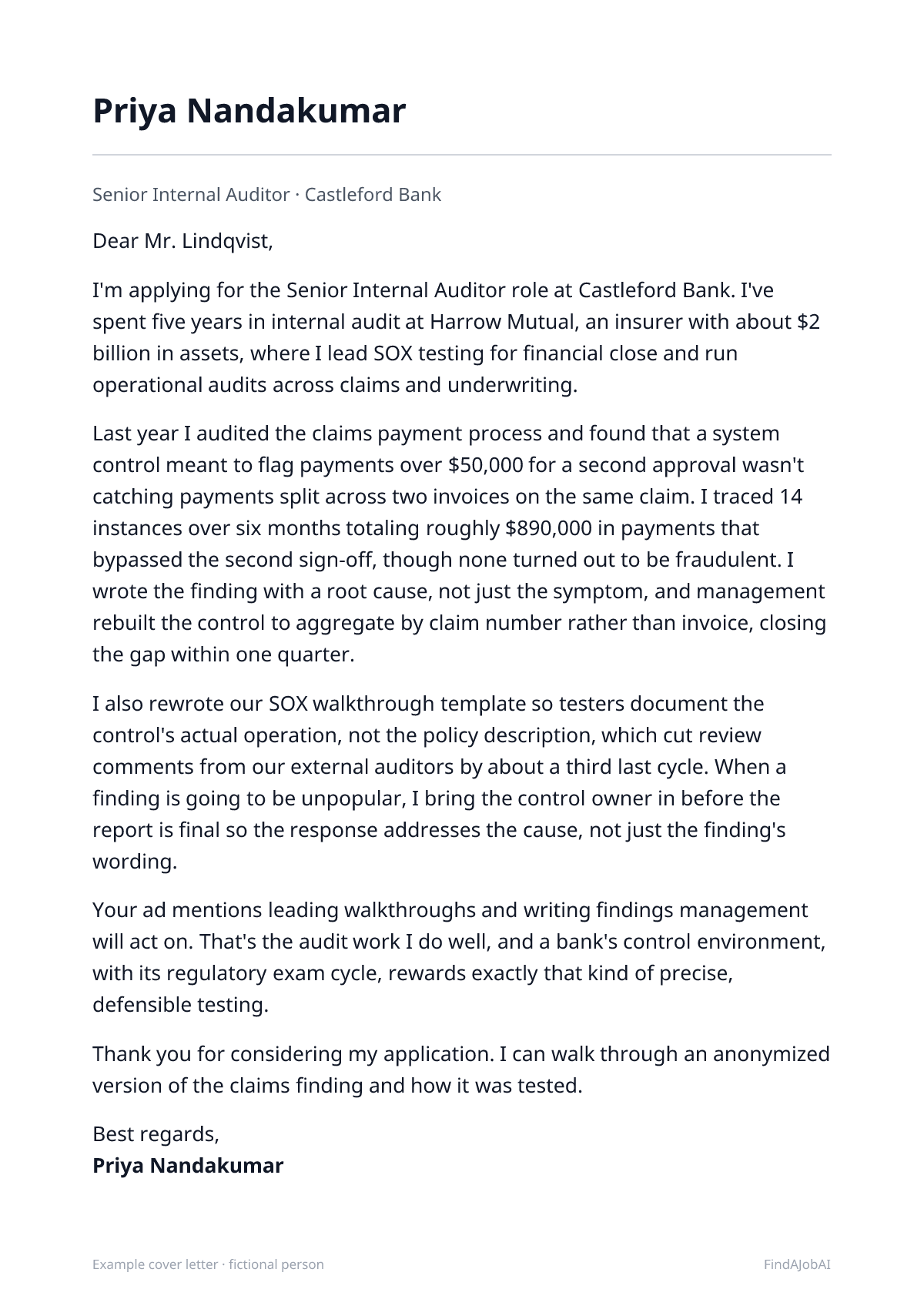
Priya runs SOX and operational audits at a mid-size insurer. The ad asks for someone who can lead walkthroughs and write findings management will act on.
Example letter · fictional
Dear Mr. Lindqvist,
I'm applying for the Senior Internal Auditor role at Castleford Bank. I've spent five years in internal audit at Harrow Mutual, an insurer with about $2 billion in assets, where I lead SOX testing for financial close and run operational audits across claims and underwriting.
Last year I audited the claims payment process and found that a system control meant to flag payments over $50,000 for a second approval wasn't catching payments split across two invoices on the same claim. I traced 14 instances over six months totaling roughly $890,000 in payments that bypassed the second sign-off, though none turned out to be fraudulent. I wrote the finding with a root cause, not just the symptom, and management rebuilt the control to aggregate by claim number rather than invoice, closing the gap within one quarter.
I also rewrote our SOX walkthrough template so testers document the control's actual operation, not the policy description, which cut review comments from our external auditors by about a third last cycle. When a finding is going to be unpopular, I bring the control owner in before the report is final so the response addresses the cause, not just the finding's wording.
Your ad mentions leading walkthroughs and writing findings management will act on. That's the audit work I do well, and a bank's control environment, with its regulatory exam cycle, rewards exactly that kind of precise, defensible testing.
Thank you for considering my application. I can walk through an anonymized version of the claims finding and how it was tested.
Best regards,
Priya Nandakumar
Example 2 · Career changer
Staff accountant moving into internal audit
Noah found and fixed a reconciliation control gap before he had the title. The ad mentions testing internal controls and working across departments.
Example letter · fictional
Dear Hiring Manager,
I'm applying for the Internal Audit Associate role at Birchmere Logistics. For three years I've worked as a staff accountant at a regional trucking company, and the part of that job I was best at was finding where our controls didn't match what we actually did, then fixing it. I'm ready to make that my full-time job.
Last year I noticed our monthly bank reconciliations were being approved by the same person who prepared them, which meant a timing error or a misstatement could go unnoticed for months. I raised it with our controller, documented the gap, and we split the duties and added a second reviewer. Within the next audit cycle, we caught a $12,000 duplicate vendor payment during the first month under the new process, something the old setup would likely have missed until year-end.
Since then I've passed two sections of the CPA exam and completed a course on internal control frameworks through my state CPA society. I'm comfortable with Excel and our ERP system's reporting tools, and I've started learning SQL so I can pull my own samples instead of waiting on IT.
Your posting mentions testing internal controls and working across departments. Spotting a segregation-of-duties gap and getting a process owner to change how they work is exactly that kind of job, and I bring both the technical accounting background and a sense of how to raise an issue without making it personal.
Thank you for your time. I'd welcome the chance to talk through the reconciliation example in more detail.
Kind regards,
Noah Salazar
Example 3 · Senior or lead
Audit manager applying to build out a first internal audit function
Grace manages a team of five auditors at a healthcare company. The ad is for an audit manager who will build the function's first risk-based annual plan.
Example letter · fictional
Dear Mr. Fairweather,
I'm applying for the Internal Audit Manager role at Thistlewood Health. For the last four years I've led five auditors at Renwick Medical, a hospital network, where we cover revenue cycle, HIPAA controls and vendor management, after seven years as a senior auditor. I'd like to write a function's first annual audit plan from scratch, starting with the risks your board worries about most.
Your ad says the audit plan currently gets built around whatever the last incident was, with no documented risk ranking. Renwick had the same gap when I joined. I built a risk assessment that scored each process area on likelihood and financial exposure, agreed it with the CFO and compliance officer, and used it to set a three-year rotation instead of a reactive one. The first cycle under that plan caught a billing code error in our outpatient revenue cycle that had overstated receivables by about $610,000 over two years, a process area the old approach hadn't touched in five years.
Audit earns credibility through findings that get fixed, not reports that get filed. When we flagged that vendor onboarding skipped background checks for about 15% of new contractors, I didn't just write the finding; I worked with procurement to build a mandatory checklist into the onboarding system itself, and compliance now reports zero gaps in the quarterly spot check.
I hired three of my five auditors and run a quarterly rotation so each one gets exposure to both financial and operational audits. I haven't built a risk assessment from a blank slate before, since Renwick had a partial one, and at Thistlewood I'd expect to spend real time with department heads early to get the exposure estimates right.
A conversation about which three risk areas concern your board most, and what the audit committee currently sees versus what it wants to see, would be a good place to start.
Sincerely,
Grace Odumosu
All three letters, and the short version below, are fictional: the people, employers and numbers are invented. Borrow the structure, never the facts.
- Prefer to write it yourself? Use the free cover letter template.
- Check your CV against the job first: the free CV score shows the missing keywords.
Why the first letter works, paragraph by paragraph
Paragraph 1: Opening
Names the scope of the writer's audit work (SOX, claims, underwriting) and the size of the company. Auditors are hired against a specific control environment, so scope signals fit.
Paragraph 2: The finding that changed a control
A specific control failure, how it was traced (14 instances, a dollar figure), the root cause, and the fix management made. Naming that it wasn't fraud shows calibrated judgment.
Paragraph 3: Working with control owners
Rewriting a walkthrough template and involving owners before the report is final are concrete signs of audit maturity, which separates seniors from staff auditors.
Paragraph 4: Why this company
Mirrors the ad's emphasis on walkthroughs and actionable findings, and names a reason the industry (bank exams) suits the writer's style of testing.
Paragraph 5: Close
The close offers an anonymized finding to walk through, a concrete next step that keeps the current employer's details private.
What the career changer's letter does differently
This letter begins with a control gap the writer found and closed before holding the title, and it names the catch: a $12,000 duplicate payment. Exam progress and a framework course show the skills becoming formal, and his accounting background is linked to the audit work the ad describes.
What the senior letter does differently
An audit manager letter reports an organization's structural habits: a risk assessment built and agreed with leadership, a rotation plan replacing reactive audits, a control built into a system rather than left as a recommendation. The gap, a risk assessment from a blank slate, is named rather than implied.
Short auditor cover letter: an email-ready version
Many applications arrive as an email or a small text box, and a full page doesn't fit. This version runs 120 to 150 words and keeps only what a reader needs to decide whether to reply. An auditor answers a utility company's short-answer application field, sent as an email because the ad listed no portal.
Short version · email · fictional124 words
Subject: Internal Auditor (SOX, operational audit) – revenue cycle – Vince Wagner
Hello Ms. Whitfield,
I'm applying for the Internal Auditor role at Ferncross Utilities. I have four years of SOX and operational audit experience at a regional water utility, where I lead testing for billing and revenue cycle controls.
My most useful finding was in meter-to-bill reconciliation: a timing gap let about 2% of usage readings post a full cycle late, understating revenue before quarter-end. We fixed the batch schedule, and the gap closed within two billing cycles, recovering roughly $180,000 in previously delayed revenue recognition.
Revenue cycle controls matter in utilities, and I'd like to bring that kind of specific, fixable finding to your team. My resume is attached, and I can walk through the reconciliation finding with company details removed.
Best,
Vince Wagner
A short-answer field forces a choice, so the short version keeps one finding and its dollar impact, in a process area (revenue cycle) the employer cares about. Offering to walk through the finding with details removed signals confidentiality without over-promising.
Opening lines that work for auditor cover letters
The first sentence decides whether the second gets read. Here are six openings, one for each situation you might be in. Pick the one that matches yours and swap in your own facts: every name and number below is invented.
1. You have a standout result
One control gap I found last year led to a rebuilt approval threshold and closed roughly $890,000 in payments that had bypassed a second sign-off. I'd like to bring that kind of testing to your audit team.
2. The ad names a problem you've solved
Your ad says findings often sit unresolved for months, according to your posting. At my current company I started bringing control owners in before the report is final, and our average time-to-remediation fell by half.
3. Someone referred you
Your controller, David Okonkwo, worked with me for two years on SOX testing, from the finance side. He mentioned you need someone who can write a finding management will actually act on, which prompted this application.
4. You admire what they build
I've followed your company's public 10-K disclosures for a few years, and the complexity of your revenue recognition footnote made me curious about the controls behind it; I'd like to help test them.
5. You're new to the field or switching into it
I worked as a staff accountant for three years, then found and fixed a segregation-of-duties gap in our reconciliation process. Internal audit is where I'd like to keep doing that kind of work.
6. You have senior scope or a specialism
As a senior auditor for seven years, I built the risk assessment my company still uses to set its audit plan. I'm looking for a role where I can build that function from its earliest stage.
How to write an auditor cover letter
Five steps, in the order you'd write them. The shape stays the same for every job (a short opening, proof, a reason for this employer, a close), and what goes into each part is what changes with the role.
Identify the process area this audit role covers
Audit jobs differ by scope: SOX and financial controls, operational audits, IT general controls, or a mix. Read the ad for the process areas it names (revenue cycle, procurement, claims) and pick a finding of yours from a similar area, tested in a similar way.
Open with the control gap, not the audit program
Describe what could have gone wrong and what you actually found, in a sentence or two, and give the testing method only afterward. A real gap in your opening paragraph keeps the reader going through the rest.
Quantify the exposure and the fix, not the hours tested
Tie one finding to a number: dollars at risk, a percentage of exceptions, time to close the gap. Avoid counting audits completed or hours logged. If you can't quantify the exposure, describe exactly what changed in the control once your finding was accepted.
Name your frameworks inside a real test
Work SOX, COSO, IIA standards, or a specific system into the story of what you tested and how. State the sample size or population and how you picked it. Frameworks are credible when attached to an actual test, not listed on their own.
Show how you work with the people you're auditing
One sentence on how you handle a finding that will be unpopular: bringing the owner in early, separating root cause from blame, or how you word a report. Close by naming a risk area you'd like to look at first, so the reader sees where you'd start.
Auditor cover letter do's and don'ts
Do
- Name the specific control you tested, how you traced the exception, and the fix that resulted, with a number attached.
- Mention the framework or standard the ad names (SOX, COSO, IIA standards) inside an example, not as a standalone list.
- Show how you handle disagreement: how you get a control owner to accept and act on a finding.
Don't
- Don't call yourself "detail-oriented with strong analytical skills"; show it with one finding and its root cause.
- Don't count audits completed; one finding that changed a control beats a dozen clean reports.
- Don't share your current employer's confidential figures; use rounded amounts or anonymized percentages.
Common auditor cover letter mistakes
Each one is easy to make and quick to fix before you send the letter.
Describing audit programs, not findings
'Completed 12 SOX walkthroughs' tells the reader about activity. Say what control gap one of those walkthroughs uncovered and what changed because of it. A single finding beats a list of completed programs.
Leaving exposure figures without context
'Identified $500,000 in control weaknesses' means little without knowing the population it was drawn from or the time period. Give the sample size, the period, and how the figure was calculated so it can be checked.
Listing certifications with no application
A row of CPA, CIA and CISA with no example suggests credentials without practice. Name the one most relevant to the ad and show it being used in a real test you ran.
Writing findings as accusations
A letter that reads as 'I caught them doing it wrong' signals a tone that makes control owners defensive. Show that you separate root cause from blame and work with the owner on the fix.
Calling yourself "highly ethical and detail-oriented"
Every applicant for an audit role writes this. Use that sentence for a concrete example instead: a specific judgment call you made on materiality, or a finding you pursued despite pushback.
Email subject lines for auditor applications
Applying by email? Put the job title, any reference number and your name in the subject line.
- Senior Internal Auditor application – SOX and operational audit, insurance – Priya Nandakumar
- Internal Audit Associate – staff accountant, CPA in progress – Noah Salazar
- Application: Internal Auditor, Credit Risk (Req. 2240) – Priya Nandakumar
Everything for Auditors
- Auditor resume exampleA full resume, plus bullet and summary examples
- Auditor interview questions30 questions with sample answers
- Auditor job descriptionDuties, skills and requirements
- Career change cover letter: template + examples
Other cover letter examples
Auditor cover letter FAQ
What should I write in an auditor cover letter?
One finding that changed a control: what you tested, what you found, the root cause, and what management changed because of it. Then a sentence on how you work with the people whose process you're reviewing. Your certifications are already on your resume.
How do I write an auditor cover letter with no experience?
Use control or reconciliation work from an accounting or finance job, such as a gap you noticed and fixed, then add exam progress (CPA, CIA) and a controls course. Name the systems you used and one concrete result.
Should I mention which audit standards or frameworks I know?
Yes, but inside an example rather than a list. Naming SOX or COSO while describing a specific test you ran shows you've actually applied the framework, not just studied it.
How we built this page
The FindAJobAI team wrote the three example letters, the short email version, the opening lines and the advice for auditor roles. The people, employers and numbers in the letters are invented; the structure, the kind of evidence and the order of the paragraphs are the parts to copy.
Once we track enough live auditor job ads, this page also shows the skills they ask for most, counted the same way as our in-demand skills report.
Last reviewed on November 1, 2026.