Financial Analyst Cover Letter Example (2026)
By FindAJobAI team Updated How we built this page
Financial analyst and FP&A ads are consistent: Excel, forecasting, budgeting and modeling, plus an ERP or planning tool. Hiring managers read cover letters to see what your models decided: a budget, a pricing change, a hiring plan. Accuracy and influence matter more than the number of models you've built.
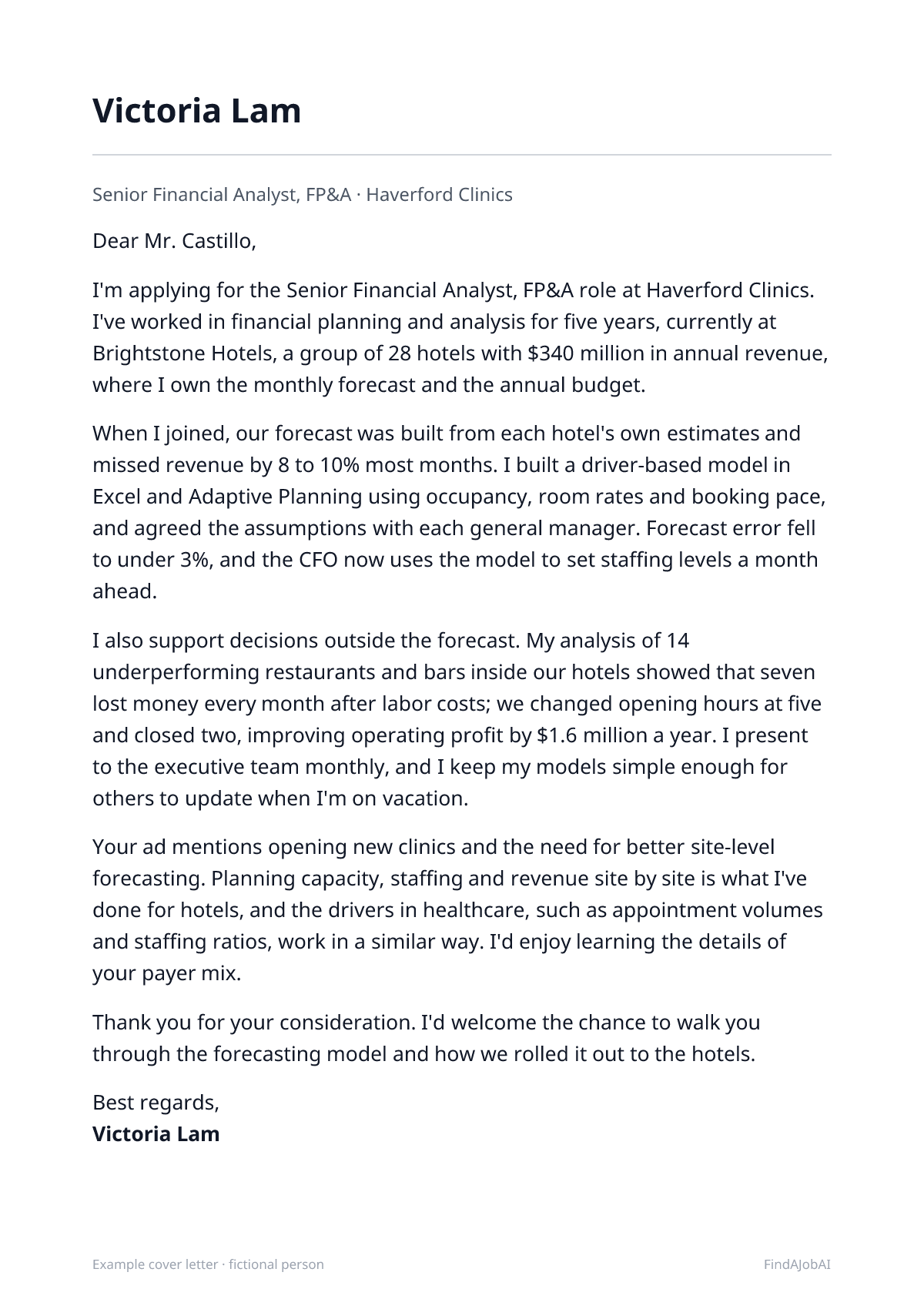
Financial Analyst cover letter template
This letter as a one-page template: an opening that names the job and your strongest fact, proof that answers the ad, a reason for this employer and a short close.
After you sign up, FindAJobAI drafts your own letter for a real job from your CV in this format, and you edit it before you send it.
Example 1 · Experienced
Senior FP&A analyst applying to a healthcare group
Victoria owns the forecast and budget for a hotel group. The ad mentions new clinic openings and better site-level forecasting.
Example letter · fictional
Dear Mr. Castillo,
I'm applying for the Senior Financial Analyst, FP&A role at Haverford Clinics. I've worked in financial planning and analysis for five years, currently at Brightstone Hotels, a group of 28 hotels with $340 million in annual revenue, where I own the monthly forecast and the annual budget.
When I joined, our forecast was built from each hotel's own estimates and missed revenue by 8 to 10% most months. I built a driver-based model in Excel and Adaptive Planning using occupancy, room rates and booking pace, and agreed the assumptions with each general manager. Forecast error fell to under 3%, and the CFO now uses the model to set staffing levels a month ahead.
I also support decisions outside the forecast. My analysis of 14 underperforming restaurants and bars inside our hotels showed that seven lost money every month after labor costs; we changed opening hours at five and closed two, improving operating profit by $1.6 million a year. I present to the executive team monthly, and I keep my models simple enough for others to update when I'm on vacation.
Your ad mentions opening new clinics and the need for better site-level forecasting. Planning capacity, staffing and revenue site by site is what I've done for hotels, and the drivers in healthcare, such as appointment volumes and staffing ratios, work in a similar way. I'd enjoy learning the details of your payer mix.
Thank you for your consideration. I'd welcome the chance to walk you through the forecasting model and how we rolled it out to the hotels.
Best regards,
Victoria Lam
Example 2 · Career changer
External auditor moving into FP&A at a software company
Michael audits SaaS companies and has built practice models. The ad asks for accounting knowledge, modeling and SaaS metrics.
Example letter · fictional
Dear Hiring Manager,
I'm applying for the Financial Analyst role at Cindergrove Software. I've spent three years in external audit at a mid-size accounting firm, mostly on technology and software clients, and I'm ready to move from checking the numbers to helping a business plan them and decide what to do next.
Auditing 12 software companies taught me how SaaS businesses really work: revenue recognition for subscriptions, deferred revenue, capitalized development costs and the metrics investors ask about. On my largest client, a $90 million subscription business, I tested the revenue process and found a contract-term error that would have overstated revenue by $1.4 million; the client corrected it before year-end.
I've built my modeling skills alongside audit work. I completed a financial modeling certification, built a three-statement model for a public SaaS company from its filings, and created a cohort analysis of ARR and churn as practice. I'm a CPA candidate with three of four exams passed. I haven't owned a budget process yet, which is what I'd most like to learn in this role, from the first assumptions to the board presentation.
Your posting asks for strong accounting knowledge, Excel modeling and an understanding of SaaS metrics. My audit experience gives me the first and third, and I've worked hard on the second. I also know what auditors will ask about your numbers, which tends to make month-end and year-end smoother.
Thank you for considering my application. I'd be happy to share my practice model and talk through its assumptions, including where I think it's weakest.
Kind regards,
Michael Chen
Example 3 · Senior or lead
FP&A manager applying for a director of FP&A role
Raymond leads three analysts and the annual plan for a $400 million software company. The ad is for a director to run planning at a growing energy business.
Example letter · fictional
Dear Ms. Vandenberg,
I'm applying for the Director of FP&A role at Meadowbrook Energy. For seven years I've worked in financial planning and analysis, and for the last three I've been FP&A manager at Ironleaf, a $400 million software company, leading three analysts and the annual plan, the quarterly forecast and the board package.
Your ad says the forecast is rebuilt by hand every quarter and the business units don't trust it. Ironleaf's was the same. I replaced the single top-down model with a driver-based forecast owned jointly by finance and each business unit, where headcount, utilization and contract renewals drive revenue and cost. Forecast error on quarterly revenue fell from 7% to 2.5%, and the quarterly close of the forecast went from three weeks to eight days.
The change that earned trust was a monthly meeting where each unit head explains the variance on their own numbers, with finance asking questions rather than presenting. It meant that surprises came up in month two instead of month eleven, and when a large customer delayed a renewal, we reforecast within a day and adjusted hiring before it hurt margin.
I coach my analysts through a rotation: each takes a business unit for six months, owns its forecast and presents it to the unit head. Two have since been promoted. I haven't managed treasury or capital allocation, which Meadowbrook's projects will need, and I'd study your capital approval process with your CFO in my first months.
I'd enjoy talking about the planning process you'd like to have in place by next year's budget, and about where finance and operations meet today.
Best regards,
Raymond Cho
All three letters, and the short version below, are fictional: the people, employers and numbers are invented. Borrow the structure, never the facts.
- Prefer to write it yourself? Use the free cover letter template.
- Check your CV against the job first: the free CV score shows the missing keywords.
Why the first letter works, paragraph by paragraph
Paragraph 1: Opening
Names the area (FP&A), the business and its size, and what the writer owns. Finance managers want the scale of the numbers you've handled.
Paragraph 2: Forecasting with results
A clear before and after on forecast accuracy, the method (a driver-based model, the tools, assumptions agreed with managers) and the decision it now drives.
Paragraph 3: Analysis that changed a decision
The restaurant analysis shows commercial judgment and ends with a profit figure. The note on simple, maintainable models answers a common worry about analysts' spreadsheets.
Paragraph 4: Why this company
Translates hotel experience into the company's healthcare context, showing the writer has thought about the drivers that matter there.
Paragraph 5: Close
Offers to walk through the model, which is often part of FP&A interviews anyway.
What the career changer's letter does differently
The auditor's letter presents audit experience as an advantage, deep knowledge of how SaaS companies account for revenue, and shows modeling skills built deliberately. CPA progress and the honest gap, owning a budget process, round it off.
What the senior letter does differently
A director of FP&A is hired for how the company plans, so the letter reports a rebuilt forecast, error cut by more than half and a monthly variance meeting that changed behavior. The people evidence is a six-month rotation, and the missing treasury and capital experience is stated with a first-months plan.
Short financial analyst cover letter: an email-ready version
Many applications arrive as an email or a small text box, and a full page doesn't fit. This version runs 120 to 150 words and keeps only what a reader needs to decide whether to reply. An FP&A analyst replies to a recruiter's request for 'a few lines on a forecast you improved'. The reply stays on one forecast.
Short version · email · fictional128 words
Subject: Financial Analyst (FP&A) – forecast error from 9% to 3% – Arvind Menon
Hello Ms. Stephenson,
The forecast I improved was monthly revenue for a regional beverage distributor. When I took it over, error averaged 9%, mostly because the sales team's estimates arrived late and weren't adjusted for promotions. I'm applying for the Financial Analyst role at Birchall Dairy with three years of FP&A experience.
I built a model that starts from last year's volumes by product, adds known promotions and price changes, and flags the three biggest assumptions each month. Error fell to 3% within two quarters, and the finance director now uses it for cash planning.
Dairy has a short shelf life and a seasonal pattern, which makes the forecast interesting. My resume is attached, and I can share a sample model with the figures changed.
Best,
Arvind Menon
The note picks one forecast and explains why it was wrong before saying how it was fixed, which is how a finance reader thinks. The reference to shelf life and seasonality shows the writer has thought about this employer's numbers, not just their own.
Opening lines that work for financial analyst cover letters
The first sentence decides whether the second gets read. Here are six openings, one for each situation you might be in. Pick the one that matches yours and swap in your own facts: every name and number below is invented.
1. You have a standout result
Quarterly revenue forecast error fell from 7% to under 3% after I rebuilt the forecast around business drivers. Your planning cycle is where I'd start.
2. The ad names a problem you've solved
A budget that takes four months and is out of date when it's approved: that's what your ad describes. I shortened ours from sixteen weeks to eight last year by agreeing assumptions with each unit head in the first two.
3. Someone referred you
Hugo Lambert, your controller, and I worked on a month-end reporting project together two years ago. He suggested I apply, saying you need an analyst who writes clearly for non-finance managers.
4. You admire what they build
Your investor presentation on cost per bed is a clear piece of unit economics, and the way it connects to site openings is why I'd like to join your finance team.
5. You're new to the field or switching into it
Three years in audit showed me how companies' numbers go wrong. I want to use that knowledge in FP&A, helping them plan better.
6. You have senior scope or a specialism
Seven years in FP&A, including a three-analyst team and a driver-based forecast the board relies on, bring me to a director role that owns the whole planning process.
How to write a financial analyst cover letter
Five steps, in the order you'd write them. The shape stays the same for every job (a short opening, proof, a reason for this employer, a close), and what goes into each part is what changes with the role.
Read the ad for the decision the numbers support
Financial analyst roles support specific decisions: product pricing, site openings, headcount, capital. Find the one in the ad. Then pick a model or analysis of yours that informed a similar decision, and lead with what the business did because of it.
Open with a forecast or planning result
State the title, your years and one figure that finance managers recognize: forecast error, budget cycle time, variance explained, savings found. Give the before and after. A planning result tells the reader you understand accuracy, which is the heart of the job.
Explain the model in plain words
Describe what drives your model in one or two sentences, such as volumes, price, headcount or renewals, and which assumptions matter most. Hiring managers need to see that you can explain a model to a non-finance colleague, since you'll do that every week.
Show your business partnering
Add one example of working with an operating manager: an assumption you challenged, a variance you explained, a decision you changed. Finance partners are hired for influence, and a short story about it carries more weight than a claim of strong communication.
Keep tools and credentials in their place
Mention Excel, SQL, a planning system or CPA and CFA progress in a clause where the ad asks for them. Close with a question about the employer's planning cycle or a unit-economics figure you've noticed, which gives the interview a real topic.
Keywords employers use for financial analyst roles
The skills named most often in the 477 newest financial analyst job ads we track (out of 1,400 live postings), with the share of ads that mention each:
- Excel 68%
- Forecasting 65%
- Budgeting 58%
- Financial modeling 46%
- Process improvement 29%
- Financial reporting 25%
- Power BI 24%
- ERP 23%
Don't list them in your letter: pick the two or three the ad repeats and back each with one sentence of evidence. Full list: Financial Analyst resume keywords.
From live job ads · updated November 2, 2026
Financial Analyst cover letter do's and don'ts
Do
- Show what your models decided: budgets, staffing, pricing, investments.
- Give accuracy or impact numbers: forecast error, savings, profit improvement.
- Name your tools (Excel, the ERP, the planning tool) inside an example.
Don't
- Don't list modeling techniques without the decision they supported.
- Don't quote confidential figures from your employer; use percentages or rounded values.
- Don't neglect communication; say who you present to and how often.
Common financial analyst cover letter mistakes
Each one is easy to make and quick to fix before you send the letter.
Claiming 'advanced Excel' as the skill
Every finance applicant says it. Show the model: what drove it, how large it was, who used it and what it changed. A well-described model proves the Excel skill without naming it.
Describing models, not decisions
'Built a three-statement model' tells the reader about a spreadsheet. Say what decision it informed, such as a site opening or a hiring plan, and what the business did differently because of it.
Quoting accuracy gains with no baseline
A forecast improvement means little without the earlier error, the period and how you measured it. Give both figures and the one change that mattered, so a finance reader can check the claim against experience.
Using jargon with non-finance readers
A hiring manager in operations may read your letter first. Say 'cost per order' not 'contribution margin by cohort' unless the ad uses the second. Plain language is itself evidence that you can partner with the business.
Listing credentials as the main evidence
CPA, CFA or MBA progress counts as support. Name the one the ad asks for in a clause, and spend the paragraph on a forecast, a variance explanation or a decision you influenced.
Email subject lines for financial analyst applications
Applying by email? Put the job title, any reference number and your name in the subject line.
- Senior Financial Analyst, FP&A – forecast error under 3% – Victoria Lam
- Financial Analyst – SaaS auditor and CPA candidate – Michael Chen
- Application: FP&A Analyst (Ref FIN-208) – Victoria Lam
Everything for Financial Analysts
- Financial Analyst jobs1,400 open roles, updated hourly
- Financial Analyst salary in the United StatesAdvertised pay in real job ads
- Financial Analyst resume exampleA full resume, plus bullet and summary examples
- Financial Analyst interview questions30 questions with sample answers
- Financial Analyst resume keywordsThe skills job ads ask for most
- Financial Analyst job descriptionDuties, skills and requirements
- Career change cover letter: template + examples
Other cover letter examples
Financial Analyst cover letter FAQ
What should a financial analyst cover letter include?
One model or analysis and the decision it supported, with a number: forecast accuracy, savings or profit improvement. Mention your tools, who you present to, and the industry you know.
How do I move from audit to FP&A?
Present audit knowledge as an advantage, especially revenue recognition and controls, and show the modeling skills you've built: certifications, practice models, cohort analyses. Be honest about the planning processes you haven't owned yet.
Should I mention CFA or CPA progress in my cover letter?
Yes, in one line, including the exams you've passed. It shows commitment and technical depth, though the rest of the letter should focus on analysis you've done.
How we built this page
The FindAJobAI team wrote the three example letters, the short email version, the opening lines and the advice for financial analyst roles. The people, employers and numbers in the letters are invented; the structure, the kind of evidence and the order of the paragraphs are the parts to copy.
The live keyword section is based on 477 financial analyst job ads analysed, the newest we track, with the same deterministic skill matcher as our in-demand skills report: no AI model reads the postings. It was last computed on November 2, 2026 and refreshes daily.
Last reviewed on November 1, 2026.