Biologist Cover Letter Example (2026)
By FindAJobAI Team Updated How we built this page
Hiring managers read biologist cover letters for method, scale and judgment. Name your specialty and the methods you run, give the size of a survey or sample set, and describe one moment when careful design or a second look changed a result. A clear, plain letter also hints at how well you write reports. These cover letter examples show three ways to do that.
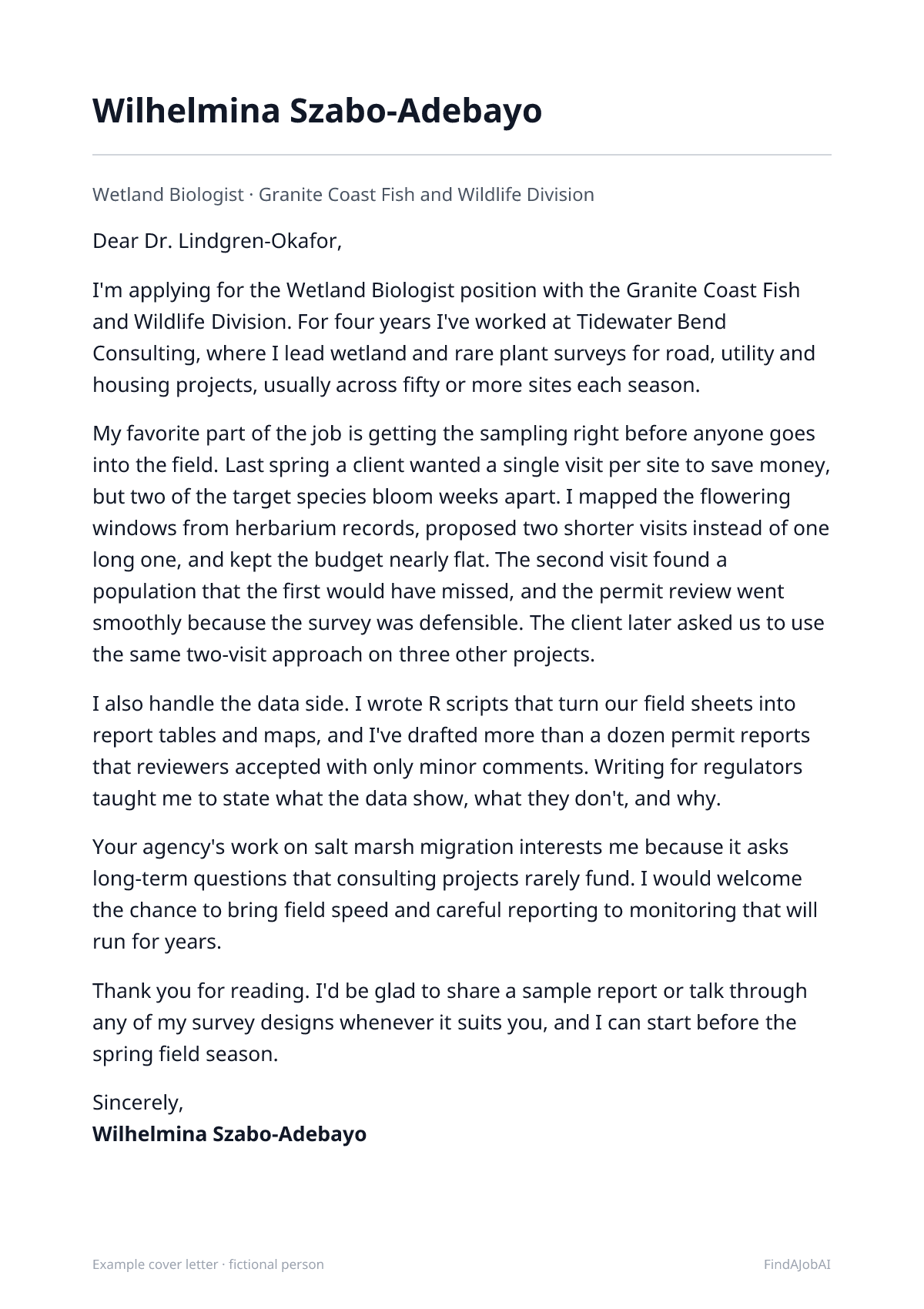
Biologist cover letter template
This letter as a one-page template: an opening that names the job and your strongest fact, proof that answers the ad, a reason for this employer and a short close.
After you sign up, FindAJobAI drafts your own letter for a real job from your CV in this format, and you edit it before you send it.
Example 1 · Experienced
Consulting biologist applying to a state wildlife agency
Wilhelmina has four years at an environmental consulting firm. The ad is for a wetland biologist at a state fish and wildlife agency.
Example letter · fictional
Dear Dr. Lindgren-Okafor,
I'm applying for the Wetland Biologist position with the Granite Coast Fish and Wildlife Division. For four years I've worked at Tidewater Bend Consulting, where I lead wetland and rare plant surveys for road, utility and housing projects, usually across fifty or more sites each season.
My favorite part of the job is getting the sampling right before anyone goes into the field. Last spring a client wanted a single visit per site to save money, but two of the target species bloom weeks apart. I mapped the flowering windows from herbarium records, proposed two shorter visits instead of one long one, and kept the budget nearly flat. The second visit found a population that the first would have missed, and the permit review went smoothly because the survey was defensible. The client later asked us to use the same two-visit approach on three other projects.
I also handle the data side. I wrote R scripts that turn our field sheets into report tables and maps, and I've drafted more than a dozen permit reports that reviewers accepted with only minor comments. Writing for regulators taught me to state what the data show, what they don't, and why.
Your agency's work on salt marsh migration interests me because it asks long-term questions that consulting projects rarely fund. I would welcome the chance to bring field speed and careful reporting to monitoring that will run for years.
Thank you for reading. I'd be glad to share a sample report or talk through any of my survey designs whenever it suits you, and I can start before the spring field season.
Sincerely,
Wilhelmina Szabo-Adebayo
Example 2 · Career changer
High school biology teacher moving into field research
Desmond taught biology for six years and spent three summers as a seasonal field technician. The ad is for an entry-level biologist at a land trust.
Example letter · fictional
Dear Ms. Rautio-Asante,
I'm writing to apply for the Field Biologist role at Quabbin Uplands Land Trust. I taught biology at a public high school for six years, and for the last three summers I've worked as a seasonal technician on forest bird and vernal pool surveys.
Teaching gave me more field skill than people expect. I ran a stream monitoring program with my students, sampling macroinvertebrates at four sites twice a year and sharing results with the town conservation commission. Keeping thirty teenagers safe beside moving water, and making sure their counts were consistent, taught me how much protocol matters. We also kept a shared data sheet that the commission still uses to compare years.
As a technician, I ran point counts before dawn, recorded egg masses in forty vernal pools and entered every record the same evening. My crew leader asked me back each season and, last year, let me train two new technicians on identification and data entry. I kept a notebook of every species I was unsure about and checked each one with the crew leader before entry.
I know I'm new to full-time research. I haven't yet designed a study on my own or written reports for regulators, and I plan to finish a graduate certificate in GIS this winter. I learn quickly, I'm comfortable explaining science to the public, and I'd bring patience from years of teaching difficult ideas clearly.
I would welcome a conversation about the role and about how your stewardship surveys are planned each year, and I can join a field day on short notice.
Best regards,
Desmond Harjula-Mbeki
Example 3 · Senior or lead
Senior fisheries biologist applying to lead a monitoring program
Cordelia has eleven years in fisheries research and runs a river monitoring project. The ad is for a lead biologist at a regional watershed council.
Example letter · fictional
Dear Mr. Abernathy-Nakamura,
I'm applying for the Lead Biologist, Monitoring position at the Housatonic Headwaters Council. I've worked in fisheries research for eleven years, the last six at Berkshire Run Field Station, where I run a river monitoring project covering about ninety stations.
When I took over that project, crews visited every station every year, and the budget was shrinking. I ran a power analysis on ten years of data and showed we could rotate a third of the stations each year and still detect the trends our funders cared about. The board approved the change, field costs fell noticeably, and we used the savings to add temperature loggers where warming was a concern. Those loggers have since shown which tributaries stay cool enough for juvenile trout in late summer.
I've also learned that monitoring only matters if people use it. I now write a two-page summary each winter for town boards and anglers, alongside the technical report, and I've presented results at public meetings where the audience did not always like what the data showed.
Leading a whole program, with staff and grant reporting across several projects, would be a step up from managing one. I've supervised technicians and co-written grants, but I haven't yet managed a team of permanent biologists. I would start by meeting each person and partner, reviewing where each dataset stands, and agreeing priorities with you before changing any protocol. I would also want to hear from the town partners who rely on our data.
I'd welcome the chance to discuss the council's plans for the next field season.
Sincerely,
Cordelia Fitzwilliam-Kanyinda
All three letters, and the short version below, are fictional: the people, employers and numbers are invented. Borrow the structure, never the facts.
- Prefer to write it yourself? Use the free cover letter template.
- Check your CV against the job first: the free CV score shows the missing keywords.
Why the first letter works, paragraph by paragraph
Paragraph 1: Opening
Names the employer, the specialty, the years and the scale of surveys, so the reader can place the applicant at once.
Paragraph 2: Design story
Shows scientific judgment: reading the biology, changing the plan within budget and finding a population a weaker design would have missed.
Paragraph 3: Data and reporting
Proves the applicant can analyze and write, which is often the bottleneck in agency and consulting work.
Paragraph 4: Fit with the agency
Links the applicant's strengths to the employer's long-term monitoring rather than repeating generic praise.
Paragraph 5: Close
Offers a writing sample, which suits a role where reports are a key output.
What the career changer's letter does differently
The career changer's letter turns classroom stream monitoring and seasonal technician work into field evidence. It gives concrete counts and duties and is honest about the study design and regulatory writing still to learn.
What the senior letter does differently
A lead biologist letter moves from running surveys to running a program: a redesign backed by a power analysis, savings reinvested in better data and results shared with the public. It is honest about managing permanent staff being new.
Short biologist cover letter: an email-ready version
Many applications arrive as an email or a small text box, and a full page doesn't fit. This version runs 120 to 150 words and keeps only what a reader needs to decide whether to reply. A molecular biologist emails a biotech lab manager who posted a research associate opening and asked for a brief note with a resume.
Short version · email · fictional124 words
Subject: Research Associate – qPCR and cell culture, 3 years – Leopoldine Vasquez-Thorsen
Hi Dr. Okafor-Thornquist,
I'm writing about the Research Associate opening on your assay team. For three years I've worked in a university lab running qPCR, cloning and mammalian cell culture for a project on immune signaling.
Last year our qPCR results drifted between runs. I traced it to a pipetting step, moved us to a master mix with plate maps checked before each run, and variation between replicates dropped enough that we stopped repeating plates and saved several weeks of reagents.
My notebooks are tidy and current, and I've trained four students. My resume is attached, and I'm also comfortable with BSL-2 work and keeping freezer inventories current. I can talk any day next week, in person or by video.
Kind regards,
Leopoldine Vasquez-Thorsen
The short version suits a busy lab manager: methods and setting first, one fix that improved data quality, then practical habits like notebooks and training.
Opening lines that work for biologist cover letters
The first sentence decides whether the second gets read. Here are six openings, one for each situation you might be in. Pick the one that matches yours and swap in your own facts: every name and number below is invented.
1. You have a standout result
As a wetland biologist who surveys more than fifty sites a season, I'd like to bring that pace and care to your agency's monitoring work.
2. The ad names a problem you've solved
Your posting asks for someone who can design surveys as well as run them. Redesigning a rare plant survey to find a missed population is the work I'm proudest of.
3. Someone referred you
Your senior ecologist, Marisol Kettering-Abiodun, suggested I apply after we worked together on a regional bat survey.
4. You admire what they build
After six years teaching biology and three seasons as a field technician, I'm ready to make field research my full-time work.
5. You're new to the field or switching into it
As a fisheries biologist who has run a ninety-station river monitoring project, I'm ready to lead a full program.
6. You have senior scope or a specialism
Your lab's work on salt marsh migration is the long-term question I most want to work on next.
How to write a biologist cover letter
Five steps, in the order you'd write them. The shape stays the same for every job (a short opening, proof, a reason for this employer, a close), and what goes into each part is what changes with the role.
Open with specialty and scale
Say what kind of biologist you are, where you work and the size of your typical survey or sample set. A hiring manager can then judge quickly whether your experience fits their projects and how much support you would need.
Show one design decision
Describe a time you chose or changed a sampling plan, control or method for a clear reason. Explain the biology behind it and the result. This shows judgment, which matters more than any list of techniques you could add.
Prove you can analyze and write
Mention the analysis tools you use and the reports, papers or permits you have written. Many biology roles are limited by how fast results reach clients or regulators, so this part of your experience is often decisive.
Connect to their projects
Name a program, species, habitat or product line the employer works on and explain why it fits your skills. Keep it specific and short, and avoid general praise about their mission that could apply to any organization in the field.
Name the methods you still need to learn
If you have not led a study, used a method or worked with a species group, say so in a sentence and explain how you will close the gap. Field and lab leads value honest self-assessment because it keeps crews safe and data clean.
Biologist cover letter do's and don'ts
Do
- Name your specialty and the field or lab methods you run independently.
- Give the scale of a survey, sample set or dataset you handled.
- Tell one story where your design or checking changed the result.
Don't
- Don't share exact locations of rare or sensitive species in a letter.
- Don't list every method you've seen once; focus on what you can lead.
- Don't send the same letter to a biotech lab and a wildlife agency.
Common biologist cover letter mistakes
Each one is easy to make and quick to fix before you send the letter.
Naming techniques with no outcome
A method list says little. Show the scale and outcome of one survey or study where you used them.
Revealing sensitive site details
Never give exact locations of rare species or private land. Describe the habitat and region in general terms.
Writing only for scientists
Many readers are managers or regulators. Explain your work plainly and save technical detail for the interview.
Ignoring field logistics
Mention travel, seasonal schedules or safety training when the role involves field work, so the reader sees you are ready.
Email subject lines for biologist applications
Applying by email? Put the job title, any reference number and your name in the subject line.
- Wetland Biologist – 4 years of permit surveys and reports – Wilhelmina Szabo-Adebayo
- Field Biologist application – teacher with 3 field seasons – Desmond Harjula-Mbeki
- Lead Biologist, Monitoring – 11 years of fisheries programs – Cordelia Fitzwilliam-Kanyinda
Everything for Biologists
- Biologist resume exampleA full resume, plus bullet and summary examples
- Biologist interview questions30 questions with sample answers
- Biologist job descriptionDuties, skills and requirements
- Career change cover letter: template + examples
Other cover letter examples
Biologist cover letter FAQ
What should a biologist cover letter include?
Your specialty, core methods, the scale of your field or lab work, one example of good scientific judgment and why the employer's projects interest you. Keep it to one page.
How do I write a biologist cover letter with no experience?
Lead with your degree, thesis and any seasonal technician or volunteer survey work. Give plot or sample counts and the methods you learned, and say what you are still learning.
Should I mention publications in a biologist cover letter?
Mention one that relates to the job, in a sentence. For consulting and agency roles, permit reports and monitoring results often matter as much as papers.
How we built this page
The FindAJobAI team wrote the three example letters, the short email version, the opening lines and the advice for biologist roles. The people, employers and numbers in the letters are invented; the structure, the kind of evidence and the order of the paragraphs are the parts to copy.
Once we track enough live biologist job ads, this page also shows the skills they ask for most, counted the same way as our in-demand skills report.
Last reviewed on November 1, 2026.