Environmental Engineer Cover Letter Example (2026)
By FindAJobAI team Updated How we built this page
Environmental engineer ads usually name a permit, a regulation or a type of site, not just a degree. The cover letter should show you've handled that kind of problem before: which agency you reported to, what the site was, and what happened after your report or design went in.
Environmental Engineer cover letter template
This letter as a one-page template: an opening that names the job and your strongest fact, proof that answers the ad, a reason for this employer and a short close.
After you sign up, FindAJobAI drafts your own letter for a real job from your CV in this format, and you edit it before you send it.
Example 1 · Experienced
Remediation engineer applying to a brownfield redevelopment firm
Deepak manages groundwater remediation at contaminated sites for a consulting firm. The ad asks for state agency reporting experience.
Example letter · fictional
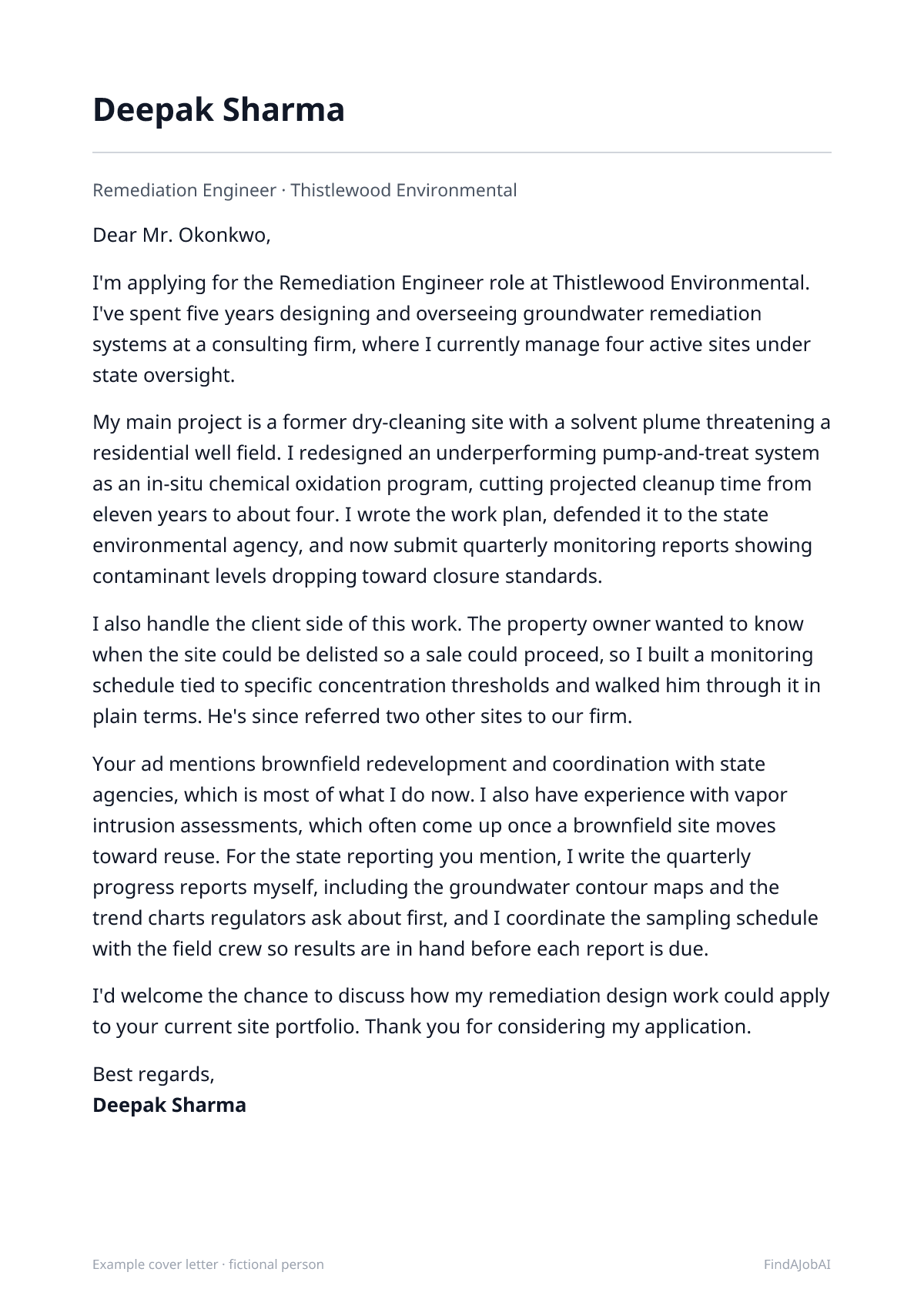
Dear Mr. Okonkwo,
I'm applying for the Remediation Engineer role at Thistlewood Environmental. I've spent five years designing and overseeing groundwater remediation systems at a consulting firm, where I currently manage four active sites under state oversight.
My main project is a former dry-cleaning site with a solvent plume threatening a residential well field. I redesigned an underperforming pump-and-treat system as an in-situ chemical oxidation program, cutting projected cleanup time from eleven years to about four. I wrote the work plan, defended it to the state environmental agency, and now submit quarterly monitoring reports showing contaminant levels dropping toward closure standards.
I also handle the client side of this work. The property owner wanted to know when the site could be delisted so a sale could proceed, so I built a monitoring schedule tied to specific concentration thresholds and walked him through it in plain terms. He's since referred two other sites to our firm.
Your ad mentions brownfield redevelopment and coordination with state agencies, which is most of what I do now. I also have experience with vapor intrusion assessments, which often come up once a brownfield site moves toward reuse. For the state reporting you mention, I write the quarterly progress reports myself, including the groundwater contour maps and the trend charts regulators ask about first, and I coordinate the sampling schedule with the field crew so results are in hand before each report is due.
I'd welcome the chance to discuss how my remediation design work could apply to your current site portfolio. Thank you for considering my application.
Best regards,
Deepak Sharma
Example 2 · Career changer
Environmental lab technician moving into field engineering
Sasha runs water quality testing for a lab and wants to move into the field design side. The ad values lab-to-field knowledge of sampling.
Example letter · fictional
Dear Hiring Manager,
I'm applying for the Staff Environmental Engineer role at Redfern Water Partners. For four years I've run water quality testing at an environmental laboratory, and I earned my environmental engineering degree part time to move from analyzing samples to designing the systems that need them.
Working in the lab taught me where field data goes wrong before an engineer ever sees it. I flagged a pattern of inconsistent nitrate readings from one municipal client and traced it to a sampling technique issue at two of their wells, not a lab error, which the client's engineer had assumed. I retrained their field crew on holding times and sample handling, and the readings stabilized within a month.
Since deciding to move into engineering, I've completed my FE exam and worked two summers as an engineering intern on a wastewater treatment upgrade, where I helped size a new clarifier and drafted sections of the permit application. I understand both what a lab result means and how to design around it.
Your posting mentions working closely with municipal clients on water quality compliance. I've spent years explaining lab results to exactly that audience, and I'd bring that plus a new engineer's design training. When a council member asked why a result looked high, I would pull the chain-of-custody form and the quality control blanks and walk through them in plain language, a habit I'd carry into any compliance meeting with your clients.
Thank you for your time. I'd welcome the opportunity to discuss how my lab background could support your engineering team.
Sincerely,
Sasha Ortega
Example 3 · Senior or lead
Principal engineer applying to lead a new environmental practice
Félicité leads a team of six at a national firm. The ad is for a principal engineer who will build a regional environmental practice.
Example letter · fictional
Dear Mr. Branwell,
I'm applying for the Principal Environmental Engineer role at Aldergate Infrastructure Group. I currently lead a team of six environmental engineers at a national consulting firm, after nine years split between remediation design and permitting work, and I'd like to build a regional practice from a smaller base.
Your ad mentions establishing the firm's presence in environmental permitting for industrial clients in a region where you don't yet have dedicated staff. I did something similar three years ago: our firm had no standing relationship with the state air permitting office, and I built one by taking on two difficult Title V renewal cases myself, then training two junior engineers on the process. We now hold permitting work for eleven industrial clients in that state.
Technically, I still lead the complex sites. A metal finishing facility I managed had chromium contamination threatening a nearby wetland; I designed a phytoremediation and hydraulic containment approach instead of a more expensive pump-and-treat system, which the client's insurer approved after I presented comparative cost and timeline data. The site is now in its third year of monitored stabilization, on budget.
I've hired and mentored four engineers, two now licensed, and I negotiate scope and fees directly with clients. I haven't yet built a practice in a new region without an existing office, so I'd want an early conversation about what local relationships, if any, already exist to build on.
I'd welcome a conversation about which clients or site types you most want this new practice to serve first.
Sincerely,
Félicité Duchamp
All three letters, and the short version below, are fictional: the people, employers and numbers are invented. Borrow the structure, never the facts.
- Prefer to write it yourself? Use the free cover letter template.
- Check your CV against the job first: the free CV score shows the missing keywords.
Why the first letter works, paragraph by paragraph
Paragraph 1: Opening
States the current role, years of experience and the number of active sites, giving the reader an immediate sense of scale and current responsibility.
Paragraph 2: The remediation project
Names the contamination type, the redesign, the time saved, and the regulatory step (defending the plan to the state agency), which shows technical and procedural competence together.
Paragraph 3: Client communication
Shows the writer translates technical thresholds into a timeline a property owner can act on, and that trust led to repeat business.
Paragraph 4: Why this company
Connects the ad's stated focus (brownfields, agency coordination) to the writer's daily work, and adds an adjacent skill, vapor intrusion, relevant to site reuse.
Paragraph 5: Close
Offers to discuss the writer's work against the firm's current sites, a concrete and low-risk next step.
What the career changer's letter does differently
The career changer's letter uses lab experience to diagnose a field problem (bad sampling technique, not lab error) before the writer had an engineering title, then shows the FE exam and an internship turning that judgment into design skills, closing on the same client-facing strength named in the first letter.
What the senior letter does differently
A principal-level letter reports what the writer built, not just designed: a new permitting relationship with a state agency, eleven client accounts that resulted, and engineers trained and now licensed. The technical example stays specific (chromium, phytoremediation, insurer approval), and the gap, no prior ground-up regional build, is named plainly.
Short environmental engineer cover letter: an email-ready version
Many applications arrive as an email or a small text box, and a full page doesn't fit. This version runs 120 to 150 words and keeps only what a reader needs to decide whether to reply. An environmental engineer answers a utility company's short online application question after a referral mentioned the opening.
Short version · email · fictional123 words
Subject: Environmental Engineer application – stormwater permitting – Declan Mbeki
Hello Ms. Castellanos,
I'm applying for the Environmental Engineer role at Haverstock Utilities. I have four years of experience managing stormwater permit compliance for a regional water authority, including two consent order sites.
My most relevant project involved a treatment plant with recurring permit exceedances. I redesigned the site's sediment control plan and set up a monitoring schedule tied to rainfall events, which brought the facility back into compliance within two reporting quarters and avoided a second fine.
Your former colleague, Aminata Diallo, suggested I reach out given your team's current stormwater caseload. My resume is attached, and I'd welcome a conversation. I can also send the monitoring schedule template, with site details removed, if that would help your team.
Best,
Declan Mbeki
With a referral already opening the door, the short version skips a general introduction and goes straight to one compliance result and who pointed the writer to the role, keeping the letter under three short paragraphs.
Opening lines that work for environmental engineer cover letters
The first sentence decides whether the second gets read. Here are six openings, one for each situation you might be in. Pick the one that matches yours and swap in your own facts: every name and number below is invented.
1. You have a standout result
I brought a treatment plant back into stormwater compliance within two reporting quarters after redesigning its sediment control plan, and I'd like to bring that kind of fix to your facilities.
2. The ad names a problem you've solved
Your ad mentions a backlog of pending air permit renewals. I cleared a similar backlog at my current firm by taking on the two hardest cases myself and training two engineers on the rest.
3. Someone referred you
Your facilities manager, Tomasz Wierzbicki, worked with me on a wetland mitigation project last year and suggested I apply, given your team's current permitting workload.
4. You admire what they build
I've followed your company's wetland restoration projects for two years, and the hydraulic design choices on your last site are part of why I'm applying to this role.
5. You're new to the field or switching into it
I spent four years testing water samples in a lab before earning my engineering degree, and I'd like to apply that sampling knowledge to designing the systems the samples come from.
6. You have senior scope or a specialism
As the engineer who built my firm's state air permitting relationship from nothing, I'm looking for a role where I can do that kind of ground-up work again.
How to write an environmental engineer cover letter
Five steps, in the order you'd write them. The shape stays the same for every job (a short opening, proof, a reason for this employer, a close), and what goes into each part is what changes with the role.
Identify the site type and regulator in the ad
Environmental engineering splits by media and agency: air permits, water discharge, soil remediation, wetlands. Read the ad for which one it names and which regulator is involved, then choose a project of yours under a similar agency or permit type to open with.
Open with the problem the site had, not your title
State what was contaminated, exceeding a limit, or stalled in permitting, in one sentence. Save your job title and years of experience for after the reader understands the kind of problem you're used to solving.
Name the technical approach and the regulatory step together
Mention the design or remediation method (such as bioremediation, SVE, or a permit renewal) alongside the agency interaction it required, like a work plan defense or a consent order negotiation. This shows you can do the engineering and navigate the process around it.
Quantify the outcome in time, cost or compliance status
Cleanup time shortened, a fine avoided, or a facility returned to compliance within a stated number of reporting periods are all concrete. Avoid vague claims like 'successfully remediated' without a measurable or verifiable detail attached.
Close on the client or community impact
One sentence on who relied on the outcome, such as a property owner needing closure for a sale or a community near a contaminated site, shows you see beyond the technical fix. End with a specific next step, like reviewing their current site portfolio.
Environmental Engineer cover letter do's and don'ts
Do
- Name the contaminant, media (soil, groundwater, air) and regulatory body you worked under; vague 'environmental compliance' reads as unfamiliar with the work.
- Mention a specific design or remediation technology the ad likely uses, such as pump-and-treat, bioremediation or SVE, inside a real project.
- Show a result tied to time, cost or regulatory status, such as cleanup time shortened or a site reaching closure.
Don't
- Don't claim a site is "fully remediated" or use language that implies a permit or closure outcome you can't verify; describe what you did and the status at the time.
- Don't list every environmental regulation you've heard of; name the one or two that governed your actual projects.
- Don't share a current client's name or site address if the work is still active or confidential; describe the site type instead.
Common environmental engineer cover letter mistakes
Each one is easy to make and quick to fix before you send the letter.
Using vague terms like 'environmental compliance'
Name the actual media, contaminant or permit type, such as groundwater solvent remediation or Title V air permitting. Vague language suggests unfamiliarity with the specific regulatory area the ad is hiring for.
Claiming a site is fully closed or remediated without basis
Describe your role and the site's status at the time you worked on it, such as 'in its third year of monitored stabilization.' Overstating a regulatory outcome can be checked and is a serious credibility risk in this field.
Listing every regulation and certification you know
Name only the ones that governed a real project you describe. A long list of acronyms without context reads as padding rather than depth.
Omitting the regulatory agency interaction
Mention the agency you reported to or negotiated with and what that involved, such as defending a work plan. This is often what distinguishes an engineer who can handle the process from one who can only do the technical design.
Naming a confidential or still-active client site
Describe the site type and general location instead of the client's name or exact address if the work is ongoing or under a confidentiality agreement.
Email subject lines for environmental engineer applications
Applying by email? Put the job title, any reference number and your name in the subject line.
- Remediation Engineer application – groundwater and brownfield sites – Deepak Sharma
- Staff Environmental Engineer – lab background moving into design – Sasha Ortega
- Application: Environmental Engineer, Water Division (Req. 2240) – Deepak Sharma
Everything for Environmental Engineers
- Environmental Engineer resume exampleA full resume, plus bullet and summary examples
- Environmental Engineer interview questions30 questions with sample answers
- Environmental Engineer job descriptionDuties, skills and requirements
- Career change cover letter: template + examples
Other cover letter examples
Environmental Engineer cover letter FAQ
What should I include in an environmental engineer cover letter?
One project naming the contaminant or issue, the media affected, the design or remediation approach, and the regulatory step involved, plus the outcome in time or status. Leave your licenses and modeling tools to the resume.
How do I write an environmental engineer cover letter with no field experience?
Use lab, internship or coursework projects that involved real sampling or permit data, and name the specific issue you caught or solved. Pair it with your FE exam status or relevant coursework.
Should I mention specific regulations in my cover letter?
Only the ones that governed your actual project, such as a state agency's cleanup standard or a federal permit program. Naming the regulation you worked under is more convincing than listing regulations generally.
How we built this page
The FindAJobAI team wrote the three example letters, the short email version, the opening lines and the advice for environmental engineer roles. The people, employers and numbers in the letters are invented; the structure, the kind of evidence and the order of the paragraphs are the parts to copy.
Once we track enough live environmental engineer job ads, this page also shows the skills they ask for most, counted the same way as our in-demand skills report.
Last reviewed on November 1, 2026.