Biomedical Engineer Cover Letter Example (2026)
By FindAJobAI team Updated How we built this page
Biomedical engineering ads ask for design controls, verification and validation, and a regulatory framework (FDA, ISO 13485) in nearly the same sentence, so resumes start to read alike. A cover letter should name the device, the failure you caught or the risk you retired, and the standard you worked under, so a hiring manager can picture you in their design history file.
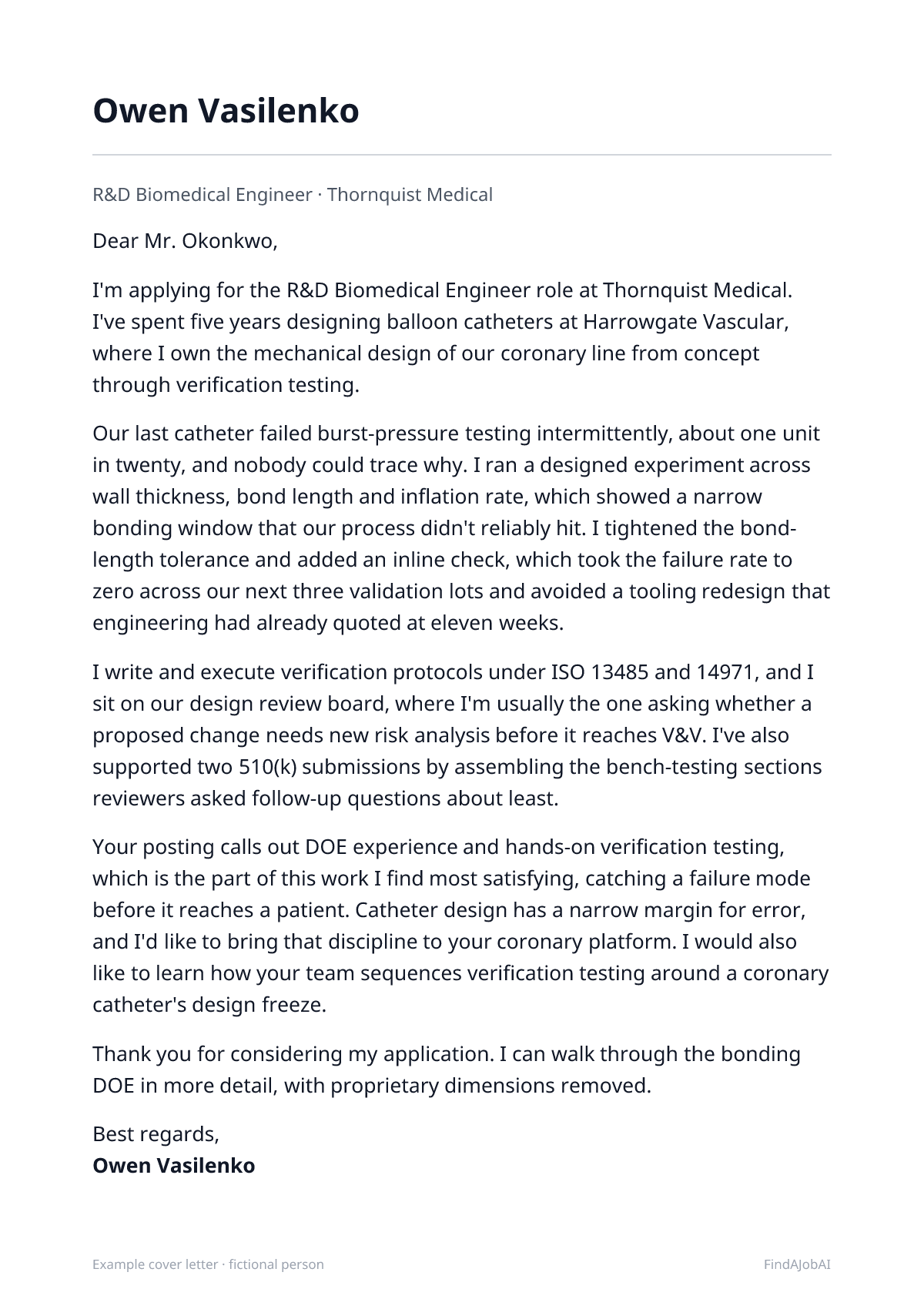
Biomedical Engineer cover letter template
This letter as a one-page template: an opening that names the job and your strongest fact, proof that answers the ad, a reason for this employer and a short close.
After you sign up, FindAJobAI drafts your own letter for a real job from your CV in this format, and you edit it before you send it.
Example 1 · Experienced
R&D engineer applying to a catheter manufacturer
Owen designs balloon catheters at a mid-size device maker. The ad asks for DOE experience and hands-on verification testing.
Example letter · fictional
Dear Mr. Okonkwo,
I'm applying for the R&D Biomedical Engineer role at Thornquist Medical. I've spent five years designing balloon catheters at Harrowgate Vascular, where I own the mechanical design of our coronary line from concept through verification testing.
Our last catheter failed burst-pressure testing intermittently, about one unit in twenty, and nobody could trace why. I ran a designed experiment across wall thickness, bond length and inflation rate, which showed a narrow bonding window that our process didn't reliably hit. I tightened the bond-length tolerance and added an inline check, which took the failure rate to zero across our next three validation lots and avoided a tooling redesign that engineering had already quoted at eleven weeks.
I write and execute verification protocols under ISO 13485 and 14971, and I sit on our design review board, where I'm usually the one asking whether a proposed change needs new risk analysis before it reaches V&V. I've also supported two 510(k) submissions by assembling the bench-testing sections reviewers asked follow-up questions about least.
Your posting calls out DOE experience and hands-on verification testing, which is the part of this work I find most satisfying, catching a failure mode before it reaches a patient. Catheter design has a narrow margin for error, and I'd like to bring that discipline to your coronary platform. I would also like to learn how your team sequences verification testing around a coronary catheter's design freeze.
Thank you for considering my application. I can walk through the bonding DOE in more detail, with proprietary dimensions removed.
Best regards,
Owen Vasilenko
Example 2 · Career changer
Clinical lab technologist moving into biomedical engineering
Priya fixed recurring assay failures with root-cause analysis before she had the title. The ad mentions equipment troubleshooting and documentation.
Example letter · fictional
Dear Hiring Manager,
I'm applying for the Associate Biomedical Engineer role at Castellane Diagnostics. For six years I've worked as a clinical lab technologist running automated immunoassay platforms, and the part of that job I gravitated toward was figuring out why an instrument was misbehaving, not just reporting that it was.
Two years ago one of our analyzers produced calibration drift that the manufacturer's service team couldn't resolve after three visits. I logged every error code against ambient temperature and reagent lot, built a simple trend chart, and found the drift tracked a specific reagent lot stored near an HVAC vent. Moving that stock fixed the drift, and I wrote up the root-cause steps, which our site now uses as the first-line troubleshooting guide for that analyzer.
Since then I've completed a biomedical instrumentation certificate and a course in medical device risk management, and I shadowed our site's field service engineers to learn the electrical and mechanical side of the platforms I'd only operated before. I'm comfortable reading schematics and service manuals, and I document everything the way I was trained to for CAP and CLIA audits.
Your posting mentions equipment troubleshooting and documentation discipline, which is exactly how I approached the drift problem, and it's the habit I'd bring to a design or sustaining engineering role rather than a service one.
Thank you for your time. I'd welcome the chance to talk through the drift investigation and how it shaped what I want to do next.
Kind regards,
Priya Nkemelu
Example 3 · Senior or lead
Principal engineer applying to lead a new implantables group
Grigor leads device design at a neuromodulation company. The ad is for a principal engineer who will set design-control practice for a new team.
Example letter · fictional
Dear Dr. Ferraro,
I'm applying for the Principal Biomedical Engineer role at Woldridge Neurotech. For the past four years I've led mechanical design for an implantable neurostimulator at Bellcroft Bionics, and before that I spent seven years as a senior design engineer. I'd like to help build a design-control practice from the ground up for a new implantables group.
Your ad says the team has shipped two external devices but no implantable, and that design history files have been inconsistent. Bellcroft had a version of that problem when I joined: four engineers kept risk files in four different formats. I wrote one risk-management procedure aligned to ISO 14971, moved every open hazard into a shared traceability matrix, and made design reviews a gate rather than a status update. Our first implantable submission closed with eleven FDA questions instead of the thirty-plus our prior external device drew, and reviewers specifically noted the traceability matrix.
Design control earns trust through caught failures, not paperwork. During verification of our stimulator's lead connector, I pushed for an accelerated fatigue test beyond the minimum cycle count in our plan, which surfaced a connector fracture mode at roughly twice the expected implant life. We redesigned the strain relief before the design freeze, which would have been far costlier after tooling was cut.
I've mentored four engineers through their first design history file and built our current verification test rig from scratch. I haven't yet managed a device through a PMA, only 510(k) and CE pathways, and at Woldridge I'd expect to lean on your regulatory team to close that gap.
I'd welcome a conversation about which design-control gaps concern you most for the implantable program, and how your current team documents risk today.
Sincerely,
Grigor Avanesyan
All three letters, and the short version below, are fictional: the people, employers and numbers are invented. Borrow the structure, never the facts.
- Prefer to write it yourself? Use the free cover letter template.
- Check your CV against the job first: the free CV score shows the missing keywords.
Why the first letter works, paragraph by paragraph
Paragraph 1: Opening
Names the device category (balloon catheters) and the writer's ownership of it end to end, so the reader knows this isn't a generalist resume.
Paragraph 2: The failure that was traced and fixed
A specific defect rate, a designed experiment, the fix, and the business cost avoided (an eleven-week tooling redesign) give the reader something concrete to evaluate.
Paragraph 3: Regulatory and design-control fluency
Naming ISO 13485, 14971 and 510(k) work signals the writer can operate inside a design history file, not just a lab.
Paragraph 4: Why this company
Connects the ad's stated need (DOE, verification) to the writer's stated preference for that work, and names the stakes (catheter design margins).
Paragraph 5: Close
Offers to discuss the DOE with proprietary details removed, which respects the current employer's confidentiality while still offering proof.
What the career changer's letter does differently
The career changer's letter starts from an equipment problem solved through root-cause analysis before the job title existed, with a specific, traceable fix (a reagent lot near an HVAC vent) rather than a vague claim. A certificate and shadowing fill the formal gap, and the letter is explicit that the goal is engineering, not service.
What the senior letter does differently
A principal engineer letter reports an organization's practices, not just a device: one risk procedure, a shared traceability matrix, eleven FDA questions instead of thirty. The fatigue-test example shows judgment beyond the minimum plan, and the PMA gap is named directly rather than implied.
Short biomedical engineer cover letter: an email-ready version
Many applications arrive as an email or a small text box, and a full page doesn't fit. This version runs 120 to 150 words and keeps only what a reader needs to decide whether to reply. A biomedical engineer answers a prosthetics company's 'why this role' field, sent by email after a recruiter asked for a direct reply.
Short version · email · fictional121 words
Subject: Biomedical Engineer (materials, fatigue testing) – Solveig Brennhaug
Hello Mr. Oyelaran,
I'm applying for the Biomedical Engineer role at Ashgrove Prosthetics. I have four years of experience designing load-bearing components for lower-limb prosthetic sockets, including fatigue and materials testing under ISO 10328.
My most useful project was tracing a socket-pylon connector that failed early fatigue testing to a stress concentration at a screw boss. I redesigned the boss geometry, which raised cycle life past the required threshold on the next test run and avoided a six-week material substitution the team had planned instead.
Prosthetic components carry real consequences for the people wearing them, and I'd like to bring that fatigue-testing discipline to your team. My resume is attached, and I'm glad to share the test data.
Best,
Solveig Brennhaug
A short, direct reply keeps one traceable failure and its fix, plus the standard it was tested under, instead of a skills list. Naming the six-week alternative avoided shows the fix had a real cost benefit, in one sentence.
Opening lines that work for biomedical engineer cover letters
The first sentence decides whether the second gets read. Here are six openings, one for each situation you might be in. Pick the one that matches yours and swap in your own facts: every name and number below is invented.
1. You have a standout result
One fatigue-testing fix I made last year raised a prosthetic connector's cycle life past its required threshold and avoided a costly material substitution. I'd like to bring that same discipline to your team.
2. The ad names a problem you've solved
Your ad mentions inconsistent design history files across past projects. At my current company I wrote the risk-management procedure the team still uses, and our last FDA submission drew a third of the questions our prior one did.
3. Someone referred you
Your senior engineer, Tobias Renkema, worked with me for two years on catheter verification before joining your team. He mentioned you need someone comfortable owning a device through V&V, which prompted this application.
4. You admire what they build
My younger brother wears a lower-limb prosthesis, and watching him go through three socket redesigns is part of why I became a biomedical engineer rather than a general mechanical one.
5. You're new to the field or switching into it
I spent six years as a clinical lab technologist troubleshooting automated analyzers before earning an instrumentation certificate. Device engineering is where I'd like to keep solving problems like that.
6. You have senior scope or a specialism
As the engineer who has owned our coronary catheter platform for five years, I wrote the verification protocols our quality team still cites as the template. I'm looking for a role that sets that standard for a new product line.
How to write a biomedical engineer cover letter
Five steps, in the order you'd write them. The shape stays the same for every job (a short opening, proof, a reason for this employer, a close), and what goes into each part is what changes with the role.
Name the device class the ad is hiring for
Implantables, diagnostics, prosthetics and capital equipment carry different risk profiles and standards. Read the ad for the device category and regulatory pathway it names, then choose a project of yours in a similar risk class, so the reader doesn't have to guess whether your experience transfers.
Open with a traced failure, not a job title
Say what went wrong, what you found the cause to be, and what changed because of it, in one or two sentences. A reader who sees a real failure mode in your opening paragraph trusts the rest of the letter more than one that opens with years of experience.
Attach a standard to the story, not to a list
Mention ISO 13485, 14971, IEC 60601 or a specific FDA pathway inside the sentence describing the work, such as the test you ran or the file you maintained. A standard named in isolation reads like a checklist; one named inside a result reads like practice.
Quantify the risk retired, not the hours spent
State a defect rate that dropped, a cycle count a part now exceeds, or a submission question count that fell. Avoid describing how many hours or tests you ran. If you can't measure the final outcome, describe what the design review or regulatory body did differently once they saw your result.
Show you can work across design, quality and regulatory
One sentence on how you supported a submission, trained a reviewer, or translated a test result for a non-engineer closes the letter well. Name a specific gap in your background, such as an unfamiliar pathway, so the reader sees you're being direct about where you'd need support.
Biomedical Engineer cover letter do's and don'ts
Do
- Name the device or platform, the standard you worked under (ISO 13485, 14971, IEC 60601), and one failure mode you traced to a cause.
- State the test method (DOE, FMEA, bench verification) inside a real example, not as a bare skill list.
- Mention any regulatory submission you supported and the specific section reviewers questioned.
Don't
- Don't write "passionate about improving patient outcomes"; show one defect you traced and fixed instead.
- Don't share proprietary dimensions, formulations or unreleased device specs from a current employer.
- Don't list every standard you've heard of; name the one or two that governed the work you're describing.
Common biomedical engineer cover letter mistakes
Each one is easy to make and quick to fix before you send the letter.
Writing about patient outcomes in the abstract
"Passionate about improving patient outcomes" is what every applicant writes. Name one failure mode you traced and fixed, and let the device's purpose speak for itself.
Naming standards without attaching them to work
Listing ISO 13485, 14971 and IEC 60601 in a row reads like a certification checklist. Pick the one or two that governed the specific test or file you're describing, and show how.
Sharing details that belong in a design history file
Proprietary dimensions, formulations or unreleased specs from a current employer don't belong in a cover letter. Describe the method and the outcome, and offer to discuss specifics with sensitive details removed.
Counting tests run instead of risks closed
"Executed 40 verification protocols" describes effort, not judgment. Say what one of those protocols found and what the design team changed because of it.
Ignoring the device's risk class
A letter that reads the same for a blood-pressure cuff and an implant misses what the ad is actually screening for. Match your example's stakes to the device class in the posting.
Email subject lines for biomedical engineer applications
Applying by email? Put the job title, any reference number and your name in the subject line.
- R&D Biomedical Engineer application – catheter verification and DOE – Owen Vasilenko
- Associate Biomedical Engineer – lab technologist with instrumentation certificate – Priya Nkemelu
- Application: Biomedical Engineer, Sustaining (Req. 2290) – Owen Vasilenko
Everything for Biomedical Engineers
- Biomedical Engineer resume exampleA full resume, plus bullet and summary examples
- Biomedical Engineer interview questions30 questions with sample answers
- Biomedical Engineer job descriptionDuties, skills and requirements
- Career change cover letter: template + examples
Other cover letter examples
Biomedical Engineer cover letter FAQ
What should I write in a biomedical engineer cover letter?
One device or platform, one failure mode you traced to a root cause, the test method you used, and the standard (ISO 13485, 14971) you worked under. Close with a specific reason this company's device or patient population interests you.
How do I write a biomedical engineer cover letter with no industry experience?
Use a troubleshooting or quality problem from a clinical, lab or manufacturing role, and describe how you traced it to a cause. Add any relevant certificate or coursework, and say plainly that you're moving from operating or servicing devices to designing or sustaining them.
Should I mention FDA submissions I worked on?
Yes, but name your actual contribution, such as assembling bench-testing data or drafting a risk analysis section, rather than claiming credit for the submission as a whole.
How we built this page
The FindAJobAI team wrote the three example letters, the short email version, the opening lines and the advice for biomedical engineer roles. The people, employers and numbers in the letters are invented; the structure, the kind of evidence and the order of the paragraphs are the parts to copy.
Once we track enough live biomedical engineer job ads, this page also shows the skills they ask for most, counted the same way as our in-demand skills report.
Last reviewed on November 1, 2026.