Electrical Engineer Cover Letter Example (2026)
By FindAJobAI team Updated How we built this page
Electrical engineering ads tend to blur together: a schematic tool, a few protocols, a nod to compliance. Your letter is the place to name one circuit or system you diagnosed or built, the measurement that proved it worked, and what that meant for the product that shipped.
Electrical Engineer cover letter template
This letter as a one-page template: an opening that names the job and your strongest fact, proof that answers the ad, a reason for this employer and a short close.
After you sign up, FindAJobAI drafts your own letter for a real job from your CV in this format, and you edit it before you send it.
Example 1 · Experienced
Power electronics engineer applying to an EV charging company
Tariq designs power supply boards for industrial controllers. The ad asks for someone who can own a board from schematic to EMI compliance.
Example letter · fictional
Dear Ms. Lindqvist,
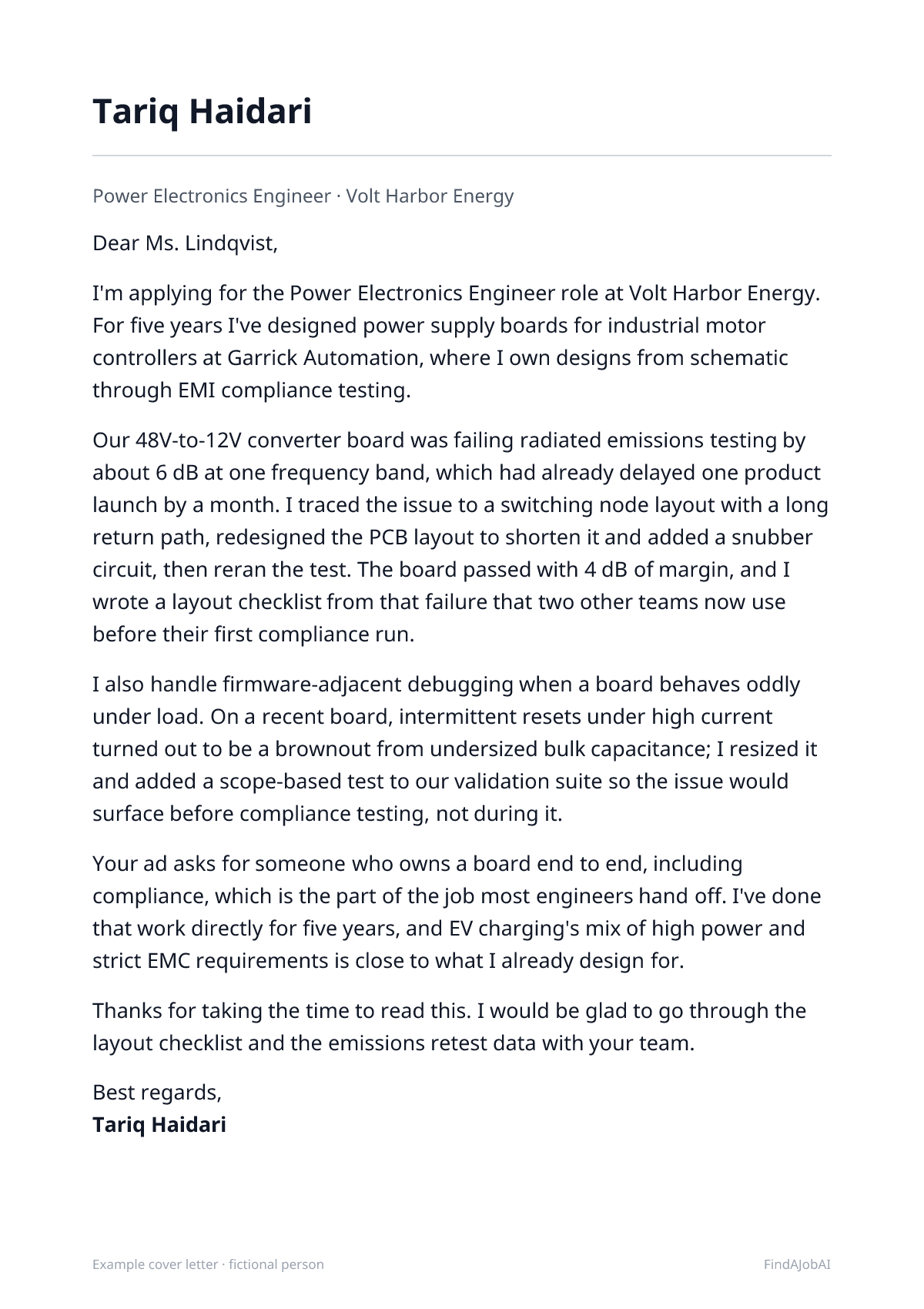
I'm applying for the Power Electronics Engineer role at Volt Harbor Energy. For five years I've designed power supply boards for industrial motor controllers at Garrick Automation, where I own designs from schematic through EMI compliance testing.
Our 48V-to-12V converter board was failing radiated emissions testing by about 6 dB at one frequency band, which had already delayed one product launch by a month. I traced the issue to a switching node layout with a long return path, redesigned the PCB layout to shorten it and added a snubber circuit, then reran the test. The board passed with 4 dB of margin, and I wrote a layout checklist from that failure that two other teams now use before their first compliance run.
I also handle firmware-adjacent debugging when a board behaves oddly under load. On a recent board, intermittent resets under high current turned out to be a brownout from undersized bulk capacitance; I resized it and added a scope-based test to our validation suite so the issue would surface before compliance testing, not during it.
Your ad asks for someone who owns a board end to end, including compliance, which is the part of the job most engineers hand off. I've done that work directly for five years, and EV charging's mix of high power and strict EMC requirements is close to what I already design for.
Thanks for taking the time to read this. I would be glad to go through the layout checklist and the emissions retest data with your team.
Best regards,
Tariq Haidari
Example 2 · Career changer
Industrial electrician moving into electrical design
Yara diagnosed a recurring motor control fault with schematics and a multimeter before earning a degree. The ad mentions PLC controls and customer schematics.
Example letter · fictional
Dear Hiring Manager,
I'm applying for the Associate Electrical Engineer role at Brackenfield Controls. For six years I worked as an industrial electrician maintaining motor control systems at a packaging plant, and I finished an electrical engineering degree last spring to move into design work.
A recurring problem at my last plant was a conveyor motor controller that tripped on overcurrent several times a week with no clear pattern. I pulled the control schematic, traced the fault to a contactor that was undersized for the motor's actual inrush current, and worked with the vendor to confirm the correct rating. Replacing it across four identical lines cut unplanned downtime from that fault to zero over the following six months.
During my degree I built a motor controller for a capstone project, including the schematic, PCB layout and firmware for basic PID speed control, and I completed a course covering NEC code and basic PLC programming. I'm comfortable reading and producing schematics in both AutoCAD Electrical and KiCad; I'm still building speed with full embedded firmware development.
The posting says you want someone who can read a customer's schematics and work alongside PLC controls. I did that every week from the maintenance side, so I know which panel layouts help a technician at two in the morning and which ones hide the fault, and I would design with that in mind from my first week.
Thank you for reading. If it would help, I can bring my contactor investigation notes and the capstone schematics to an interview and walk you through both.
Kind regards,
Yara Haddad
Example 3 · Senior or lead
Electrical engineering lead applying to own a new sensor product line
Simone leads five electrical engineers at an industrial sensor maker. The ad is for a lead who will own a new wireless sensor line and mentor junior engineers.
Example letter · fictional
Dear Mr. Abioye,
I'm applying for the Electrical Engineering Lead role at Ferrowatt Sensing. For three years I've led five electrical engineers at Hallgate Instruments, after seven years designing analog and mixed-signal boards for industrial sensors, and I'd now like to carry a product line from its first sketch to shipment.
The ad says recent boards took two or three spins each because problems appeared at certification instead of at design review. Hallgate had the same pattern. I made a signal integrity review before layout, and a low-cost pre-scan before formal EMC testing, required gates ahead of fabrication. Our latest wireless sensor board cleared certification on its first submission, the first time in three product cycles, and the change saved roughly six weeks of spin time and lab fees per cycle.
Leading, to me, means finding the problem before the lab does. During that same review one of my engineers spotted a possible ground loop in the antenna feed. I helped her design the bench test that confirmed it, and the fix went into the layout before a single board was built. She now chairs signal integrity reviews for two smaller projects.
There are two things I haven't done yet: hired a team around a brand-new product line from its first position, and owned a lab equipment budget outright. I would plan both with your director of engineering rather than learn them on your time.
I'd like to hear where your certification process costs you the most rework, and where a lead could make the first difference.
Sincerely,
Simone Delacroix
All three letters, and the short version below, are fictional: the people, employers and numbers are invented. Borrow the structure, never the facts.
- Prefer to write it yourself? Use the free cover letter template.
- Check your CV against the job first: the free CV score shows the missing keywords.
Why the first letter works, paragraph by paragraph
Paragraph 1: Opening
Names the product (motor controller power boards) and the scope of ownership (schematic through compliance), setting up why a compliance story will matter.
Paragraph 2: The failure that got fixed
A specific test failure (6 dB over on emissions), the diagnosis (switching node layout), the fix, and a reusable artifact (the checklist). Electrical hiring managers want evidence of root-cause work, not just a passing test.
Paragraph 3: Debugging under real conditions
The brownout story shows the writer catches intermittent, hard-to-reproduce faults and builds the fix into future testing, which matters more than any single clean design.
Paragraph 4: Why this company
Ties the ad's call for end-to-end ownership, compliance included, to what the writer already does each day, and names the technical demands the two share (EMC, high power).
Paragraph 5: Close
Offers the checklist and the test data, so the reader has something concrete to ask about before an interview.
What the career changer's letter does differently
Yara's letter starts with a maintenance mystery she solved with a schematic and a multimeter before she held an engineering title, and it ends with a number: one recurring overcurrent trip eliminated across four lines. The degree, the capstone controller and the code course show the skills are now formal, and her years as an electrician read as field knowledge a design team lacks, not as a gap.
What the senior letter does differently
A lead's letter reports team habits and outcomes rather than single-board fixes: two review gates added before fabrication, and a board that cleared certification on its first submission for the first time in three cycles. The mentee story shows judgment being passed on, and the two gaps, building a team from its first hire and owning a lab budget, are stated plainly instead of hidden.
Short electrical engineer cover letter: an email-ready version
Many applications arrive as an email or a small text box, and a full page doesn't fit. This version runs 120 to 150 words and keeps only what a reader needs to decide whether to reply. An electrical engineer replies to a robotics company's short application field, pasted into an email because the portal rejected the file format.
Short version · email · fictional122 words
Subject: Electrical Engineer (schematic, EMC) – motor control boards – Felix Omondi
Hello Ms. Petrossian,
I'm applying for the Electrical Engineer role at Ironvale Robotics. For four years I've designed motor driver boards at an industrial automation supplier and owned each one from schematic to validation testing.
One board kept overheating in the field under sustained load. A thermal camera run during a load test pointed to an undersized copper pour on the power stage; I added thermal relief in the layout, and temperature-related shutdowns fell from 9 a month to 1 the next quarter.
Sustained load is the everyday condition for a robot joint, so this is the work I want to do for you. My resume is attached, and I can send the thermal data with customer details removed.
Best,
Felix Omondi
One fault, one fix and one field number are enough in a short note. Mentioning that the test data can be shared once customer names are removed tells the reader you can back the claim without breaching confidentiality.
Opening lines that work for electrical engineer cover letters
The first sentence decides whether the second gets read. Here are six openings, one for each situation you might be in. Pick the one that matches yours and swap in your own facts: every name and number below is invented.
1. You have a standout result
Adding thermal relief to one motor driver layout took field shutdowns on that board from nine a month to one. I'd like to bring that kind of measured fix to your motor control group.
2. The ad names a problem you've solved
Your posting says boards often need two or three spins to clear certification. At my current employer I put a signal integrity review ahead of layout, and our latest board passed on its first submission.
3. Someone referred you
Noor Kazemi, who now tests on your team, and I spent two years on compliance work together. She told me you want someone who finds EMC problems before the lab does, so I'm writing.
4. You admire what they build
A dropout under load on one of your home automation sensors sent me looking at the board design behind it, and I admired how clean the analog front end was. I'd like to help your team keep it that way.
5. You're new to the field or switching into it
I spent six years diagnosing motor control faults as an industrial electrician, then finished an engineering degree so I could prevent those faults at the design stage. That is the work I'm applying to do.
6. You have senior scope or a specialism
I own the power electronics boards at my company from schematic to certification, and across three product lines nine years of that has cut emissions failures and field returns. I want that scope again, with a team that values it.
How to write an electrical engineer cover letter
Five steps, in the order you'd write them. The shape stays the same for every job (a short opening, proof, a reason for this employer, a close), and what goes into each part is what changes with the role.
Find the one domain the ad cares about
Most electrical ads lean on a single area: power electronics, motor control, sensing, wireless or industrial controls. Read the posting for the product, the protocols and the standards it names, then choose a project from your own work that sits in the same area or uses the same standards.
Start with the fault or the requirement
Describe what was wrong with a circuit, or what a board had to achieve, before you mention a schematic package or a piece of test equipment. A real electrical problem in your first lines gives the reader a reason to keep going and see how you handled it.
Say what you measured to prove the fix
Tell the reader how you knew it worked: an EMC retest, a thermal scan under load, a scope capture, or field returns tracked over a stated period. A fix with no measurement behind it sounds like a guess, however good the design was.
Give the result as a number an engineering manager trusts
Pick one figure your reader will recognize: dB of margin, shutdowns per month, spins avoided or hours of downtime removed. When you cannot measure it, say what stopped happening, such as a repeat call from the same customer.
Put your tools inside the story, then connect to the company
Mention the schematic package, the simulator or the instrument only where it appears in the project you are telling. Close with one reason this employer's products or standards suit your background, so the letter would not work for any other company.
Electrical Engineer cover letter do's and don'ts
Do
- Pick one circuit, board or system and tell the fault or requirement, the instrument or standard involved (oscilloscope, EMI test, NEC) and the fix, in a single story.
- Report the outcome as test margin, downtime, failure rate or units affected rather than 'fixed the issue.'
- Match the voltage range, power level or protocol the ad's industry works with, so the letter reads as written for that product.
Don't
- Don't list every schematic or simulation package you have opened; name the one you used on the project you describe.
- Don't write 'strong problem-solving skills'; a brownout you traced to an undersized bulk capacitor shows it better.
- Don't paste in a current employer's proprietary schematics or specs; describe the fault and the fix in general terms.
Common electrical engineer cover letter mistakes
Each one is easy to make and quick to fix before you send the letter.
Naming schematic tools with no project behind them
“Proficient in Altium, LTspice and KiCad” says little about how well you use them. Pair each tool with a board you designed or a fault you found with it.
Calling a fix done without saying how it was checked
A redesign that “solved the problem” needs evidence: an EMC retest, a thermal image, or field returns over a stated period. In engineering, a claim without a check is just a hope.
Reporting a result with no starting point
“Cut failures a lot” cannot be checked. Give the rate before, what you changed and the rate after, so the reader can see the size of the improvement for themselves.
Leaving out the voltage, power or standards
A letter that would suit any electrical job shows no fit. Mention the voltage range, power level or standard the ad points to, such as EMC, UL or NEC, and tie your own work to it.
Writing 'passionate about electronics' as the motive
Every applicant says it. Give a reason only you have, such as a fault mode in the company's product you would want to study, or a certification step you have shortened before.
Email subject lines for electrical engineer applications
Applying by email? Put the job title, any reference number and your name in the subject line.
- Power Electronics Engineer application – board design and EMC compliance – Tariq Haidari
- Associate Electrical Engineer – electrician with schematic and PLC experience – Yara Haddad
- Application: Electrical Engineer, Controls (Req. 3315) – Tariq Haidari
Everything for Electrical Engineers
- Electrical Engineer jobs1,192 open roles, updated hourly
- Electrical Engineer salary in the United StatesAdvertised pay in real job ads
- Electrical Engineer resume exampleA full resume, plus bullet and summary examples
- Electrical Engineer interview questions30 questions with sample answers
- Electrical Engineer job descriptionDuties, skills and requirements
- Career change cover letter: template + examples
Other cover letter examples
Electrical Engineer cover letter FAQ
What should I write in an electrical engineer cover letter?
Pick one circuit, board or system you diagnosed or designed and tell it in three beats: the fault or requirement, the instrument or standard you used (a scope, an EMC scan, NEC), and the measured result. Leave your long tool list for the resume.
What do I put in an electrical engineer cover letter if I'm a new graduate?
Lead with a capstone, an internship or work as an electrician or technician, and describe a single design or diagnosis in depth: the problem, your approach, and the scope capture or bench test that showed it worked.
Should I mention specific test equipment or standards in an electrical engineer cover letter?
Yes, but inside the story. An EMI scan, a scope trace or a code reference sitting next to a real fault convinces a reader far more than the same words in a skills list.
How we built this page
The FindAJobAI team wrote the three example letters, the short email version, the opening lines and the advice for electrical engineer roles. The people, employers and numbers in the letters are invented; the structure, the kind of evidence and the order of the paragraphs are the parts to copy.
Once we track enough live electrical engineer job ads, this page also shows the skills they ask for most, counted the same way as our in-demand skills report.
Last reviewed on November 1, 2026.