Certified Nursing Assistant Cover Letter Example (2026)
By FindAJobAI team Updated How we built this page
CNA ads mostly list the same certification and the same duties, so the letter is where you show how you actually work with residents and the rest of the care team. Name a resident situation you handled, what you noticed before it became a problem, and how you work with nurses and families.
Certified Nursing Assistant cover letter template
This letter as a one-page template: an opening that names the job and your strongest fact, proof that answers the ad, a reason for this employer and a short close.
After you sign up, FindAJobAI drafts your own letter for a real job from your CV in this format, and you edit it before you send it.
Example 1 · Experienced
CNA applying to a long-term care facility
Denise has worked a dementia care unit for three years. The ad asks for patience with behavioral symptoms and close communication with the nursing staff.
Example letter · fictional
Dear Mr. Okonjo,
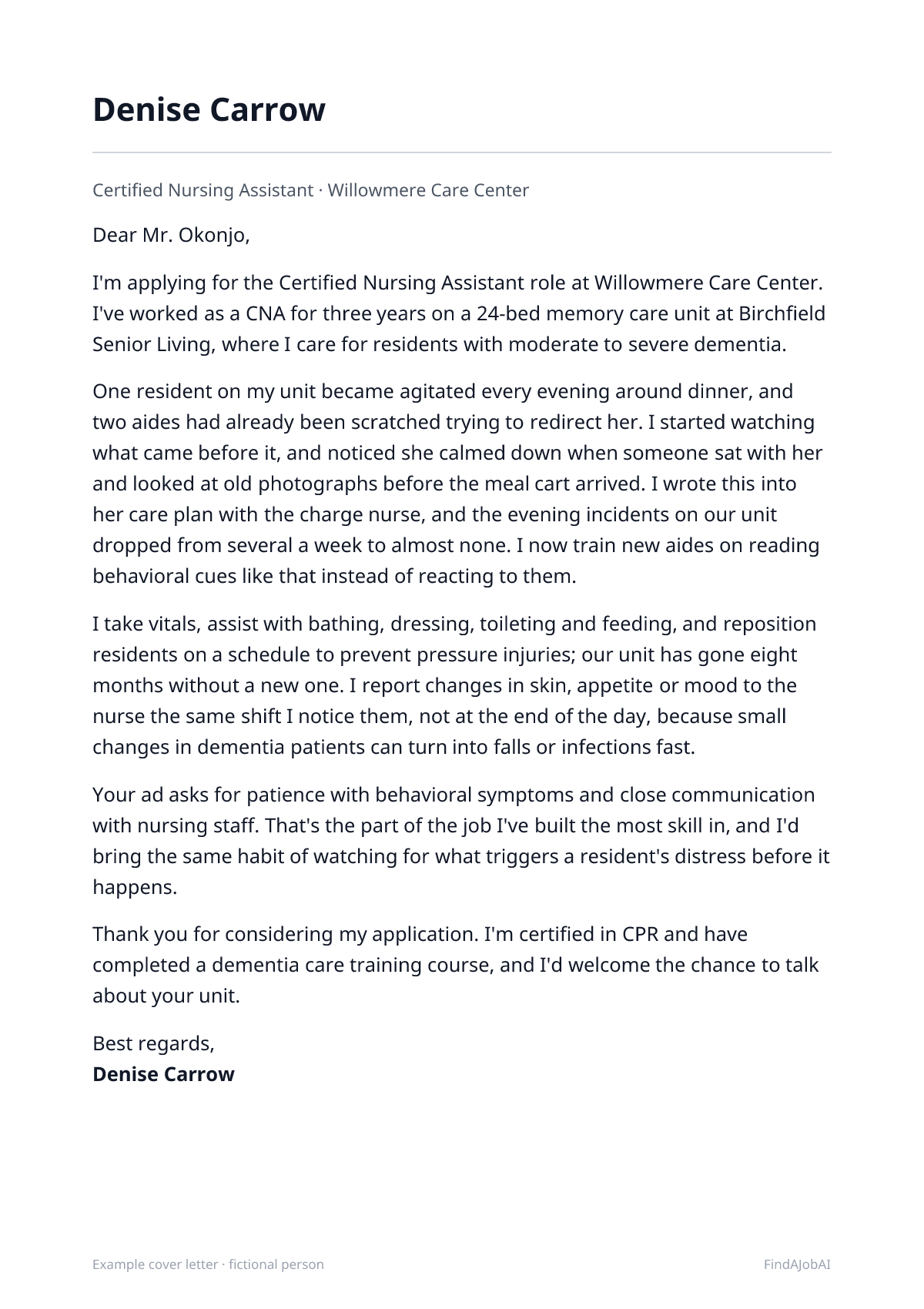
I'm applying for the Certified Nursing Assistant role at Willowmere Care Center. I've worked as a CNA for three years on a 24-bed memory care unit at Birchfield Senior Living, where I care for residents with moderate to severe dementia.
One resident on my unit became agitated every evening around dinner, and two aides had already been scratched trying to redirect her. I started watching what came before it, and noticed she calmed down when someone sat with her and looked at old photographs before the meal cart arrived. I wrote this into her care plan with the charge nurse, and the evening incidents on our unit dropped from several a week to almost none. I now train new aides on reading behavioral cues like that instead of reacting to them.
I take vitals, assist with bathing, dressing, toileting and feeding, and reposition residents on a schedule to prevent pressure injuries; our unit has gone eight months without a new one. I report changes in skin, appetite or mood to the nurse the same shift I notice them, not at the end of the day, because small changes in dementia patients can turn into falls or infections fast.
Your ad asks for patience with behavioral symptoms and close communication with nursing staff. That's the part of the job I've built the most skill in, and I'd bring the same habit of watching for what triggers a resident's distress before it happens.
Thank you for considering my application. I'm certified in CPR and have completed a dementia care training course, and I'd welcome the chance to talk about your unit.
Best regards,
Denise Carrow
Example 2 · Career changer
Retail associate newly certified as a CNA
Priya cared for her grandmother at home for two years before getting certified. The ad is for a hospital med-surg floor and asks for stamina and teamwork.
Example letter · fictional
Dear Hiring Manager,
I'm applying for the Certified Nursing Assistant role on your med-surg floor. I spent six years in retail management, and for the last two of those years I also cared for my grandmother at home as her health declined, which is what led me to get certified.
Caring for her meant managing her medication schedule, helping her bathe and move safely after a hip fracture, and noticing early signs that something was wrong, like a change in her breathing that turned out to be the start of pneumonia. I called her doctor the same morning, and she was treated before it became a hospital stay. That experience is why I completed my CNA certification this spring, with 100 hours of clinical training at a skilled nursing facility.
From retail, I bring a different kind of stamina: shifts on my feet, calm handling of upset people, and tracking a dozen small tasks at once without dropping any of them. In my clinical rotations I took vitals, assisted with ADLs for twelve residents a shift, and reported changes to the charge nurse promptly, which my clinical instructor noted on my evaluation.
Your posting asks for stamina and teamwork on a busy floor. I've already worked long shifts on my feet, and I'm used to being the person a family or a coworker relies on when something is going wrong.
Thank you for your time. I'm available to start clinicals or orientation immediately and would welcome the chance to discuss the role.
Kind regards,
Priya Nandan
Example 3 · Senior or lead
Charge CNA applying to lead and train new aides
Rosalind has mentored new CNAs for two years at a rehab facility. The ad is for a charge CNA who will train new hires and fill in for the floor supervisor.
Example letter · fictional
Dear Ms. Kowalczyk,
I'm applying for the Charge CNA role at Maple Terrace Rehabilitation. I've worked as a CNA for seven years, the last two as the informal mentor for new hires on our 40-bed short-term rehab unit, and I'd like to take on that training role officially.
Your ad says new aides on your floor often leave within the first three months. We had the same problem until I built a two-week shadowing schedule that pairs each new hire with a different experienced aide each day, instead of leaving them with one trainer. First-year turnover on our unit dropped by roughly half after we started it, and three of the aides I trained are still with us two years later.
I also fill in for our floor supervisor on her days off, which means covering call-outs, checking that every resident's rounds are done on time, and being the first call when a resident falls or a family has a concern. Last year I caught a UTI developing in a resident from a subtle change in confusion that two other aides had chalked up to normal sundowning, and the quick catch kept it from turning into a hospital transfer.
I haven't yet managed a full staffing schedule or handled disciplinary conversations, and at Maple Terrace I'd want to learn those from your current supervisor before taking them on alone.
I'd welcome a conversation about how your floor currently onboards new aides and where you'd want a charge CNA to start.
Sincerely,
Rosalind Peete
All three letters, and the short version below, are fictional: the people, employers and numbers are invented. Borrow the structure, never the facts.
- Prefer to write it yourself? Use the free cover letter template.
- Check your CV against the job first: the free CV score shows the missing keywords.
Why the first letter works, paragraph by paragraph
Paragraph 1: Opening
Names the specific unit (24-bed memory care) and years of experience, which tells the reader the applicant already knows the population they'd be working with.
Paragraph 2: The resident situation
A concrete problem (evening agitation), the applicant's own observation, the fix written into the care plan, and the measurable result (incidents dropping from several a week to almost none).
Paragraph 3: Daily duties with a safety habit
Lists the real tasks of the job, then adds a habit, reporting changes the same shift, that signals judgment beyond just completing a checklist.
Paragraph 4: Why this facility
Mirrors the ad's own language (patience with behavioral symptoms, communication with nursing staff) instead of generic enthusiasm.
Paragraph 5: Close
Names specific credentials (CPR, dementia care training) as proof rather than restating 'certified CNA,' which is already on the resume.
What the career changer's letter does differently
The career changer's letter starts from unpaid caregiving experience and turns it into the same proof points a hired CNA would offer: a specific incident noticed and acted on, and real clinical hours. It also reframes a retail background as relevant stamina and composure rather than apologizing for the career change.
What the senior letter does differently
A charge CNA letter reports on the unit's own problem (new hire turnover) and the system the writer built to fix it, with a before-and-after result. It adds a supervisory example (the UTI catch while covering for the supervisor) and names the one gap, scheduling and discipline, honestly instead of overclaiming leadership experience.
Short certified nursing assistant cover letter: an email-ready version
Many applications arrive as an email or a small text box, and a full page doesn't fit. This version runs 120 to 150 words and keeps only what a reader needs to decide whether to reply. A CNA answers a skilled nursing facility's short online application form, sent as an email because the facility asked candidates to email HR directly.
Short version · email · fictional129 words
Subject: Certified Nursing Assistant application – night shift – Marcus Dubois
Hello Ms. Villanueva,
I'm applying for the Certified Nursing Assistant role on your night shift. I have two years of experience on a skilled nursing unit, where I'm one of three aides covering 30 residents overnight.
Last winter I noticed a resident's breathing had changed subtly during rounds and called the nurse before his oxygen levels dropped; he was treated for early pneumonia the same night instead of being found in distress later. Catching small changes like that before they become emergencies is the part of this job I take most seriously.
I'm certified in CPR and comfortable working independently overnight with minimal supervision. I can send my resume right away and start within two weeks. I also write a clear handoff note before shift change.
Best,
Marcus Dubois
The short version keeps a single resident-safety moment and the shift detail (overnight, minimal supervision) that matters most to this employer, cutting the daily duty list entirely since it's already on the resume.
Opening lines that work for certified nursing assistant cover letters
The first sentence decides whether the second gets read. Here are six openings, one for each situation you might be in. Pick the one that matches yours and swap in your own facts: every name and number below is invented.
1. You have a standout result
On my unit last year, I noticed a resident's confusion was a sign of a UTI rather than normal sundowning, and the early catch kept her out of the hospital. I'd like to bring that same attention to your residents.
2. The ad names a problem you've solved
Your ad mentions trouble keeping new aides past their first few months. I built a shadowing schedule for new hires on my current unit that cut our first-year turnover roughly in half, and I'd like to do the same for your team.
3. Someone referred you
Your charge nurse, Angela Petrosyan, has supervised me for a year on the memory care unit. She mentioned you're looking for an aide who communicates changes quickly, which is why I'm applying.
4. You admire what they build
My father was a resident at your facility for eight months before he passed, and the aides who cared for him are part of why I became a CNA myself.
5. You're new to the field or switching into it
I spent six years in retail before I started caring for my grandmother at home, which led me to get certified as a CNA. I'd like to keep doing that work for people who need it.
6. You have senior scope or a specialism
As a CNA for seven years, I've informally trained most of the new hires on my unit, and I'm looking for a charge role where that becomes part of my job.
How to write a certified nursing assistant cover letter
Five steps, in the order you'd write them. The shape stays the same for every job (a short opening, proof, a reason for this employer, a close), and what goes into each part is what changes with the role.
Identify the setting and shift in the ad
CNA work differs a lot by setting: memory care, skilled nursing, hospital med-surg, home health or hospice, and by shift. Match a story from a similar setting and shift pattern if you have one, since a hiring manager is picturing you on their actual floor.
Open with a resident moment, not a duty list
Say what you noticed about a resident or patient and what you did about it in one or two sentences before anything else. The hiring manager already knows a CNA takes vitals and helps with ADLs; what they want to know is whether you notice things and act.
Give one result that shows the stakes
Tie your story to what it prevented or improved: a fall avoided, an infection caught early, incidents reduced, a family reassured. If you can't attach a number, describe clearly what would have happened without the catch.
Name your specific training once
Mention certifications beyond the base CNA license, dementia care, CPR, hospice, wound care, inside the context of the story, not as a bare list. A credential means more attached to something you actually did with it.
Show you work with the care team, not alone
One sentence on how and when you report to a nurse, a supervisor or a family. CNAs who communicate promptly prevent bigger problems, and naming that habit tells the reader how you'll fit into their floor.
Certified Nursing Assistant cover letter do's and don'ts
Do
- Describe one resident or patient situation you noticed and handled, not a list of every duty on the job description.
- Mention your specific setting (memory care, med-surg, rehab, home health) since the skills and pace differ by setting.
- Name the credentials the ad asks for (CPR, BLS, state registry number, dementia-specific training) once, with no restating what's already on your resume.
Don't
- Don't write "compassionate and hardworking" without a situation that shows it; those words appear in almost every CNA cover letter.
- Don't list every ADL you can perform; pick the one moment where noticing something mattered more than completing a task.
- Don't share a specific resident's or patient's real name or identifying details, even in a positive story; describe the situation instead.
Common certified nursing assistant cover letter mistakes
Each one is easy to make and quick to fix before you send the letter.
Listing every ADL and duty from the job posting
Repeating 'bathing, dressing, toileting, feeding, repositioning' back at the employer tells them nothing new. Pick one moment where you noticed something beyond the routine task and describe that instead.
Using "compassionate and hardworking" with no evidence
These words show up in nearly every CNA letter and prove nothing on their own. Replace them with one specific situation that demonstrates the quality instead of naming it.
Sharing identifying details about a resident or patient
Even a positive story can violate privacy if it includes a real name, room number or enough detail to identify someone. Describe the situation and the outcome without identifying details.
Treating physical stamina as the whole pitch
"I can lift and stand for 12 hours" matters less than what you do during those 12 hours. Mention stamina briefly, then spend the rest of the letter on judgment and communication.
Skipping the setting entirely
A letter that could apply to any CNA job anywhere misses a chance to show fit. Name the specific setting (memory care, rehab, hospice) you've worked in and why it matches this one.
Email subject lines for certified nursing assistant applications
Applying by email? Put the job title, any reference number and your name in the subject line.
- Certified Nursing Assistant application – memory care unit – Denise Carrow
- CNA application, newly certified – home caregiving experience – Priya Nandan
- Application: CNA, Med-Surg (Req. 2240) – Priya Nandan
Everything for Certified Nursing Assistants
- Certified Nursing Assistant resume exampleA full resume, plus bullet and summary examples
- Certified Nursing Assistant interview questions30 questions with sample answers
- Certified Nursing Assistant job descriptionDuties, skills and requirements
- Career change cover letter: template + examples
Other cover letter examples
Certified Nursing Assistant cover letter FAQ
What should I write in a CNA cover letter?
One resident or patient situation you noticed and acted on, what you did, and what changed. Add the setting you've worked in and any specific training (dementia care, wound care, hospice) the ad mentions. Your certification and registry status belong on your resume.
How do I write a CNA cover letter with no paid experience?
Use your clinical training hours and a specific skill you practiced there, plus any caregiving you've done for family, which counts as real experience even unpaid. Name the hours completed and the setting (skilled nursing, hospital, home health).
Should a CNA cover letter mention physical stamina?
Only briefly, and tied to the shift pattern the ad names (12-hour shifts, a busy floor, heavy lifting). A sentence on handling long shifts calmly matters more than simply claiming to be strong.
How we built this page
The FindAJobAI team wrote the three example letters, the short email version, the opening lines and the advice for certified nursing assistant roles. The people, employers and numbers in the letters are invented; the structure, the kind of evidence and the order of the paragraphs are the parts to copy.
Once we track enough live certified nursing assistant job ads, this page also shows the skills they ask for most, counted the same way as our in-demand skills report.
Last reviewed on November 1, 2026.