Medical Assistant Cover Letter Example (2026)
By FindAJobAI team Updated How we built this page
Medical assistant ads mostly ask for the same certification and EHR familiarity, so the cover letter is where you show how you actually handle a packed schedule, an anxious patient or a provider who needs a room turned around fast. Name a real shift, a real problem, and what you did about it.
Medical Assistant cover letter template
This letter as a one-page template: an opening that names the job and your strongest fact, proof that answers the ad, a reason for this employer and a short close.
After you sign up, FindAJobAI drafts your own letter for a real job from your CV in this format, and you edit it before you send it.
Example 1 · Experienced
Medical assistant applying to a busy family practice
Lila works front and back office at a three-provider clinic. The ad asks for someone comfortable with a high patient volume and Epic.
Example letter · fictional
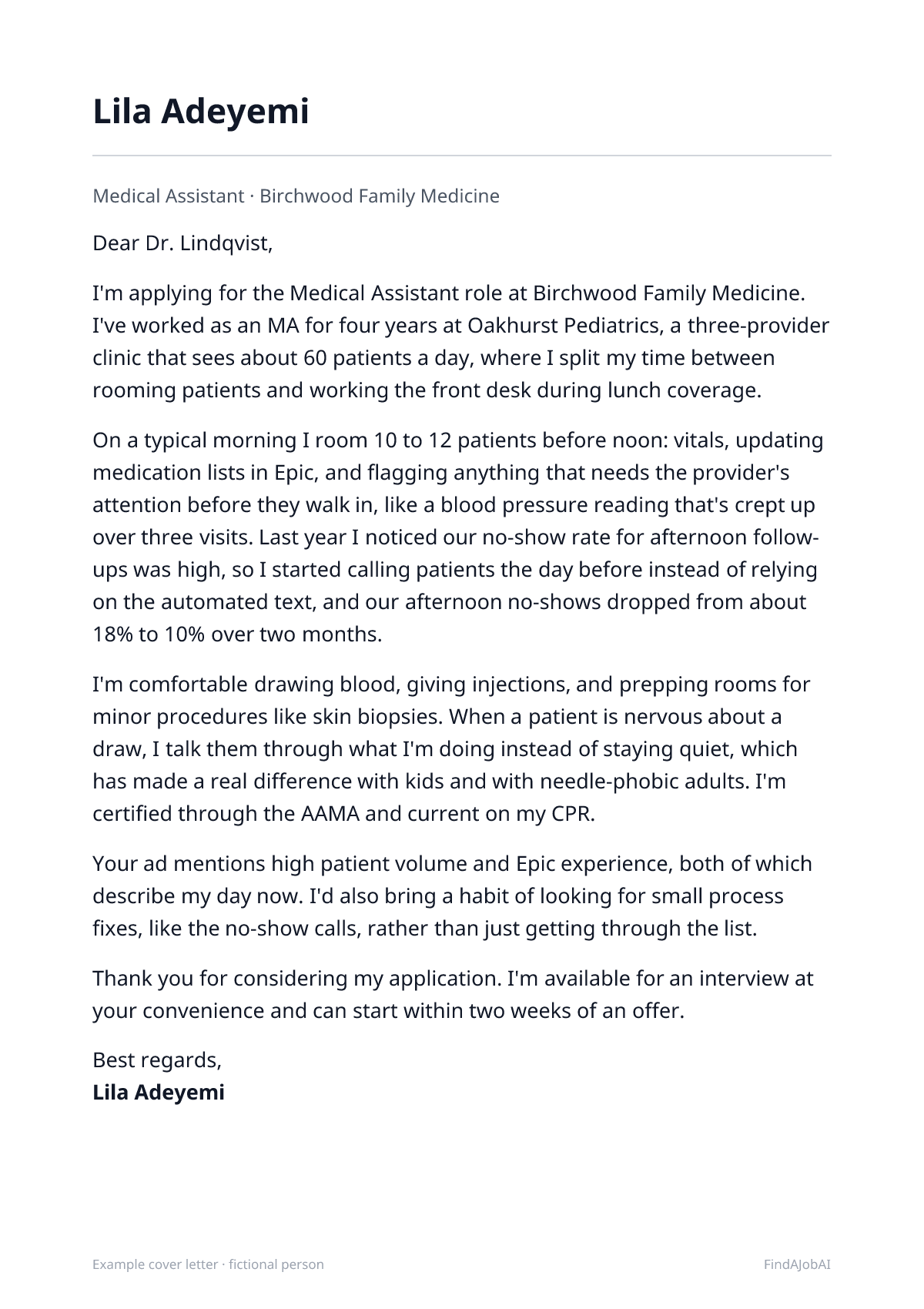
Dear Dr. Lindqvist,
I'm applying for the Medical Assistant role at Birchwood Family Medicine. I've worked as an MA for four years at Oakhurst Pediatrics, a three-provider clinic that sees about 60 patients a day, where I split my time between rooming patients and working the front desk during lunch coverage.
On a typical morning I room 10 to 12 patients before noon: vitals, updating medication lists in Epic, and flagging anything that needs the provider's attention before they walk in, like a blood pressure reading that's crept up over three visits. Last year I noticed our no-show rate for afternoon follow-ups was high, so I started calling patients the day before instead of relying on the automated text, and our afternoon no-shows dropped from about 18% to 10% over two months.
I'm comfortable drawing blood, giving injections, and prepping rooms for minor procedures like skin biopsies. When a patient is nervous about a draw, I talk them through what I'm doing instead of staying quiet, which has made a real difference with kids and with needle-phobic adults. I'm certified through the AAMA and current on my CPR.
Your ad mentions high patient volume and Epic experience, both of which describe my day now. I'd also bring a habit of looking for small process fixes, like the no-show calls, rather than just getting through the list.
Thank you for considering my application. I'm available for an interview at your convenience and can start within two weeks of an offer.
Best regards,
Lila Adeyemi
Example 2 · Career changer
Hotel front-desk worker newly certified as a medical assistant
Dion spent six years calming guests and solving problems at a hotel desk, then completed an MA program. The ad mentions a fast-paced urgent care.
Example letter · fictional
Dear Hiring Manager,
I'm applying for the Medical Assistant role at Harborview Urgent Care. I spent six years at the front desk of a 200-room hotel, often handling the first conversation with someone who was tired, in pain, or upset about something going wrong. I completed my Medical Assistant certificate last spring and I'm ready to put that training to work in a clinical setting.
During my externship at a community clinic, I rotated through intake, rooming, and basic lab work: vitals, EKGs, and specimen collection for about 15 patients a day. My preceptor had me lead the walk-in flow during my last two weeks, which meant triaging who needed to be seen first and keeping three exam rooms moving at once, a rhythm that felt familiar from managing a hotel lobby during a convention weekend.
At the hotel, I was the one who handled overbooked rooms and late-night emergencies calmly enough that guests stopped escalating. I think that same steadiness matters more in urgent care than almost anywhere else, since patients are often scared or in pain when they walk in. I'm certified through NHA, current on CPR, and comfortable with EHR systems after training on Athenahealth during my externship.
Your posting mentions a fast-paced environment and patients who are often anxious or in pain. That combination is exactly what drew me to urgent care rather than a slower specialty practice, and six years of guest-facing work means I don't rattle easily when things get busy.
Thank you for your time. My externship supervisor is happy to speak to my clinical readiness, and I'd welcome the chance to discuss how I can contribute.
Kind regards,
Dion Fletcher
Example 3 · Senior or lead
Lead medical assistant applying to oversee a growing clinic's MA team
Lena trains and schedules six medical assistants across two clinics. The ad is for a lead MA to standardize onboarding and handle provider complaints.
Example letter · fictional
Dear Ms. Caldwell,
I'm applying for the Lead Medical Assistant role at Sutton Health Partners. For the last two years I've led a team of six MAs across two locations for Fenwick Internal Medicine, and before that I worked four years as a staff MA. I'd like to bring that same structure to a clinic that's growing fast enough to need it.
When I took over, new MAs took about six weeks to get comfortable with our rooming workflow, and providers were fielding small questions all day that a lead should have caught. I wrote a one-week shadowing checklist, built a short reference sheet for our ten most common provider preferences, and set a standing 15-minute daily huddle. New hires now reach full speed in about three weeks, and provider interruptions during patient hours dropped noticeably, which two of our three physicians mentioned unprompted at review time.
The clearest example of the job is a scheduling conflict I inherited: two MAs covering four exam rooms during our busiest clinic session, which meant rooms sat empty while one MA caught up. I restructured the rotation so MAs are paired to rooms by provider pace rather than split evenly, and our average time from check-in to provider entry fell from 22 minutes to 14.
I haven't yet managed a budget or hired for a brand-new location, both of which your ad mentions, and I'd want to learn Sutton's hiring process early rather than assume my old one transfers directly.
I'd welcome a conversation about how your two locations currently handle onboarding and where the biggest friction is for your providers.
Sincerely,
Lena Mercer
All three letters, and the short version below, are fictional: the people, employers and numbers are invented. Borrow the structure, never the facts.
- Prefer to write it yourself? Use the free cover letter template.
- Check your CV against the job first: the free CV score shows the missing keywords.
Why the first letter works, paragraph by paragraph
Paragraph 1: Opening
Names the clinic's size and patient volume so the reader can picture the pace, and states the split between rooming and front-desk work, which matches how most MA roles actually run.
Paragraph 2: A typical day plus a problem solved
Gives a concrete rooming routine, then one specific fix (calling patients the day before) with a before-and-after no-show rate, showing initiative beyond the basic task list.
Paragraph 3: Clinical skills and patient manner
Lists procedures the writer is comfortable with and adds a detail about talking nervous patients through a draw, which shows bedside manner, not just a skills checklist.
Paragraph 4: Why this clinic
Mirrors the ad's own language (high volume, Epic) and adds the habit (process fixes) that the resume alone wouldn't show.
Paragraph 5: Close
States availability plainly, which matters in a field where clinics often need to fill a seat quickly.
What the career changer's letter does differently
The career changer's letter leans on the externship for every clinical claim, since there's no paid MA experience yet, and names the specific rotation (walk-in flow, three exam rooms) rather than just 'completed my externship.' It also draws a direct, honest line from hotel front-desk pressure to urgent care's pace, instead of claiming the two jobs are the same.
What the senior letter does differently
A lead MA letter reports team habits and systems, not individual patient care: a six-week onboarding cut to three, a rotation redesign with a before-and-after check-in time, and a named gap (budget and hiring at a new site) rather than overclaiming readiness for the full scope of the role.
Short medical assistant cover letter: an email-ready version
Many applications arrive as an email or a small text box, and a full page doesn't fit. This version runs 120 to 150 words and keeps only what a reader needs to decide whether to reply. A certified medical assistant answers a dermatology practice's online application by email after the portal rejected a resume upload.
Short version · email · fictional131 words
Subject: Certified Medical Assistant application – dermatology, 3 years – Felix Okonkwo
Hello Mr. Bartoli,
I'm applying for the Medical Assistant role at Clearview Dermatology. I've worked three years as a CMA at a general dermatology practice, where I assist with biopsies, cryotherapy, and patch testing in addition to standard rooming duties.
One change I'm proud of: our biopsy follow-up calls used to slip for a week or more, so I built a simple tracking sheet tied to our pathology turnaround, and late follow-ups dropped from roughly a third of cases to almost none.
I'd like to bring that same attention to a growing practice. My resume is attached, and I'm glad to share more about my procedural experience on a call. I also keep a short checklist for each procedure room so supplies are ready before the patient arrives.
Best,
Felix Okonkwo
The short version keeps one process fix with a clear before-and-after instead of a full skills list, since the resume already covers procedures. It names the specialty-specific tasks (biopsies, cryotherapy) in one line so the reader doesn't need to guess at relevant experience.
Opening lines that work for medical assistant cover letters
The first sentence decides whether the second gets read. Here are six openings, one for each situation you might be in. Pick the one that matches yours and swap in your own facts: every name and number below is invented.
1. You have a standout result
Our biopsy follow-up tracking sheet, which I built after noticing calls were slipping by a week or more, cut late follow-ups to almost none. I'd like to bring that same habit of noticing gaps to your dermatology team.
2. The ad names a problem you've solved
Your ad mentions a high patient volume and limited support staff. At my current clinic I room 10 to 12 patients before noon most days, and I've learned to flag what the provider needs to know before they walk in rather than after.
3. Someone referred you
Your office manager, Teresa Lin, mentioned you need someone comfortable with pediatric draws specifically, which is the part of the job I get asked to help with most at my current practice.
4. You admire what they build
I've been a patient at your clinic for years, and the calm way your staff handles a packed waiting room is part of why I'd like to work there rather than somewhere less organized.
5. You're new to the field or switching into it
I spent six years at a hotel front desk managing frustrated guests before training as a medical assistant, and urgent care's pace is exactly the kind of pressure I already know how to stay steady under.
6. You have senior scope or a specialism
As lead MA for a six-person team across two locations, I built the onboarding checklist our clinic still uses. I'm looking for a role where I can do that kind of standardizing from day one.
How to write a medical assistant cover letter
Five steps, in the order you'd write them. The shape stays the same for every job (a short opening, proof, a reason for this employer, a close), and what goes into each part is what changes with the role.
Match your setting to theirs
Pediatrics, urgent care, dermatology, and family medicine each move at a different pace and ask for different procedures. Read the ad for the specialty and patient volume, then lead with the experience of yours that's closest, even if it's from an externship rather than a paid job.
Open with a patient or workflow moment, not your certification
Your CMA or RMA credential is already on your resume. Spend your first lines on something you noticed and fixed, like a no-show pattern or a slow rooming process, so the reader sees judgment before they see an acronym.
Name procedures you've actually performed
Draws, injections, EKGs, biopsy assistance, and prior auth calls carry more weight than 'clinical and administrative duties.' Say how often you've done each one and in what setting, so a reader can picture your actual day.
Use a before-and-after number when you have one
A no-show rate, a check-in-to-provider-entry time, or a follow-up completion rate makes a process fix concrete. If you don't have a number, describe what changed for the provider or patient instead of leaving the claim vague.
Show your bedside manner in one sentence
Mention how you handle a scared child, an anxious adult, or an angry patient at checkout. This is often what separates candidates with identical certifications, so give it a real moment rather than the word 'compassionate.'
Medical Assistant cover letter do's and don'ts
Do
- Name your certification (CMA, RMA, NHA, CCMA) and keep it current; mention CPR status too.
- Describe one patient or workflow problem you noticed and what you did about it, not just your task list.
- Name the EHR system the ad lists (Epic, Athenahealth, eClinicalWorks) if you've used it, even briefly in an externship.
Don't
- Don't write "I'm a people person who loves helping others" without a specific example attached to it.
- Don't list every procedure you've ever watched; name the ones you've actually performed and how often.
- Don't skip your externship if you're newly certified; describe it with the same detail as a paid job.
Common medical assistant cover letter mistakes
Each one is easy to make and quick to fix before you send the letter.
Listing certifications instead of showing clinical judgment
'CMA certified, CPR current, EHR proficient' is a resume line repeated in sentence form. Use the letter for a moment that shows you noticing something a checklist wouldn't catch, like a vitals trend across visits.
Writing 'I'm a people person' with nothing behind it
Every applicant says this. Replace it with how you've actually calmed a scared patient or defused a frustrated one at checkout, a specific moment rather than a trait.
Treating an externship as less than real experience
If it's your only clinical experience, describe it with real detail: patient volume, tasks, and one thing you handled well. Hedging language like 'just an externship' undersells it before the reader even judges it.
Ignoring the practice's specialty
A letter that would work for any clinic misses a chance to show fit. Name the specific procedures or patient population the specialty involves, like pediatric draws or biopsy assistance, if you have that experience.
Overpromising on scope in a lead or senior application
Claiming full readiness for budget ownership or hiring when you haven't done either invites a hard question in the interview. Name the gap honestly and pair it with what you have led.
Email subject lines for medical assistant applications
Applying by email? Put the job title, any reference number and your name in the subject line.
- Medical Assistant application – Epic, high-volume family practice – Lila Adeyemi
- Medical Assistant – newly certified, urgent care experience via externship – Dion Fletcher
- Application: Certified Medical Assistant, Pediatrics (Req. 2240) – Lila Adeyemi
Everything for Medical Assistants
- Medical Assistant resume exampleA full resume, plus bullet and summary examples
- Medical Assistant interview questions30 questions with sample answers
- Medical Assistant job descriptionDuties, skills and requirements
- Career change cover letter: template + examples
Other cover letter examples
Medical Assistant cover letter FAQ
What should I write in a medical assistant cover letter?
One specific example of rooming patients or managing a clinic workflow, a problem you noticed and fixed, and your certification status. Name the EHR system if the ad lists one. Your task list belongs on the resume; the letter is for the judgment behind it.
How do I write a medical assistant cover letter with no experience?
Describe your externship rotation in the same detail you'd give a paid job: how many patients, which tasks, and one moment you handled well. Add any transferable skill from prior work, like a fast-paced, people-facing job, without overstating the overlap.
Should I mention my certification exam score or just that I passed?
Just that you passed and which body certified you (AAMA, NHA, AMT) is enough. Scores aren't expected and take up space better used on a clinical example.
How we built this page
The FindAJobAI team wrote the three example letters, the short email version, the opening lines and the advice for medical assistant roles. The people, employers and numbers in the letters are invented; the structure, the kind of evidence and the order of the paragraphs are the parts to copy.
Once we track enough live medical assistant job ads, this page also shows the skills they ask for most, counted the same way as our in-demand skills report.
Last reviewed on November 1, 2026.