Chemical Engineer Cover Letter Example (2026)
By FindAJobAI team Updated How we built this page
Chemical engineering ads list the same core coursework and software, so a cover letter has to show what you actually fixed on a line or in a process: the yield problem, the safety incident, the batch that kept failing spec, and what changed because of your work.
Chemical Engineer cover letter template
This letter as a one-page template: an opening that names the job and your strongest fact, proof that answers the ad, a reason for this employer and a short close.
After you sign up, FindAJobAI drafts your own letter for a real job from your CV in this format, and you edit it before you send it.
Example 1 · Experienced
Process engineer applying to a specialty chemicals plant
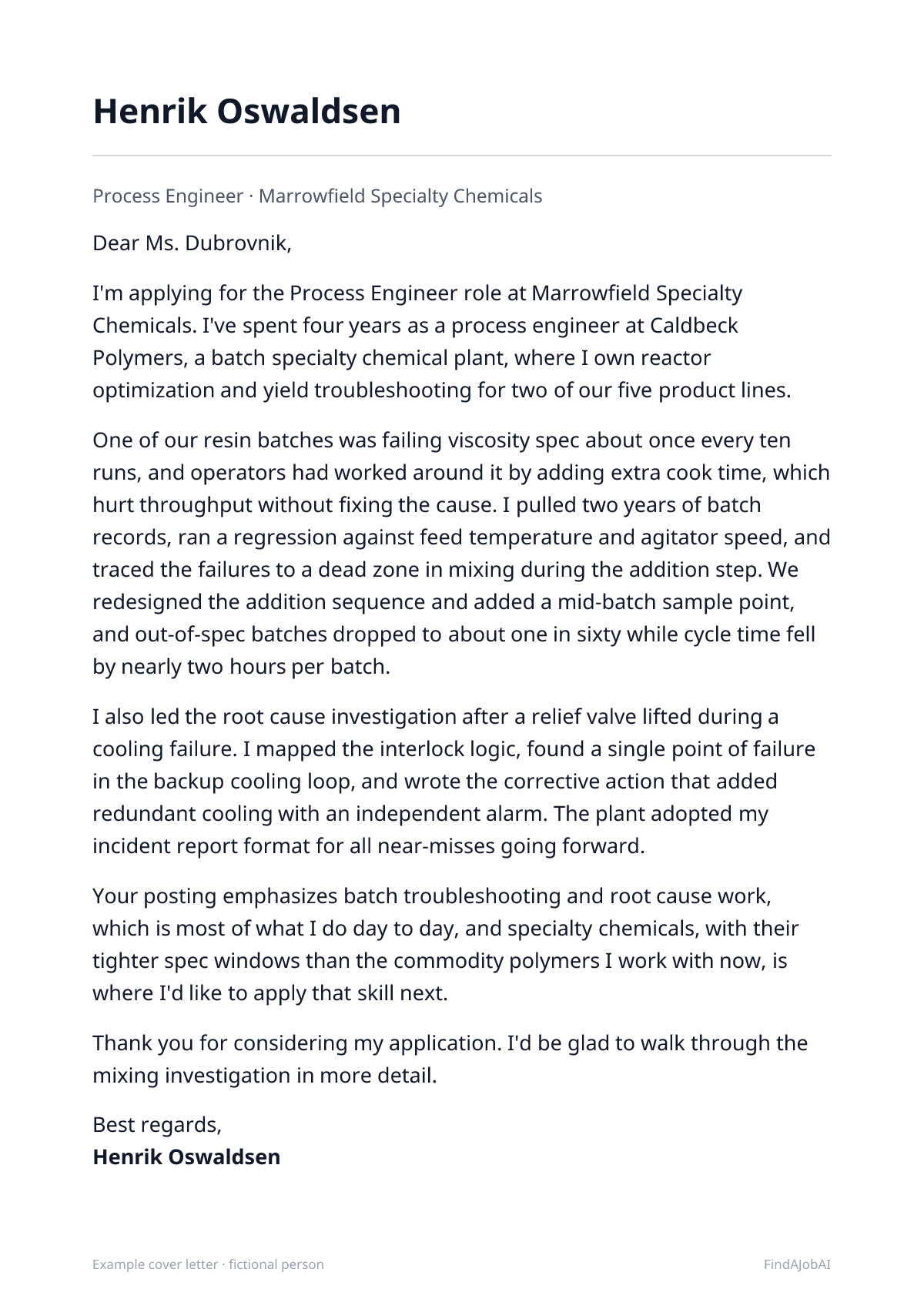
Henrik runs reactor optimization at a mid-size plant. The ad asks for batch process experience and root cause investigation.
Example letter · fictional
Dear Ms. Dubrovnik,
I'm applying for the Process Engineer role at Marrowfield Specialty Chemicals. I've spent four years as a process engineer at Caldbeck Polymers, a batch specialty chemical plant, where I own reactor optimization and yield troubleshooting for two of our five product lines.
One of our resin batches was failing viscosity spec about once every ten runs, and operators had worked around it by adding extra cook time, which hurt throughput without fixing the cause. I pulled two years of batch records, ran a regression against feed temperature and agitator speed, and traced the failures to a dead zone in mixing during the addition step. We redesigned the addition sequence and added a mid-batch sample point, and out-of-spec batches dropped to about one in sixty while cycle time fell by nearly two hours per batch.
I also led the root cause investigation after a relief valve lifted during a cooling failure. I mapped the interlock logic, found a single point of failure in the backup cooling loop, and wrote the corrective action that added redundant cooling with an independent alarm. The plant adopted my incident report format for all near-misses going forward.
Your posting emphasizes batch troubleshooting and root cause work, which is most of what I do day to day, and specialty chemicals, with their tighter spec windows than the commodity polymers I work with now, is where I'd like to apply that skill next.
Thank you for considering my application. I'd be glad to walk through the mixing investigation in more detail.
Best regards,
Henrik Oswaldsen
Example 2 · Career changer
Lab chemist moving into a process engineering role
Adaeze has done quality control testing for three years and earned a process safety certificate. The ad is for an entry-level process engineer at a food plant.
Example letter · fictional
Dear Mr. Falkenrath,
I'm applying for the Process Engineer I role at Thornquist Ingredients. For three years I've worked as a quality control chemist at Verdalen Foods, testing incoming ingredients and finished batches, and I recently completed a process safety management certificate to move toward process engineering directly.
In my current role I noticed our moisture test results drifted upward every summer, which traced back to humidity in an unconditioned raw material storage room rather than any issue with the supplier. I worked with our maintenance team to add a dehumidifier and a logging sensor, and out-of-spec moisture rejections for that ingredient fell from roughly one in eight deliveries to almost none the following summer. That project is what pushed me to want ownership of a process rather than just testing its output.
Since then I've completed coursework in process safety management and mass and energy balances, and I shadowed our plant's process engineer for two months on a line rebalancing project, where I helped build the mass balance spreadsheet used to size a new pump.
Your posting is for an entry-level engineer supporting ingredient processing lines, and I already understand this plant's quality specs from the testing side, which I think shortens the learning curve on why a given parameter matters. I'm also comfortable reading a batch record and spotting which step a deviation most likely came from.
I'd welcome the chance to discuss the role further. Thank you for your time and consideration. I can bring the mass balance spreadsheet, with the plant details removed, to an interview.
Sincerely,
Adaeze Monteiro-Siebert
Example 3 · Senior or lead
Plant engineering manager applying to lead a struggling site
Solveig manages eight engineers at one plant. The ad is for an engineering manager at a sister site with chronic downtime.
Example letter · fictional
Dear Mr. Okonkwo-Reyes,
I'm applying for the Plant Engineering Manager role at Haldercrest's Millbrook facility. I currently manage a team of eight process and reliability engineers at our sister site in Carnoway, where I was promoted from senior process engineer three years ago after leading a two-year effort to cut unplanned downtime.
Your posting describes Millbrook's unplanned downtime running well above the group's other sites, with maintenance and process engineering blaming each other for root causes. Carnoway had the same dynamic when I took over. I merged our process and reliability review into one weekly meeting with a shared failure log instead of two separate ones, and required every unplanned stop over four hours to get a written root cause before the next week's meeting. Unplanned downtime fell from roughly eighteen percent of scheduled run time to about seven percent over eighteen months, and the finger-pointing mostly stopped once both teams were reading the same log.
The hardest part wasn't the process changes but convincing two senior maintenance techs that engineering wasn't just there to criticize their work. I spent time on the floor with them before changing anything, and one of them now leads our reliability-centered maintenance pilot. People follow a plan faster when they helped shape it.
I haven't managed a team through a full capital project, only operational improvements, so at Millbrook I'd want to lean on your capital planning group early if the downtime work points to equipment that needs replacing rather than just better maintenance practice.
I'd welcome a conversation about what Millbrook's failure data shows so far and where your maintenance and engineering teams currently disagree.
Sincerely,
Solveig Imbrasaite
All three letters, and the short version below, are fictional: the people, employers and numbers are invented. Borrow the structure, never the facts.
- Prefer to write it yourself? Use the free cover letter template.
- Check your CV against the job first: the free CV score shows the missing keywords.
Why the first letter works, paragraph by paragraph
Paragraph 1: Opening
States the exact scope Henrik owns, reactor optimization on two product lines at a named type of plant, so the reader knows the scale before any story starts.
Paragraph 2: The yield investigation
A specific recurring failure, the method (batch records and regression), the root cause, the fix, and two measured results, scrap rate and cycle time, rather than a vague claim of 'process improvement.'
Paragraph 3: The safety incident
Shows judgment under a serious event, names the specific failure mode (single point of failure in a cooling loop), and the lasting change, an adopted report format, which signals influence beyond his own line.
Paragraph 4: Why this company
Matches the ad's two stated priorities and gives an honest reason specialty chemicals suits his experience, rather than generic enthusiasm.
Paragraph 5: Close
Offers a concrete next step, walking through the investigation, which respects that full data would stay with his current employer.
What the career changer's letter does differently
The lab chemist's letter leads with a problem she noticed and helped fix from the quality side, with a measured result (moisture rejections dropping from about one in eight deliveries to almost none), before naming her certificate and shadowing work as formal preparation, and closes by turning her testing background into a specific advantage for process work at the same kind of plant.
What the senior letter does differently
A plant engineering manager letter reports a site's overall reliability trend over years, not one investigation: unplanned downtime cut from about eighteen percent to seven percent of scheduled run time, a merged review meeting that ended interdepartmental blame, and a maintenance tech turned into a reliability champion. The gap, capital project leadership, is named rather than hidden.
Short chemical engineer cover letter: an email-ready version
Many applications arrive as an email or a small text box, and a full page doesn't fit. This version runs 120 to 150 words and keeps only what a reader needs to decide whether to reply. A process engineer answers a chemical manufacturer's short online application after a referral, sent as a follow-up email with the resume attached.
Short version · email · fictional129 words
Subject: Process Engineer II application – referral from Yelena Dmitrova – Garrick Nnamdi-Olsen
Hello Ms. Travers,
I'm applying for the Process Engineer II role at Felstone, referred by your reliability engineer, Yelena Dmitrova, a former colleague of mine. Yelena mentioned your team is expanding its distillation work, which is why I'm writing now.
I've spent three years optimizing a continuous distillation unit at Hallowmere Petrochemical. My main project cut column fouling by redesigning the reboiler cleaning schedule around actual fouling data instead of a fixed calendar, which extended average run length between cleanings by about three weeks.
I'm drawn to Felstone's work on continuous processes specifically, since that's where most of my hands-on experience sits. My resume is attached, and I'm happy to discuss the fouling project in more detail. I'm available for a call on any weekday afternoon.
Best,
Garrick Nnamdi-Olsen
The short version keeps the referral, one measurable project result, and a reason the specific process type fits, cutting the broader safety and teamwork detail the full letter covers for space.
Opening lines that work for chemical engineer cover letters
The first sentence decides whether the second gets read. Here are six openings, one for each situation you might be in. Pick the one that matches yours and swap in your own facts: every name and number below is invented.
1. You have a standout result
One fouling investigation I led extended run length between reboiler cleanings by about three weeks, saving a full shift of downtime most months. I'd like to apply that kind of troubleshooting to your distillation unit.
2. The ad names a problem you've solved
Your posting describes unplanned downtime as a persistent problem on your line. At my current plant I built a shared failure log that helped cut unplanned stops by roughly half over a year, and I'd like to bring that habit to your team.
3. Someone referred you
Your reliability engineer, Yelena Dmitrova, worked alongside me for two years and suggested I apply, which is why I'm writing.
4. You admire what they build
I toured your Hollowmere facility as a vendor representative last year and noticed how tightly your batch records were kept; that kind of discipline is what drew me to apply directly.
5. You're new to the field or switching into it
I spent three years as a quality control chemist testing the output of a process I now want to help design, and I recently finished a process safety certificate to make that move.
6. You have senior scope or a specialism
As a plant engineering manager for three years, I cut unplanned downtime at my site by more than half. I'm looking for a role leading engineering at a site that needs that kind of turnaround.
How to write a chemical engineer cover letter
Five steps, in the order you'd write them. The shape stays the same for every job (a short opening, proof, a reason for this employer, a close), and what goes into each part is what changes with the role.
Lead with the process problem, not your coursework
Readers skim past a list of thermodynamics and unit operations classes. Open with a specific process issue you diagnosed, a yield loss, a fouling problem, a safety near-miss, and let your technical background show through how you describe solving it.
Walk through your method, briefly
Name the data you pulled, the tool or analysis you used, Aspen, a mass balance, a regression on batch records, and what it pointed to. A short, accurate description of your actual method is more convincing than claiming broad software fluency.
Report the result in the plant's own metric
Yield, scrap rate, cycle time, downtime, and throughput are the numbers plants actually track. State the before and after, rounded if the exact figures are proprietary, so the claim is specific enough to discuss in an interview without revealing confidential data.
Show you take process safety seriously
If you have a real example, an interlock you helped design, a near-miss investigation, a hazard review you contributed to, include it briefly. If you don't, naming a safety certificate or coursework honestly is better than implying experience you haven't had.
Close with a reason tied to this specific plant
Match your closing to something the ad or the company actually does: a process type, an industry, a stated problem like downtime or scrap. A reason specific to their operation reads as more considered than general enthusiasm for the company.
Chemical Engineer cover letter do's and don'ts
Do
- Name the specific process problem, your method for finding the cause, and the result in the plant's own terms (yield, scrap rate, cycle time, downtime).
- Mention the software or method the ad names (Aspen, mass and energy balances, Six Sigma, DCS) inside an actual investigation, not as a bare list.
- Show you understand process safety: an interlock, a hazard review, or a near-miss you helped prevent, if you have one.
Don't
- Don't write "strong problem-solving skills and attention to detail"; show one investigation instead.
- Don't share a current employer's proprietary process details, exact formulations, or confidential yield figures; use rounded or relative numbers.
- Don't claim hands-on plant experience you only had in a classroom lab; label coursework and internships as what they are.
Common chemical engineer cover letter mistakes
Each one is easy to make and quick to fix before you send the letter.
Listing software without a result attached
"Proficient in Aspen, MATLAB, and Excel" tells the reader nothing about what you did with them. Attach one tool to one investigation, such as building a mass balance in Aspen to size a new pump.
Reporting effort instead of outcome
"Analyzed over 500 batch records" describes work, not impact. State what the analysis found and what changed afterward, such as a reduced scrap rate or a shorter cycle time.
Giving suspiciously exact proprietary figures
An oddly precise number, like a yield improvement to three decimal places, can read as either fabricated or a confidentiality risk. Round the figure or express it relative to a baseline instead.
Overstating plant experience from a lab or classroom
Describing a senior design project or lab rotation as if it were full-scale plant work undermines credibility once an interviewer asks follow-up questions. Label the setting honestly and focus on what you learned that transfers.
Skipping process safety entirely
A chemical engineering letter with no mention of safety can read as unaware of how central it is to the field. Include a real example if you have one, or at least name relevant coursework or certification.
Email subject lines for chemical engineer applications
Applying by email? Put the job title, any reference number and your name in the subject line.
- Process Engineer application – batch troubleshooting and root cause investigation – Henrik Oswaldsen
- Process Engineer I – QC chemist with process safety certificate – Adaeze Monteiro-Siebert
- Application: Chemical Engineer, Utilities (Req. 3390) – Henrik Oswaldsen
Everything for Chemical Engineers
- Chemical Engineer resume exampleA full resume, plus bullet and summary examples
- Chemical Engineer interview questions30 questions with sample answers
- Chemical Engineer job descriptionDuties, skills and requirements
- Career change cover letter: template + examples
Other cover letter examples
Chemical Engineer cover letter FAQ
What should I write in a chemical engineer cover letter?
One process problem you investigated: what was failing, how you found the cause, the fix, and the result measured in yield, scrap, downtime, or cycle time. Add a line on process safety if you have a relevant example. Your degree and software skills are already on your resume.
How do I write a chemical engineer cover letter with no plant experience?
Use a senior design project, an internship, or lab or quality work where you solved a measurement or process problem. Name the tools you used, Aspen, mass and energy balances, or statistical analysis, and the result, even if it was in a classroom or pilot setting.
Should I mention safety incidents in a chemical engineer cover letter?
Yes, if you played a real role in the investigation or fix, since safety judgment matters as much as process knowledge in this field. Describe the failure mode and the corrective action, not just that an incident happened.
How specific should the numbers in my cover letter be?
Specific enough to be credible, a yield rate, a cycle time, a defect rate, but rounded or relative if the exact figures are proprietary to a current employer. A believable range beats a suspiciously precise number you can't actually verify in an interview.
How we built this page
The FindAJobAI team wrote the three example letters, the short email version, the opening lines and the advice for chemical engineer roles. The people, employers and numbers in the letters are invented; the structure, the kind of evidence and the order of the paragraphs are the parts to copy.
Once we track enough live chemical engineer job ads, this page also shows the skills they ask for most, counted the same way as our in-demand skills report.
Last reviewed on November 1, 2026.