Chemist Cover Letter Example (2026)
By FindAJobAI Team Updated How we built this page
Lab managers read chemist cover letters looking for proof that your numbers can be trusted. A good letter names the techniques you run on your own, the quality system you work under and one short story about a method you fixed or a result you investigated. It should sound like a careful scientist explaining work to a colleague, not a list of instruments copied from the posting.
Chemist cover letter template
This letter as a one-page template: an opening that names the job and your strongest fact, proof that answers the ad, a reason for this employer and a short close.
After you sign up, FindAJobAI drafts your own letter for a real job from your CV in this format, and you edit it before you send it.
Example 1 · Experienced
Pharmaceutical QC chemist applying to a biologics contract lab
Lucinda runs HPLC release and stability testing at a generic drug maker. The ad is for an analytical chemist at a contract lab serving biotech clients.
Example letter · fictional
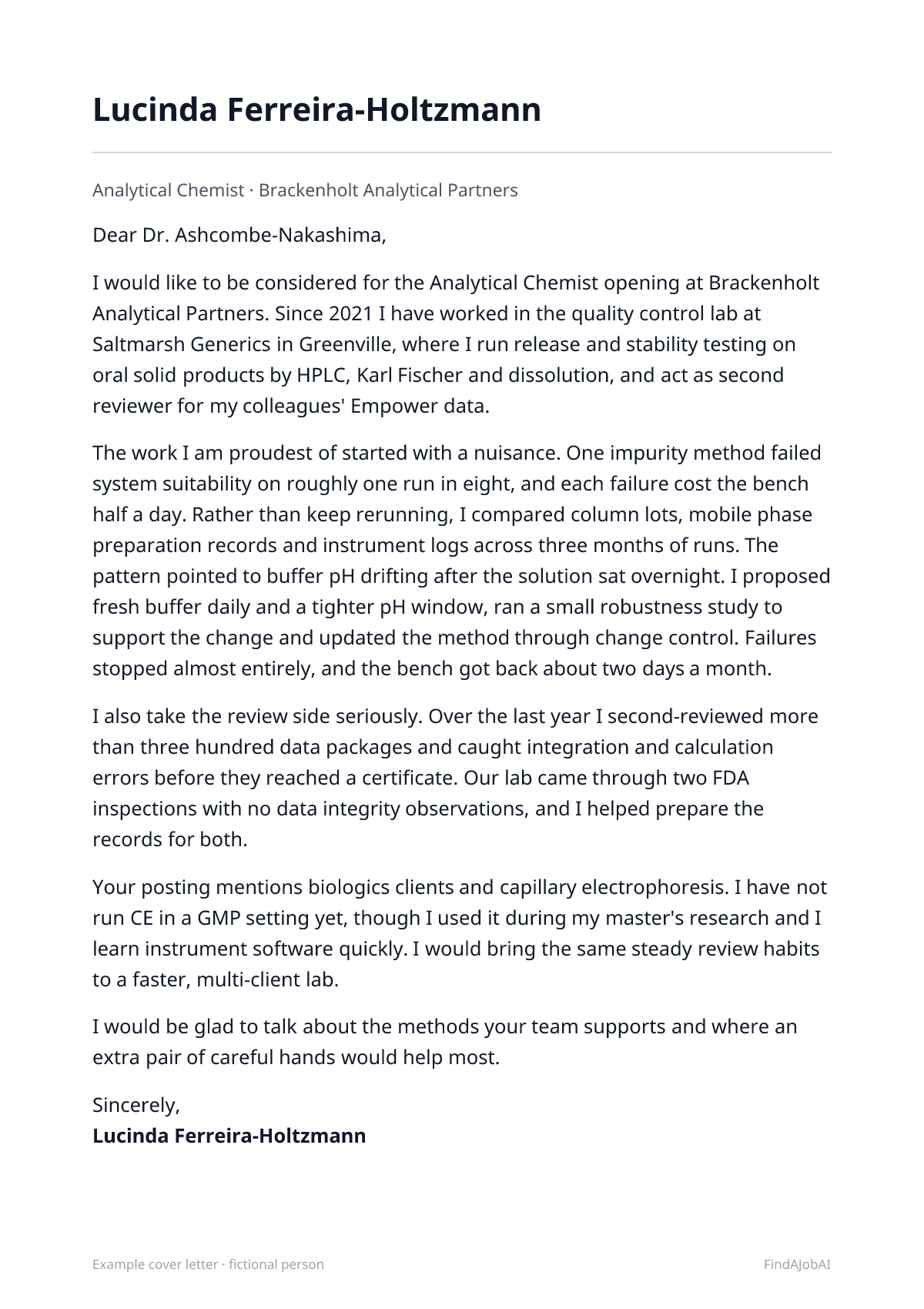
Dear Dr. Ashcombe-Nakashima,
I would like to be considered for the Analytical Chemist opening at Brackenholt Analytical Partners. Since 2021 I have worked in the quality control lab at Saltmarsh Generics in Greenville, where I run release and stability testing on oral solid products by HPLC, Karl Fischer and dissolution, and act as second reviewer for my colleagues' Empower data.
The work I am proudest of started with a nuisance. One impurity method failed system suitability on roughly one run in eight, and each failure cost the bench half a day. Rather than keep rerunning, I compared column lots, mobile phase preparation records and instrument logs across three months of runs. The pattern pointed to buffer pH drifting after the solution sat overnight. I proposed fresh buffer daily and a tighter pH window, ran a small robustness study to support the change and updated the method through change control. Failures stopped almost entirely, and the bench got back about two days a month.
I also take the review side seriously. Over the last year I second-reviewed more than three hundred data packages and caught integration and calculation errors before they reached a certificate. Our lab came through two FDA inspections with no data integrity observations, and I helped prepare the records for both.
Your posting mentions biologics clients and capillary electrophoresis. I have not run CE in a GMP setting yet, though I used it during my master's research and I learn instrument software quickly. I would bring the same steady review habits to a faster, multi-client lab.
I would be glad to talk about the methods your team supports and where an extra pair of careful hands would help most.
Sincerely,
Lucinda Ferreira-Holtzmann
Example 2 · Entry level
New chemistry graduate applying for a first QC chemist role
Desmond finished a BS in chemistry with an undergraduate research project. The ad is for an entry-level chemist at a food and flavor manufacturer.
Example letter · fictional
Dear Ms. Szczepanik-Oduya,
I am applying for the Chemist I role at Copperleaf Flavor Works. I graduated in May with a bachelor's degree in chemistry from the University of Iowa, and I spent my final two years doing undergraduate research in an analytical lab that studied volatile compounds in fermented foods.
In that lab I prepared samples, ran headspace GC-MS and helped build a library of about forty aroma compounds from reference standards. My own project compared two extraction techniques for vanilla samples. The first approach gave inconsistent peak areas, so I tracked down the cause, which turned out to be uneven heating in the sample tray, and I rebuilt the procedure with timed equilibration. My replicate results became much tighter, and my advisor asked me to write the revised steps into the group's shared protocol.
I know a production QC lab is different from a university bench. Records must be complete the first time and results have to be ready when the plant needs them. I kept a bound notebook throughout my research, logged every standard I prepared and finished my university's chemical hygiene and waste handling training.
Your posting lists GC, FTIR and sensory panel support. GC is where I have the most hours, and I have used FTIR in two upper-level lab courses. I would be glad to learn your methods and specifications quickly and to start on whichever shift helps the lab most.
Thank you for reading my letter. I would welcome a chance to talk about the role and the training your new chemists receive.
Best regards,
Desmond Oyelowo-Brandtner
Example 3 · Senior or lead
Principal scientist applying to lead an analytical development group
Wilhelmina is a principal scientist at a mid-size drug developer. The ad is for an associate director running analytical development at a growing biotech.
Example letter · fictional
Dear Dr. Rutherford-Mensah,
I am applying for the Associate Director, Analytical Development position at Northvale Molecular Sciences. I have spent fourteen years in small-molecule analytical work, and for the last five I have led a team of seven chemists at Brightwater Pharmaceuticals, supporting four programs from first-in-human studies through late-stage development.
When I took over the team, method transfers to our contract manufacturers were our weakest point. Roughly a third needed extra work after transfer, and each repeat cost weeks on the program timeline. I set up a short pre-transfer review in which our chemists and the receiving lab walked through critical method steps, column choices and system suitability limits together before any samples moved. Over the next two years almost every transfer passed on the first attempt, and our partners began asking to use the same checklist for other clients.
I have also written the analytical sections of two marketing applications and answered agency questions on impurity specifications. That work taught me to build validation packages that tell a clear story to a reviewer who has never seen our lab, which I now coach my team to do from the first draft.
Northvale is moving its lead asset into Phase 3 while adding a second modality. I would focus my first months on understanding the methods already in place, agreeing transfer and validation standards with your CMC lead and making sure each chemist on the team knows where their work fits in the filing plan.
I would welcome a conversation about the program timeline and the analytical support you need over the next two years.
Kind regards,
Wilhelmina Castellano-Obi
All three letters, and the short version below, are fictional: the people, employers and numbers are invented. Borrow the structure, never the facts.
- Prefer to write it yourself? Use the free cover letter template.
- Check your CV against the job first: the free CV score shows the missing keywords.
Why the first letter works, paragraph by paragraph
Paragraph 1: Opening
Names the employer, the type of testing, the main techniques and the reviewer role, which answers a lab manager's first questions in two sentences.
Paragraph 2: The buffer pH story
Shows an investigation in order: a recurring failure, data compared across months, a root cause, a supported fix through change control and a measured result.
Paragraph 3: Data review and inspections
Proves the writer protects data quality for the whole lab, which matters as much as personal bench speed.
Paragraph 4: The CE gap
Admits the missing GMP experience honestly, then points to related research use and fast learning.
Paragraph 5: Close
Short and focused on the team's methods, which keeps attention on the employer's needs.
What the entry-level letter does differently
The graduate's letter turns undergraduate research into QC language: sample prep, GC-MS, a reproducibility problem traced to its cause and a written protocol. It also shows awareness that production labs demand complete records and on-time results.
What the senior letter does differently
A senior chemist letter talks about the group, not one method: transfers, filings, reviewer questions and coaching. It ties the writer's plan to the company's next development milestone.
Short chemist cover letter: an email-ready version
Many applications arrive as an email or a small text box, and a full page doesn't fit. This version runs 120 to 150 words and keeps only what a reader needs to decide whether to reply. An environmental chemist replies by email to a lab director who posted an opening for a metals chemist on a regional jobs board.
Short version · email · fictional123 words
Subject: Metals Chemist – 4 years ICP-MS, EPA 200.8 and 6020 – Rosamund Iwasaki-Pellegrino
Hi Mr. Delacroix-Amankwah,
I am writing about the Metals Chemist opening at Tidewater Environmental Testing. For four years I have run ICP-MS and ICP-OES for a NELAP-accredited lab, analyzing drinking water, soil and wastewater samples under EPA methods 200.8 and 6020.
My main strength is keeping a busy metals bench on schedule without cutting corners. Last spring I reorganized our digestion schedule so the instrument never sat idle waiting for samples, which cleared a two-week backlog in about a month. I also handle routine cone cleaning, tuning and interference checks myself.
I can start with two weeks' notice and would be happy to talk whenever suits you. My resume and a list of the methods I run are attached.
Thank you,
Rosamund Iwasaki-Pellegrino
The short version leads with instruments, sample types and the EPA methods a metals lab screens for, then gives one scheduling result. A busy lab director can judge fit in under a minute.
Opening lines that work for chemist cover letters
The first sentence decides whether the second gets read. Here are six openings, one for each situation you might be in. Pick the one that matches yours and swap in your own facts: every name and number below is invented.
1. You have a standout result
I run release and stability testing by HPLC under GMP and second-review my colleagues' data, and I would like to bring that care to your contract lab.
2. The ad names a problem you've solved
Your posting asks for a chemist who can investigate failures rather than rerun them. My best work last year started with a method that failed one run in eight.
3. Someone referred you
After two years of undergraduate research on volatile compounds, I am ready to move my GC-MS skills from a university bench into a production lab.
4. You admire what they build
Your QC manager, Ignatius Fairweather-Boateng, suggested I apply after we spoke at a regional analytical chemistry meeting last month.
5. You're new to the field or switching into it
Every result I report has passed system suitability, a second review and a check against the specification, which is why our lab has had clean inspections.
6. You have senior scope or a specialism
As a principal scientist leading seven chemists, I have learned that most delays in development come from method transfers, and I know how to prevent them.
How to write a chemist cover letter
Five steps, in the order you'd write them. The shape stays the same for every job (a short opening, proof, a reason for this employer, a close), and what goes into each part is what changes with the role.
Open with techniques and setting
In the first two sentences, name the lab type you work in, the techniques you run independently and the quality system, such as GMP or ISO 17025. A lab manager sorts letters by whether you can work to their standard from day one, so make that easy to see.
Tell one investigation in order
Pick a failed run, an out-of-specification result or an unstable method. Describe what you compared, the cause you found, how you proved the fix and what changed afterward. A step-by-step account shows scientific judgment far better than calling yourself detail-oriented.
Show you protect data quality
Mention second review, audit or inspection results and how you document deviations. Hiring managers worry most about data integrity, so a sentence showing careful, honest records can carry as much weight as your instrument list.
Address gaps in instruments honestly
If the posting names a technique you have not used under GMP, say so and point to the closest experience, such as research use or a similar platform. Admitting the gap and showing how you would close it builds more trust than a vague claim.
Close with the lab's needs
End by connecting your skills to the lab's products, clients or programs, and offer a conversation. Keep the close short so the reader finishes on your strongest evidence instead of a long paragraph of thanks.
Chemist cover letter do's and don'ts
Do
- Name the techniques you run without supervision and the quality system you work under.
- Tell one investigation or method story in the order you worked it, with a result.
- Mention data review, audits or inspections, because trust in your numbers is the real hiring question.
Don't
- Don't copy every instrument from the posting; managers will test you on any you name.
- Don't describe skipping steps or rerunning until a result passes; it reads as a data integrity risk.
- Don't spend the letter on your thesis theory; focus on hands-on lab work and results.
Common chemist cover letter mistakes
Each one is easy to make and quick to fix before you send the letter.
Pasting the instrument list from your resume
Name two or three main techniques and show what you achieved with one of them instead of listing everything.
Writing like a journal abstract
Use plain sentences about bench work, results and records. Save theory and background for the interview.
Skipping the quality system
State whether you work under GMP, GLP or ISO 17025, because it tells the reader how much training you need.
Claiming a method you only watched
Interviews test named techniques. Only claim instruments you have run yourself, and be clear about the setting.
Email subject lines for chemist applications
Applying by email? Put the job title, any reference number and your name in the subject line.
- Analytical Chemist application – 5 years GMP QC, HPLC and Empower – Lucinda Ferreira-Holtzmann
- Chemist I – BS Chemistry 2025, GC-MS research experience – Desmond Oyelowo-Brandtner
- Associate Director, Analytical – 14 years, method team lead – Wilhelmina Castellano-Obi
Everything for Chemists
- Chemist resume exampleA full resume, plus bullet and summary examples
- Chemist interview questions30 questions with sample answers
- Chemist job descriptionDuties, skills and requirements
- Cover letter with no experience: templates
Other cover letter examples
Chemist cover letter FAQ
What should a chemist cover letter include?
The techniques and instruments you use independently, the quality system you work under, one story about a method or investigation with a result, and why this lab or product area interests you. Keep it to one page.
How do I write a chemist cover letter with no industry experience?
Use undergraduate or graduate research, lab courses and internships. Describe the instruments you ran, a problem you solved in the lab and how you kept records, and show you understand that industry labs need complete documentation.
Should a chemist cover letter mention publications?
Briefly, if the role is in research or development. One line naming a paper or poster is enough; the letter should focus on what you can do at the bench for this employer.
How we built this page
The FindAJobAI team wrote the three example letters, the short email version, the opening lines and the advice for chemist roles. The people, employers and numbers in the letters are invented; the structure, the kind of evidence and the order of the paragraphs are the parts to copy.
Once we track enough live chemist job ads, this page also shows the skills they ask for most, counted the same way as our in-demand skills report.
Last reviewed on November 1, 2026.