Claims Processor Cover Letter Example (2026)
By FindAJobAI Team Updated How we built this page
Claims supervisors hire for accuracy, pace and judgment, so a processor's letter should read like a clean claim: complete, specific and free of errors. Say which claims you handle and for what kind of payer, give your daily volume and audited accuracy, show how you deal with pended or tricky claims, and keep the letter short and carefully proofread.
Claims Processor cover letter template
This letter as a one-page template: an opening that names the job and your strongest fact, proof that answers the ad, a reason for this employer and a short close.
After you sign up, FindAJobAI drafts your own letter for a real job from your CV in this format, and you edit it before you send it.
Example 1 · Experienced
Health plan claims processor applying to a larger administrator
Henrietta processes about 95 medical claims a day at 99.2% accuracy. The administrator is growing its facility claims team and has a pended backlog.
Example letter · fictional
Dear Ms. Tennyson-Adewale,
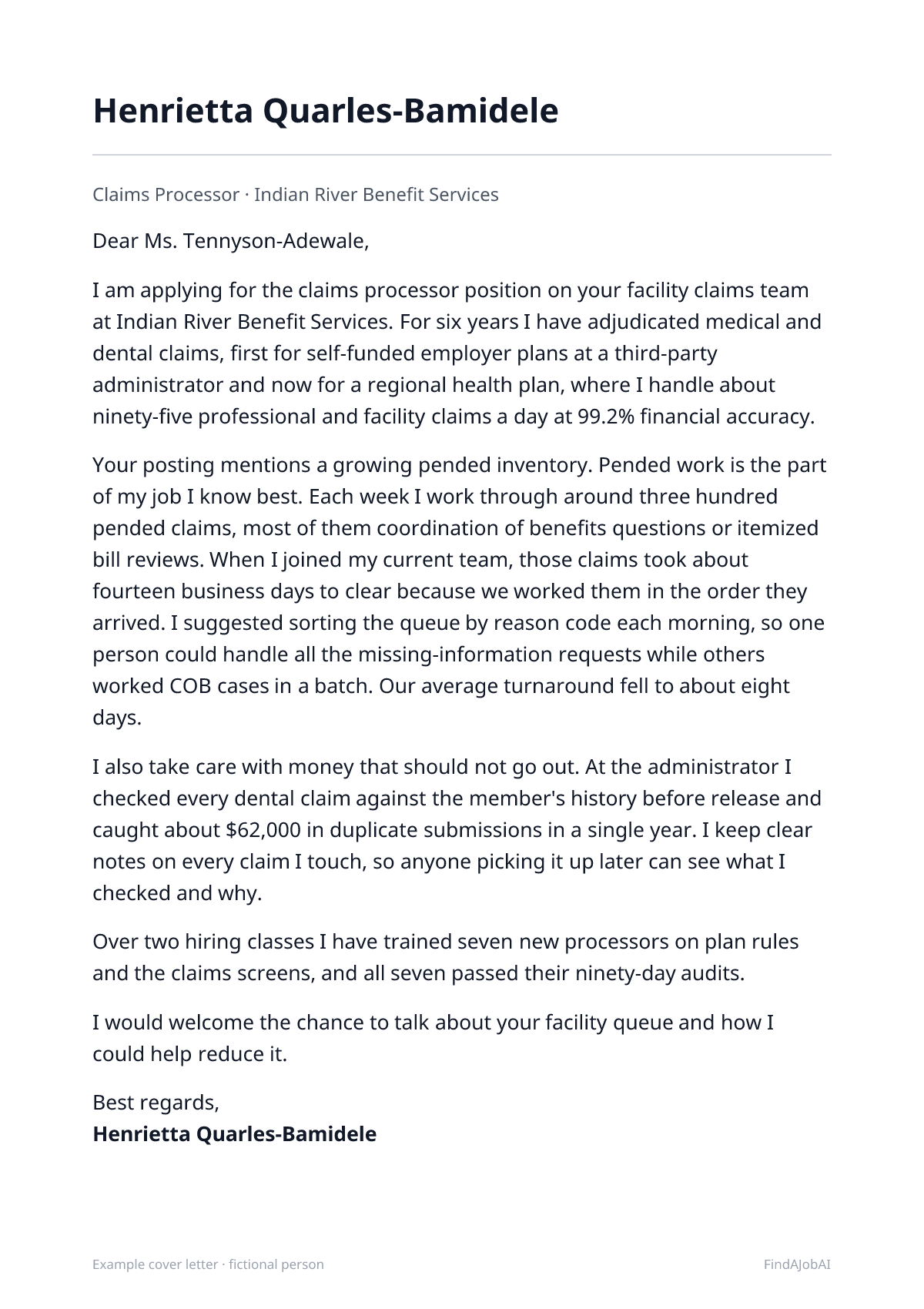
I am applying for the claims processor position on your facility claims team at Indian River Benefit Services. For six years I have adjudicated medical and dental claims, first for self-funded employer plans at a third-party administrator and now for a regional health plan, where I handle about ninety-five professional and facility claims a day at 99.2% financial accuracy.
Your posting mentions a growing pended inventory. Pended work is the part of my job I know best. Each week I work through around three hundred pended claims, most of them coordination of benefits questions or itemized bill reviews. When I joined my current team, those claims took about fourteen business days to clear because we worked them in the order they arrived. I suggested sorting the queue by reason code each morning, so one person could handle all the missing-information requests while others worked COB cases in a batch. Our average turnaround fell to about eight days.
I also take care with money that should not go out. At the administrator I checked every dental claim against the member's history before release and caught about $62,000 in duplicate submissions in a single year. I keep clear notes on every claim I touch, so anyone picking it up later can see what I checked and why.
Over two hiring classes I have trained seven new processors on plan rules and the claims screens, and all seven passed their ninety-day audits.
I would welcome the chance to talk about your facility queue and how I could help reduce it.
Best regards,
Henrietta Quarles-Bamidele
Example 2 · Entry level
Insurance call center representative applying for a first claims role
Florentyna has answered health insurance member calls for three years with a 97% quality score and recently finished a coding basics course.
Example letter · fictional
Dear Mr. Ravenscroft-Ozumba,
I am writing to apply for the claims processor trainee role at Ellendale Mutual Health Cooperative. For three years I have answered member calls at a health insurance service center, and the questions I enjoy most are the ones about why a claim paid the way it did. I would like to move from explaining claims to processing them.
On a typical day I take about sixty calls on benefits, deductibles and claim status, and I explain around forty explanation of benefits statements a week in plain language. When a claim looks wrong, I send a reprocessing request to the claims team. I learned early that a vague request comes back to me, so I always include the member's question, the claim lines involved and what the plan document says. The claims supervisor once told my manager that my requests were the easiest ones to work.
Quality matters in our center, and every month a sample of my calls is audited. My average score across thirty-six audits is 97%. Before this role I worked as a temporary data entry clerk, entering about four hundred forms a day at 99.5% accuracy on double-entry checks, so I am used to steady volume where small mistakes count.
To prepare for claims work, I completed a ten-week medical terminology and coding basics course this year, covering CPT and ICD-10-CM codes. I know I still have a lot to learn about adjudication rules, and your six-week trainee program is the reason this role appeals to me.
I would be grateful for the chance to interview and to complete any skills test you use.
Sincerely,
Florentyna Oduya-Penhaligon
Example 3 · Senior or lead
Claims team lead applying for a claims supervisor role
Augustin leads 11 processors handling about 1,000 claims a day. A health plan wants a supervisor to fix accuracy and an aging pended inventory.
Example letter · fictional
Dear Ms. Galbraith-Onyekachi,
I would like to be considered for the claims supervisor position at Hearns Pond Community Health Plan. I have worked in health claims for thirteen years, and for the last seven I have led a team of eleven processors who handle about one thousand professional and facility claims a day.
Your posting mentions two challenges I have faced directly: accuracy that has slipped below target and a pended inventory that keeps aging. When I took over my team, financial accuracy was around 97.5%, and most errors came from a small number of benefit rules that had changed. I began reviewing audit findings with each processor every week, in a short one-to-one rather than an email, and I wrote or updated twenty-six procedures so the rules were clear in one place. Team accuracy has stayed above 99% for three years.
The pended inventory needed a different fix. Claims older than thirty days had grown to about 2,400, mainly because everyone worked the newest items first. I built a daily queue plan that set aside time each morning for the oldest claims and assigned each pend reason to the person who knew it best. Within five months the aged inventory was down to about six hundred and has stayed near that level.
Before leading the team I spent five years as a claims examiner on complex and high-dollar claims, so I can still step into difficult cases and coach processors through them.
I would value the chance to discuss your current audit results and what a first ninety days could look like.
Kind regards,
Augustin Velarde-Kowalczyk
All three letters, and the short version below, are fictional: the people, employers and numbers are invented. Borrow the structure, never the facts.
- Prefer to write it yourself? Use the free cover letter template.
- Check your CV against the job first: the free CV score shows the missing keywords.
Why the first letter works, paragraph by paragraph
Paragraph 1: Opening
Names the claim types, the payers and daily volume with an audited accuracy figure.
Paragraph 2: Pended claims story
Answers the backlog mentioned in the posting with a queue change and a turnaround result.
Paragraph 3: Protecting money
Shows careful review with a dollar figure for duplicates caught before payment.
Paragraph 4: Training line
Adds value beyond personal volume with new hires who passed their audits.
Paragraph 5: Close
Links back to the employer's queue, which keeps the letter focused on their need.
What the entry-level letter does differently
The entry-level letter turns call center work into claims evidence: reprocessing requests, explanation of benefits questions and audited quality scores. Mentioning a coding course and the trainee program shows the writer has a realistic plan to learn.
What the senior letter does differently
This senior letter matches the two problems in the posting with two specific fixes and results. Weekly audit reviews and the queue plan show management habits, and the examiner background reassures the reader that the lead can still handle hard claims.
Short claims processor cover letter: an email-ready version
Many applications arrive as an email or a small text box, and a full page doesn't fit. This version runs 120 to 150 words and keeps only what a reader needs to decide whether to reply. A processor replies on an insurance jobs board to a recruiter who asked candidates for a short email and their audited accuracy.
Short version · email · fictional124 words
Subject: Claims Processor – 4 yrs auto claims, 98.9% audited accuracy – Philippa Nwachukwu-Brannagh
Hi Mr. Lindqvist-Obuya,
I saw your post for a claims processor at Rehoboth Bayside Auto Insurance and would like to apply. For four years I have processed auto physical damage and rental claims, about seventy a day, with 98.9% accuracy in my last four quarterly audits.
I set up new claims from first notice of loss, check coverage and deductibles, request repair estimates and photos, and issue payments once adjusters approve them. I also keep files complete for subrogation, so recovery staff rarely need to come back to me.
My current manager knows I am looking, and I am available to start in two weeks. Could we arrange a short call this week to talk about your team and claim volumes?
Thanks,
Philippa Nwachukwu-Brannagh
Recruiters on insurance job boards look first for claim type, volume and accuracy. This email puts all three in the opening, adds a sentence on the full workflow and asks for a call.
Opening lines that work for claims processor cover letters
The first sentence decides whether the second gets read. Here are six openings, one for each situation you might be in. Pick the one that matches yours and swap in your own facts: every name and number below is invented.
1. You have a standout result
I adjudicate about ninety-five medical claims a day, and my last four quality audits came in at 99.2% financial accuracy.
2. The ad names a problem you've solved
Pended claims are the part of the job I know best, and your posting says your pended inventory is growing.
3. Someone referred you
Three years of explaining claims to members on the phone have made me want to process them myself.
4. You admire what they build
Over three years my team of eleven processors has kept financial accuracy above 99% while handling a thousand claims a day.
5. You're new to the field or switching into it
Cordelia Ashford-Nwosu, who audits claims on your dental team, suggested I apply for the open processor role.
6. You have senior scope or a specialism
Last year I caught about $62,000 in duplicate dental claims simply by checking each one against the member's history.
How to write a claims processor cover letter
Five steps, in the order you'd write them. The shape stays the same for every job (a short opening, proof, a reason for this employer, a close), and what goes into each part is what changes with the role.
Open with claim type, volume and accuracy
Say which claims you handle, for what kind of payer, how many a day and your audited accuracy. Claims supervisors compare these numbers with their own targets almost immediately, so giving them up front saves the reader time and builds trust.
Show how you handle the hard claims
Pick pended, COB, high-dollar or out-of-network claims and describe how you work them. A short example with a turnaround or backlog result shows judgment, which separates strong processors from people who only work clean claims.
Put a number on protected money
Mention duplicates, overpayments or coding errors you caught before payment, with an approximate dollar figure. It shows that your care has real value to the plan or insurer, not just a high score on a quality report.
Match the employer's claims
Read the posting for claim types, codes and systems, and connect your experience to them. If you are moving between medical, dental, auto or property claims, explain which skills carry over and what you are ready to learn.
Keep it short and error-free
A claims letter with a typo undercuts the accuracy you are selling. Keep it to one page, read it aloud and check names and numbers twice. Close by offering to take any skills or accuracy test the employer uses.
Claims Processor cover letter do's and don'ts
Do
- Give daily claim volume and audited accuracy in the first paragraph.
- Show how you handle pended, complex or high-dollar claims.
- Proofread with extra care, because accuracy is the job.
Don't
- Don't rely on the phrase detail-oriented without an audit figure.
- Don't leave out which claim types and codes you know.
- Don't send a long letter; supervisors read many applications quickly.
Common claims processor cover letter mistakes
Each one is easy to make and quick to fix before you send the letter.
Claiming accuracy without an audit figure
Give your audited financial or procedural accuracy and the period it covers.
Not naming the claim types you know
Say whether you process medical, dental, auto, property or workers' compensation claims.
Only describing clean, routine claims
Add an example of pended, COB or high-dollar work and how you resolved it.
Typos in a letter about accuracy
Proofread slowly, read it aloud and double-check every number and name.
A long letter that repeats the resume
Keep one or two examples with results and leave the full job list to the resume.
Email subject lines for claims processor applications
Applying by email? Put the job title, any reference number and your name in the subject line.
- Claims Processor – 6 yrs medical and dental, 99.2% accuracy – Henrietta Quarles-Bamidele
- Claims Processor Trainee – member services, coding basics course – Florentyna Oduya-Penhaligon
- Claims Supervisor – team of 11, 1,000 claims a day, 99% accuracy – Augustin Velarde-Kowalczyk
Everything for Claims Processors
- Claims Processor resume exampleA full resume, plus bullet and summary examples
- Claims Processor interview questions30 questions with sample answers
- Claims Processor job descriptionDuties, skills and requirements
- Cover letter with no experience: templates
Other cover letter examples
Claims Processor cover letter FAQ
What should a claims processor cover letter include?
The claim types you handle, daily volume, audited accuracy, how you work pended or complex claims, any coding knowledge and one example of catching an error or improving turnaround.
How do I write a claims processor cover letter with no claims experience?
Use related work such as insurance customer service, billing or data entry. Give volume and accuracy numbers, mention any coding or insurance course and say you are ready for a skills test.
How long should a claims processor cover letter be?
About 260 to 320 words. Keep it to one page with an opening, one or two examples with numbers, a line on accuracy and a short close.
How we built this page
The FindAJobAI team wrote the three example letters, the short email version, the opening lines and the advice for claims processor roles. The people, employers and numbers in the letters are invented; the structure, the kind of evidence and the order of the paragraphs are the parts to copy.
Once we track enough live claims processor job ads, this page also shows the skills they ask for most, counted the same way as our in-demand skills report.
Last reviewed on November 1, 2026.