Construction Manager Cover Letter Example (2026)
By FindAJobAI team Updated How we built this page
Construction manager ads care about one thing above credentials: whether you bring jobs in on schedule and on budget. The cover letter should read like a short project report, naming the job, the problem that threatened it, and the number that proves you fixed it.
Construction Manager cover letter template
This letter as a one-page template: an opening that names the job and your strongest fact, proof that answers the ad, a reason for this employer and a short close.
After you sign up, FindAJobAI drafts your own letter for a real job from your CV in this format, and you edit it before you send it.
Example 1 · Experienced
commercial superintendent applying to a general contractor
Lloyd runs multi-trade commercial jobs for a regional contractor. The ad asks for someone who can manage subcontractors and keep a tight schedule.
Example letter · fictional
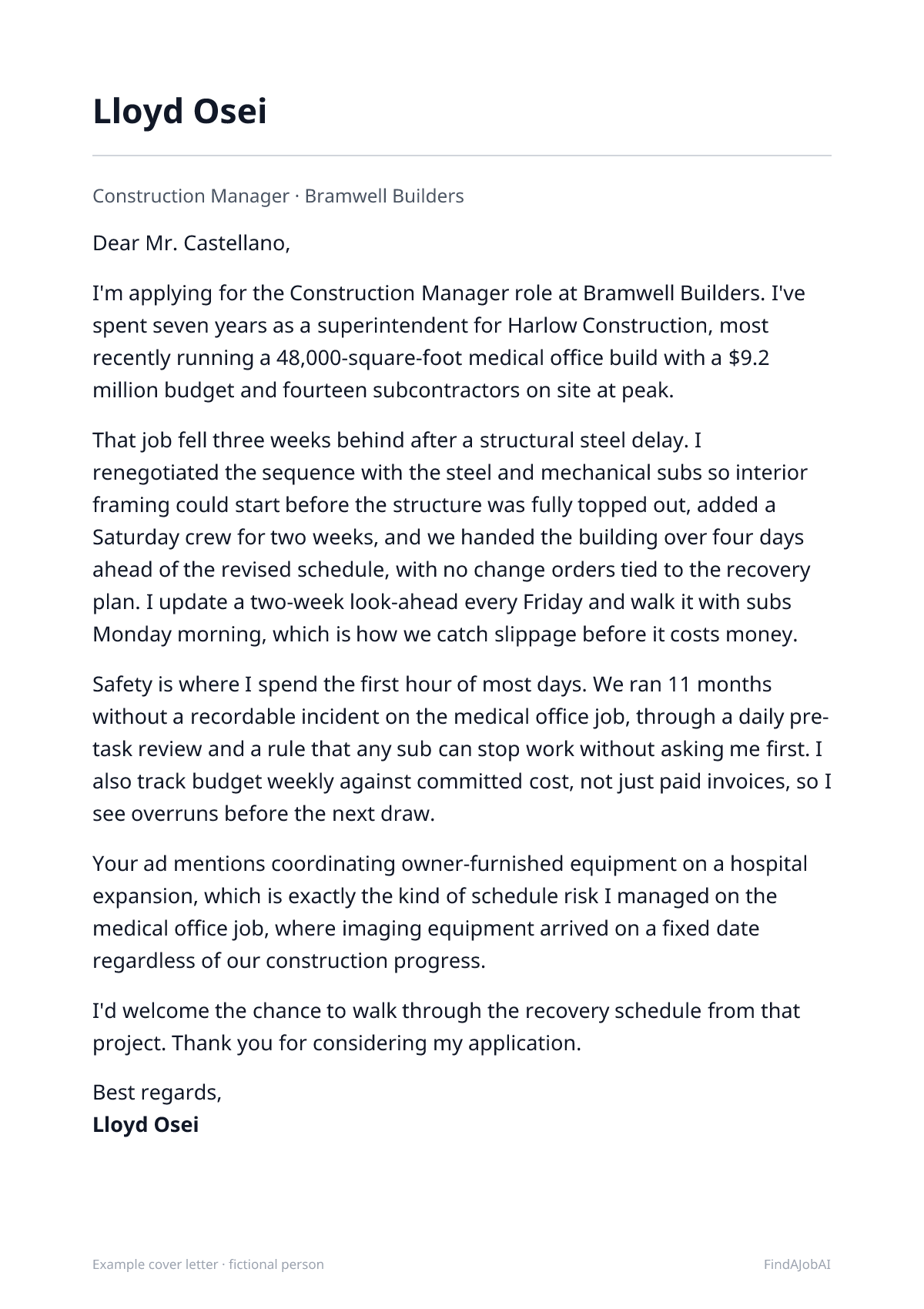
Dear Mr. Castellano,
I'm applying for the Construction Manager role at Bramwell Builders. I've spent seven years as a superintendent for Harlow Construction, most recently running a 48,000-square-foot medical office build with a $9.2 million budget and fourteen subcontractors on site at peak.
That job fell three weeks behind after a structural steel delay. I renegotiated the sequence with the steel and mechanical subs so interior framing could start before the structure was fully topped out, added a Saturday crew for two weeks, and we handed the building over four days ahead of the revised schedule, with no change orders tied to the recovery plan. I update a two-week look-ahead every Friday and walk it with subs Monday morning, which is how we catch slippage before it costs money.
Safety is where I spend the first hour of most days. We ran 11 months without a recordable incident on the medical office job, through a daily pre-task review and a rule that any sub can stop work without asking me first. I also track budget weekly against committed cost, not just paid invoices, so I see overruns before the next draw.
Your ad mentions coordinating owner-furnished equipment on a hospital expansion, which is exactly the kind of schedule risk I managed on the medical office job, where imaging equipment arrived on a fixed date regardless of our construction progress.
I'd welcome the chance to walk through the recovery schedule from that project. Thank you for considering my application.
Best regards,
Lloyd Osei
Example 2 · Career changer
lead carpenter moving into construction management
Haruka has run crews and coordinated subs informally for years without the title. The ad mentions residential and light commercial work.
Example letter · fictional
Dear Hiring Manager,
I'm applying for the Assistant Construction Manager role at Thornridge Development. For six years I've worked as a lead carpenter for a custom home builder, and for the last two I've effectively run our jobsites: scheduling subs, walking inspections and keeping owners updated, without holding the manager title.
Last year our framing crew was double-booked across two houses because nobody was tracking sub availability against the master schedule. I built a shared calendar in Excel that every trade foreman could see, added two-week look-aheads, and we finished both houses within five days of each other's original completion dates, down from a typical three-week spread. The owner now asks me to run that calendar on every active job.
I hold an OSHA 30 card, have passed city building and electrical inspections without a failed re-inspection in two years, and I'm currently working toward my general contractor's license. I read plans and specs fluently and know where framing, MEP and finish trades typically collide.
Your posting mentions residential and light commercial work, which is where I've spent my career, and the chance to formalize the scheduling and sub-coordination work I've already been doing is what draws me to this role. Walking a site each morning with a short list of what has to be finished before the next trade arrives is the habit I'd bring first, and I would write that list down so the whole crew can see it.
Thank you for your time. I'd welcome a walkthrough of a current jobsite if that's useful.
Kind regards,
Haruka Pruitt
Example 3 · Senior or lead
senior project executive applying to lead a regional construction division
Walter oversees six projects for a mid-size GC. The ad is for a project executive to manage a portfolio and build out a project management bench.
Example letter · fictional
Dear Ms. Delacroix,
I'm applying for the Senior Project Executive role at Marrow & Vance Construction. For the past four years I've managed a portfolio of five to six concurrent commercial projects for Haskell Regional, worth roughly $60 million combined, overseeing four project managers and reporting directly to the VP of operations.
Your ad notes that project managers are inconsistent in how they forecast cost to completion, which was true at Haskell when I started. I built a standard cost-to-complete template tied to our ERP's committed-cost data, trained the PM team to update it biweekly, and required variance explanations over 3%. Our portfolio-wide cost overruns fell from an average of 6% to under 2% across eight quarters, and two PMs who struggled with forecasting became the most accurate on the team.
Portfolios earn their margin in the projects nobody is watching closely. A warehouse buildout that looked routine was quietly absorbing a subcontractor's pricing error on concrete; I caught it in a monthly portfolio review, we renegotiated before the pour, and it saved roughly $180,000 that would otherwise have surfaced as a change order fight after the fact.
I've hired and mentored three project managers into their roles, but I haven't yet built a PM bench from the ground up at the scale your ad describes, nor worked directly with a preconstruction estimating team; both are areas I'd want to set up deliberately with your existing leads.
I'd like to talk through which two or three projects in your current portfolio concern you most, and how your PMs currently report cost and schedule risk upward.
Sincerely,
Walter Kowalski
All three letters, and the short version below, are fictional: the people, employers and numbers are invented. Borrow the structure, never the facts.
- Prefer to write it yourself? Use the free cover letter template.
- Check your CV against the job first: the free CV score shows the missing keywords.
Why the first letter works, paragraph by paragraph
Paragraph 1: Opening
Names the project size, budget and trade count up front. Construction hiring managers size up a candidate by the scale of job they've run, not just years of title.
Paragraph 2: The schedule recovery
A specific delay, the fix (resequencing trades, added shifts), and the measurable outcome (four days ahead, no change orders) show judgment under pressure, which is the core of the job.
Paragraph 3: Safety and budget discipline
A concrete safety record and a budget-tracking habit (committed cost vs. paid invoices) answer the two questions every GC asks before trusting someone with a jobsite.
Paragraph 4: Why this company
Connects the ad's specific risk (owner-furnished equipment on a fixed date) to a directly comparable problem the writer already solved.
Paragraph 5: Close
Offers a concrete, verifiable artifact, the recovery schedule, rather than a generic offer to discuss further.
What the career changer's letter does differently
The career changer's letter starts from informal management work done without the title, with a measurable scheduling fix (a five-day spread instead of three weeks) and names the specific credentials (OSHA 30, inspection record, GC license in progress) that make the step up credible rather than aspirational.
What the senior letter does differently
A project executive letter reports portfolio-level habits: a standard cost-to-complete template, overruns down from 6 percent to under 2 percent across quarters, a caught pricing error worth a specific dollar figure. The gap, building a PM bench from scratch and working with preconstruction, is named directly rather than glossed over.
Short construction manager cover letter: an email-ready version
Many applications arrive as an email or a small text box, and a full page doesn't fit. This version runs 120 to 150 words and keeps only what a reader needs to decide whether to reply. A construction manager answers a hospital system's facilities department posting by email after the recruiter asked for a short note instead of a full letter.
Short version · email · fictional127 words
Subject: Construction Manager (healthcare TI) – $14M renovation – Felix Haroun
Hello Mr. Sutcliffe,
I'm applying for the Construction Manager role at Abernathy Health. I've managed healthcare tenant improvement projects for five years, most recently a $14 million occupied-hospital renovation that required phased work around active patient floors.
The hardest part of that job was infection control during demolition near an ICU. I worked with the hospital's facilities team to build a negative-air containment plan and a strict after-hours demo schedule, and we completed the phase with zero infection control violations and no disruption to ICU operations.
Occupied healthcare work is where I'd like to keep building my career, and I understand the coordination it demands with clinical staff. My resume is attached, and I'm glad to walk through the containment plan in more detail.
Best,
Felix Haroun
A short email keeps one project (the dollar figure and the occupied-hospital constraint) and the single hardest problem it posed, cutting the broader career history. Naming zero infection control violations is a compact, checkable proof point rather than a vague claim of success.
Opening lines that work for construction manager cover letters
The first sentence decides whether the second gets read. Here are six openings, one for each situation you might be in. Pick the one that matches yours and swap in your own facts: every name and number below is invented.
1. You have a standout result
On my last project, a steel delay threatened to push a $9 million medical office three weeks behind. I resequenced the trade schedule and we handed the building over four days ahead of the recovery plan.
2. The ad names a problem you've solved
Your ad mentions coordinating owner-furnished equipment on a fixed delivery date. I managed that exact risk on a hospital imaging suite, where the scanner arrived regardless of our construction progress.
3. Someone referred you
Your superintendent, Marcus Webb, and I worked together on a retail buildout two years ago. He mentioned your team needs someone who can manage subs directly, which is most of what I do.
4. You admire what they build
I toured the building your firm renovated on Fifth Street last year and was struck by how the phasing kept the ground-floor tenants operating; I'd like to help plan work like that.
5. You're new to the field or switching into it
I spent six years as a lead carpenter running jobsites informally, scheduling subs and walking inspections without the title. Construction management is the formal version of work I'm already doing.
6. You have senior scope or a specialism
As a project executive managing a $60 million portfolio, I built the cost-forecasting process my division still uses. I'm looking for a role that extends that discipline across a larger team.
How to write a construction manager cover letter
Five steps, in the order you'd write them. The shape stays the same for every job (a short opening, proof, a reason for this employer, a close), and what goes into each part is what changes with the role.
Lead with the project's scale
State the project type, square footage or unit count, and budget in your first paragraph. A reviewer sizes you up by the scale of job you've run before reading anything else, so put that number where it will be seen first.
Describe one schedule or budget threat and how you fixed it
Pick a delay, a cost overrun, or a sequencing conflict that genuinely put the job at risk. Explain what you changed, resequencing, added shifts, a renegotiated sub scope, and the measurable outcome: days recovered, dollars saved, or the overrun percentage avoided.
Name your safety and budget tracking habits
Mention a specific safety record or practice (an incident-free streak, a stop-work policy) and how you track cost, such as committed cost versus paid invoices. These habits are what hiring managers check for before they trust someone with a site.
Match the ad's project type and risks
A hospital renovation, a ground-up retail build, and a tenant improvement job carry different risks: infection control, public access, or lease deadlines. Pull the risk the ad implies and show you've managed something comparable. Name the risk in plain language.
Close with a verifiable offer
Offer to walk through a schedule, a recovery plan, or a specific jobsite rather than a generic invitation to talk. It signals the work you're describing is real and documented. Offer only what you can really show and are allowed to share.
Construction Manager cover letter do's and don'ts
Do
- Name the project size (square footage, budget, trade count) so the reader can place you on the right scale of job.
- Describe one schedule or budget problem, what you did about it, and the number that proves it worked.
- Mention your safety record and how you track budget, since both are first questions in construction hiring.
Don't
- Don't just list every trade you've coordinated; show the coordination working through one real conflict.
- Don't claim a project finished early or on budget without saying what specifically you changed to make that happen.
- Don't omit licenses, certifications (OSHA, GC license) or software (Procore, Bluebeam) the ad specifically names.
Common construction manager cover letter mistakes
Each one is easy to make and quick to fix before you send the letter.
Listing every trade or project type you've touched
A long list of trades coordinated or project types managed reads as breadth without depth. Pick the one project most like the job you're applying for and go deep on a single problem from it.
Claiming an on-time, on-budget finish with no detail
'Delivered on schedule and under budget' is what every applicant writes. Name the specific threat to the schedule or budget and the decision you made that kept it on track.
Leaving out project scale
Without square footage, budget or unit count, a reviewer can't tell if you've run a $500,000 remodel or a $50 million build. State the number plainly in your first or second sentence.
Treating safety as a line item instead of a habit
'Safety is my top priority' is filler. Name a specific incident-free streak, a daily practice, or a policy (like stop-work authority for any trade) that shows how safety actually gets managed on your sites.
Skipping the software and certifications the ad names
If the ad specifies Procore, Bluebeam, or a particular license, mention your experience with it directly tied to a task, not as a standalone skills list.
Email subject lines for construction manager applications
Applying by email? Put the job title, any reference number and your name in the subject line.
- Construction Manager application – commercial superintendent, $9.2M medical office – Lloyd Osei
- Assistant Construction Manager – lead carpenter transitioning to management – Haruka Pruitt
- Application: Construction Manager, Hospital Expansion (Req. 4417) – Lloyd Osei
Everything for Construction Managers
- Construction Manager resume exampleA full resume, plus bullet and summary examples
- Construction Manager interview questions30 questions with sample answers
- Construction Manager job descriptionDuties, skills and requirements
- Career change cover letter: template + examples
Other cover letter examples
Construction Manager cover letter FAQ
What should I write in a construction manager cover letter?
One project with its size and budget, one schedule or budget problem you solved on it, and the measurable outcome. Add your safety record and how you track cost. Your certifications belong on your resume, not repeated at length in the letter.
How do I write a construction manager cover letter with no formal management title?
Use informal coordination work you've already done, scheduling subs, running look-aheads, walking inspections, and give it a measurable result. Name certifications like OSHA 30 and any licensing progress to show the step up is deliberate.
Should a construction manager cover letter mention safety record?
Yes, briefly. A specific incident-free streak or a concrete safety habit (daily pre-task review, stop-work authority) answers a question every hiring GC has before they ask it.
How we built this page
The FindAJobAI team wrote the three example letters, the short email version, the opening lines and the advice for construction manager roles. The people, employers and numbers in the letters are invented; the structure, the kind of evidence and the order of the paragraphs are the parts to copy.
Once we track enough live construction manager job ads, this page also shows the skills they ask for most, counted the same way as our in-demand skills report.
Last reviewed on November 1, 2026.