Project Engineer Cover Letter Example (2026)
By FindAJobAI team Updated How we built this page
Project engineer ads describe the job as the link between design, the field and the schedule, so your letter should name an RFI, a submittal or a schedule conflict you actually resolved, not a general claim about being organized or detail-oriented.
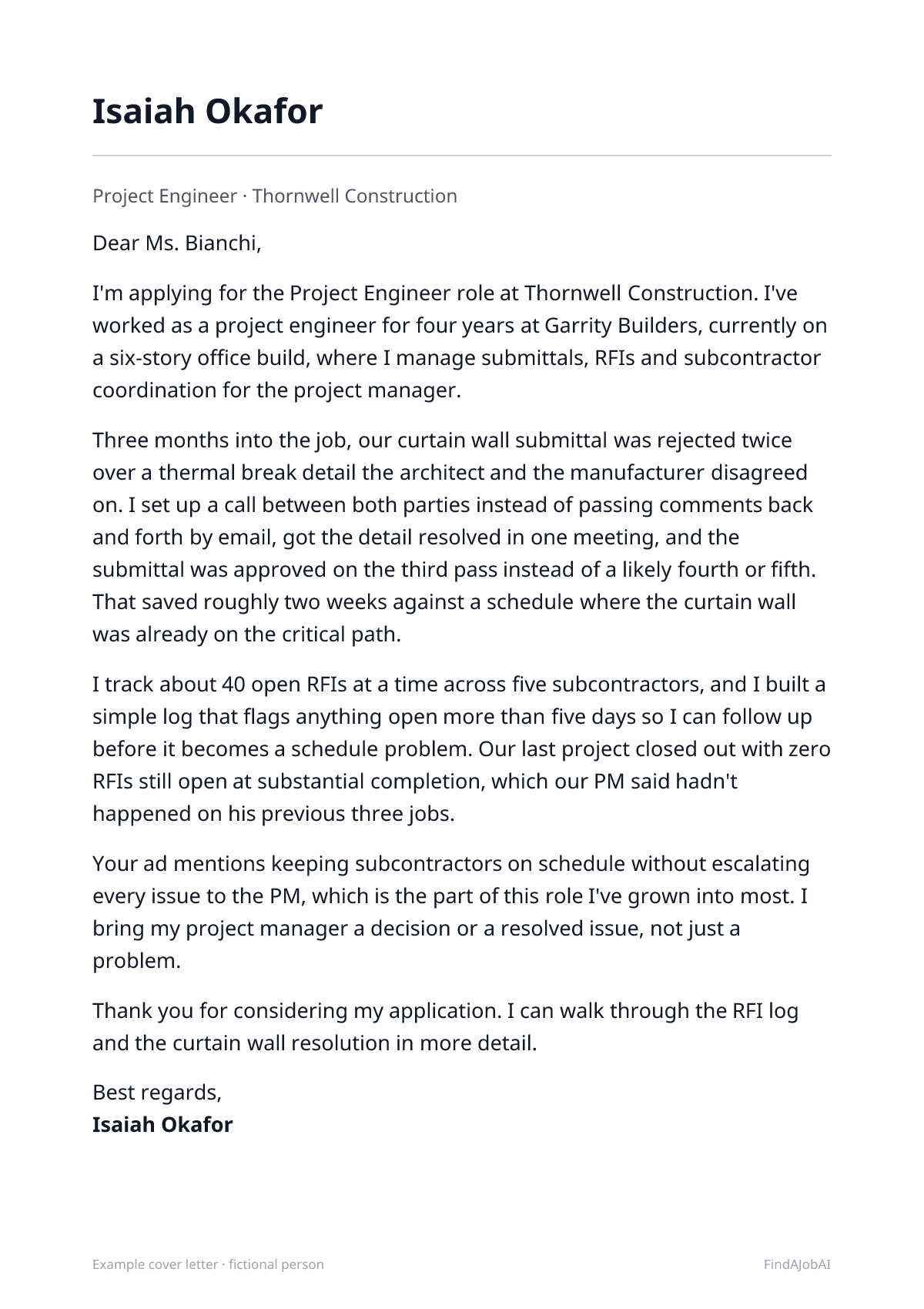
Project Engineer cover letter template
This letter as a one-page template: an opening that names the job and your strongest fact, proof that answers the ad, a reason for this employer and a short close.
After you sign up, FindAJobAI drafts your own letter for a real job from your CV in this format, and you edit it before you send it.
Example 1 · Experienced
Commercial construction project engineer applying to a general contractor
Isaiah manages submittals and RFIs on a mid-rise office build. The ad asks for someone who keeps subcontractors on schedule without constant escalation.
Example letter · fictional
Dear Ms. Bianchi,
I'm applying for the Project Engineer role at Thornwell Construction. I've worked as a project engineer for four years at Garrity Builders, currently on a six-story office build, where I manage submittals, RFIs and subcontractor coordination for the project manager.
Three months into the job, our curtain wall submittal was rejected twice over a thermal break detail the architect and the manufacturer disagreed on. I set up a call between both parties instead of passing comments back and forth by email, got the detail resolved in one meeting, and the submittal was approved on the third pass instead of a likely fourth or fifth. That saved roughly two weeks against a schedule where the curtain wall was already on the critical path.
I track about 40 open RFIs at a time across five subcontractors, and I built a simple log that flags anything open more than five days so I can follow up before it becomes a schedule problem. Our last project closed out with zero RFIs still open at substantial completion, which our PM said hadn't happened on his previous three jobs.
Your ad mentions keeping subcontractors on schedule without escalating every issue to the PM, which is the part of this role I've grown into most. I bring my project manager a decision or a resolved issue, not just a problem.
Thank you for considering my application. I can walk through the RFI log and the curtain wall resolution in more detail.
Best regards,
Isaiah Okafor
Example 2 · Entry level
Field engineer stepping up to project engineer
Natalie has handled layout and quality control in the field for two years. The ad wants someone comfortable with both the field and submittals.
Example letter · fictional
Dear Hiring Manager,
I'm applying for the Project Engineer role at Birchfield Commercial. For two years I've worked as a field engineer at Castellan General Contractors, handling layout, quality control inspections and daily reports on a retail construction project, and I'm ready to take on more of the submittal and scheduling side of the work.
Six months ago our concrete subcontractor poured a footing two inches out of tolerance because the layout stakes had been disturbed by another trade. I caught it during my routine QC check before the pour cured past the point it could be addressed cheaply, documented it with photos and survey data, and worked with the structural engineer on an approved repair instead of a full demo and repour. The fix cost about $3,000 against an estimated $40,000 for a repour and schedule delay.
Since then I've started shadowing our project engineer on submittal reviews and RFI responses, and I've taken over tracking submittals for two trade packages on my own, with his review before anything goes out. I'm comfortable in Procore and Bluebeam, and I read drawings and specs carefully enough to catch conflicts before they reach the field.
Your posting wants someone equally comfortable in the field and on submittals, which is exactly the move I've been making, from catching problems on the ground to preventing them on paper before they get there.
Thank you for your time. I'd welcome the chance to discuss the footing issue and how I've been building toward this role.
Kind regards,
Natalie Reyes
Example 3 · Senior or lead
Senior project engineer applying to run a multi-site program
Marcus oversees project engineers on three builds for a regional contractor. The ad is for a senior engineer to standardize submittals and RFIs.
Example letter · fictional
Dear Mr. Castellanos,
I'm applying for the Senior Project Engineer role at Haverford Regional Construction. For the last three years I've overseen project engineers across three concurrent commercial builds at Ashgrove Contracting, and before that spent five years as a project engineer on single sites. I'd like to bring that multi-site experience to a role explicitly built around standardizing process.
Your ad says each site handles submittals differently, which makes it hard to see where a project is falling behind until it's late. We had the same problem at Ashgrove. I built one submittal log template and one RFI escalation rule, open more than seven days triggers a call, not another email, and required every site's project engineer to use both. Average submittal turnaround across our three sites fell from 19 days to 11, and for the first time I could compare sites against each other in a Monday review instead of taking each PE's word for how things stood.
Standardizing a process still has to survive contact with an actual site. On one build, the new escalation rule surfaced a mechanical submittal stuck with an unresponsive subcontractor for 12 days; a single call from our site PE got it resolved in two, avoiding what would have been a two-week slip on rough-in. That case became the example I use to train new project engineers on the rule.
I've trained four project engineers on these templates and rules, and I review their logs weekly rather than daily, which I think is the right level of oversight once someone's trained. I haven't managed a program with subcontractor prequalification or a formal change order process, and at Haverford I'd want to learn how those currently work before suggesting changes.
I'd welcome a conversation about which of your sites is furthest behind and why, since that's usually where a standard process pays off first.
Sincerely,
Marcus Donahue
All three letters, and the short version below, are fictional: the people, employers and numbers are invented. Borrow the structure, never the facts.
- Prefer to write it yourself? Use the free cover letter template.
- Check your CV against the job first: the free CV score shows the missing keywords.
Why the first letter works, paragraph by paragraph
Paragraph 1: Opening
Names the project type (a six-story office build) and the exact responsibilities (submittals, RFIs, subcontractor coordination) the ad is likely screening for.
Paragraph 2: The conflict resolved
Names a specific rejected submittal, the disagreement behind it, the writer's intervention and a schedule result (two weeks saved) rather than a vague claim about problem-solving.
Paragraph 3: Systems and follow-through
The RFI log and a zero-open-RFI closeout are concrete, checkable claims that show organization without using the word 'organized.'
Paragraph 4: Why this company
Directly answers the ad's stated concern (escalation to the PM) with a sentence that reframes the writer's habit as the solution.
Paragraph 5: Close
Offers to walk through specific artifacts, the RFI log and the curtain wall resolution, which gives the reader something concrete to ask about in an interview.
What the entry-level letter does differently
The field engineer's letter starts from a quality catch in the field with a dollar amount avoided (a $3,000 fix against a $40,000 repour), which proves judgment before the title changes. Shadowing the project engineer and already owning two trade packages' submittals show the move to the role is underway, and naming Procore and Bluebeam answers the ad's tool requirements without a bare list.
What the senior letter does differently
A senior project engineer letter reports what changed across multiple sites, not one: a shared submittal log, an escalation rule, turnaround down from 19 to 11 days, sites that can finally be compared. The mechanical submittal example shows the standard surviving contact with a real site, and the gap, no experience with prequalification or change orders, is named rather than glossed over.
Short project engineer cover letter: an email-ready version
Many applications arrive as an email or a small text box, and a full page doesn't fit. This version runs 120 to 150 words and keeps only what a reader needs to decide whether to reply. A project engineer answers a healthcare construction firm's short application question after seeing the posting on a specialty contractor job board.
Short version · email · fictional125 words
Subject: Project Engineer (healthcare construction, Procore) – Rosa Lindqvist
Hello Mr. Abara,
I'm applying for the Project Engineer role at Caldwell Medical Builders. I've spent three years as a project engineer on hospital renovation projects, where infection control and phasing make even routine submittals more complicated than standard commercial work.
On my current project, a mislabeled fire-rated wall submittal almost went out approved for the wrong assembly type. I caught the discrepancy against the life safety drawings before it reached the field, which avoided a likely stop-work order from the authority having jurisdiction and an estimated two-week delay.
Healthcare projects reward exactly that kind of double-checking, and I'd like to bring it to Caldwell. My resume is attached, and I'm glad to discuss the submittal process I use on occupied-hospital work.
Best,
Rosa Lindqvist
A specialty job board posting gets a letter that stays short but names the one thing that makes this sector different, phasing and life safety review, and backs it with a single caught error rather than a general claim about attention to detail.
Opening lines that work for project engineer cover letters
The first sentence decides whether the second gets read. Here are six openings, one for each situation you might be in. Pick the one that matches yours and swap in your own facts: every name and number below is invented.
1. You have a standout result
Last year I caught a mislabeled fire-rated wall submittal before it reached the field, avoiding a likely stop-work order and a two-week delay. I'd like to bring that kind of review to your team.
2. The ad names a problem you've solved
Your ad says submittal turnaround is inconsistent across sites. At my current company I built one shared log and escalation rule, and average turnaround fell from 19 days to 11.
3. Someone referred you
Your superintendent, Hannah Okonkwo, and I worked together on a retail buildout last year, from the project engineering side. She mentioned your team needed someone who keeps subcontractors moving without constant escalation, which prompted this application.
4. You admire what they build
I've watched your firm's hospital expansion rise from the parking garage next door for the past year and read about the phasing challenges with real interest; I'd like to help manage a project like that.
5. You're new to the field or switching into it
I worked two years as a field engineer, handling layout and QC, before moving toward the submittal and scheduling side of the job. Project engineering is where I want to keep solving problems from both sides.
6. You have senior scope or a specialism
As the project engineer managing RFIs and submittals across three concurrent sites for three years, I built the escalation rules my company still uses. I'm looking for a role where I set that kind of standard at a larger scale.
How to write a project engineer cover letter
Five steps, in the order you'd write them. The shape stays the same for every job (a short opening, proof, a reason for this employer, a close), and what goes into each part is what changes with the role.
Identify which side of the role the ad is weighted toward
Some project engineer postings lean toward field coordination, others toward submittals and documentation, others toward scheduling. Read for which problems the ad names, then choose an example from your own work that answers that specific weighting.
Open with the conflict, not the project description
Name the rejected submittal, the disputed RFI or the schedule clash before naming the building or client. A reader who sees a real conflict and its resolution in your first paragraph trusts the rest of your examples more.
Quantify time or money, not activity
Say how many days were saved, what a delay would have cost, or how a metric like RFI turnaround changed. Avoid counting submittals processed or RFIs answered as if volume alone were the achievement. Use one figure from a real job.
Show you work both the field and the office
Project engineers sit between design intent and field execution, so include one example from each side if you can: a field catch and a document review. This answers the most common concern in these ads before it's asked.
Name the software inside a specific task
Mention Procore, Bluebeam, Primavera P6 or similar tools attached to what you tracked or built in them, such as a submittal log or an RFI dashboard. Close with a question about how their current site or program handles that same task.
Project Engineer cover letter do's and don'ts
Do
- Name a specific RFI, submittal or schedule conflict you resolved, with what caused it and how you fixed it.
- Give a number tied to the result: days saved, dollars avoided, RFIs closed, not just 'improved efficiency.'
- Mention the field and the office both; the role usually sits between them, so show you've worked both sides.
Don't
- Don't describe yourself as 'detail-oriented' or 'a strong communicator' without an example attached.
- Don't claim PM-level authority you didn't have; be precise about what you decided versus what you recommended.
- Don't list every software tool (Procore, Bluebeam, P6, Excel) without tying at least one to what you actually did in it.
Common project engineer cover letter mistakes
Each one is easy to make and quick to fix before you send the letter.
Claiming organization without proof
'Highly organized and detail-oriented' is what every applicant writes. Describe the log, checklist or follow-up system you actually built and the result it produced, such as zero open RFIs at closeout.
Counting submittals or RFIs instead of naming the hard one
'Processed 200 submittals' says nothing about your judgment. Pick the one that was rejected, disputed or nearly missed, and describe how you resolved it.
Blurring project engineer and project manager roles
Claiming you 'managed the budget' when you tracked costs for the PM overstates your role. Be precise about what you decided versus what you flagged or recommended; interviewers will probe this distinction.
Leaving out the field side entirely
A letter that's all submittals and RFIs can read like a desk job description. Add one example of being on site, catching a layout or quality issue, to show you understand what the paperwork is actually protecting.
Treating software proficiency as an achievement
'Proficient in Procore and Bluebeam' belongs on the resume. In the letter, attach one of them to a specific task you used it for, such as building an RFI log that flagged items open past five days.
Email subject lines for project engineer applications
Applying by email? Put the job title, any reference number and your name in the subject line.
- Project Engineer application – submittals, RFIs and subcontractor coordination – Isaiah Okafor
- Project Engineer – field engineer transitioning, QC and layout background – Natalie Reyes
- Application: Project Engineer, Commercial Division (Req. 3087) – Isaiah Okafor
Everything for Project Engineers
- Project Engineer resume exampleA full resume, plus bullet and summary examples
- Project Engineer interview questions30 questions with sample answers
- Project Engineer job descriptionDuties, skills and requirements
- Cover letter with no experience: templates
Other cover letter examples
Project Engineer cover letter FAQ
What should I write in a project engineer cover letter?
One specific RFI, submittal or schedule conflict you resolved, how you resolved it, and the time or money it saved. Add a sentence on how you work with both the field and the office, since that's usually the core of the role.
How do I write a project engineer cover letter with no construction experience?
Use whatever you have, an internship, a field engineer or intern role, or coursework with a construction management component, and describe a specific problem you helped solve, such as a layout error or a scheduling conflict, even a small one.
Should a project engineer cover letter mention software like Procore or Bluebeam?
Yes, if the ad names them, but attach the tool to something you did with it, such as tracking 40 open RFIs in a log, rather than listing it alongside other software with no context.
How we built this page
The FindAJobAI team wrote the three example letters, the short email version, the opening lines and the advice for project engineer roles. The people, employers and numbers in the letters are invented; the structure, the kind of evidence and the order of the paragraphs are the parts to copy.
Once we track enough live project engineer job ads, this page also shows the skills they ask for most, counted the same way as our in-demand skills report.
Last reviewed on November 1, 2026.