Cybersecurity Analyst Cover Letter Example (2026)
By FindAJobAI team Updated How we built this page
Cybersecurity analyst ads tend to list the same certifications and tool names, SIEM, EDR, a framework or two, so applicants read alike. The cover letter is where you show judgment: an alert you investigated, a false positive you ruled out correctly, or an incident you helped contain before it spread.
Cybersecurity Analyst cover letter template
This letter as a one-page template: an opening that names the job and your strongest fact, proof that answers the ad, a reason for this employer and a short close.
After you sign up, FindAJobAI drafts your own letter for a real job from your CV in this format, and you edit it before you send it.
Example 1 · Experienced
SOC analyst applying to a healthcare company tightening its security team
Yusuf triages alerts and runs incident response at a hospital network's SOC. The ad asks for HIPAA-regulated experience and phishing response.
Example letter · fictional
Dear Ms. Reyes,
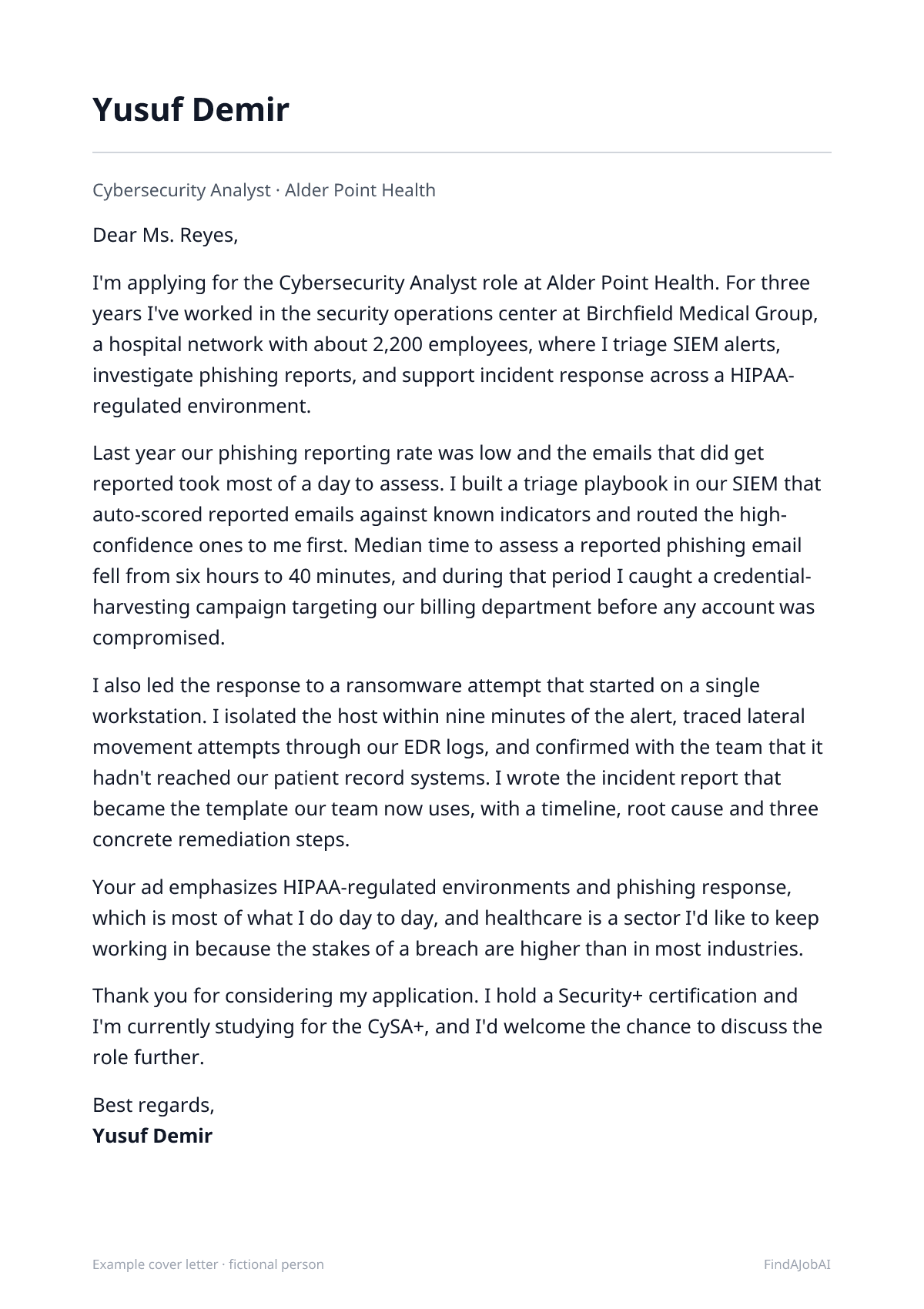
I'm applying for the Cybersecurity Analyst role at Alder Point Health. For three years I've worked in the security operations center at Birchfield Medical Group, a hospital network with about 2,200 employees, where I triage SIEM alerts, investigate phishing reports, and support incident response across a HIPAA-regulated environment.
Last year our phishing reporting rate was low and the emails that did get reported took most of a day to assess. I built a triage playbook in our SIEM that auto-scored reported emails against known indicators and routed the high-confidence ones to me first. Median time to assess a reported phishing email fell from six hours to 40 minutes, and during that period I caught a credential-harvesting campaign targeting our billing department before any account was compromised.
I also led the response to a ransomware attempt that started on a single workstation. I isolated the host within nine minutes of the alert, traced lateral movement attempts through our EDR logs, and confirmed with the team that it hadn't reached our patient record systems. I wrote the incident report that became the template our team now uses, with a timeline, root cause and three concrete remediation steps.
Your ad emphasizes HIPAA-regulated environments and phishing response, which is most of what I do day to day, and healthcare is a sector I'd like to keep working in because the stakes of a breach are higher than in most industries.
Thank you for considering my application. I hold a Security+ certification and I'm currently studying for the CySA+, and I'd welcome the chance to discuss the role further.
Best regards,
Yusuf Demir
Example 2 · Career changer
Network administrator moving into cybersecurity analysis
Harriet manages a manufacturer's network and has taken on vulnerability scanning and firewall review. The ad mentions vulnerability management and SIEM.
Example letter · fictional
Dear Hiring Manager,
I'm applying for the Cybersecurity Analyst role at Thornridge Manufacturing. For four years I've been a network administrator at a 300-person industrial parts manufacturer, and over the last year I've taken on vulnerability scanning and firewall rule review because our IT team had no dedicated security staff.
When I ran our first full vulnerability scan, it returned over 400 findings with no way to tell which mattered. I built a scoring process that combined the scanner's severity rating with whether a system was internet-facing, and worked through the list by actual exposure instead of by count. We closed the 30 highest-risk findings within a month, including an unpatched remote access server that had been open to the internet for over a year.
I also noticed our firewall had accumulated rules going back six years with no owner or expiration. I documented and reviewed every rule, removed 60 that were no longer needed, and set a quarterly review so it wouldn't happen again. Since then I've earned a Security+ certification and completed a SIEM fundamentals course, and I monitor our Splunk instance for alerts in addition to my network duties.
Your posting mentions vulnerability management and SIEM monitoring, both of which I'm already doing without the title, and manufacturing's mix of IT and older operational systems is an environment I understand from the infrastructure side.
Thank you for your time. I'd welcome the opportunity to talk about how my network background would translate to this role.
Kind regards,
Harriet Voss
Example 3 · Senior or lead
Security operations manager applying to build a first in-house SOC
Grace manages five analysts at a logistics company. The ad is for a security operations manager to build an in-house SOC and replace an outsourced provider.
Example letter · fictional
Dear Mr. Petrov,
I'm applying for the Security Operations Manager role at Vantage Logistics. For the last three years I've managed a team of five analysts at Corvid Freight, a logistics company, and before that I spent five years as a SOC analyst and incident responder. I'd like to lead a team through the same build you're planning.
Your ad says you're moving from an outsourced SOC provider to an in-house team. I managed that exact transition at Corvid two years ago. I wrote the detection use cases we needed on day one based on a gap analysis of what the provider had missed, hired three analysts in the first quarter, and ran a 90-day overlap where we shadowed the provider's alerts before taking over fully. Mean time to acknowledge an alert dropped from four hours under the provider to 12 minutes with our own team, and we haven't had a missed critical alert since the handover.
Trust in a security team comes from the incidents it catches, not the dashboards it builds. Six months into the new team, we caught a business email compromise attempt that had already fooled one employee into starting a wire transfer; we flagged the anomalous login before the transfer cleared and recovered the full amount with the bank. That case is now part of our new analyst training.
I've hired and coached every analyst on my current team, but I haven't built a security budget from scratch or negotiated tooling contracts directly with vendors, both of which an in-house build at your scale will require. I'd want to work closely with your finance team on that in the first few months.
I'd welcome a conversation about which alerts or incidents currently worry you most under the outsourced model, and how your team wants to ask for support once it's in-house.
Sincerely,
Grace Oyelaran
All three letters, and the short version below, are fictional: the people, employers and numbers are invented. Borrow the structure, never the facts.
- Prefer to write it yourself? Use the free cover letter template.
- Check your CV against the job first: the free CV score shows the missing keywords.
Why the first letter works, paragraph by paragraph
Paragraph 1: Opening
Names the environment (a 2,200-person hospital network, HIPAA-regulated) and the writer's core duties. Security hiring managers care about the sensitivity of what you've protected as much as the tools you used.
Paragraph 2: The process that caught a real threat
A specific problem (slow phishing triage), the fix (a scoring playbook), a measured result (six hours to 40 minutes), and the concrete payoff: a credential-harvesting campaign caught before damage.
Paragraph 3: An incident handled end to end
A real incident with a timeline (nine minutes to isolate), the tool used (EDR logs) to investigate it, and a lasting artifact, the incident report template, that shows the writer improved the team's process, not just their own work.
Paragraph 4: Why this company
Mirrors the ad's named requirements (HIPAA, phishing response) and gives a genuine reason the sector fits the writer's priorities.
Paragraph 5: Close
States certifications plainly and in progress, which in security hiring functions like proof of baseline knowledge, without overselling it.
What the career changer's letter does differently
The network administrator's letter starts from real security work she took on before the title existed at her company, with two measurable results (30 high-risk findings closed, 60 stale firewall rules removed) and a lasting process (a quarterly review). A certification and course show the skills are now formal, and the letter connects an infrastructure background directly to the ad's stated needs.
What the senior letter does differently
A security operations manager letter reports a team's build-out in concrete terms: a 90-day shadow period, a mean-time-to-acknowledge metric, a recovered wire transfer. The incident example shows the team's judgment under real pressure, not just its monitoring coverage, and the gaps, budget ownership and vendor negotiation, are named directly since the ad is for exactly that kind of build.
Short cybersecurity analyst cover letter: an email-ready version
Many applications arrive as an email or a small text box, and a full page doesn't fit. This version runs 120 to 150 words and keeps only what a reader needs to decide whether to reply. A cybersecurity analyst answers a retail company's short online application form, sent as an email because the applicant tracking system rejected the resume file format.
Short version · email · fictional126 words
Subject: Cybersecurity Analyst application – SOC analyst, Splunk and CrowdStrike – Tobias Lindgren
Hello Mr. Abara,
I'm applying for the Cybersecurity Analyst role at Holloway Retail Group. I have three years of SOC experience at an e-commerce company, working daily in Splunk and CrowdStrike to triage alerts and investigate incidents.
My most useful work was building a detection rule for credential stuffing against our login page, after we saw a spike in failed logins from a narrow IP range. The rule now blocks about 200 attempts a month automatically and flags anything unusual for review, which has caught two real account takeover attempts since.
Retail's exposure to credential stuffing and payment fraud is familiar territory, and I'd like to bring that focus to your team. My resume is attached, and I hold an active Security+ certification.
Best,
Tobias Lindgren
A short application form rewards one concrete detection story over a list of tools, so this version keeps the credential-stuffing rule and its measurable effect and drops the rest. The certification gets one phrase, not a paragraph.
Opening lines that work for cybersecurity analyst cover letters
The first sentence decides whether the second gets read. Here are six openings, one for each situation you might be in. Pick the one that matches yours and swap in your own facts: every name and number below is invented.
1. You have a standout result
A detection rule I built last year now blocks about 200 credential-stuffing attempts a month automatically and has caught two real account takeovers. I'd like to bring that same focus to your retail login traffic.
2. The ad names a problem you've solved
Your ad says your SOC is moving off an outsourced provider this year. I managed that exact transition on my current team, cutting our time to acknowledge an alert from four hours to 12 minutes in the process.
3. Someone referred you
Your IT director, Simone Achebe, worked with me for two years on access reviews and suggested I apply, since you're looking for someone who can both investigate alerts and clean up legacy firewall rules.
4. You admire what they build
I've watched your company's public breach disclosure process for two years with professional interest, and I'd like to help your team make it less often necessary.
5. You're new to the field or switching into it
I managed network infrastructure for four years, then took on vulnerability scanning when our company had no dedicated security staff. I'd like to make that security focus my full-time role.
6. You have senior scope or a specialism
As a SOC analyst and incident responder for eight years, I built the detection playbook my current team still trains new analysts on. I'm ready to lead a team doing that work.
How to write a cybersecurity analyst cover letter
Five steps, in the order you'd write them. The shape stays the same for every job (a short opening, proof, a reason for this employer, a close), and what goes into each part is what changes with the role.
Identify what kind of environment this ad is protecting
Healthcare, retail, manufacturing and finance each carry different threats, HIPAA data, payment fraud, operational technology, regulatory audits. Read the ad for the environment and compliance framework named, then choose a story of yours from a similar context.
Open with what you caught or prevented, not the tool you used
State the threat or problem first: a phishing campaign, a stale firewall rule, a credential-stuffing spike. Name the SIEM or EDR tool afterward, as the thing that made the catch possible, not as the headline.
Give a measurable result tied to risk, not activity
Time to detect, time to contain, number of accounts protected, findings closed by actual exposure rather than raw count. Avoid simply stating how many alerts you reviewed or tickets you closed; show what the work actually prevented or fixed.
Name the specific framework or tool the ad asks for
Work the ad's named SIEM, EDR or framework (Splunk, CrowdStrike, NIST, HIPAA, PCI-DSS) into the story of what you investigated or remediated. A tool named inside a real case is more credible than the same tool listed on its own.
Show your judgment on escalation and false positives
One sentence on how you decide what to escalate versus rule out keeps the letter from reading like a tool demo. Close by naming a type of threat or gap you'd want to look at first in their environment, so the reader sees your first-month focus.
Cybersecurity Analyst cover letter do's and don'ts
Do
- Name one alert, scan or incident you handled, the tool you used, and the measurable result or outcome.
- Mention the specific framework, SIEM or EDR tool the ad names (Splunk, CrowdStrike, NIST, HIPAA) inside a real example.
- Show judgment under uncertainty: how you ruled out a false positive, or how you decided what to escalate.
Don't
- Don't write "passionate about protecting data"; describe one threat you investigated and what you found.
- Don't name specific vulnerabilities, IP ranges or system details from a current employer's environment; keep examples general.
- Don't list every certification you're pursuing without context; name the one or two most relevant to this role.
Common cybersecurity analyst cover letter mistakes
Each one is easy to make and quick to fix before you send the letter.
Listing certifications and tools with no story attached
A row of Security+, CySA+, Splunk, CrowdStrike and NIST reads like a resume repeated in prose. Pick the one or two the ad asks for and show them doing something, inside a real alert, scan or incident.
Reporting alert volume instead of outcomes
"Reviewed over 1,000 alerts a month" describes workload, not skill. Say what one of those alerts turned out to be, how you investigated it, and what happened as a result.
Naming specific systems or exposures from a current employer
Detailing an unpatched server's IP range or a specific vulnerability still open at a current job can expose that employer and raises trust concerns. Describe the type of issue and the fix generally, without identifying details.
Writing "passionate about cybersecurity" as the motivation
Every applicant writes this. Replace it with a concrete reason: an incident you'd like to work on more of, or a sector's specific risk (payment fraud, patient data, operational technology) that draws you to this company.
Skipping judgment calls in favor of technical detail
A letter all about tools and no mention of how you decide what matters misses what senior reviewers look for. Add one sentence on ruling out a false positive or deciding what to escalate, so judgment is visible, not just technical skill.
Email subject lines for cybersecurity analyst applications
Applying by email? Put the job title, any reference number and your name in the subject line.
- Cybersecurity Analyst application – SOC and incident response, Security+ – Yusuf Demir
- Cybersecurity Analyst – network admin with vulnerability management background – Harriet Voss
- Application: Cybersecurity Analyst, SOC Team (Req. 3317) – Yusuf Demir
Everything for Cybersecurity Analysts
- Cybersecurity Analyst resume exampleA full resume, plus bullet and summary examples
- Cybersecurity Analyst interview questions30 questions with sample answers
- Cybersecurity Analyst job descriptionDuties, skills and requirements
- Career change cover letter: template + examples
Other cover letter examples
Cybersecurity Analyst cover letter FAQ
What should I write in a cybersecurity analyst cover letter?
One alert, scan or incident you investigated: what you found, the tool you used, and what happened as a result. Add a sentence on how you judge what to escalate versus dismiss as a false positive. Certifications and tool lists belong on your resume.
How do I write a cybersecurity analyst cover letter with no SOC experience?
Use security-adjacent work from another IT role, such as vulnerability scanning, firewall review or access management, and name a measurable result. Add a certification like Security+ and connect your experience to what the ad specifically asks for.
Should I mention specific vulnerabilities or incidents from my current employer?
Describe the type of incident and what you did generally, but avoid naming specific systems, IP addresses or details that could identify your employer's environment or ongoing exposure.
How we built this page
The FindAJobAI team wrote the three example letters, the short email version, the opening lines and the advice for cybersecurity analyst roles. The people, employers and numbers in the letters are invented; the structure, the kind of evidence and the order of the paragraphs are the parts to copy.
Once we track enough live cybersecurity analyst job ads, this page also shows the skills they ask for most, counted the same way as our in-demand skills report.
Last reviewed on November 1, 2026.