Security Engineer Cover Letter Example (2026)
By FindAJobAI team Updated How we built this page
Security hiring managers look past acronyms. A strong security engineer cover letter shows the controls you actually built, the frameworks you worked under (SOC 2, ISO 27001, NIST), and how you made the secure path the easy one for developers. Incidents handled and risks reduced, with numbers, carry the most weight.
Security Engineer cover letter template
This letter as a one-page template: an opening that names the job and your strongest fact, proof that answers the ad, a reason for this employer and a short close.
After you sign up, FindAJobAI drafts your own letter for a real job from your CV in this format, and you edit it before you send it.
Example 1 · Experienced
Application security engineer applying to a health platform
Clara built a secure development program at a payroll company. The ad mentions HIPAA and scaling security without slowing releases.
Example letter · fictional
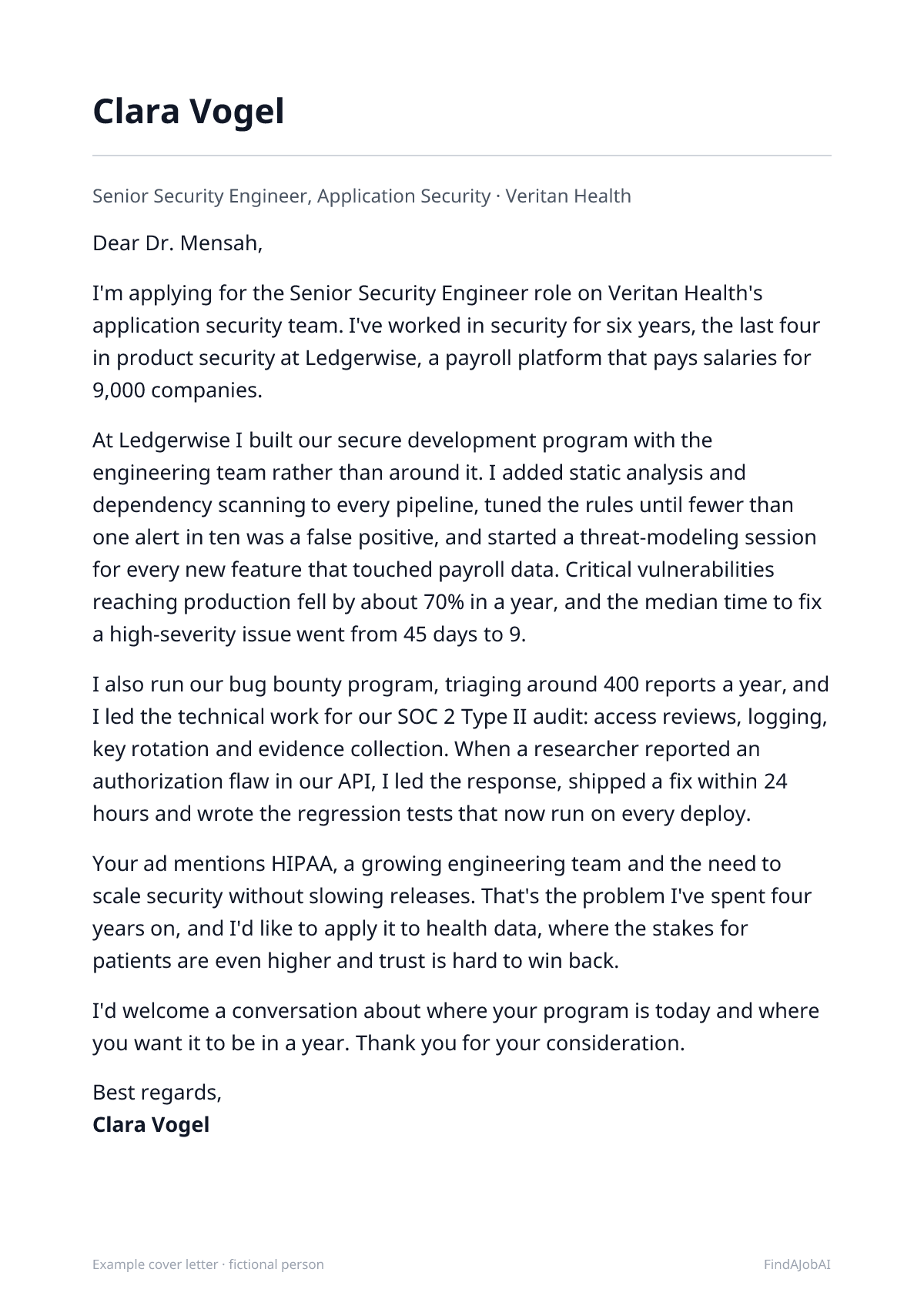
Dear Dr. Mensah,
I'm applying for the Senior Security Engineer role on Veritan Health's application security team. I've worked in security for six years, the last four in product security at Ledgerwise, a payroll platform that pays salaries for 9,000 companies.
At Ledgerwise I built our secure development program with the engineering team rather than around it. I added static analysis and dependency scanning to every pipeline, tuned the rules until fewer than one alert in ten was a false positive, and started a threat-modeling session for every new feature that touched payroll data. Critical vulnerabilities reaching production fell by about 70% in a year, and the median time to fix a high-severity issue went from 45 days to 9.
I also run our bug bounty program, triaging around 400 reports a year, and I led the technical work for our SOC 2 Type II audit: access reviews, logging, key rotation and evidence collection. When a researcher reported an authorization flaw in our API, I led the response, shipped a fix within 24 hours and wrote the regression tests that now run on every deploy.
Your ad mentions HIPAA, a growing engineering team and the need to scale security without slowing releases. That's the problem I've spent four years on, and I'd like to apply it to health data, where the stakes for patients are even higher and trust is hard to win back.
I'd welcome a conversation about where your program is today and where you want it to be in a year. Thank you for your consideration.
Best regards,
Clara Vogel
Example 2 · Career changer
IT support specialist moving into security engineering
Kwame has taken on most of the security work at a manufacturer. The ad asks for Windows, Active Directory, scripting and calm under pressure.
Example letter · fictional
Dear Hiring Team,
I'm applying for the Associate Security Engineer role at Bluefen Logistics. I've worked in IT support for three years at a 600-person manufacturer, and over the last year I've taken on most of our day-to-day security work, which I'd now like to do full time.
When a wave of phishing emails hit our company last year, I volunteered to help our only security analyst. I set up mail rules and one-click reporting in Microsoft Defender for Office 365, ran three phishing simulations, and built short training for the teams that clicked most. The click rate on simulations fell from 19% to 4%, and staff now report suspicious emails within minutes, which helped us stop a payroll fraud attempt in March.
I've also rolled out multi-factor authentication for every account, removed 140 stale admin accounts from Active Directory, and written the playbook we use for lost or stolen laptops. To build my foundations, I earned CompTIA Security+ and I'm working through a hands-on SOC analyst course with Splunk. I haven't yet worked in a 24/7 security operations team, and I'd expect to learn a lot from your analysts.
Your posting asks for Windows and Active Directory knowledge, scripting and a calm approach to incidents. Supporting a factory floor, where an hour of downtime stops production, has given me all three. I also write PowerShell scripts to automate our quarterly account reviews.
Thank you for considering my application. I'd be glad to talk about the phishing program and what I'd do next.
Kind regards,
Kwame Asante
Example 3 · Senior or lead
Security lead applying to be a startup's first security hire
Rafael leads a security team of three at a 400-person company. The ad is for a first dedicated security hire who will build the program from nothing.
Example letter · fictional
Dear Ms. Achterberg,
I'm applying for the Head of Security role at Knotwell. I've worked in security for nine years, and for the last four I've led a team of three at Pellam Logistics, a 400-person company with the kind of customer data and compliance needs you describe. I'd like to build a program again from an earlier stage.
Your ad says Knotwell passed its first SOC 2 audit through heroic effort rather than systems. Pellam was in the same place when I joined. I built an asset inventory, a risk register ranked by what a breach would cost, and vulnerability deadlines by severity. The median time to fix a critical vulnerability fell from 41 days to 6, and our SOC 2 Type II audit finished with no exceptions.
I also made security something engineers volunteer for. I started a security champions group of eleven developers, gave them a threat-modeling checklist, and ran two tabletop incident exercises with executives. In the second, the team found the gap in our communication plan that would have delayed customer notice by a day, and we fixed it before a real incident tested it.
A first security hire has to choose, and I'd spend my first 90 days listening: inventory, the ten biggest risks and one visible improvement. I haven't been the only security person, so I'd lean on an outside penetration-testing firm and a fractional adviser while I hired the first engineer. I'd also write the first incident response plan with legal and communications in the room, since that is where small companies are most exposed.
What the board expects from the first year is the conversation I'd most like to have next.
Sincerely,
Rafael Ortega
All three letters, and the short version below, are fictional: the people, employers and numbers are invented. Borrow the structure, never the facts.
- Prefer to write it yourself? Use the free cover letter template.
- Check your CV against the job first: the free CV score shows the missing keywords.
Why the first letter works, paragraph by paragraph
Paragraph 1: Opening
Names the specialty (application security) and the sensitive data involved. Security managers hire for specific domains, so the letter declares one immediately.
Paragraph 2: The program
Security built with engineers, not imposed on them. The false-positive figure shows respect for developers' time, and the before and after numbers prove the program worked.
Paragraph 3: Breadth and incidents
Bug bounty triage, a SOC 2 audit and a real incident fixed in 24 hours cover what most product-security roles involve, each with a concrete detail.
Paragraph 4: Why this company
Mirrors the ad (HIPAA, growth, release speed) and connects the writer's experience to why health data matters, without repeating the company's slogan.
Paragraph 5: Close
Asks about their current program, signalling that the writer will assess before prescribing.
What the career changer's letter does differently
The IT support letter turns everyday admin work into security evidence: a phishing program with measurable results, an MFA rollout and a cleanup of admin accounts. Security+ and a SOC course show commitment, and the letter is honest that 24/7 SOC experience is still missing.
What the senior letter does differently
A first security hire is a builder and a negotiator, so the letter shows a program, an inventory, a risk register and deadlines, with audit and time-to-fix results, plus the champions group that makes security a shared job. It sketches the first 90 days and says where outside help would be needed.
Short security engineer cover letter: an email-ready version
Many applications arrive as an email or a small text box, and a full page doesn't fit. This version runs 120 to 150 words and keeps only what a reader needs to decide whether to reply. A security engineer replies to a team lead who posted the role in a community forum and asked for 'a short note, no formal cover letter'.
Short version · email · fictional130 words
Subject: Security Engineer (detection and response) – Zainab Bello
Hello Mr. Okoro,
I saw your forum post about the Security Engineer role at Thistledown Bank. I've worked in detection and response for five years, the last three at a payments company where I own the alerts that feed our on-call rotation.
Last year I rewrote 60 noisy detection rules around attacker behavior rather than single indicators. False positives dropped by two thirds, and the analyst team now closes alerts in minutes rather than hours. I wrote the playbooks and ran the exercises that tested them.
Your post says the team wants to move from reacting to alerts to hunting. That is the next step I'd like to take, and I'd enjoy talking about how, starting with which detections you'd want to hunt for first. Resume attached.
Best,
Zainab Bello
In security, the short version keeps the result that matters to a team lead, fewer false alarms, and drops anything confidential: no tool vendors, no incident details, no named systems. The last paragraph echoes the post's own wording about hunting.
Opening lines that work for security engineer cover letters
The first sentence decides whether the second gets read. Here are six openings, one for each situation you might be in. Pick the one that matches yours and swap in your own facts: every name and number below is invented.
1. You have a standout result
Critical vulnerabilities used to take 41 days to fix; they now take 6. We also passed our SOC 2 audit with no exceptions, and I'd like to build that discipline for your platform.
2. The ad names a problem you've solved
Developers see security as a blocker, you write in your ad. I built a champions group of eleven engineers and a review process that takes two days instead of two weeks, and the friction mostly disappeared.
3. Someone referred you
Camila Reyes, your head of engineering, thought of me when she heard you were hiring. We worked through a ransomware tabletop together at a previous company, and she said your team needs someone who explains risk plainly.
4. You admire what they build
Your published vulnerability disclosure policy is the clearest I've read, with response times you actually meet; that standard is why I'd like to work on your security team.
5. You're new to the field or switching into it
In four years of IT support I built our phishing training program. I'd like to move into security engineering, where I can fix the causes of the problems I currently report.
6. You have senior scope or a specialism
I'm ready to set security strategy after nine years of application security across three companies, including a secure development program for 300 engineers.
How to write a security engineer cover letter
Five steps, in the order you'd write them. The shape stays the same for every job (a short opening, proof, a reason for this employer, a close), and what goes into each part is what changes with the role.
Choose the security area the ad is really about
Security ads cover very different jobs: application security, cloud security, detection and response, compliance. Read for the verbs. Then pick the project from your history that sits closest to that area, and leave the rest of your experience for the interview.
Open with the thing you protect and its size
Say what the environment is: a payments platform, a hospital network, a developer-facing API, and how large it is in users, systems or engineers. Security results mean more once the reader knows what was at stake and how big the surface was.
Report outcomes in terms the business uses
Use time to fix, incidents contained, audit findings closed or phishing reports rising. Avoid counts of tools deployed or alerts generated. A hiring manager wants evidence that risk fell, and that you reached the engineers or staff who had to act.
Show you can explain risk to non-specialists
Include one moment where you made a security decision understandable to developers, executives or customers: a tabletop exercise, a risk memo, a review process that engineers adopted. Security programs fail when the people who must follow them don't see why.
Keep every detail safe to share
Describe your work at a level that gives away nothing confidential: no vulnerability specifics, no internal system names, no customer incidents that weren't public. Then close with the first area you'd want to review at the new company, such as how access is granted.
Keywords employers use for security engineer roles
The skills named most often in the 504 newest security engineer job ads we track (out of 2,841 live postings), with the share of ads that mention each:
- Incident management 40%
- AWS 35%
- Python 35%
- Cloud security 30%
- Azure 28%
- Vulnerability management 27%
- NIST 26%
- Auditing 24%
Don't list them in your letter: pick the two or three the ad repeats and back each with one sentence of evidence. Full list: Security Engineer resume keywords.
From live job ads · updated November 2, 2026
Security Engineer cover letter do's and don'ts
Do
- Name the frameworks you worked under and the controls you built for them (SOC 2 access reviews, an ISO 27001 risk register).
- Measure risk reduction: vulnerabilities reaching production, time to fix, phishing click rate, incidents contained.
- Show how you worked with engineers or staff, not just what you required of them.
Don't
- Don't list every security acronym you know; the ad's top three, with evidence, are enough.
- Don't share confidential details of past incidents; describe the type of issue and the outcome.
- Don't present certifications as experience; put them after the work they support.
Common security engineer cover letter mistakes
Each one is easy to make and quick to fix before you send the letter.
Letting certifications stand in for experience
CISSP, OSCP and Security+ in a row show study. Mention the one the ad requires, then show what you did with it: a program you built, a finding you fixed, an incident you led.
Revealing confidential details
Don't describe a past employer's vulnerabilities, tooling or incidents beyond what's public. Interviewers read it as a preview of how you'll treat their secrets. Describe the type of problem and the result, not the system.
Using fear as the argument
Warnings about breaches and hackers read as a sales pitch. Show calm, specific evidence instead: what you found, what you changed and how the numbers moved. Teams trust security people who lower anxiety.
Naming compliance frameworks with no role in them
'Familiar with SOC 2 and ISO 27001' tells little. Say which controls you owned, what evidence you produced and what the auditor found, so the reader can tell hands-on work from awareness.
Ignoring the engineers you'd work with
Security that engineers route around fails. Add one example of working with developers or IT staff, such as a fix you paired on or a process you shortened, and what they said about it afterwards.
Email subject lines for security engineer applications
Applying by email? Put the job title, any reference number and your name in the subject line.
- Senior Security Engineer (AppSec) application – SOC 2, threat modeling – Clara Vogel
- Associate Security Engineer – IT support with phishing program results – Kwame Asante
- Application: Security Engineer, Cloud Security (Req. 7710) – Clara Vogel
Everything for Security Engineers
- Security Engineer jobs2,841 open roles, updated hourly
- Security Engineer salary in the United StatesAdvertised pay in real job ads
- Security Engineer resume exampleA full resume, plus bullet and summary examples
- Security Engineer interview questions30 questions with sample answers
- Security Engineer resume keywordsThe skills job ads ask for most
- Security Engineer job descriptionDuties, skills and requirements
- Career change cover letter: template + examples
Other cover letter examples
Security Engineer cover letter FAQ
What should a security engineer put in a cover letter?
Your specialty (application, cloud, network or security operations), the frameworks you worked under, the controls you built and measurable risk reduction. One incident you handled, described without confidential details, shows how you work under pressure.
How do I write a cybersecurity cover letter with no experience?
Use the security work you already do in IT or development (access management, patching, phishing response), add a certification such as Security+, and show hands-on practice in labs. Be clear about what you haven't done yet.
Should I mention certifications like CISSP or OSCP in a cover letter?
Yes, in one sentence when the ad asks for them. Use the rest of the letter for what you did with that knowledge.
How we built this page
The FindAJobAI team wrote the three example letters, the short email version, the opening lines and the advice for security engineer roles. The people, employers and numbers in the letters are invented; the structure, the kind of evidence and the order of the paragraphs are the parts to copy.
The live keyword section is based on 504 security engineer job ads analysed, the newest we track, with the same deterministic skill matcher as our in-demand skills report: no AI model reads the postings. It was last computed on November 2, 2026 and refreshes daily.
Last reviewed on November 1, 2026.