Dialysis Technician Cover Letter Example (2026)
By FindAJobAI Team Updated How we built this page
Every dialysis technician posting lists cannulation, machine setup and patient monitoring, so a good letter shows how you work on the floor: a moment you noticed something early, how you keep water and equipment checks exact, and how you earn the trust of patients who see you three times a week.
Dialysis Technician cover letter template
This letter as a one-page template: an opening that names the job and your strongest fact, proof that answers the ad, a reason for this employer and a short close.
After you sign up, FindAJobAI drafts your own letter for a real job from your CV in this format, and you edit it before you send it.
Example 1 · Experienced
Outpatient dialysis technician applying to a larger center
Benedikt is a certified technician at a small outpatient unit. The ad is for a technician at a busy 30-station center with an evening shift.
Example letter · fictional
Dear Mrs. Kowalczyk-Ibarra,
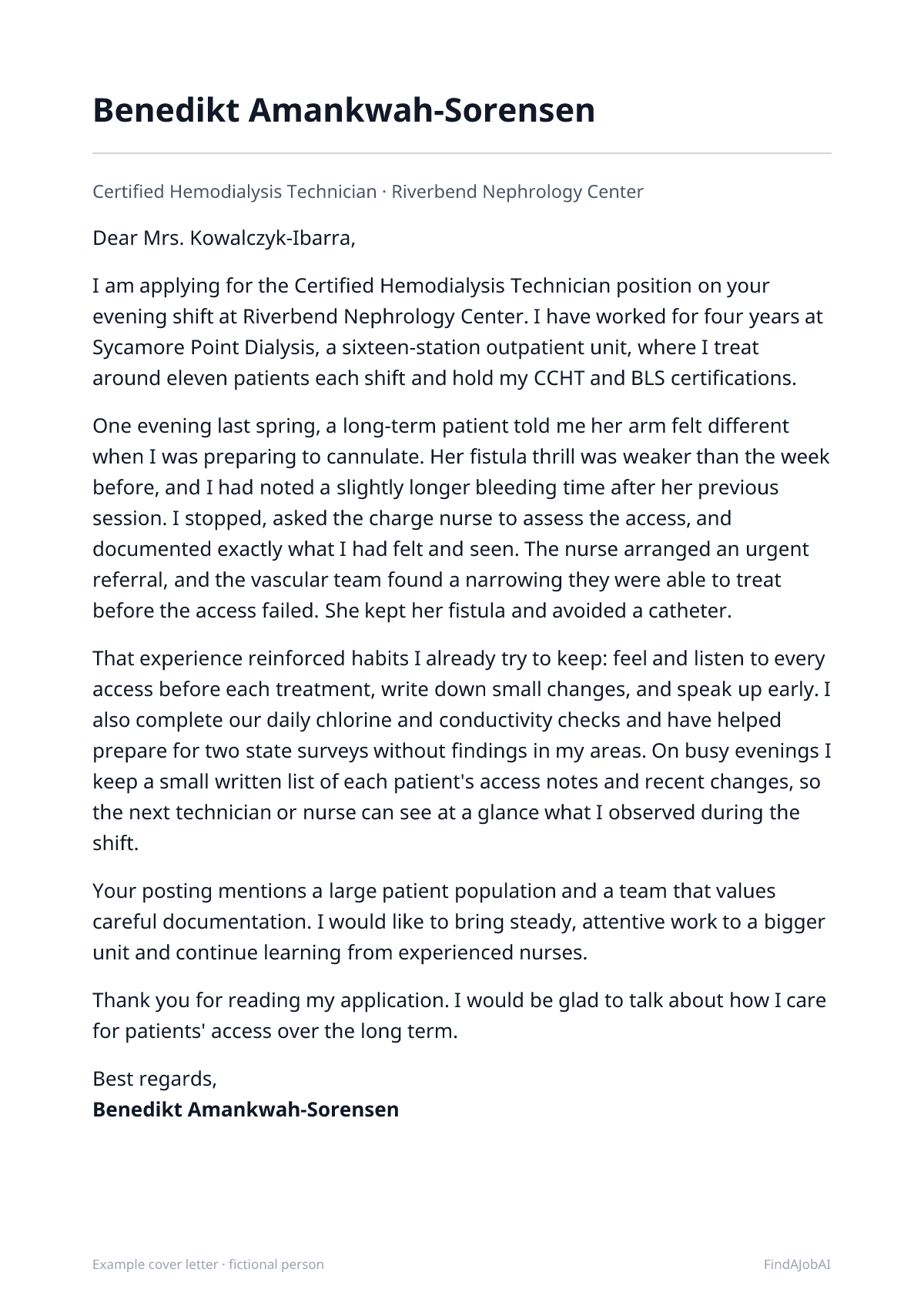
I am applying for the Certified Hemodialysis Technician position on your evening shift at Riverbend Nephrology Center. I have worked for four years at Sycamore Point Dialysis, a sixteen-station outpatient unit, where I treat around eleven patients each shift and hold my CCHT and BLS certifications.
One evening last spring, a long-term patient told me her arm felt different when I was preparing to cannulate. Her fistula thrill was weaker than the week before, and I had noted a slightly longer bleeding time after her previous session. I stopped, asked the charge nurse to assess the access, and documented exactly what I had felt and seen. The nurse arranged an urgent referral, and the vascular team found a narrowing they were able to treat before the access failed. She kept her fistula and avoided a catheter.
That experience reinforced habits I already try to keep: feel and listen to every access before each treatment, write down small changes, and speak up early. I also complete our daily chlorine and conductivity checks and have helped prepare for two state surveys without findings in my areas. On busy evenings I keep a small written list of each patient's access notes and recent changes, so the next technician or nurse can see at a glance what I observed during the shift.
Your posting mentions a large patient population and a team that values careful documentation. I would like to bring steady, attentive work to a bigger unit and continue learning from experienced nurses.
Thank you for reading my application. I would be glad to talk about how I care for patients' access over the long term.
Best regards,
Benedikt Amankwah-Sorensen
Example 2 · Career changer
Certified nursing assistant moving into dialysis
Lucinda is a nursing assistant in long-term care who just finished hemodialysis training. The ad is for a trainee technician at an outpatient clinic.
Example letter · fictional
Dear Mr. Tremblay-Asante,
Please accept my application for the Dialysis Technician Trainee role at Bluestem Renal Clinic. For three years I have worked as a certified nursing assistant in a long-term care home, and last month I completed a twelve-week hemodialysis training program with two hundred supervised clinical hours.
Several residents in my care went to dialysis three days a week, and I was often the one helping them get ready and settling them when they came back tired. I noticed that one resident returned dizzy more often than the others, so I started recording her intake and output more carefully on non-dialysis days and shared the pattern with our nurse. Her care plan was adjusted, and her post-treatment dizziness became much less frequent. Those conversations made me want to understand the treatment itself, which led me to enrol in the program.
During my clinical placement I primed machines, recorded vitals and weights, and completed sixty supervised cannulations on established fistulas. I am preparing for the CCHT exam and know I still have much to learn about difficult access and water treatment, which is why your structured training appeals to me. I learn best by watching closely, practising under supervision and asking questions afterwards, and my preceptor noted that I always repeated the safety checks aloud before starting, even on the busiest days of my placement.
Your clinic's emphasis on patient education stands out. Explaining fluid limits gently and clearly is something I practised daily with residents and their families.
I would welcome the chance to discuss my training and how my care experience could support your patients.
Kind regards,
Lucinda Fairclough-Oduya
Example 3 · Senior or lead
Lead dialysis technician applying to run a new unit's technical team
Hyacinth leads technicians at an established center. The ad is for a lead technician to set up the team and water program at a newly opened unit.
Example letter · fictional
Dear Ms. Vandermeer-Kaplan,
I am writing to apply for the Lead Dialysis Technician role at your new Coralstone Kidney Health unit. I have worked in hemodialysis for eleven years, and for the past four I have led a team of eight technicians at Larchmont Renal Services, a twenty-eight-station outpatient center.
When I became lead, our new technicians often struggled with cannulation in their first months, and some patients asked not to be assigned to them. I set up a mentoring plan in which each new technician practised on established accesses with a named preceptor, reviewed every missed stick together, and moved to newer fistulas only after sign-off. Within half a year our newer staff were cannulating with far more confidence, and patient requests to avoid them stopped.
I also run our water treatment program, including daily chlorine testing, monthly cultures and endotoxin samples, and the logs we present during surveys. We have had no water-related findings in four inspections. A new unit gives the chance to build those routines correctly from the first day rather than fixing them later. I would want every technician on the new team to understand why each test matters, not just how to log it, because people who know the reasons are far less likely to skip a step at the end of a long shift.
I have not opened a unit before, so I would rely on your clinical manager and biomedical team for the commissioning steps, and I would want to learn your company's policies thoroughly before writing local checklists.
I would appreciate the opportunity to discuss how you plan to staff and train the team in the first year.
Sincerely,
Hyacinth Morrow-Achebe
All three letters, and the short version below, are fictional: the people, employers and numbers are invented. Borrow the structure, never the facts.
- Prefer to write it yourself? Use the free cover letter template.
- Check your CV against the job first: the free CV score shows the missing keywords.
Why the first letter works, paragraph by paragraph
Paragraph 1: Opening
States Benedikt's unit size, patient load and certifications at once, the three things a dialysis manager screens for.
Paragraph 2: The access change he caught
A specific moment of noticing, stopping and escalating shows clinical attention that a duty list cannot.
Paragraph 3: Daily habits and safety checks
Access assessment, documentation and water testing answer a manager's main safety concerns in a few lines.
Paragraph 4: Why this nephrology center
Connects the larger patient population and documentation culture to his goals.
Paragraph 5: Close
Offers a conversation on long-term access care, a topic every dialysis interviewer values.
What the career changer's letter does differently
Lucinda's letter turns nursing assistant work into evidence for dialysis: she noticed a pattern, recorded it carefully and told the nurse. She is honest about gaps in difficult access and water treatment and shows real training progress.
What the senior letter does differently
A lead technician letter focuses on building people and routines: a cannulation mentoring plan and a survey-ready water program. The gap, opening a new unit, is named honestly with a sensible plan to rely on the right colleagues.
Short dialysis technician cover letter: an email-ready version
Many applications arrive as an email or a small text box, and a full page doesn't fit. This version runs 120 to 150 words and keeps only what a reader needs to decide whether to reply. A dialysis technician answers a recruiter at a hospital who asked for a quick note about acute dialysis experience before a phone screen.
Short version · email · fictional126 words
Subject: Acute Dialysis Technician – CCHT with ICU bedside experience – Lysander Ferreira-Holloway
Hi Ms. Bergstrom-Okeke,
Thank you for reaching out about the Acute Dialysis Technician role at Westbrook Memorial Medical Center. I am a certified technician with three years of inpatient experience, mostly in intensive care and step-down units.
Each day I set up portable machines for six to eight bedside treatments, coordinate timing with nurses around procedures and scans, and complete the infection control checklist before and after every session. Last year I helped our team move to a new machine model by writing a short setup guide for colleagues, which made the first weeks much smoother. I enjoy the pace of acute work and the close teamwork it requires.
My resume is attached, and I am available for a call any weekday afternoon.
Best,
Lysander Ferreira-Holloway
The email stays focused on acute experience: bedside setup, coordination with nurses and infection control, plus one helpful contribution. It is brief because the recruiter only asked for a few lines.
Opening lines that work for dialysis technician cover letters
The first sentence decides whether the second gets read. Here are six openings, one for each situation you might be in. Pick the one that matches yours and swap in your own facts: every name and number below is invented.
1. You have a standout result
A patient's fistula felt weaker before her treatment one evening, and stopping to call the nurse helped her keep that access. I would like to bring that attentiveness to your unit.
2. The ad names a problem you've solved
For four years I have run hemodialysis for around eleven patients a shift, and your evening role describes the steady, careful work I enjoy most.
3. Someone referred you
Your charge nurse, Philippa Okonkwo-Raines, trained alongside me at a regional dialysis workshop and suggested I apply for this opening.
4. You admire what they build
I helped residents prepare for dialysis for three years as a nursing assistant, and now I want to provide the treatment myself.
5. You're new to the field or switching into it
Keeping water logs flawless through four surveys taught me that safety in dialysis depends on small checks done every single day.
6. You have senior scope or a specialism
As the lead who built a cannulation mentoring plan for new technicians, I am looking for a unit where I can set up strong routines from the start.
How to write a dialysis technician cover letter
Five steps, in the order you'd write them. The shape stays the same for every job (a short opening, proof, a reason for this employer, a close), and what goes into each part is what changes with the role.
Match the dialysis setting in the posting
Outpatient centers, hospital acute teams and home dialysis programs each need different strengths. Note whether the role involves chair-side outpatient work, bedside treatments in intensive care or patient training at home, and choose one example from your own experience that fits that setting closely.
Tell one story of noticing and escalating
Describe a change you spotted in a patient's access, blood pressure or behaviour, or a fault in a machine or water test, and explain how you reported it. Managers want technicians who notice small changes early and know when to involve a nurse.
Show your safety routines
Mention how you complete pre-treatment checks, water testing, infection control and documentation. A sentence about clean survey results or careful logs reassures a clinical manager that you follow standards even on long, busy shifts with many patients.
Show how you build trust with patients
Dialysis patients often see the same staff for years. Explain how you calm anxious patients, explain fluid limits or adjust your approach to someone with a difficult access, so the reader can picture you on their floor.
Be clear about certification
State your CCHT, CHT or CCNT status, BLS and any state certification, or give your exam date if you are still in training. Clear credentials help a recruiter move your application forward without needing to ask follow-up questions.
Dialysis Technician cover letter do's and don'ts
Do
- Describe one situation where you noticed a change in a patient or machine and acted on it.
- State your certification, patient load and the setting you work in.
- Mention how you handle water testing, machine checks and documentation.
Don't
- Don't include patient names, dates of birth or other identifying details.
- Don't claim to perform tasks that belong to nurses in your state.
- Don't rely on general phrases about compassion without an example.
Common dialysis technician cover letter mistakes
Each one is easy to make and quick to fix before you send the letter.
Repeating the job duties back
Managers already know the duties. Use your letter for one example of careful observation and its result.
Telling patient stories that identify someone
Keep stories general, with no names, ages or dates that could identify a patient, to respect privacy rules.
Skipping water and machine safety
Surveyors and managers focus on these checks. Mention your testing routine and any clean audit results.
Overstating your scope of practice
Describe tasks you perform as a technician and those you support under nurse direction, accurately.
Leaving certification status unclear
Name your certification and date, or your exam date if new, so the recruiter can screen quickly.
Email subject lines for dialysis technician applications
Applying by email? Put the job title, any reference number and your name in the subject line.
- Hemodialysis Technician, evening shift – CCHT, 4 years – Benedikt Amankwah-Sorensen
- Dialysis Technician Trainee – CNA with completed hemodialysis program – Lucinda Fairclough-Oduya
- Application: Lead Dialysis Technician (Ref. 4416) – Hyacinth Morrow-Achebe
Everything for Dialysis Technicians
- Dialysis Technician resume exampleA full resume, plus bullet and summary examples
- Dialysis Technician interview questions30 questions with sample answers
- Dialysis Technician job descriptionDuties, skills and requirements
- Career change cover letter: template + examples
Other cover letter examples
Dialysis Technician cover letter FAQ
What should a dialysis technician cover letter include?
Your certification and setting, one example of noticing and escalating a patient or equipment issue, and a line on how you handle water, machine and documentation checks.
How do I write a dialysis technician cover letter with no experience?
Use your training program, clinical hours and any patient care work, such as being a nursing assistant. Describe one moment of careful observation and say when you will take the certification exam.
Should I mention my cannulation rate in a cover letter?
You can mention it briefly if it is strong and tracked by your unit, but a short story about caring for an access over time often says more.
How we built this page
The FindAJobAI team wrote the three example letters, the short email version, the opening lines and the advice for dialysis technician roles. The people, employers and numbers in the letters are invented; the structure, the kind of evidence and the order of the paragraphs are the parts to copy.
Once we track enough live dialysis technician job ads, this page also shows the skills they ask for most, counted the same way as our in-demand skills report.
Last reviewed on November 1, 2026.