Full Stack Developer Cover Letter Example (2026)
By FindAJobAI team Updated How we built this page
A full stack cover letter has to prove range without turning into a list of technologies. Hiring managers, often at startups and small product teams, want someone who can take a feature from database to interface alone and make sensible trade-offs on the way.
Full Stack Developer cover letter template
This letter as a one-page template: an opening that names the job and your strongest fact, proof that answers the ad, a reason for this employer and a short close.
After you sign up, FindAJobAI drafts your own letter for a real job from your CV in this format, and you edit it before you send it.
Example 1 · Experienced
Product-minded full stack developer applying to an early-stage startup
Lucas is one of four engineers at a SaaS company. The ad says the first engineers will shape the product as much as the code.
Example letter · fictional
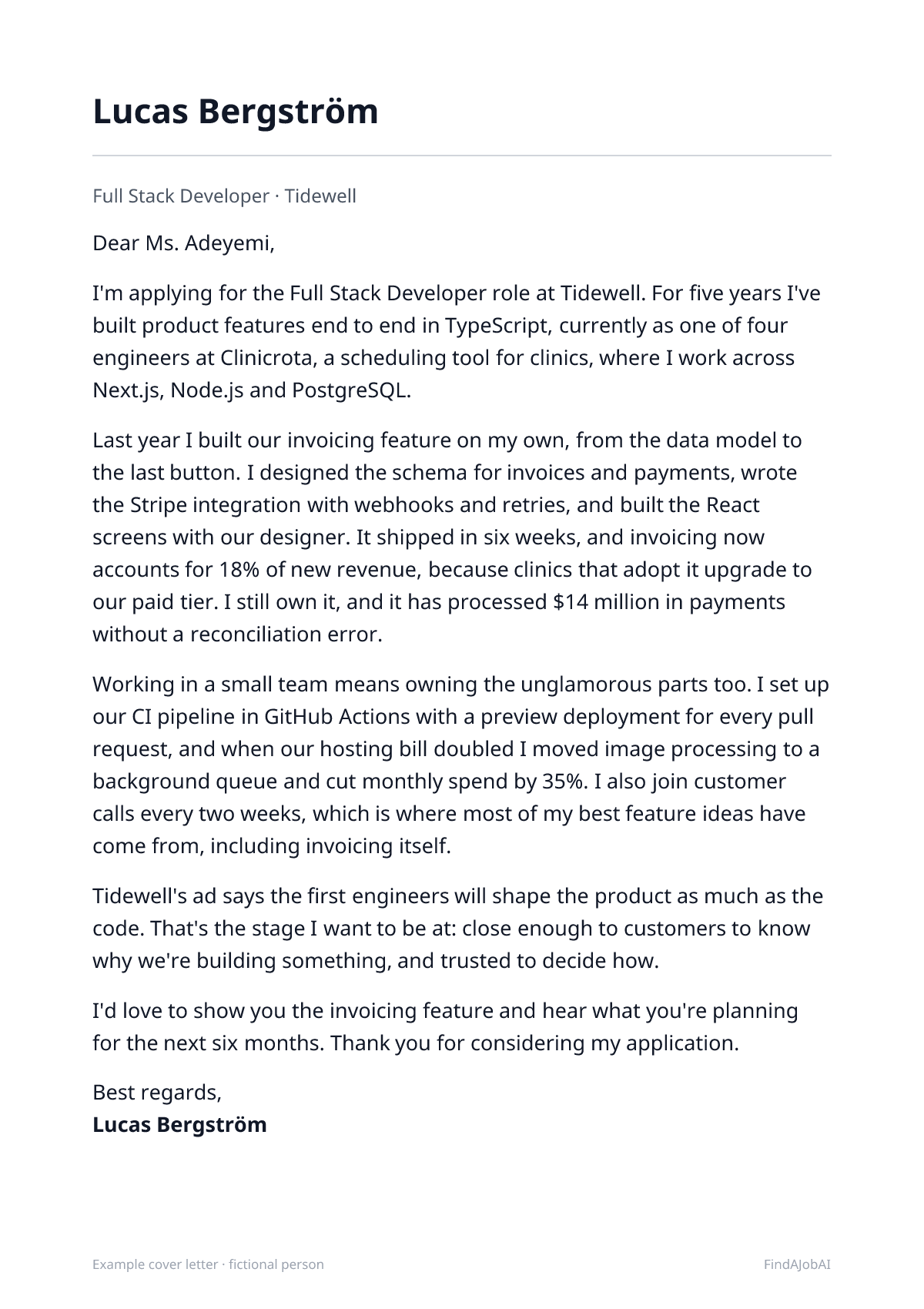
Dear Ms. Adeyemi,
I'm applying for the Full Stack Developer role at Tidewell. For five years I've built product features end to end in TypeScript, currently as one of four engineers at Clinicrota, a scheduling tool for clinics, where I work across Next.js, Node.js and PostgreSQL.
Last year I built our invoicing feature on my own, from the data model to the last button. I designed the schema for invoices and payments, wrote the Stripe integration with webhooks and retries, and built the React screens with our designer. It shipped in six weeks, and invoicing now accounts for 18% of new revenue, because clinics that adopt it upgrade to our paid tier. I still own it, and it has processed $14 million in payments without a reconciliation error.
Working in a small team means owning the unglamorous parts too. I set up our CI pipeline in GitHub Actions with a preview deployment for every pull request, and when our hosting bill doubled I moved image processing to a background queue and cut monthly spend by 35%. I also join customer calls every two weeks, which is where most of my best feature ideas have come from, including invoicing itself.
Tidewell's ad says the first engineers will shape the product as much as the code. That's the stage I want to be at: close enough to customers to know why we're building something, and trusted to decide how.
I'd love to show you the invoicing feature and hear what you're planning for the next six months. Thank you for considering my application.
Best regards,
Lucas Bergström
Example 2 · Career changer
Bootcamp graduate moving from logistics operations into development
Grace left operations for a 24-week program and built an app real warehouse staff used. The ad offers mentorship and pairing.
Example letter · fictional
Dear Roamwise Hiring Team,
I'm applying for the Junior Full Stack Developer position. Until last year I worked in operations at a logistics company, where I started automating my own reports; that turned into a career change, a 24-week full stack program and the project I describe below.
My capstone was a shift-swap app for warehouse staff, built with React, Node.js and PostgreSQL and deployed on Render. I designed the database, wrote the REST API with authentication and role-based access, and built the mobile-friendly frontend. Two supervisors at my old warehouse piloted it with 45 staff for a month, and their feedback shaped the second version: fewer screens, and push notifications instead of email. The warehouse still uses it today.
My operations background shows in how I work. I'm used to talking to the people who'll use a tool, writing down the rules before building, and checking afterwards that it really saved time. Before I could code, I cut our weekly reporting from four hours to thirty minutes with spreadsheets and macros; now I can build the proper version.
What I still need is experience in a larger codebase with regular code review, which is why your mentorship program and pairing sessions appealed to me. I ask questions early, and I write the answers down so I don't have to ask twice; my old team still uses the process notes I left behind.
Thank you for reading. The app and its code are linked on my resume, and I'd be glad to walk you through them.
Kind regards,
Grace Oduya
Example 3 · Referral or internal move
Support engineer applying internally for a full stack role
Carla has fixed customer bugs in her company's code for two years. The internal posting is for a developer on the team she works beside, and her manager agrees.
Example letter · fictional
Dear Mr. Lindgaard,
I'm applying for the Full Stack Developer position on the Customer Tools team. I've been a support engineer at Nestwell for two years, and my manager, Dev Anand, knows I'm applying and has said he'll support the move. I'd like to explain why I think the step is a natural one.
In support I don't only triage. Since last March I've fixed 63 customer-reported bugs in our Rails and React codebase, each through a reviewed pull request. The one that mattered most was an invoice export that dropped line items for customers with more than 200. I found the cause in the query's pagination, wrote the fix and a regression test, and the 14 affected accounts had corrected files within a day.
I've also built something of my own for the team. A macro tool I wrote in TypeScript suggests the right help-center article while an agent types a reply, and it cut our median first response from 41 minutes to 29. Two of your engineers reviewed it, and their comments changed how I structure my tests.
What I bring as an internal candidate is that I already know our customers' pain, our deploy process and who to ask. The gap is depth: I haven't owned a feature from schema to release, so I've been working with Jelena Marković on a small one, a saved-filter setting, to learn that path before I ask for the job.
A conversation with the team about what a six-month onboarding would look like is the next step I'm hoping for, and I'd like to ask which smaller bugs I could take first.
Thank you,
Carla Benedetti
All three letters, and the short version below, are fictional: the people, employers and numbers are invented. Borrow the structure, never the facts.
- Prefer to write it yourself? Use the free cover letter template.
- Check your CV against the job first: the free CV score shows the missing keywords.
Why the first letter works, paragraph by paragraph
Paragraph 1: Opening
Establishes range in one sentence: years, a stack across both ends, and a small-team context. Startups want generalists who work without a big support structure.
Paragraph 2: One feature, end to end
Instead of listing skills, the letter follows one feature from schema to screens and ends with a business result (18% of new revenue). That proves full stack in practice.
Paragraph 3: Owning the rest
CI, preview deployments, a cost cut and customer calls show the writer handles the work nobody assigns, which is what small teams need most.
Paragraph 4: Why this company
Quotes the company's own line about early engineers and explains why that stage suits the writer, so the motivation is about the role, not flattery.
Paragraph 5: Close
Proposes showing the feature and asking about their plans, which turns the interview into a working conversation.
What the career changer's letter does differently
The bootcamp graduate makes the old career an asset: talking to users, writing rules down, measuring time saved. The capstone had 45 real users, and the letter ties its gap, a large codebase with review, to the company's mentorship program.
What the referral letter does differently
An internal letter doesn't re-introduce the company. It proves the move with work already done in the codebase, and says plainly that the manager knows. Naming what's still missing, owning a feature end to end, and showing a step toward it keeps the request realistic.
Short full stack developer cover letter: an email-ready version
Many applications arrive as an email or a small text box, and a full page doesn't fit. This version runs 120 to 150 words and keeps only what a reader needs to decide whether to reply. A founder's hiring post says 'email me, two paragraphs at most'. The note leads with the one product the writer built and launched alone.
Short version · email · fictional129 words
Subject: Full Stack Developer – built and launched a booking product solo – Alma Torres
Hi Mr. Eze,
I'm applying for the Full Stack Developer role at Gablefield. Last year I built and launched a booking tool for yoga studios on my own: Next.js, Node and PostgreSQL, with Stripe for payments. It has 38 paying studios and I handle support myself.
Doing everything taught me where the real work is. I wrote the schema, the API and the interface, but also the email reminders that cut no-shows by a third, and the alerts that wake me when a payment webhook fails, which have saved us twice.
Gablefield's ad says engineers talk to customers directly, which is how I work now: I answer every support email myself on Fridays. My resume is attached, and I can start a call whenever suits you.
Best,
Alma Torres
For a founder, the proof is a whole product, so the note names the stack, the paying customers and the unglamorous parts. It stays at two substantive paragraphs because the ad asked for that, then adds a short third to close.
Opening lines that work for full stack developer cover letters
The first sentence decides whether the second gets read. Here are six openings, one for each situation you might be in. Pick the one that matches yours and swap in your own facts: every name and number below is invented.
1. You have a standout result
At Tidal Row I'd like to build the kind of feature I built last year: an invoicing tool, from schema to last button, that now accounts for a fifth of our new revenue.
2. The ad names a problem you've solved
The first engineers decide what to build, not just how, says your ad. That's how I've worked for three years at a six-person company, and I'm looking for the same ownership with more users.
3. Someone referred you
A former colleague, Marek Dvorak, now your head of product, told me you need someone who can work across the stack. We shipped three features together at my last job, so he knows how I work.
4. You admire what they build
I used your booking tool when I travelled last spring, and the mobile checkout was the smoothest I met; I'd like to help build the next version of it.
5. You're new to the field or switching into it
Six years of logistics operations came before my full stack course, and the shift-planning app I built for my old warehouse is still in daily use. I'm ready to build software full time, starting in your junior role.
6. You have senior scope or a specialism
Eight years of shipping products from database to deployment have left me wanting a lead role at a small company, where I can choose the architecture and the people.
How to write a full stack developer cover letter
Five steps, in the order you'd write them. The shape stays the same for every job (a short opening, proof, a reason for this employer, a close), and what goes into each part is what changes with the role.
Choose one feature that touches the whole stack
Skip the list of technologies and pick a single feature you took from idea to production: the data model, the API, the interface and the deploy. A reader sees range in one story. If you've only done parts, choose the feature where you crossed the most layers.
Open with range and the size of the team
Say how many engineers you work with and which layers you cover. 'Full stack in a team of four' tells a startup you work without a big support structure; 'full stack on a platform team' tells a larger company something else. Match the ad's setting.
End the feature story with a business result
Full stack developers sit close to the product, so finish the story with what changed for users or revenue: adoption, support tickets avoided, hours saved. A technical win without a user attached suggests you haven't looked up from the code.
Show the unassigned work you own
Add a paragraph on the things nobody gave you: CI, preview deployments, monitoring, hosting costs, talking to customers. Small teams hire for ownership, so one concrete example of fixing something outside your ticket does a lot.
Say where you're strongest and close on the product
Be honest about which end of the stack is your home, and describe the other end with a real example. Then close with a question about the product's next six months. It signals that you're thinking as an owner rather than applying for a task list.
Keywords employers use for full stack developer roles
The skills named most often in the 479 newest full stack developer job ads we track (out of 3,818 live postings), with the share of ads that mention each:
- React 63%
- TypeScript 59%
- CI/CD 53%
- JavaScript 44%
- AWS 43%
- Python 42%
- Node.js 39%
- Java 38%
Don't list them in your letter: pick the two or three the ad repeats and back each with one sentence of evidence. Full list: Full Stack Developer resume keywords.
From live job ads · updated November 2, 2026
Full Stack Developer cover letter do's and don'ts
Do
- Follow one feature from data model to UI, and end with what it did for users or revenue.
- Name both halves of your stack the way the ad does (React and Node, Django and Vue), in context.
- Mention the operational work you own: CI, deployments, monitoring, hosting costs.
Don't
- Don't claim equal depth everywhere; say where you're strongest and where you're still growing.
- Don't send a list of tutorial apps; one deployed project with users is worth ten clones.
- Don't forget the product side: at small companies, how you decide what to build matters as much as how.
Common full stack developer cover letter mistakes
Each one is easy to make and quick to fix before you send the letter.
Claiming equal depth on both ends of the stack
Almost nobody is strongest everywhere, and hiring managers know it. Say where you're strongest, give one real example from the other end, and let the difference be a plan rather than a surprise in the interview.
Sending a list of tutorial apps
A to-do list and a weather app don't show judgment. One deployed project with real users, even ten of them, shows how you handle authentication, data and mistakes. Link it and say how many people use it.
Forgetting the product side
At small companies, deciding what to build matters as much as how. Include one decision where you changed the plan after talking to a user or reading the data, and say what happened next.
Naming a stack the ad never mentioned
If the ad asks for Django and Vue, lead with the nearest thing you've used, and say how you'd cover the difference. Opening with technologies the company doesn't use makes the letter look sent to many employers.
Leaving out deployment and operations
Full stack means the code runs somewhere. Add a sentence on how you deploy, how you find out something broke and what you've fixed in production. It separates builders from people who only write features.
Email subject lines for full stack developer applications
Applying by email? Put the job title, any reference number and your name in the subject line.
- Full Stack Developer application – TypeScript, Next.js, PostgreSQL – Lucas Bergström
- Junior Full Stack Developer – career changer with a deployed app – Grace Oduya
- Application: Full Stack Developer (founding team) – Lucas Bergström
Everything for Full Stack Developers
- Full Stack Developer jobs3,818 open roles, updated hourly
- Full Stack Developer salary in the United StatesAdvertised pay in real job ads
- Full Stack Developer resume exampleA full resume, plus bullet and summary examples
- Full Stack Developer interview questions30 questions with sample answers
- Full Stack Developer resume keywordsThe skills job ads ask for most
- Full Stack Developer job descriptionDuties, skills and requirements
- Career change cover letter: template + examples
Other cover letter examples
Full Stack Developer cover letter FAQ
How do I show full stack skills in a cover letter?
Describe one feature you built end to end: the data model, the API, the interface and the result for users. That shows range far better than a list of frameworks, and it gives the interviewer a story to dig into.
Is a cover letter important for startup full stack roles?
Often more than at large companies. Small teams hire for ownership and judgment, and a short letter showing you've shipped whole features, talked to users and handled deployments answers that directly.
What if I'm stronger on the frontend than the backend?
Say so, and show the backend work you have done with a concrete example. Full stack ads rarely expect equal depth everywhere; they expect you to get a feature working across the stack.
How we built this page
The FindAJobAI team wrote the three example letters, the short email version, the opening lines and the advice for full stack developer roles. The people, employers and numbers in the letters are invented; the structure, the kind of evidence and the order of the paragraphs are the parts to copy.
The live keyword section is based on 479 full stack developer job ads analysed, the newest we track, with the same deterministic skill matcher as our in-demand skills report: no AI model reads the postings. It was last computed on November 2, 2026 and refreshes daily.
Last reviewed on November 1, 2026.