HVAC Technician Cover Letter Example (2026)
By FindAJobAI team Updated How we built this page
HVAC ads mostly list certifications and a truck, so a cover letter earns its place by naming the systems you've actually worked on and the calls that went sideways before you fixed them. Dispatchers and service managers read for judgment under pressure, not a list of refrigerants.
HVAC Technician cover letter template
This letter as a one-page template: an opening that names the job and your strongest fact, proof that answers the ad, a reason for this employer and a short close.
After you sign up, FindAJobAI drafts your own letter for a real job from your CV in this format, and you edit it before you send it.
Example 1 · Experienced
Commercial service technician applying to a property management company
Esteban services rooftop units for retail clients. The ad wants someone who can handle emergency calls without backup.
Example letter · fictional
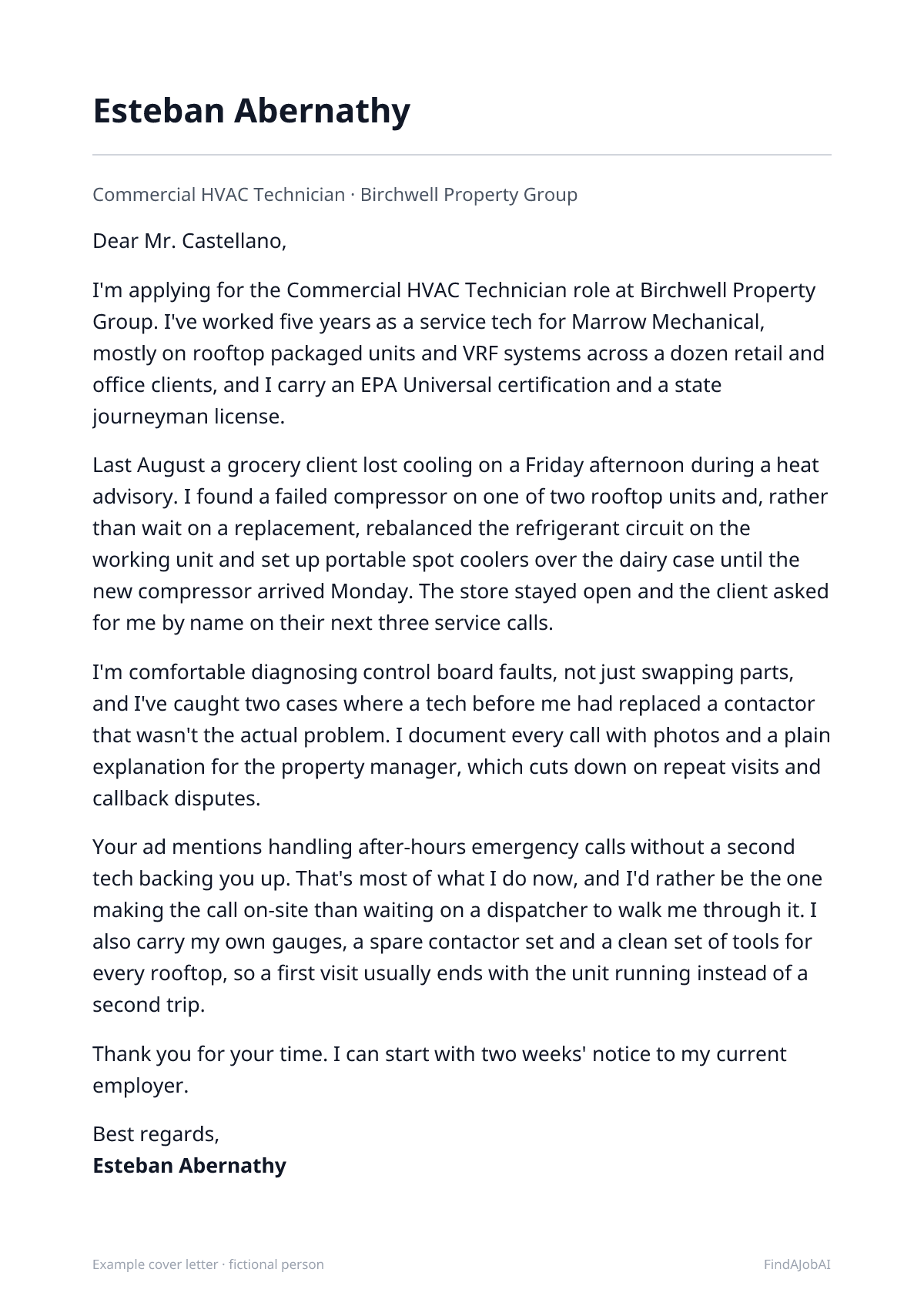
Dear Mr. Castellano,
I'm applying for the Commercial HVAC Technician role at Birchwell Property Group. I've worked five years as a service tech for Marrow Mechanical, mostly on rooftop packaged units and VRF systems across a dozen retail and office clients, and I carry an EPA Universal certification and a state journeyman license.
Last August a grocery client lost cooling on a Friday afternoon during a heat advisory. I found a failed compressor on one of two rooftop units and, rather than wait on a replacement, rebalanced the refrigerant circuit on the working unit and set up portable spot coolers over the dairy case until the new compressor arrived Monday. The store stayed open and the client asked for me by name on their next three service calls.
I'm comfortable diagnosing control board faults, not just swapping parts, and I've caught two cases where a tech before me had replaced a contactor that wasn't the actual problem. I document every call with photos and a plain explanation for the property manager, which cuts down on repeat visits and callback disputes.
Your ad mentions handling after-hours emergency calls without a second tech backing you up. That's most of what I do now, and I'd rather be the one making the call on-site than waiting on a dispatcher to walk me through it. I also carry my own gauges, a spare contactor set and a clean set of tools for every rooftop, so a first visit usually ends with the unit running instead of a second trip.
Thank you for your time. I can start with two weeks' notice to my current employer.
Best regards,
Esteban Abernathy
Example 2 · Career changer
Warehouse forklift mechanic moving into residential HVAC
Lourdes fixed refrigeration on her own initiative before starting trade school. The ad wants a motivated apprentice for a residential company.
Example letter · fictional
Dear Hiring Manager,
I'm applying for the HVAC Apprentice Technician role at Thistledown Heating & Air. For four years I've maintained forklifts and the walk-in cooler at a produce warehouse, and I'm now finishing a nine-month HVAC/R program at Caldervale Technical College with my EPA 608 certification already in hand.
The cooler at my warehouse kept icing over and nobody had budget to call a contractor every time. I started tracing the defrost cycle myself, found a failed timer relay, and replaced it after watching three repair videos and checking my work against the wiring diagram. It held for over a year before I left, and I ended up handling smaller refrigeration fixes there instead of sending them out.
In the program I've torn down and rebuilt a split system, brazed copper lines, and practiced static pressure readings on a duct trainer. My instructor had me help two classmates troubleshoot a no-cool call during our last lab session, which I liked more than I expected to.
Your posting asks for someone motivated to learn fieldwork fast rather than someone with years of residential experience, which is exactly where I am. I show up early, I ask the tech ahead of time what's expected on a job, and I don't mind the attic work. I keep a notebook of every lab and every shop visit, with the symptom, the cause and the fix, so I never ask the same question twice, and I'd bring it on every ride-along.
Thank you for considering me. I'm available to start as soon as my certification paperwork clears.
Sincerely,
Lourdes Chaudhry
Example 3 · Senior or lead
Lead technician applying to run a four-person residential crew
Arjun currently trains new hires informally. The ad is for a crew lead who'll own scheduling and quality callbacks.
Example letter · fictional
Dear Ms. Oyelaran,
I'm applying for the Lead HVAC Technician role at Gantry Comfort Systems. I've spent eight years as a residential and light commercial tech at Fennimore Air, the last two informally training new hires, and I'd like a role where that's part of the job description rather than something I do on the side.
Your ad mentions a callback rate that's been creeping up as the crew has grown. At Fennimore we had a similar stretch, and when I looked at our last twenty callbacks, more than half traced back to two causes: undersized refrigerant charges on new installs and skipped static pressure checks on replacement jobs. I built a one-page checklist for both and started reviewing it with newer techs before they left the shop each morning. Callbacks on new-hire jobs dropped noticeably within a season, and the owner adopted the checklist company-wide.
I still carry a full service route three days a week, so I'm not asking to step away from fieldwork, just to pair it with keeping an eye on the crew's work. I've walked two technicians through their first commercial rooftop job start to finish, and I'd rather catch a mistake on a Tuesday morning review than on a Thursday callback.
I haven't built a formal training program or handled scheduling for a crew this size, and at Gantry I'd want to learn how dispatch currently assigns jobs before changing anything.
I'd welcome a conversation about where your callbacks are coming from now and how the crew is scheduled day to day.
Sincerely,
Arjun Barrett
All three letters, and the short version below, are fictional: the people, employers and numbers are invented. Borrow the structure, never the facts.
- Prefer to write it yourself? Use the free cover letter template.
- Check your CV against the job first: the free CV score shows the missing keywords.
Why the first letter works, paragraph by paragraph
Paragraph 1: Opening
States years of experience, the equipment type (rooftop units and VRF) and the credentials the ad is likely to screen for, so the reader doesn't have to hunt the resume for them.
Paragraph 2: The call that went right
A specific emergency, the diagnosis, and an improvised fix that kept the client's doors open. This is the moment service managers want to picture before they hand someone an after-hours phone.
Paragraph 3: Judgment over parts-swapping
Naming a case where a previous tech replaced the wrong part shows diagnostic thinking, and mentioning documentation addresses a real cost for property managers: callback disputes.
Paragraph 4: Why this company
Mirrors the ad's specific worry, working solo on emergency calls, and answers it directly instead of restating a general interest in HVAC.
Paragraph 5: Close
Gives a concrete start date instead of a vague availability statement, which matters for a role that gets filled quickly.
What the career changer's letter does differently
The apprentice's letter leads with a refrigeration fix she did without being asked, before any formal training, then shows the training is nearly finished and specific (brazing, a duct trainer, a timer relay). It answers the ad's actual ask, someone motivated to learn fast, instead of apologizing for the lack of field hours.
What the senior letter does differently
A lead technician letter reports patterns across a crew's work, not one call: a traced cause behind rising callbacks, a checklist that fixed it, and training folded into a normal workday rather than a separate program. The gaps, formal scheduling and training structure, are named plainly.
Short HVAC technician cover letter: an email-ready version
Many applications arrive as an email or a small text box, and a full page doesn't fit. This version runs 120 to 150 words and keeps only what a reader needs to decide whether to reply. An HVAC technician applies through a staffing agency's portal that caps the cover letter field, so the note goes out as a short email instead.
Short version · email · fictional127 words
Subject: HVAC Service Technician – EPA 608, 3 years commercial – Soledad Vasquez
Hello Mr. Petrossian,
I'm applying for the HVAC Service Technician role at Harrowgate Mechanical. I have three years of commercial service experience, mostly packaged rooftop units, and hold an EPA 608 Universal certification and a state technician license.
At my current job I handle a route of about fifteen client sites and respond to after-hours emergency calls on a rotating basis. Last winter I diagnosed a failed heat exchanger on a restaurant's furnace before it became a carbon monoxide risk, which the client's insurer later asked to see documentation on.
I'm looking for steadier year-round hours than my current seasonal schedule allows. I've attached my resume and have open availability for a call this week. I can start within two weeks of an offer.
Best,
Soledad Vasquez
The short version keeps one safety-relevant catch, the heat exchanger call, because it says more about judgment than a list of routine repairs would, and states plainly why the technician is looking, which agencies tend to ask about anyway.
Opening lines that work for HVAC technician cover letters
The first sentence decides whether the second gets read. Here are six openings, one for each situation you might be in. Pick the one that matches yours and swap in your own facts: every name and number below is invented.
1. You have a standout result
Last winter I caught a cracked heat exchanger before it became a carbon monoxide risk, on a routine furnace tune-up most techs would have signed off on. That kind of catch is what I'd bring to your service team.
2. The ad names a problem you've solved
Your ad mentions a callback rate that's climbed as your crew has grown. I traced a similar problem at my current shop to two root causes and built a checklist that cut it, which the owner adopted company-wide.
3. Someone referred you
Your service manager, Fenwick Abara, and I worked the same emergency call line for two winters before he moved to your company. He mentioned you're looking for someone who can run solo after-hours calls, which is most of what I do now.
4. You admire what they build
My own furnace was serviced by your company last spring, and the tech's explanation of what he found was clear enough that I remembered it months later. I'd like to bring that same habit to your team.
5. You're new to the field or switching into it
I spent four years fixing forklifts and a warehouse cooler before trade school, mostly because nobody had budget to call a contractor every time something broke. HVAC work let me turn that habit into a trade.
6. You have senior scope or a specialism
As the technician other techs ask when a diagnosis doesn't add up, I'm looking for a lead role where training newer hires is part of the job rather than something I fit in between service calls.
How to write a HVAC technician cover letter
Five steps, in the order you'd write them. The shape stays the same for every job (a short opening, proof, a reason for this employer, a close), and what goes into each part is what changes with the role.
Name the systems the ad is actually hiring for
Residential split systems, commercial rooftop units, VRF, boilers and refrigeration each call for different experience. Read the ad for the equipment and building type, then open with the matching part of your background instead of a general HVAC summary.
Lead with a diagnosis, not a repair list
Describe one call where the symptom didn't match the obvious cause: what you checked, what you found, and what happened for the customer or building. This shows troubleshooting skill, which separates a technician from someone who can only follow a checklist.
Put required certifications where they'll be seen first
If the ad requires EPA 608/Universal, a state license or NATE certification, state it in the opening paragraph, not just on your resume. Many service managers scan cover letters for this one fact before reading further.
Show you can work without backup
Many ads mention after-hours or solo emergency calls. Mention a time you handled a failure on-site without waiting for a second tech or a parts delivery, and what you did to keep the building or customer functioning in the meantime.
Close with real availability
HVAC roles often need to be filled quickly, especially before a season change. State your notice period or start date plainly, and mention any schedule flexibility, such as willingness to rotate on-call weeks, if the ad asks for it.
HVAC Technician cover letter do's and don'ts
Do
- Name the equipment you've worked on (packaged rooftop units, VRF, mini-splits, boilers) rather than just saying 'HVAC systems.'
- Describe one hard call: the symptom, your diagnosis, and how the client or building was affected.
- Mention your certifications (EPA 608/Universal, state license, NATE) by name, once, inside a sentence rather than as a bare list.
Don't
- Don't claim you can fix anything; name the systems and brands you actually know.
- Don't bury the certification that's required in the ad; put it in the first paragraph if it's a stated requirement.
- Don't describe a repair without saying what happened to the customer or building; that's the part that shows judgment.
Common HVAC technician cover letter mistakes
Each one is easy to make and quick to fix before you send the letter.
Listing every brand and refrigerant you've touched
A long list of brands reads like a resume, not a letter. Name the one or two equipment types the ad cares about and describe a specific job on that equipment instead.
Describing a repair without the diagnosis
'Replaced a capacitor' tells the reader what part you swapped, not how you found the problem. Include the symptom, what you ruled out, and how you confirmed the actual cause.
Skipping the certification the ad requires
If the ad names EPA 608, a state license, or NATE and your letter doesn't mention it, some readers won't check the resume to find it. State it once, early, in a sentence rather than a bare line.
Writing 'hard worker who shows up on time' as the main pitch
Every applicant claims this. Replace it with one call or job that shows the habit: an early arrival that caught a leak before a tenant noticed, or a route you ran without a missed appointment in a year.
Ignoring the building type in the ad
Residential, light commercial and industrial HVAC work call for different judgment. If the ad is for a grocery chain or a hospital, say something about why that setting suits your experience, not just that you're willing to work there.
Email subject lines for HVAC technician applications
Applying by email? Put the job title, any reference number and your name in the subject line.
- Commercial HVAC Technician application – EPA Universal, journeyman licensed – Esteban Abernathy
- HVAC Apprentice Technician – EPA 608 certified, trade school graduate – Lourdes Chaudhry
- Application: HVAC Service Technician (Req. 3340) – Esteban Abernathy
Everything for HVAC Technicians
- HVAC Technician resume exampleA full resume, plus bullet and summary examples
- HVAC Technician interview questions30 questions with sample answers
- HVAC Technician job descriptionDuties, skills and requirements
- Career change cover letter: template + examples
Other cover letter examples
HVAC Technician cover letter FAQ
What should I write in an HVAC technician cover letter?
One difficult call: the system, what was wrong, how you found it, and what happened for the customer or building once it was fixed. Mention your certifications once, inside that story or the opening, rather than as a separate list.
How do I write an HVAC cover letter with no field experience?
Use any repair or maintenance work you've done, even informally, plus your trade school program and certification. Name specific coursework (brazing, controls, a duct trainer) so the reader sees real hands-on time, not just a class title.
Should I mention my own truck or tools?
Only if the ad asks for it or you're applying to a company that expects techs to supply their own tools. Otherwise, your diagnostic experience and certifications matter more than what's in your toolbox.
How we built this page
The FindAJobAI team wrote the three example letters, the short email version, the opening lines and the advice for HVAC technician roles. The people, employers and numbers in the letters are invented; the structure, the kind of evidence and the order of the paragraphs are the parts to copy.
Once we track enough live HVAC technician job ads, this page also shows the skills they ask for most, counted the same way as our in-demand skills report.
Last reviewed on November 1, 2026.