Intern Cover Letter Example (2026)
By FindAJobAI team Updated How we built this page
Internship ads mostly ask for a major, a graduation date and some coursework, so most applicants look similar on paper. The cover letter is where you show what you've actually built or organized, even without a job title, and why this specific team's work interests you.
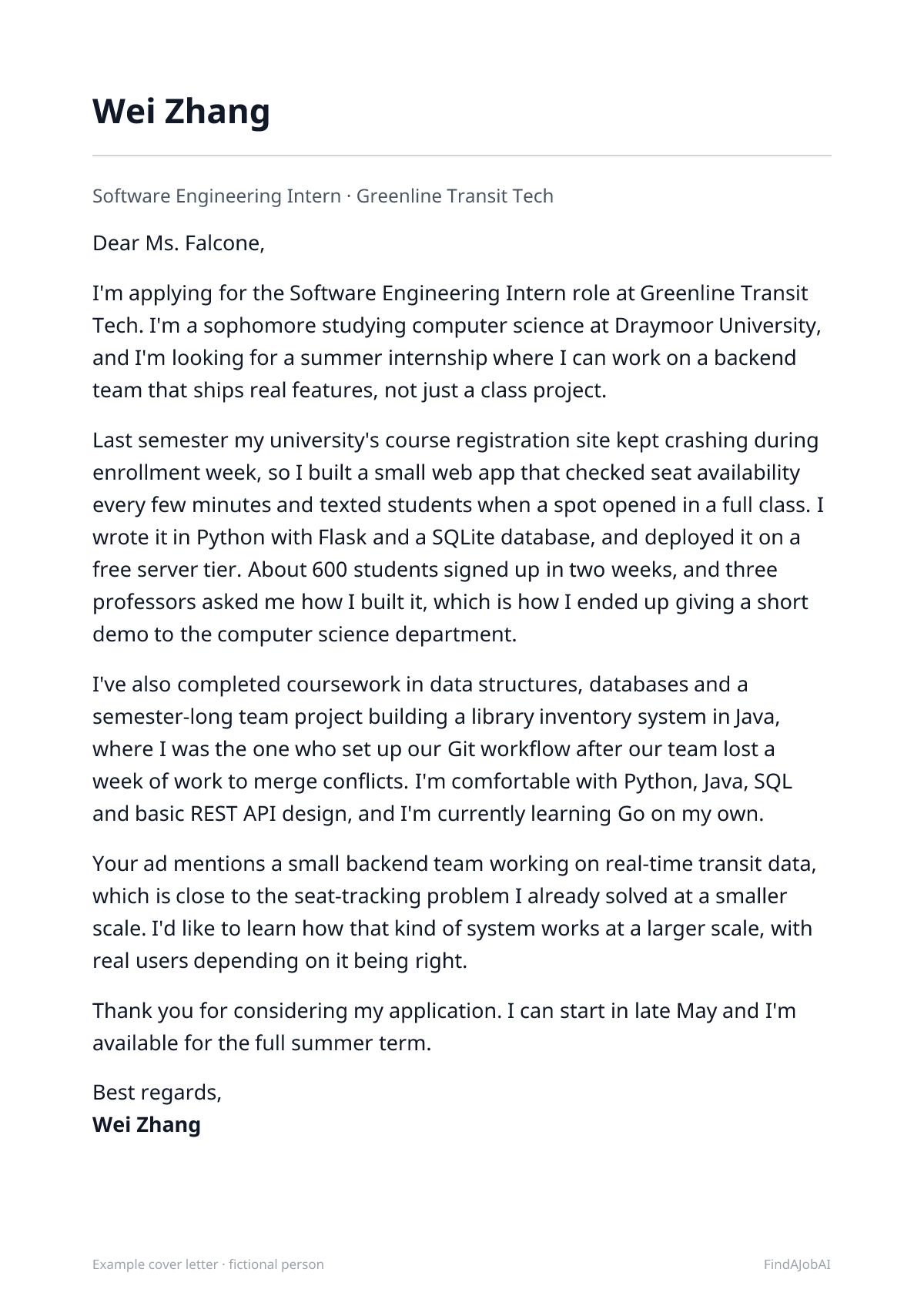
Intern cover letter template
This letter as a one-page template: an opening that names the job and your strongest fact, proof that answers the ad, a reason for this employer and a short close.
After you sign up, FindAJobAI drafts your own letter for a real job from your CV in this format, and you edit it before you send it.
Example 1 · Experienced
Computer science student applying for a software engineering internship
Wei is a sophomore who built a class scheduling tool used by other students. The ad is for a summer software engineering intern on a small backend team.
Example letter · fictional
Dear Ms. Falcone,
I'm applying for the Software Engineering Intern role at Greenline Transit Tech. I'm a sophomore studying computer science at Draymoor University, and I'm looking for a summer internship where I can work on a backend team that ships real features, not just a class project.
Last semester my university's course registration site kept crashing during enrollment week, so I built a small web app that checked seat availability every few minutes and texted students when a spot opened in a full class. I wrote it in Python with Flask and a SQLite database, and deployed it on a free server tier. About 600 students signed up in two weeks, and three professors asked me how I built it, which is how I ended up giving a short demo to the computer science department.
I've also completed coursework in data structures, databases and a semester-long team project building a library inventory system in Java, where I was the one who set up our Git workflow after our team lost a week of work to merge conflicts. I'm comfortable with Python, Java, SQL and basic REST API design, and I'm currently learning Go on my own.
Your ad mentions a small backend team working on real-time transit data, which is close to the seat-tracking problem I already solved at a smaller scale. I'd like to learn how that kind of system works at a larger scale, with real users depending on it being right.
Thank you for considering my application. I can start in late May and I'm available for the full summer term.
Best regards,
Wei Zhang
Example 2 · Career changer
Marketing major pivoting into a business operations internship
Aaliyah runs social media for her university's student union but wants to try operations. The ad asks for comfort with spreadsheets and process work.
Example letter · fictional
Dear Hiring Manager,
I'm applying for the Business Operations Intern role at Thornfield Office Supply. I'm a junior marketing major at Castlewood College, and while most of my experience is in content and social media, I'd like to use this internship to try operations, where I think my organizational habits would actually fit better.
As social media coordinator for my university's 40-club student union, I was the one who noticed we had no system for tracking which clubs had submitted their semester budget requests. I built a spreadsheet that tracked submission status, deadlines and approval stage for all 40 clubs, and automated reminder emails using a simple script, which cut late submissions from about a third of clubs to under 5% in one semester.
That project is what made me realize I enjoy fixing a messy process more than I enjoy writing captions. I've since taken an introductory course in process mapping and completed a self-paced Excel course covering pivot tables and basic macros, and I'm comfortable learning new software quickly. The course ended with a map of a real returns process at a local store, which taught me to ask the people doing the work where it slows down.
Your posting mentions tracking vendor orders and reconciling inventory counts across locations, which sounds like the same kind of tracking-and-follow-up problem I solved for the student union, just with physical goods instead of budget forms. I'd like to apply that habit somewhere it has a direct effect on a business.
Thank you for your time. I'm available starting in June and can commit to a full-time summer schedule.
Sincerely,
Aaliyah Brooks
Example 3 · Referral or internal move
Returning intern applying for a full-time return offer
Sofia completed a data internship last summer and is applying for the full-time new-grad role on the same team; her former manager will vouch for her.
Example letter · fictional
Dear Mr. Whitfield,
I'm applying for the Associate Data Analyst role on the Customer Insights team, where I interned last summer under Tessa Brandvold. I graduate from Draymoor University in May with a degree in statistics, and I'd like to return to the team full time rather than start over somewhere new.
During my internship, I was given a backlog project nobody had time for: cleaning up three years of inconsistent product category tags in our customer database. I wrote a set of SQL scripts and a matching rule set that resolved about 70% of the mismatches automatically, and worked with two category managers to manually resolve the rest. The cleaned data became the basis for a churn analysis the team ran that fall, which Priya has said she's happy to confirm.
I also sat in on the team's weekly stakeholder meetings for the full ten weeks, which taught me how differently a finding needs to be presented to a VP versus a category manager. By my last few weeks, I was presenting my own findings in those meetings instead of just taking notes.
I haven't yet owned a project from its original request through to a final decision made by leadership, since my internship project fed into someone else's analysis. I'd welcome starting full time with a project I can see through end to end.
I'd be glad to have Priya speak to my work directly, and I'm looking forward to the chance to keep building on what I started this summer.
Sincerely,
Sofia Mendez
All three letters, and the short version below, are fictional: the people, employers and numbers are invented. Borrow the structure, never the facts.
- Prefer to write it yourself? Use the free cover letter template.
- Check your CV against the job first: the free CV score shows the missing keywords.
Why the first letter works, paragraph by paragraph
Paragraph 1: Opening
States the year, major and what kind of work the student is specifically looking for, which signals intent beyond a generic internship search.
Paragraph 2: The project that mattered
A self-initiated project with a real problem, the tools used, and a usage number (600 students), which stands in for work experience the student doesn't yet have.
Paragraph 3: Coursework and current learning
Names specific classes and a concrete team lesson (the Git workflow after lost work), plus a skill being learned independently, which shows initiative beyond required coursework.
Paragraph 4: Why this company
Connects the student's own project to the team's actual domain (real-time transit data) rather than praising the company in general terms.
Paragraph 5: Close
States availability dates clearly, since internship timing is often a hard constraint for the employer.
What the career changer's letter does differently
The pivot letter is built around one concrete process fix (budget tracking for 40 clubs) rather than the writer's actual job title, since the internship she wants doesn't match her major. It names the moment she realized her real interest, adds a course taken to back up the shift, and translates her project directly into the ad's own terms (vendor orders, inventory) instead of asking the employer to make that connection.
What the referral letter does differently
A return-offer letter leans on the team's own memory of the writer's work instead of introducing herself from scratch: a named manager willing to vouch, a specific project with its completion rate stated, and how her role changed over ten weeks. It names the one gap, owning a project end to end, since that's the real difference a full-time offer would close.
Short intern cover letter: an email-ready version
Many applications arrive as an email or a small text box, and a full page doesn't fit. This version runs 120 to 150 words and keeps only what a reader needs to decide whether to reply. A student applies for a marketing internship by email after a career fair recruiter asked for a resume and a short note by Friday.
Short version · email · fictional129 words
Subject: Marketing Intern application – campus ambassador program lead – Jordan Ellis
Hello Ms. Park,
I'm writing after we spoke at the Draymoor University career fair about the Marketing Intern role at Cobalt Outdoor Gear. I'm a junior marketing major and I currently lead a 15-person campus ambassador program for an outdoor apparel brand.
I built our ambassador tracking spreadsheet and a content calendar that raised our average posts per ambassador from two to five a month, which doubled our campus engagement numbers over one semester. I also wrote the one-page brief new ambassadors use, so each new member starts posting in their first week.
I'd like to bring that same organizing habit to a bigger brand. My resume is attached, I can send the content calendar if it would help, and I'm available to start this summer.
Best,
Jordan Ellis
The short version keeps the one measurable result (posts per ambassador doubling engagement) and drops the coursework and long-term goals mentioned in a longer letter, since a recruiter who already met the writer at a career fair just needs a quick reason to follow up.
Opening lines that work for intern cover letters
The first sentence decides whether the second gets read. Here are six openings, one for each situation you might be in. Pick the one that matches yours and swap in your own facts: every name and number below is invented.
1. You have a standout result
I built a seat-tracking tool last semester that 600 students used during enrollment week, and I'd like to bring that same instinct for solving real problems to your backend team.
2. The ad names a problem you've solved
Your ad mentions a small team shipping real features over the summer, not just shadowing engineers. That's exactly the kind of internship I'm looking for after building and deploying a tool used by hundreds of my classmates.
3. Someone referred you
Your senior analyst, Tessa Brandvold, supervised my internship last summer and offered to speak to my work directly, which is why I'm applying for the full-time role on her team.
4. You admire what they build
I've used your app's trip-planning feature for two years as a daily commuter, and the routing problems I've noticed made me want to see if I could help fix them as an intern.
5. You're new to the field or switching into it
As a marketing major who spent a semester fixing a budget-tracking process instead of writing captions, I've realized operations work suits me better, and I'd like to prove that with a full summer internship.
6. You have senior scope or a specialism
I returned last year's internship with a project that's still used by the team I worked on, and I'd like to come back full time to keep building on it.
How to write an intern cover letter
Five steps, in the order you'd write them. The shape stays the same for every job (a short opening, proof, a reason for this employer, a close), and what goes into each part is what changes with the role.
Open with the project, not your GPA or year in school
State your school and major briefly, but lead with a specific thing you built, organized or fixed. Employers reading intern letters are looking for initiative and follow-through, which a project shows faster than a transcript line.
Describe the project with enough detail to be believed
Name the tools or methods you used, the problem you were solving, and one number showing scale or effect, such as users, time saved, or an error rate reduced. Vague claims like 'improved efficiency' read as filler without a specific number attached.
Connect your coursework or self-teaching to the actual role
Pick the one or two classes or self-taught skills most relevant to this specific internship, not a full course list. If you're learning something on your own right now, say so, since it signals you don't wait to be assigned work.
Explain why this team specifically, using their actual work
Reference something concrete about what the team does, such as a product feature, a dataset, or a process mentioned in the ad, and connect it to your own project or interest. This shows you read the posting rather than sending the same letter everywhere.
Close with clear availability and enthusiasm that's specific
State your start and end dates plainly, since internship terms are often fixed. End on what you'd like to learn or work on there specifically, rather than a general statement about being excited for the opportunity.
Intern cover letter do's and don'ts
Do
- Lead with a specific project you built or organized, even if it was for a class, a club or yourself.
- Name the tools, languages or software you used and one number that shows its scale or impact.
- State your availability dates clearly, since internships usually run on a fixed schedule.
Don't
- Don't list every class you've taken; mention the one or two most relevant to this specific role.
- Don't say you're 'eager to learn' without naming something you've already taught yourself.
- Don't apologize for having no formal work experience; a strong project covers that gap.
Common intern cover letter mistakes
Each one is easy to make and quick to fix before you send the letter.
Leading with 'I am a highly motivated student'
This describes every applicant and proves nothing. Replace it with the first line of a real project or accomplishment, and let the motivation show through what you actually did.
Listing a full course schedule instead of one relevant class
A list of five class titles reads like a transcript. Pick the single most relevant course, describe a project from it in one sentence, and move on to things you did outside of class.
Treating lack of experience as something to apologize for
Phrases like 'Although I don't have much experience' undercut the letter before it starts. Skip the apology and go straight to the project or coursework that shows what you can actually do.
Writing the same letter for every internship application
A letter with no mention of the specific team, product or ad language could have been sent anywhere. Reference one detail from the posting and connect it to your own background in at least one sentence.
Omitting availability dates
Internships run on fixed calendars, and a missing start or end date can get an otherwise strong application set aside. State your available dates clearly near the close of the letter.
Email subject lines for intern applications
Applying by email? Put the job title, any reference number and your name in the subject line.
- Software Engineering Intern application – Python/Flask project, available May–August – Wei Zhang
- Business Operations Intern – spreadsheet automation experience – Aaliyah Brooks
- Application: Summer Intern, Data Team (Req. 2207) – Wei Zhang
Everything for Interns
- Internship jobs10,185 open roles, updated hourly
- Intern resume exampleA full resume, plus bullet and summary examples
- Intern interview questions30 questions with sample answers
- Intern job descriptionDuties, skills and requirements
- Career change cover letter: template + examples
Other cover letter examples
Intern cover letter FAQ
What should I write in an intern cover letter with no work experience?
Use a class project, a club you've organized, or something you built on your own. Name the tools you used and one number showing its scale or effect, such as how many people used it or how much time it saved.
How long should an internship cover letter be?
Four to five short paragraphs is enough: who you are, one project in detail, relevant coursework or self-taught skills, why this team's work interests you, and your availability dates.
Should I mention my GPA or coursework in an intern cover letter?
Only if it's strong or directly relevant, and briefly. A specific class project described in two sentences says more about your skills than a GPA number or a list of course titles.
Can I apply for an internship outside my major?
Yes, but explain the connection yourself. Name a project or experience from your actual background and translate it directly into the terms the ad uses, so the employer doesn't have to guess why you're a fit.
How we built this page
The FindAJobAI team wrote the three example letters, the short email version, the opening lines and the advice for intern roles. The people, employers and numbers in the letters are invented; the structure, the kind of evidence and the order of the paragraphs are the parts to copy.
Once we track enough live intern job ads, this page also shows the skills they ask for most, counted the same way as our in-demand skills report.
Last reviewed on November 1, 2026.